A rice cooker that turns out dry, clumpy, or mushy basmati rice is worse than no rice cooker at all. The long, slender grains of basmati demand precise temperature control and moisture management that standard on-off cookers simply cannot deliver. The secret to achieving those separate, fluffy, aromatic grains every time lies in fuzzy logic technology and targeted heating patterns.
I’m Mohammad Maruf — the founder and writer behind AirfryerBite. I’ve spent years analyzing small kitchen appliance specifications, comparing fuzzy logic algorithms, non-stick coatings, and heating configurations to find the models that actually perform as advertised.
After researching dozens of models and filtering for those with the smart cooking intelligence to properly handle basmati’s unique starch profile, I’ve identified the top contenders for the rice cooker for basmati rice that will consistently deliver restaurant-quality grains at home.
How To Choose The Best Rice Cooker For Basmati Rice
Basmati rice is not just another white rice. Its elongated grains are low in amylopectin, which means they are naturally less sticky and require a gentler, more precise cooking curve than short-grain varieties. A basic cooker that boils water until it evaporates will often overcook the exterior while leaving the core too firm, or turn the entire batch into a sticky paste. The right machine uses fuzzy logic to read the internal temperature and adjust the power curve specifically for basmati’s needs.
Fuzzy Logic Is The Only Real Option
A standard mechanical rice cooker operates on a simple binary: boil until the temperature hits a threshold, then switch to warm. That approach fails with basmati because the water absorption rate and gelatinization temperature differ from other rices. A fuzzy logic microcomputer continuously monitors the temperature and moisture inside the pot, making micro-adjustments throughout the cycle. This is what allows the grains to cook evenly without clumping or turning mushy. If you cook basmati regularly, skip any cooker that lacks this intelligence.
Capacity That Matches Your Serving Size
Basmati is often served in larger portions at family meals. A 3-cup uncooked model (producing about 6 cups cooked) is ideal for two to four people. For a family of six or more, a 5.5-cup uncooked unit gives you the room to cook a full bag without crowding the pot, which is critical because overcrowding traps steam and makes grains stick together.
Non-Stick Or Ceramic Inner Pot Quality
The coating on the inner pot directly affects how easily the cooked rice releases and how evenly heat distributes. Standard PTFE non-stick coatings work well but can scratch over time. Higher-end models now use PFAs-free ceramic coatings, which are more durable and do not release harmful compounds at high temperatures. A thicker pot — around 1.5 mm to 3 mm — also helps stabilize cooking temperature and prevents hot spots that burn the bottom layer of basmati.
Quick Comparison
On smaller screens, swipe sideways to see the full table.
| Model | Category | Best For | Key Spec | Amazon |
|---|---|---|---|---|
| Zojirushi NL-GAC10BM | Premium Fuzzy Logic | Umami & grain separation | Umami + GABA Brown settings | Amazon |
| Zojirushi NL-AAC10 | Mid-Range Fuzzy Logic | Consistent white/basmati | Made in Japan, 5.5 cups | Amazon |
| TOSHIBA OriginTaste | Value Fuzzy Logic | Family-sized batches | 3.1mm thick ceramic pot | Amazon |
| CUCKOO CR-0351F | Compact Fuzzy Logic | Turbo basmati in 25 min | Turbo mode & My Mode | Amazon |
| Toshiba Mini TRCS02 | Compact Fuzzy Logic | Small batches & singles | 8 cooking functions, 3 cups | Amazon |
In‑Depth Reviews
1. Zojirushi NL-GAC10BM Umami Micom Rice Cooker

The Zojirushi NL-GAC10BM is engineered for those who want the absolute best texture from their basmati rice. Its standout feature is the dedicated Umami setting, which slightly extends the soaking and steaming phases to enhance the natural sweetness and aroma of the grain. The microcomputer uses a more sensitive temperature sensor array than typical fuzzy logic cookers, detecting even minor fluctuations and adjusting the heating element accordingly. The 1.5 mm thick non-stick inner pan is heavier than the standard Zojirushi models, providing more stable heat distribution that prevents the bottom grains from scorching while the top stays perfectly steamed.
This model also includes a GABA Brown Rice cycle, which is useful if you ever cook sprouted brown basmati. The steaming basket accessory is BPA-free and lets you steam vegetables or fish simultaneously above the rice, making a complete meal in one appliance. The LCD control panel is intuitive, with a clock, delay timer, and two keep-warm temperature settings (standard and extended) that can hold basmati at an ideal serving texture for up to 12 hours without drying it out.
One minor trade-off is the price point, which reflects its Japanese-made construction and advanced features. The unit is also slightly taller than other 5.5-cup models, so measure your cabinet clearance if you plan to store it under upper cabinets. The removable inner lid is dishwasher safe, but the main body should be wiped clean with a damp cloth only.
Why it’s great
- Umami setting elevates basmati flavor noticeably
- Heavy-duty non-stick pan prevents scorching
- Extended keep-warm keeps grains fluffy for hours
Good to know
- Premium price reflects Japanese build quality
- Tall profile may not fit under low cabinets
- Manual has a learning curve for all 13 menu settings
2. Zojirushi NL-AAC10 Micom Rice Cooker

If the NL-GAC10BM is the full-spec luxury option, the NL-AAC10 is the sweet spot where Zojirushi’s fuzzy logic technology meets a more accessible investment. The microcomputer in this model automatically adjusts cooking temperature and time across seven menu settings, including white/sushi, mixed, porridge, sweet, brown, and a dedicated steam function. For basmati rice, the white rice setting with a standard water ratio produces consistently separate grains with a light, non-sticky bite. The quick cook mode reduces cooking time by roughly 30 percent, though the standard cycle delivers noticeably better texture for basmati.
The unit includes a detachable power cord, a retractable power cord storage compartment on the base, and a spatula holder built into the side of the body — small ergonomic details that make daily use convenient. The non-stick inner pot is rated for 5.5 cups uncooked (about 11 cups cooked), which suits families of four to six. The LCD panel displays a real-time cooking timer and a clock, and the delay timer can schedule basmati to finish cooking exactly when you need it. The unit’s weight at 8 pounds indicates a robust build, with a stainless steel exterior band that resists fingerprints.
The main difference from the NL-GAC10BM is the absence of the Umami and GABA Brown settings, as well as the slightly thinner inner pot. The keep-warm function has two settings, but the extended duration is shorter. For most households that cook basmati two to four times per week, this model delivers the same core fuzzy logic performance at a significantly lower cost.
Why it’s great
- Proven fuzzy logic from a trusted Japanese brand
- Consistent basmati results with minimal effort
- Built-in spatula holder and cord storage
Good to know
- Lacks dedicated Umami/GABA settings
- Inner pot thinner than premium sibling
- Keep-warm duration is shorter
3. TOSHIBA OriginTaste RC-10DRUNA(W)
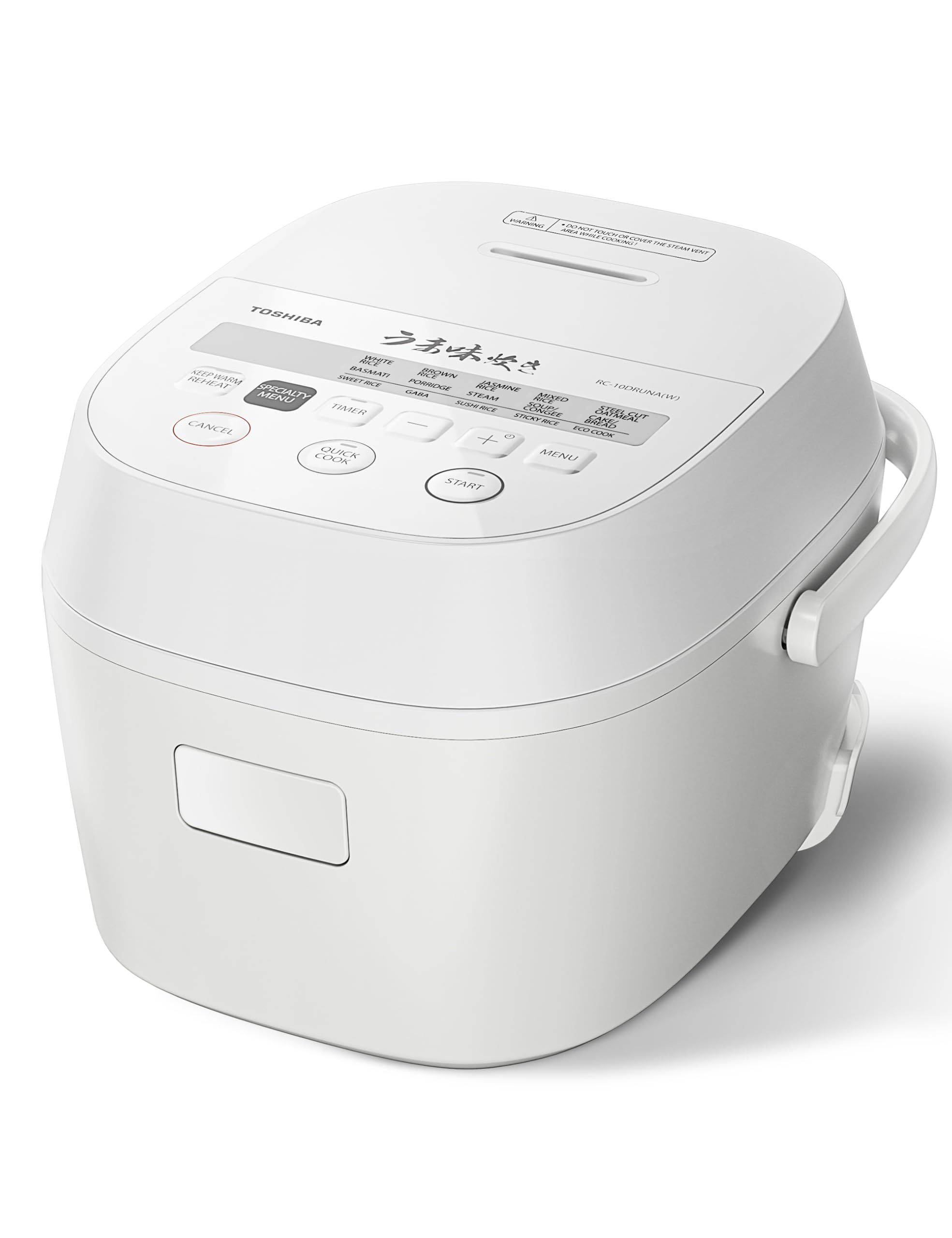
The TOSHIBA OriginTaste is a strong mid-range contender that directly challenges the idea that you need to spend Zojirushi money for great basmati. It uses a fuzzy logic microcomputer with 15 cooking functions, including specific presets for white rice, jasmine rice, brown rice, mixed grain, and porridge. The 3D heating technology wraps heat around the entire inner pot — not just the bottom — which helps the elongated basmati grains cook evenly from all sides. This is especially noticeable when cooking larger batches, where bottom-only heat often leaves the top grains slightly undercooked.
The inner pot measures 3.1 mm thick and uses a PFAs-free ceramic coating, which is a significant upgrade over standard PTFE. The ceramic surface releases cooked rice cleanly without needing oil or butter, and it resists scratching better than conventional non-stick. The 5.5-cup uncooked capacity serves up to six people, making it a practical choice for family dinners. The 24-hour delay timer and automatic keep-warm function let you set it up in the morning and have perfectly steamed basmati waiting at dinner time.
The lid is plastic rather than stainless steel, which makes the unit lighter overall but slightly less premium in feel. The instruction manual recommends hand washing the inner pot rather than using a dishwasher, even though the coating is durable. Some users report that the LCD display is bright enough for daytime use but could be clearer under direct sunlight. Overall, this is the best option for large households who want fuzzy logic precision without paying Zojirushi prices.
Why it’s great
- 3.1mm thick ceramic pot is very durable
- 3D heating cooks basmati evenly in large batches
- 15 functions cover all common rice types
Good to know
- Plastic lid feels less premium
- Pot is hand-wash recommended only
- Lacks a dedicated basmati preset
4. CUCKOO CR-0351F Micom Rice Cooker

This CUCKOO model is the most compact fuzzy logic rice cooker in this lineup, with a 3-cup uncooked (6-cup cooked) capacity that is ideal for couples, small families, or anyone with limited counter space. Its defining feature is the Turbo mode, which can cook a single cup of basmati rice in roughly 12 to 15 minutes and two cups in under 25 minutes. That speed comes from a higher-wattage heating element combined with a pressurized steaming cycle that forces heat into the grains faster than standard atmospheric cooking. The texture in Turbo mode is slightly firmer — closer to al dente — which some basmati purists prefer for biryani or pilaf where the grains need to hold their shape during further cooking.
The My Mode function lets you manually control the cooking temperature, which is rare at this price tier. You can set the temperature curve to your preferred doneness level for basmati, from very soft to firm and separate. The included non-stick inner pot is lighter than the Toshiba and Zojirushi options, but the aluminum construction heats quickly and evenly. The red glossy finish is eye-catching and available in multiple colors if the standard red doesn’t match your kitchen.
The digital display is bright but small, and the button labels on the control panel are lightly printed, making them harder to read in dim lighting. The accompanying manual has some awkward English translations, though the cooker itself is intuitive once you run a test batch. The Turbo mode is louder than standard cooking due to the rapid boiling, but the sound is no louder than a typical kettle.
Why it’s great
- Turbo mode cooks basmati in under 25 minutes
- My Mode lets you fine-tune temperature
- Compact size saves counter space
Good to know
- Small capacity not for larger families
- Turbo texture is slightly firmer than standard
- Button labels are hard to read in low light
5. Toshiba Mini TRCS02 Rice Cooker
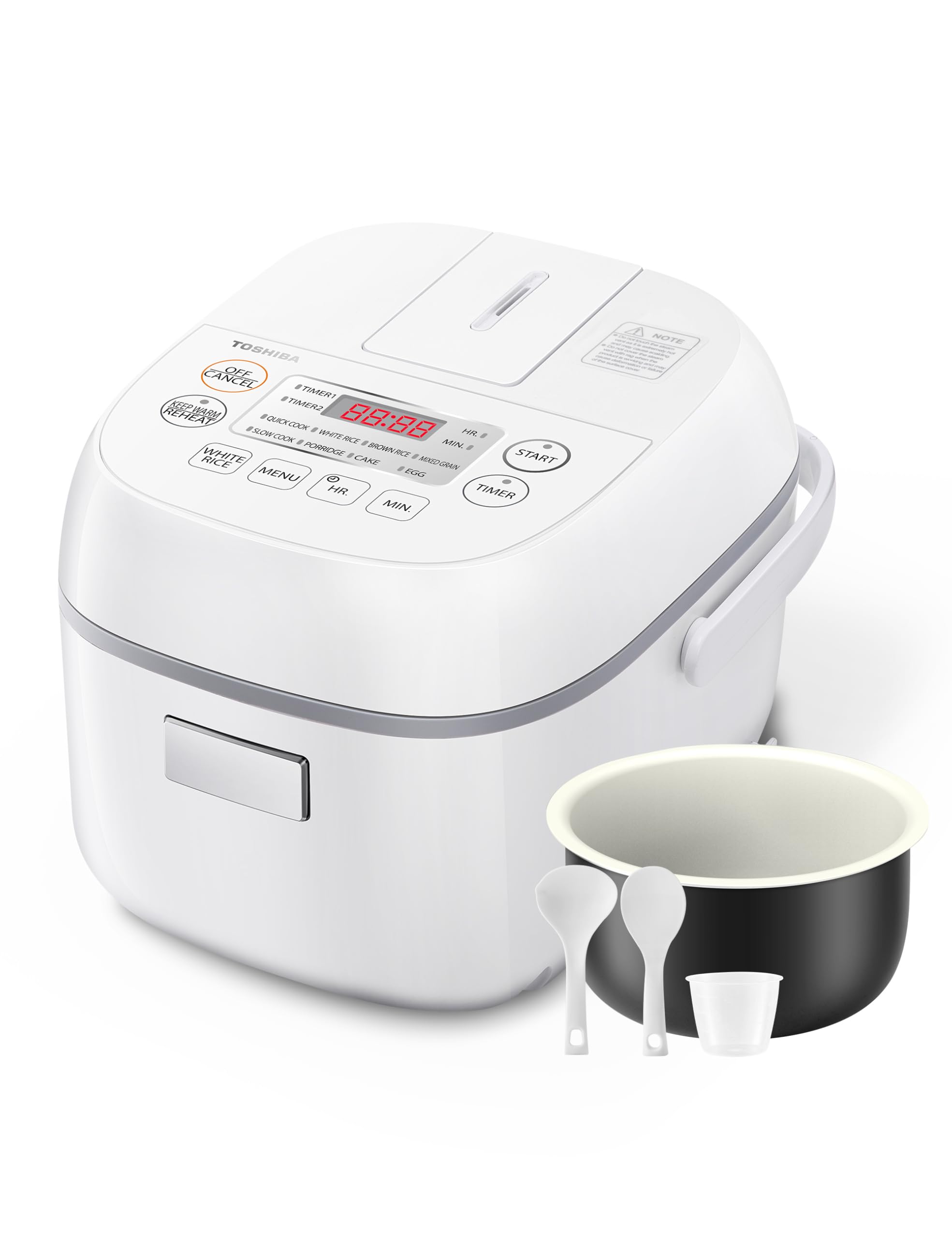
The Toshiba Mini TRCS02 is the most affordable fuzzy logic cooker in this guide, but it does not cut corners on the features that matter for basmati. Its 8 cooking functions include White Rice, Quick Cook, Brown Rice, Mixed Grain, Slow Cook, Porridge, Cake, and Egg — no dedicated basmati preset, but the White Rice mode on its standard cycle delivers very respectable results for 1 to 3 cups of basmati. The fuzzy logic sensor adjusts the temperature curve in real time, so the grains cook evenly without the layer of burned starch that commonly forms in budget cookers. The Quick Cook function works well for smaller portions when you need rice in about 30 minutes.
The 3-cup uncooked capacity (about 6 cups cooked) is perfect for one to three people. The stainless steel lid adds a nice tactile premium feel that is unusual at this price level. The inner pot has a non-stick coating that releases basmati cleanly, though it is not recommended for dishwasher cleaning — a soft sponge and mild soap are required to preserve the coating. The detachable power cord and firm lid lock make it safe to leave unattended, and the 24-hour delay timer is a genuinely useful feature for scheduling rice to finish when you walk in the door.
The biggest limitation is the non-stick coating, which is standard PTFE rather than the more durable ceramic found in the larger Toshiba OriginTaste. Over several years of heavy use, the coating may show wear. The keep-warm function holds rice at a safe temperature, but the rice will begin to dry out after about 4 hours, so it is best used for same-sitting meals rather than all-day holding. For anyone cooking small batches of basmati and wanting fuzzy logic performance without spending a lot, this is the entry-level sweet spot.
Why it’s great
- Fuzzy logic in a compact, affordable package
- Stainless steel lid feels high-quality
- 24-hour delay timer is very convenient
Good to know
- PTFE coating is less durable than ceramic
- Keep-warm starts drying rice after 4 hours
- Not recommended for dishwasher cleaning
FAQ
Can I use any rice cooker for basmati rice?
What is the ideal water-to-rice ratio for basmati in a rice cooker?
Does a dedicated basmati preset actually make a difference?
Why does my basmati rice come out sticky in a rice cooker?
Is the keep-warm function safe for basmati rice?
Final Thoughts: The Verdict
For most households, the best rice cooker for basmati rice is the Zojirushi NL-GAC10BM because its Umami setting and extended keep-warm provide the ideal texture and aroma that basmati lovers seek, and the build quality justifies the investment for years of daily use. If you want a more budget-conscious option with the same core fuzzy logic intelligence, the Zojirushi NL-AAC10 delivers consistent basmati without the premium extras. And for large families who need generous capacity with durable ceramic coating at a mid-range price, the TOSHIBA OriginTaste is the smart balance of performance and value.