A dull knife is not just a bad tool — it’s a safety risk that forces you to apply more pressure, increasing the chance of a slip and a serious cut. Professional electric knife sharpeners eliminate the guesswork of whetstone angles and the inconsistency of pull-through rods, delivering repeatable, factory-quality edges in under two minutes. This category is defined by abrasive technology — diamond-plated disks or flexible abrasive belts — and precision angle guides that lock the blade into the correct geometry for your kitchen, hunting, or pocket knives.
I’m Mohammad Maruf — the founder and writer behind AirfryerBite. I’ve spent hundreds of hours analyzing the mechanical specs, abrasive compositions, and motor designs of electric sharpeners to understand what separates a tool that removes too much metal from one that restores a blade’s geometry without shortening its life.
Whether you maintain a set of German forged chef knives or own a mix of Japanese steel and ceramic blades, choosing the right sharpener determines how often you replace cutlery. This guide breaks down seven models to help you find the best professional electric knife sharpener for your specific blade collection and sharpening frequency.
How To Choose The Best Professional Electric Knife Sharpener
Selecting the right sharpener requires matching the abrasive type, stage count, and angle control system to your knives. A heavy-duty chef’s knife behaves differently from a thin 15-degree Japanese blade, and ceramic knives demand diamond abrasives that standard steel stones cannot cut. Below are the four specs that determine whether a sharpener extends your knife’s life or grinds it down prematurely.
Abrasive Type — Diamond vs. Standard Grinding Wheel
Diamond abrasives are the hardest natural substance and the only abrasive capable of sharpening ceramic knives efficiently. Electric sharpeners in the professional category use 100-percent diamond-plated disks or belts. Standard aluminum-oxide or silicon-carbide wheels wear quickly on high-hardness steels (60+ HRC) and cannot touch ceramic blades at all. Look for “diamond abrasives” explicitly listed in the spec — this is the dividing line between a true professional tool and a budget sharpener that will struggle with anything beyond soft stainless steel.
Stage Count — 2-Stage vs. 3-Stage Systems
A 2-stage sharpener uses a coarse slot to reshape the edge and a fine slot to hone it. A 3-stage system adds a stropping or polishing stage that removes the microscopic burr left by the honing process, resulting in a razor edge that glides through tomato skins without tearing. For knives that have never been professionally sharpened, a 3-stage system removes less metal over time because the stropping stage refines rather than re-grinds. If you own serrated bread knives, a dedicated serrated slot or adjustable guide is essential to avoid damaging the scalloped edge.
Angle Control — Fixed Guides vs. Flexible Belts
Fixed-angle guides (often 15-degree or 20-degree) lock the blade into a preset geometry, which is ideal for repeatability on identical knives. Flexible belt sharpeners — like the Work Sharp system — use belts that conform to the blade’s existing edge, making them better for mixed collections where some knives have been hand-sharpened to non-standard angles. Guides with spring-loaded rollers maintain constant pressure across the blade’s curve, producing a uniform edge from heel to tip without over-grinding the belly.
Motor Power and Duty Cycle
Professional sharpeners use motors rated for intermittent use — typically 60 to 120 seconds of continuous operation followed by a cool-down period. A motor that draws too much power without thermal protection can overheat thin Japanese blades, ruining the temper. Look for sharpeners with automatic shutoff timers (common on belt-driven models) or low-RPM motors that produce less friction heat. The 1.5-amp to 3-amp range is standard; higher amperage does not mean better sharpening — it often means faster material removal, which is only desirable for heavily nicked or blunt blades.
Quick Comparison
On smaller screens, swipe sideways to see the full table.
| Model | Category | Best For | Key Spec | Amazon |
|---|---|---|---|---|
| Chef’sChoice 15XV | 3-Stage Diamond | 15-degree edge conversion | 5 lb metal housing, 3-stage diamond | Amazon |
| Work Sharp E5 | Belt Sharpener | Belt-driven factory edges | Built-in vacuum, 90-sec cycle | Amazon |
| Work Sharp Mk.2 | Belt Sharpener | Multi-tool sharpening | P80-P220-6K belt kit included | Amazon |
| Chef’sChoice UltraHone | 2-Stage Diamond | 20-degree straight & serrated | 1 lb, stage 2 micro diamonds | Amazon |
| Homly 3-Stage | 3-Stage Diamond | Mixed steel & ceramic | 3 lb, 2-year warranty | Amazon |
| VIDOME Professional | 3-Stage Diamond | Ceramic & 15-degree edges | 2.7 lb, diamond abrasives | Amazon |
| XARILK GEN2 | Manual Jig System | Precision angle control | 5.15 lb, aluminum construction | Amazon |
In‑Depth Reviews
1. Chef’sChoice 15XV Professional Electric Knife Sharpener

The Chef’sChoice 15XV is the sharpener that serious home cooks and semi-professionals gravitate toward when they want to convert their entire knife collection to a 15-degree edge. Its brushed metal upper housing weighs 5 pounds, providing stability that prevents the unit from walking across the counter during sharpening — a real concern with lighter plastic sharpeners that flex under pressure. The 3-stage EdgeSelect system uses 100-percent diamond-plated disks in the first two slots to reshape and hone, then a patented flexible abrasive stropping stage to polish the edge. Users report that a first-time sharpen on a blunt German knife takes approximately 60 seconds, with resharpening cycles dropping to about 10 seconds.
The real value of this model lies in its ability to convert standard 20-degree factory edges to a 15-degree XV geometry. For Japanese-style blades that ship with 15-degree angles, the 15XV matches the original grind without requiring additional guides or accessories. The motor runs between 65 dB and 75 dB — audible but not disruptive — and the spring-loaded guides automatically adjust to the blade’s curve, producing uniform edge contact from the heel to the tip. One note from experienced users: the metal housing dissipates heat more effectively than plastic, reducing the risk of overheating thin-bladed knives during multiple passes.
On the downside, the 15XV is not ideal for serrated blades longer than 10 inches because the guide slots are oriented for straight-edge knives. Users with large bread knives may need to pull the blade through multiple short segments rather than one continuous pass. The unit ships in a plain brown box even though the packaging photos show retail branding — this is a standard practice from Chef’sChoice and does not affect the product itself. For anyone who maintains a collection of 15-to-20-degree knives and wants a durable, low-maintenance sharpener that sits on the counter, this is the benchmark model in its tier.
Why it’s great
- Metal housing dissipates heat, protecting blade temper
- 3-stage diamond system converts 20° to 15° edges effectively
- Spring-loaded guides produce uniform edge from heel to tip
Good to know
- Not suited for large serrated bread knives in a single pass
- Ships in plain box despite retail packaging images
- Requires practice to avoid excessive pressure on thin blades
2. Work Sharp Professional Electric Culinary E5 Kitchen Knife Sharpener

The Work Sharp E5 is the only electric sharpener in this lineup that uses flexible abrasive belts — the same method knife manufacturers employ to edge their blades at the factory. Rather than fixed diamond disks that grind a preset angle, the belt conforms to the blade’s existing geometry, making it exceptionally good for knives that have been previously hand-sharpened to non-standard angles. The sharpener has three pre-programmed settings: shape (for heavily nicked blades), sharpen (for routine maintenance), and hone (for polishing), with an automatic shutoff after roughly 90 seconds.
What sets the E5 apart from other belt systems is the built-in vacuum that collects steel and ceramic dust during sharpening. This is a practical feature for anyone who sharpens on a countertop rather than over a sink — the debris from diamond abrasives is fine and tends to settle on surrounding surfaces. Users report that the medium and extra-fine belts included with the unit handle most routine sharpening, but the upgrade kit (sold separately) adds 15- and 17-degree angle guides for Japanese knives and a coarse belt for restoring very dull blades.
The main limitation is that the out-of-box setup is locked to a 20-degree angle, which is fine for German knives but suboptimal for thin Japanese blades. If you primarily own Wusthof, Henckels, or Victorinox knives, the stock configuration works perfectly. For collections that include Shun or Global knives, you will need the upgrade kit to access the lower angle guides. The vacuum is effective but adds to the noise level — expect 70-80 dB during operation. For cooks who want factory-style belt sharpening without the learning curve of a bench grinder, the E5 delivers repeatable results with minimal cleanup.
Why it’s great
- Flexible belts match factory sharpening method
- Built-in vacuum collects abrasive dust for clean operation
- Three pre-programmed cycles with auto shutoff
Good to know
- Stock setup only supports 20-degree angles
- Upgrade kit required for 15/17-degree Japanese knives
- Takes more counter space than compact diamond sharpeners
3. Work Sharp Knife & Tool Sharpener Mk.2 + Replacement Belt Kit
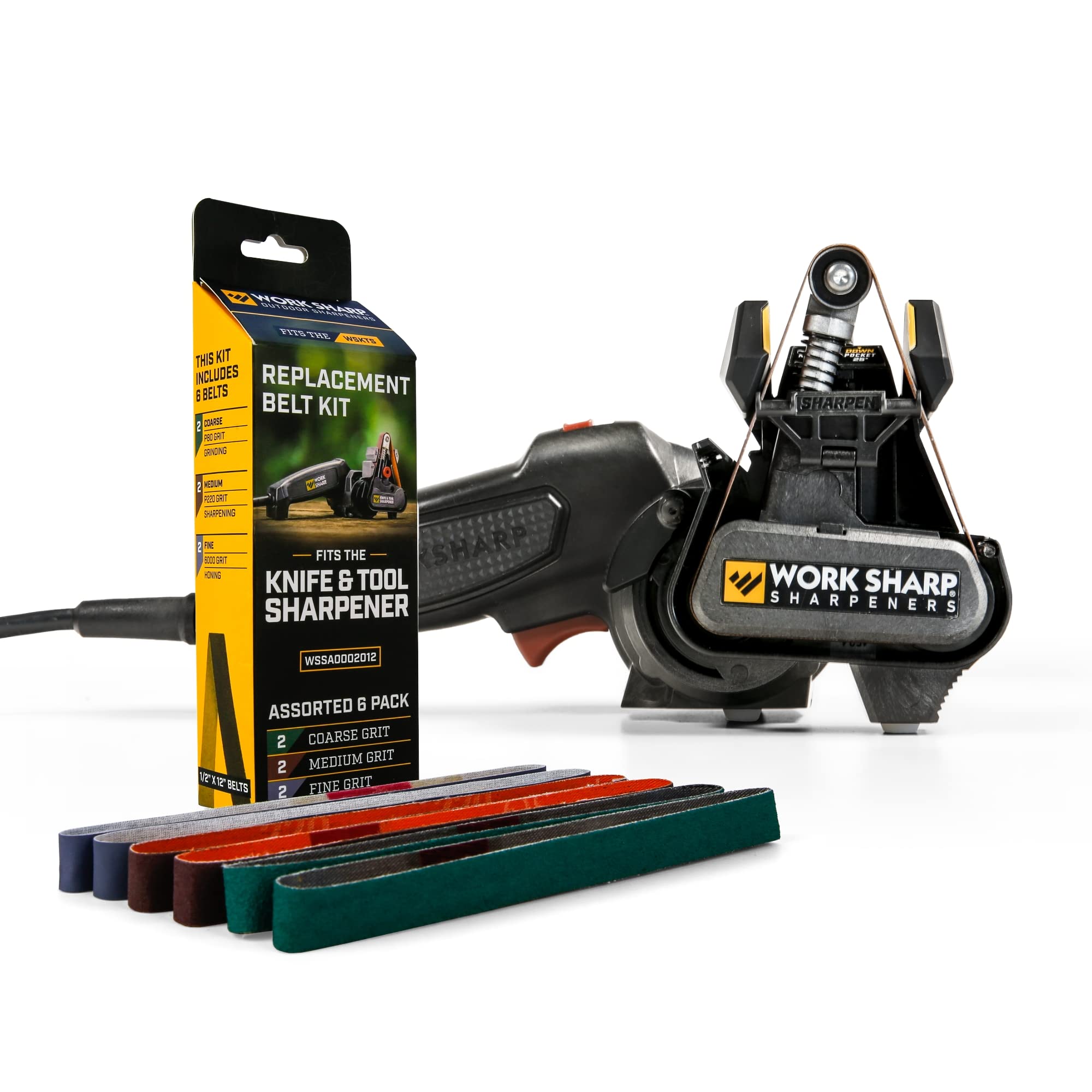
The Work Sharp Mk.2 is designed for the user who needs to sharpen outdoor knives, scissors, serrated blades, and even lawn mower blades — not just kitchen cutlery. It is a compact belt-driven system with interchangeable angle guides that snap onto the front, allowing quick switching between 25 degrees for outdoor and pocket knives and 20 degrees for kitchen knives. The included 12-piece belt kit covers the full spectrum: P80 coarse for reshaping damaged edges, P220 medium for general sharpening, and 6000 fine for honing and polishing.
The flexible belt technology is the same as the E5 but in a smaller, more portable form factor. The Mk.2 does not have a pre-programmed timer or a vacuum, which makes it slightly less automated but also more versatile — you control the duration and pressure manually, which is important when sharpening delicate scissors or serrated blades where too much pressure can damage the teeth. The leather-lined angle guide provides a scratch-resistant surface and helps maintain consistent geometry. Users note that switching belts is straightforward but requires removing a few screws, so it is not as fast as a quick-change disk system.
Where the Mk.2 excels is in handling non-kitchen tools. Scissors, pruning shears, and even small hatchets can be sharpened on the same machine with the same belts, making it a single-solution purchase for a workshop or garage. The motor is robust enough for carbon steel and softer stainless, but high-hardness steels (above 60 HRC) may require multiple passes on the fine belt to achieve a burr-free edge. For the home cook who also maintains garden and workshop tools, the Mk.2 eliminates the need for separate sharpening systems — a genuine space-saving advantage.
Why it’s great
- Interchangeable angle guides for kitchen and outdoor knives
- 12-piece belt kit covers coarse to fine grits
- Sharpens scissors, serrated knives, and small tools
Good to know
- Belt changes require removing screws — not quick-swap
- No automatic timer or vacuum included
- High-hardness steels need multiple fine passes
4. Chef’sChoice Professional Electric Knife Sharpener UltraHone

The Chef’sChoice UltraHone is a 2-stage diamond sharpener that prioritizes simplicity and speed over advanced angle conversion. It uses 100-percent diamond abrasives in both stages, with Stage 2 employing micron-size diamonds for a finer finish than standard coarse-to-fine setups. The unit weighs only 1 pound and measures 11.8 inches long, making it the most portable electric sharpener in this comparison — easy to store in a drawer or take to a vacation kitchen. It is designed exclusively for 20-degree straight-edge and serrated knives, so there is no angle adjustment or conversion capability.
User feedback consistently highlights how effectively this sharpener handles German stainless steels like Wusthof and Henckels, which are notoriously difficult to sharpen on pull-through rods because the steel is hard enough to skip across cheap abrasives. The UltraHone’s diamond disks cut into these steels cleanly, producing an edge that users describe as “smooth as glass.” The serrated slot accommodates bread knives and steak knives without damaging the scalloped teeth, though the process requires pulling the knife slowly to let the diamond disk work into each serration individually.
The main trade-off is the lack of a stropping stage. After Stage 2, the blade is sharp and test-cuts paper, but there is often a micro-burr that remains on the edge. A quick pass on a leather strop or a ceramic rod eliminates this burr, but the UltraHone does not include such a step. For users who sharpen every few months and do not demand a polished, mirror-like edge, this is a non-issue. For those who want the absolute finest edge possible from a single machine, the 3-stage sharpeners in this list are better suited. The UltraHone is a solid, no-fuss tool for maintaining a standard set of 20-degree kitchen knives.
Why it’s great
- Micron-size diamond abrasives produce smooth edge on hard German steel
- Lightweight 1-pound design for easy storage and portability
- Dedicated serrated slot protects scalloped blades
Good to know
- 2-stage system leaves micro-burr without stropping stage
- Limited to 20-degree edges — no angle conversion
- Not ideal for Japanese 15-degree blades
5. Homly Professional Electric Knife Sharpener

The Homly 3-Stage sharpener is a diamond-abrasive system that covers straight-edge steel knives and ceramic blades in a single compact unit. The first two stages use 100-percent diamond disks for sharpening and honing, while the third stage polishes the edge. Unlike some 3-stage sharpeners that reserve the final stage exclusively for stropping, the Homly’s third stage employs a felt-like polishing disk that effectively removes the burr left by the honing stage. Users report that this step is the key difference between a knife that cuts paper and one that effortlessly slices through tomato skin without pressure.
The unit includes a magnetic shavings collector that catches metal and ceramic dust, keeping the counter clean — a feature usually found on more expensive models like the Work Sharp E5. The motor runs quietly compared to belt-driven systems, and the flexible spring guide rods maintain consistent contact across curved blades. The Homly measures 12.2 inches long and 4.8 inches high, making it one of the larger compact sharpeners, but still small enough to store in a utility drawer. The included 2-year manufacturer warranty provides peace of mind that budget-priced sharpeners rarely offer.
Where the Homly falls short is on very thin ceramic blades, such as small ceramic paring knives. The spring-loaded guide slots are designed for blades wider than roughly 1.5 inches, and narrower blades can rock inside the slot, resulting in uneven edge contact. For standard ceramic chef knives and Santoku blades, the sharpening is effective and fast. The plastic housing is sturdy but does not dissipate heat as efficiently as the metal-clad Chef’sChoice 15XV, so limiting sharpening cycles to 30 seconds with a cool-down interval is recommended for ceramic blades to prevent thermal stress.
Why it’s great
- 3-stage diamond system effectively handles steel and ceramic knives
- Magnetic shavings collector keeps counter clean
- 2-year warranty covers defects and motor issues
Good to know
- Narrow ceramic paring knives may rock in guide slots
- Plastic housing retains heat — avoid long continuous cycles
- Larger footprint than some compact 2-stage models
6. VIDOME Professional Electric Knife Sharpener

The VIDOME Professional Electric Knife Sharpener is a 3-stage diamond abrasive system that specifically targets 15-degree edge geometry, making it a strong match for Japanese-style knives and cooks who want to convert their 20-degree blades to a finer angle. The first two stages use 100-percent diamond disks to sharpen and hone, and the third stage employs stropping disks to polish the edge. The unit is powered by a German-imported motor that runs between 60 dB and 80 dB — quieter than many belt-driven models but still audible during operation.
One standout design feature is the elastic constant-force spring guides, which maintain steady pressure as the blade moves through each slot. This prevents the uneven edge wear that happens when users inadvertently push harder on the belly of the blade than on the tip. The magnetic chip collection tray is integrated into the base, making disposal straightforward without touching abrasive dust. The champagne gold finish adds a visual polish that matches well with stainless steel kitchen appliances, though this is purely aesthetic and does not affect performance.
The primary complaint from users is the layout of the guide slots. Stage 3 (stropping) is positioned on the left side and Stage 1 (coarse) on the right, which means you have to pull the knife toward your body on one side and away on the other. This requires a momentary mental adjustment for users accustomed to all slots facing the same direction. Additionally, the sharpener is not designed for blades shorter than roughly 3 inches — small paring knives may not make solid contact with the abrasive disk. For standard chef knives, Santoku blades, and utility knives, the VIDOME delivers consistent, repeatable edges with minimal practice.
Why it’s great
- Optimized for 15-degree edges — ideal for Japanese knives
- Elastic constant-force spring guides prevent uneven wear
- Magnetic chip collector for easy cleanup
Good to know
- Slot layout has left-right orientation — requires adjustment
- Not effective for blades shorter than 3 inches
- Gold finish is cosmetic only; plastic housing retains heat
7. XARILK Professional Knife Sharpening System GEN2

The XARILK GEN2 is a manual knife sharpening jig system rather than a motorized sharpener, included in this guide because it represents the precision alternative for users who want full control over edge geometry without relying on a motor-driven abrasive. The system is built entirely from machined aluminum — base, guide rods, and clamping mechanism — weighing 5.15 pounds, which provides the stability necessary for repeatable angle control. The GEN2 upgrade over the GEN1 includes improved jig screws and higher-quality diamond stones: coarse (320 grit), medium (800 grit), and fine (2000 grit).
The key advantage of this system over electric sharpeners is the angle adjustment range of 10 to 30 degrees, allowing you to match the exact factory geometry of any blade, including specialty angles like 12 degrees for ultra-thin Japanese slicers or 25 degrees for heavy-duty outdoor knives. The diamond stones lock into a rigid guide rod, and the clamping vise holds the blade stationary while you draw the stone across the edge. The result is a consistent bevel from heel to tip, with no risk of overheating from friction — a concern with belt-driven electric units on thin, high-hardness steels.
The trade-off is time. A full sharpening session on a very dull knife can take 15 to 30 minutes, compared to 60 to 90 seconds with an electric sharpener. The learning curve is also steeper: users must maintain consistent stroke speed and pressure across multiple passes, and beginners may need a digital angle finder to verify the guide rod setting. The system does not handle serrated knives or ceramic blades — it is strictly for straight-edge metal knives. For the enthusiast who enjoys the process of achieving a mirror-polished edge and has the patience to learn the technique, the XARILK GEN2 offers angle precision that no electric sharpener in this price tier can match.
Why it’s great
- Full aluminum construction for stability and durability
- 10-30 degree angle range fits any straight-edge blade
- Diamond stones produce consistent bevels with no heat risk
Good to know
- Sharpening takes 15-30 minutes per session
- Steeper learning curve than electric sharpeners
- Cannot sharpen serrated or ceramic knives
FAQ
Can a professional electric sharpener handle both German and Japanese knives?
How often should I sharpen kitchen knives with an electric sharpener?
Will diamond abrasives damage my ceramic knives?
What is the difference between 2-stage and 3-stage sharpening?
Final Thoughts: The Verdict
For most users, the best professional electric knife sharpener winner is the Chef’sChoice 15XV because its metal housing, 3-stage diamond system, and 15-degree conversion capability cover the widest range of kitchen blades without requiring accessory upgrades. If you want belt-driven factory-style sharpening with built-in vacuum cleanup, grab the Work Sharp E5. And for the enthusiast who demands sub-degree angle precision and enjoys the sharpening process itself, nothing beats the XARILK GEN2 manual jig system.