The gap between grocery store orange juice and the real thing isn’t just taste—it’s the difference between a liquid that sat on a shelf and a glass of pure, vibrant energy. A dedicated OJ juicer changes your morning from a routine to a ritual, delivering a freshness that no carton can replicate, but only if you choose the right machine for your kitchen habits.
I’m Mohammad Maruf — the founder and writer behind AirfryerBite. I spend my days dissecting kitchen appliance specs, analyzing motor wattage, pulp control mechanisms, and build materials to find the hardware that delivers on its promise for the home cook.
Whether you want a quick glass before work or plan to process a bushel of citrus from your backyard tree, finding the best oj juicer means comparing motor power, pulp settings, and cleanup speed to match your personal juicing frequency.
How To Choose The Best OJ Juicer
An OJ juicer looks simple—a cone spins, you push down a fruit half, juice comes out. But the details in motor power, build quality, and pulp management separate a machine that lasts years from one that frustrates after a single season. Here are the three specs that matter most.
Motor Power and Extraction Efficiency
Wattage is the best predictor of how completely a juicer will empty a fruit. A 75-watt motor works for occasional use but may stall or overheat when processing multiple oranges at once. Premium units in the 150-300 watt range maintain consistent speed and apply more torque, squeezing the last drops without requiring you to manually press down hard.
Pulp Control and Strainer Design
Some people want a clear, pulp-free glass; others want the fiber-rich pulp for texture. A juicer with a multi-position reamer or interchangeable strainer cones gives you that choice. The finest mesh screens catch nearly all solids, while coarser screens or low-pulp settings allow more through. Check if the strainer is removable and dishwasher safe—clogged pulp is the top reason cleanup becomes a chore.
Build Material and Stability
Light plastic bodies with suction-cup feet can walk across the counter during operation. A die-cast metal or heavy stainless steel chassis anchors the machine, reducing vibration and allowing you to press down without the base lifting. For high-volume users, the extra weight is a feature, not a flaw, and metal components resist the corrosive effects of citric acid better than plated plastic.
Quick Comparison
On smaller screens, swipe sideways to see the full table.
| Model | Category | Best For | Key Spec | Amazon |
|---|---|---|---|---|
| Eurolux ELCJ-4800 | Electric | Quick one-touch juicing | 300W motor, 110 RPM | Amazon |
| Eurolux Die Cast | Electric | Heavy duty home use | 300W die-cast body | Amazon |
| Reemix BH3305T1 | Electric | Durable build on a budget | 100W zinc alloy shell | Amazon |
| Cuisinart CCJ-500P1 | Electric | Adjustable pulp preference | 3 pulp control settings | Amazon |
| Healnitor 150W | Electric | Quiet morning operation | 150W, under 60dB | Amazon |
| Oster 75W | Electric | Budget-friendly basic model | 75W motor, glass pitcher | Amazon |
| Hamilton Beach 932 | Manual | Restaurant-grade yield | 2000 lbs pressing force | Amazon |
In‑Depth Reviews
1. Eurolux Electric Citrus Juicer (ELCJ-4800)
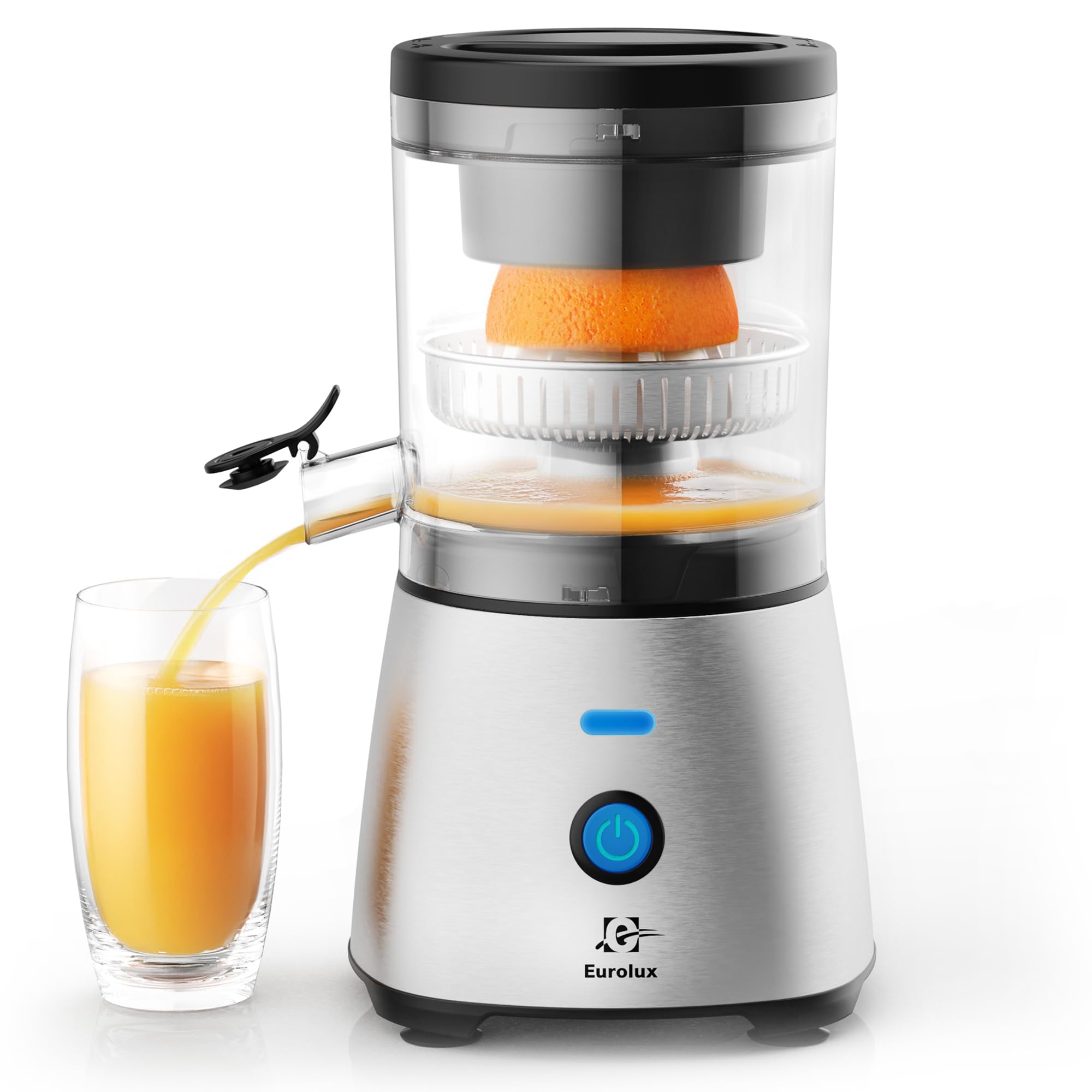
The Eurolux ELCJ-4800 strikes an impressive balance between motor power and ease of use with a 300-watt motor that spins at a low 110 RPM, reducing noise while maximizing juice extraction. Its one-touch operation simplifies the process: cut the fruit, place it on the cone, close the lid, and press the button—the machine does the rest without requiring you to hold down a lever. The compact stainless steel body measures 4 x 8 x 4 inches, fitting easily under upper cabinets without dominating your counter space.
All food-contact parts are top-rack dishwasher safe, making post-juice cleanup quick. Users report the motor easily squeezes oranges completely dry, extracting more juice than lower-wattage competitors. The single-button interface and stable base make it approachable for anyone who wants fresh juice without the learning curve.
Some users note that the lid requires slight pressure to stay fully seated during operation, and the strainer can clog with pulp after roughly one cup of juice, requiring a quick rinse. The motor does warm up with prolonged use, making it better suited for 2-4 glasses at a time rather than continuous high-volume processing.
Why it’s great
- Powerful 300W motor yields completely dry squeezed fruit halves
- One-touch operation with automatic pressing reduces manual effort
- Compact footprint fits tight counter spaces
Good to know
- Lid may not lock fully on its own, requiring a hand hold
- Strainer fills quickly with pulp, needing mid-session rinses
- Motor temperature rises during extended juicing sessions
2. Eurolux Die Cast Stainless Steel Electric Citrus Juicer (ELCJ-1800)

The Eurolux Die Cast model upgrades every component with a fully stainless steel body and die-cast construction that weighs enough to stay planted during aggressive juicing. The same 300-watt industrial-strength motor powers a one-hand pressing arm that lets you juice with minimal effort, and the no-drip spout lock prevents countertop messes when you lift the glass away. Suction cups on the base provide additional anchoring on smooth surfaces.
Two interchangeable stainless steel filter cones allow fine or coarse pulp control, and the clear dome cover prevents splatter while letting you watch the extraction. Users with large families or backyard citrus trees praise its ability to process pounds of fruit quickly without the machine walking across the counter. The die-cast chassis also dissipates heat better than plastic housings, allowing longer continuous run times.
A notable concern is that the central cone piece can be difficult to remove for cleaning. Some units have developed motor shaft issues after the warranty period, and replacement costs approach the price of a new unit. The small pressing cup also struggles with very large grapefruits, occasionally pressing bitter rind oil into the juice.
Why it’s great
- Heavy die-cast and stainless body provides exceptional stability
- Two filter cones give genuine pulp control from fine to coarse
- No-drip spout lock keeps counters clean between glasses
Good to know
- Central cone piece resists removal for cleaning
- Motor shaft may fail after extended use, with limited support
- Small pressure cup handles large grapefruits poorly
3. Reemix Electric Citrus Juicer (BH3305T1)

The Reemix BH3305T1 uses a zinc alloy die-casting shell that gives it a brushed metal look far more premium than its price tier suggests. The 100-watt motor is paired with an ergonomically designed handle that activates the automatic juicing process with minimal downward pressure, and the heavy lid easily accommodates oranges of any size. Two interchangeable cones handle small limes through large grapefruits, ensuring complete fruit coverage.
Users who have run this machine daily for two years report consistent performance and easy part replacement through the manufacturer’s responsive customer support. The alloy materials resist staining and deformation from citric acid, and all parts are dishwasher safe. The 6.3 x 7.09 x 13.7 inch footprint is taller than compact models but still fits comfortably on a standard counter.
Some users note that the manual press requires a bit more physical force than fully automatic one-touch juicers. The design does not include a dedicated on/off switch—pressing the handle starts the motor—which some find less convenient for quick pauses. Lower volume parts availability outside the manufacturer direct channel could complicate long-term repairs.
Why it’s great
- Zinc alloy die-cast shell resists corrosion and looks premium
- Responsive customer support with direct part replacement options
- Two cone sizes handle all citrus fruit diameters
Good to know
- Manual handle press requires more effort than automatic juicers
- No dedicated power switch for quick pauses
- Parts are primarily available through manufacturer direct
4. Cuisinart Pulp Control Citrus Juicer (CCJ-500P1)

The Cuisinart CCJ-500P1 stands out for its three-position pulp control reamer that lets you dial in exactly how much fiber makes it into your glass. The auto-reversing universal cone rotates in both directions to shred more juice from the fruit interior, and the final-spin feature continues extracting juice from the pulp after the main cycle ends, reducing waste. The snap-up spout extends to accommodate taller glasses and locks in place to prevent drips.
Users consistently describe this as a dependable everyday juicer that requires minimal effort to clean. The reamer, cone, and pulp container are all dishwasher safe, and the overall 5.75 x 6.38 x 10.75 inch footprint is compact enough for small kitchens. Performance is reliable for oranges and lemons, and the three-year limited warranty provides good long-term coverage for the price range.
The motor power is not specified by Cuisinart but feels adequate for single fruit halves—grapefruits may require you to halve them further or reposition the fruit midway. The base is relatively light, and several users note that it can shift across the counter during use, creating a minor spill risk if you don’t brace it with your free hand.
Why it’s great
- Three adjustable pulp settings give texture control from clear to chunky
- Auto-reversing cone improves juice extraction efficiency
- Dishwasher safe parts simplify daily cleanup
Good to know
- Light base can slide on counter during operation
- Grapefruit halves require repositioning for full extraction
- Motor power is modest, not ideal for high volume processing
5. Healnitor 150W Electric Citrus Juicer

The Healnitor 150W juicer prioritizes quiet operation, running at a decibel level no higher than 60—quiet enough for early morning juicing without waking others. The stainless steel shell wraps a compact body that measures 8.8 x 6.5 x 10.8 inches, and the upgraded aluminum die-casting handle and two different sized juicing heads improve juice yield across lime, lemon, orange, and grapefruit sizes. The anti-drip spout and stainless steel slag tray keep the counter clean.
All removable parts are dishwasher safe, and the four non-slip rubber feet provide enough grip to prevent walking. Users highlight the quiet motor as a genuine daily benefit, and the 150 watt power delivers efficient juice extraction without the noise of similarly priced units. The thoughtful design makes it approachable for anyone new to electric juicers.
A design quirk causes liquid to drip down the back side of the unit during operation, potentially running near the power cable area if you don’t hold the handle to tilt the drip back into the tray. Some users also note the absence of a dedicated power on/off button—the motor activates when you press the fruit down, which can be slightly less intuitive than a separate switch.
Why it’s great
- Exceptionally quiet motor perfect for early mornings
- Aluminum die-cast handle and two cones improve yield across fruit sizes
- Non-slip rubber feet maintain stability during operation
Good to know
- Juice can drip down the back of the unit near the cord
- No dedicated power switch requires pressure activation
- Pulp builds up relatively fast in the catch plate
6. Oster Electric Citrus Juicer (75 Watt)

The Oster 75-watt juicer offers a no-frills entry into fresh citrus juice with a 450 ml glass collection pitcher that can be used as a serving container or directly filled by the spout. Its dual design lets you collect juice in the built-in reservoir or pour directly into a glass, giving you flexibility without extra parts. The polished silver finish and glass pitcher feel more substantial than the plastic-heavy alternatives at the same price point.
Users who replaced twenty-year-old Oster units find the new version performs similarly for basic orange and lemon juicing. The adjustable spout and strainer are easy to clean, and the compact footprint takes up minimal counter space. For light weekly use—a few oranges per session—this machine delivers reliable results without costing a premium.
The 75-watt motor is underpowered for larger loads. Some users report it requires manual pushing to juice fruit fully, and the motor can overheat before finishing a single bag of oranges, triggering a cooldown period. The strainer also fails to trap fine pulp, often requiring additional sieving for those who prefer a clear glass.
Why it’s great
- Glass pitcher feels durable and serves directly from the juicer
- Dual collection design offers reservoir or direct-pour options
- Compact footprint and simple operation for occasional users
Good to know
- 75W motor struggles with large batches and can overheat
- Requires manual pressing pressure for full extraction
- Strainer allows fine pulp through, requiring extra filtering
7. Hamilton Beach Commercial 932 Manual Citrus Juicer

The Hamilton Beach Commercial 932 is a manual press that generates up to 2,000 lbs of force through a simple lever arm, extracting every drop of juice while keeping bitter skin oils and pulp to a minimum. The acid-resistant enamel finish and metal components are built to withstand years of commercial-grade abuse, and the stainless steel strainer cone and ABS plastic funnel are removable for quick sanitation. Sure Grip feet lock the base to the counter, preventing tipping during repeated pressing cycles.
Home bar enthusiasts and backyard orchard owners praise this unit for its speed and yield when processing whole bags of lemons, limes, and oranges. The manual operation is actually faster than electric juicers for high volumes because there is no motor cooldown or pulp jams, and the four-part construction washes clean in seconds. NSF certification confirms it meets food safety standards for commercial kitchens.
The unit stands 19.5 inches tall, requiring dedicated under-cabinet clearance. The pressing cup is somewhat small for very large grapefruits, occasionally pressing rind oil into the juice. Some users also note that the base can twist slightly on its rubber pads during heavy use, requiring periodic repositioning.
Why it’s great
- Manual lever generates 2,000 lbs force for near-total juice extraction
- Fastest option for high-volume citrus processing with no motor limits
- NSF certified build with acid-resistant materials for long term durability
Good to know
- 19.5 inch height requires generous under-cabinet clearance
- Small pressing cup struggles with extra-large grapefruit halves
- Base can twist on rubber pads during intense pressing sessions
FAQ
What wattage motor do I need for daily orange juicing?
Are electric or manual OJ juicers better for high volume processing?
How do I prevent pulp from clogging the strainer during juicing?
Is a die-cast metal body worth the extra investment for a countertop juicer?
Final Thoughts: The Verdict
For most users, the best oj juicer winner is the Eurolux ELCJ-4800 because it combines a powerful 300-watt motor with one-touch automatic operation and a compact footprint for an approachable price. If you want heavy-duty build quality with dual filter cones for precise pulp control, grab the Eurolux Die Cast. And for restaurant-grade throughput and zero motor limitations during large batches, nothing beats the Hamilton Beach Commercial 932 manual press.