The difference between a frustrating meal prep and a smooth, almost meditative cooking rhythm often comes down to a single factor: the edge on your blade. Dull knives crush cell walls rather than slicing cleanly, turning a ripe tomato into a sad puddle and demanding twice the effort for every onion. The right kitchen knife transforms that struggle into effortless control.
I’m Mohammad Maruf — the founder and writer behind AirfryerBite. Over the past several years, I’ve analyzed hundreds of blade steel compositions, handle ergonomics, and heat-treatment processes to understand what separates a knife that performs from one that just looks good on a magnetic strip.
Whether you are equipping a first apartment or upgrading a professional kit, finding the best kitchen knives means cutting through marketing claims to focus on real-world edge retention, balance, and steel quality that matches your cooking style.
How To Choose The Best Kitchen Knives
Selecting a kitchen knife set or individual blade requires more than picking a price bracket. The steel type, construction method, and handle design dictate how the knife performs during the first use and after a year of daily cooking. Focus on these three factors to narrow your decision.
Steel Composition and Hardness
The blade material determines how long the edge stays sharp and how easily it can be honed. High-carbon stainless steel offers a balance of corrosion resistance and edge retention. German steel, typically forged to 56–58 HRC, is tougher and easier to sharpen on a steel rod. Japanese steel, often reaching 60–62 HRC, holds a sharper edge longer but requires more careful handling and diamond or water stone sharpening. For most home cooks, a Rockwell hardness between 57 and 60 provides the best mix of durability and maintainability.
Construction: Forged vs. Stamped and Full Tang vs. Partial Tang
A forged blade is shaped from a single heated billet of steel, resulting in a denser grain structure and better weight distribution. Stamped blades are cut from a flat sheet and then heat-treated — they are lighter and more affordable but may lack the balance of a forged knife. Full-tang construction means the steel runs the entire length of the handle, providing superior stability and control. Partial-tang knives can flex during heavy work and cause hand fatigue over extended use.
Quick Comparison
On smaller screens, swipe sideways to see the full table.
| Model | Category | Best For | Key Spec | Amazon |
|---|---|---|---|---|
| WÜSTHOF Classic 2-Piece Set | Premium | Long-term investment, daily driver | 58 HRC forged German steel | Amazon |
| Shun Classic 8″ Kiritsuke | Premium | Precision slicing, vegetable work | VG-MAX core, 68-layer Damascus | Amazon |
| HOSHANHO 3-Piece Set | Premium | Professional-grade edge retention | 60 HRC Japanese 10Cr15CoMoV | Amazon |
| KnifeSaga 14-Piece Set | Mid-Range | Complete block set, gift-ready | 10° ultra-sharp edge | Amazon |
| Dalstrong Kiritsuke 8.5″ | Mid-Range | Knuckle clearance, heavy chopping | 14-16° hand-polished edge | Amazon |
| KYOKU Shogun 8″ Chef | Mid-Range | Damascus aesthetics, balanced weight | VG-10 core, 58-60 HRC | Amazon |
| Astercook 14-Piece Set | Budget | Entry-level full set, value | Full tang, built-in sharpener | Amazon |
In‑Depth Reviews
1. WÜSTHOF Classic 2-Piece Chef’s Knife Set

WÜSTHOF’s Classic series has earned its place as a benchmark in German cutlery for good reason. This two-piece set includes an 8-inch chef’s knife and a 3.5-inch paring knife, both forged from a single block of high-carbon stainless steel and precision-tempered to 58 degrees HRC. The Precision Edge Technology (PEtec) delivers a blade that is 20 percent sharper out of the box with twice the edge retention of previous generations, reducing the frequency of honing sessions during heavy meal prep.
The full-tang, triple-riveted polypropylene handle resists fading and impact, and the bolster provides a safe finger guard during pinch-grip work. At 0.85 pounds for the chef knife, the balance point sits exactly at the bolster, giving a nimble feel for rocking cuts on herbs and enough heft for breaking down squash. The paring knife matches the same steel quality, making it ideal for intricate work like deveining shrimp or coring fruit.
Real user feedback over years of use consistently highlights the edge’s ability to hone back to razor sharpness on a simple steel rod — a trait that Japanese knives at higher HRC cannot match without diamond stones. The set is dishwasher safe per the manufacturer, though hand washing preserves the handle integrity longer.
Why it’s great
- Forged German steel with PEtec offers outstanding out-of-box sharpness
- Full-tang polypropylene handle withstands commercial kitchen conditions
- Easily sharpened on a honing steel without specialized stones
Good to know
- Only two knives included; no block or storage sheath provided
- Polypropylene handle feels less warm than wood or pakkawood alternatives
2. Shun Classic 8″ Kiritsuke Knife

Shun’s Classic Kiritsuke brings the revered Japanese flat-edge profile — a cross between a traditional gyuto and a usuba — to the Western kitchen. The core is VG-MAX steel, an proprietary alloy known for its fine carbide structure, clad in 68 layers of Damascus stainless steel that produce the signature wavy pattern. The blade is sharpened to a 16-degree edge per side, significantly more acute than the typical 20-degree edge on German knives, allowing it to slice through tomato skins without compression.
The D-shaped pakkawood handle is ergonomically contoured to fit both left and right hands, with a brass bolster and end cap that add a subtle forward balance. At 0.6 pounds, the kiritsuke feels light and agile — ideal for precise vegetable work, julienning, and thin slicing of boneless proteins. Shun includes a free sharpening service with the purchase, which is valuable given that the harder steel (60+ HRC) requires diamond stones or professional service for maintenance.
Long-term owners note that the edge is exceptionally sharp out of the box but can micro-chip if used to cut through bones, frozen foods, or hard squash without care. This knife is best suited for cooks who prioritize precision over brute utility and are willing to adopt proper cutting technique.
Why it’s great
- VG-MAX core with Damascus cladding delivers exceptional edge sharpness
- Lightweight design reduces fatigue during extended prep sessions
- Free sharpening service included from manufacturer
Good to know
- Hard steel can chip if misused on bones or frozen items
- D-shaped handle may not suit all hand sizes equally
3. HOSHANHO 3-Piece Kitchen Knife Set
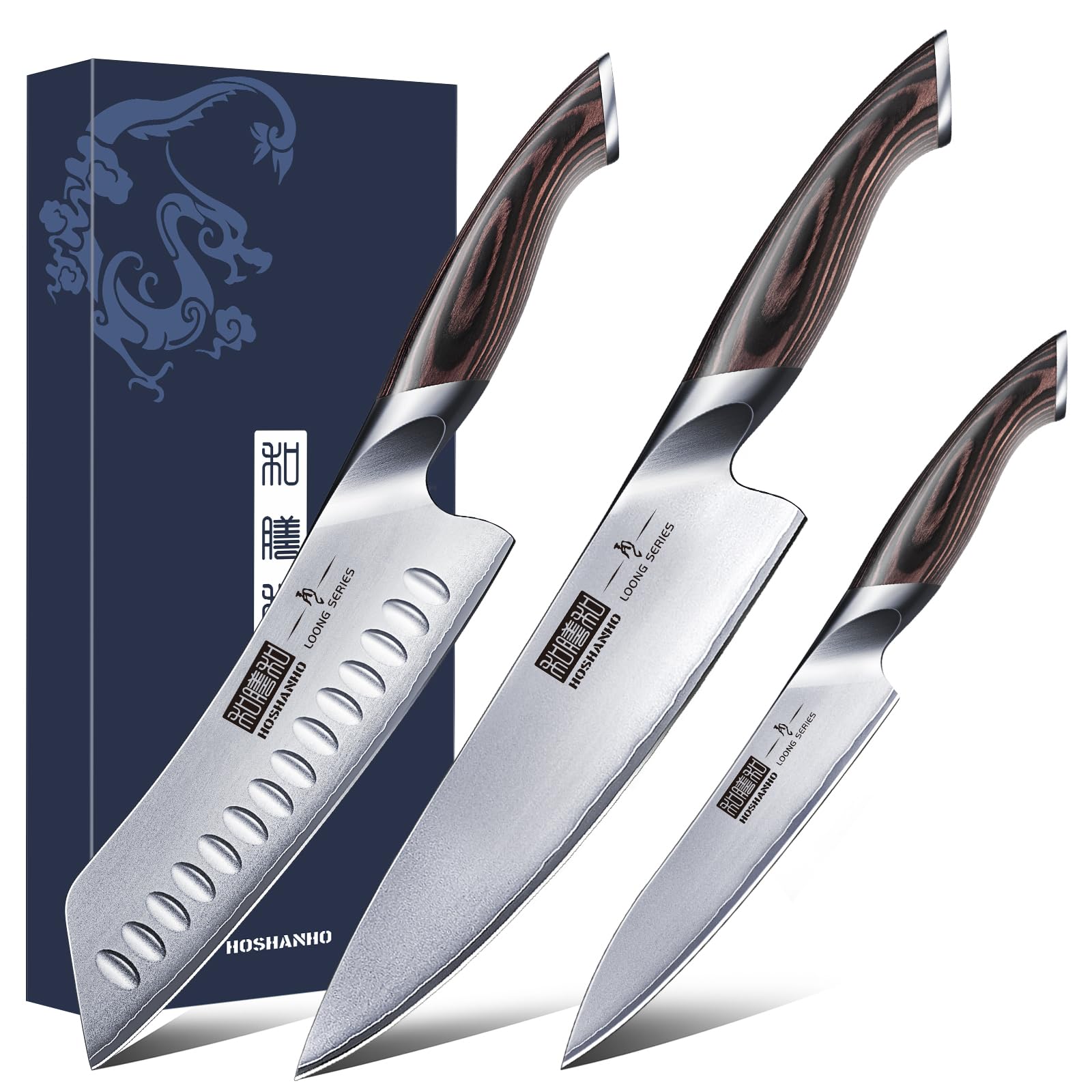
HOSHANHO’s three-piece set — an 8-inch chef’s knife, a 7-inch santoku, and a 6-inch utility knife — uses Japanese 10Cr15CoMoV high-carbon stainless steel hardened to 60 HRC, placing it in the same hardness territory as many premium single-blade offerings. The steel is treated with high-temperature vacuum and low-temperature cold nitrogen processing before being hand-polished to a 15-degree edge per side. The result is a blade that holds a fine edge through multiple prep sessions without noticeable degradation.
The pakkawood handles are ergonomically shaped and mated to full-tang blades with hidden rivets, giving the set a clean, minimalist look. Each knife weighs enough to feel substantial but not cumbersome — the chef’s knife balances well for both rocking and push-cutting. The santoku’s Granton edge (dimpled) helps reduce friction when slicing sticky foods like potatoes or cheese.
This set omits a block, pairing knife, and shears, so it is best for cooks who want three core blades without unnecessary extras. The high hardness means you will need a ceramic rod or diamond sharpener rather than a standard honing steel, but the edge longevity offsets that additional tool cost over time.
Why it’s great
- 60 HRC Japanese steel outperforms many German blades in edge retention
- Full-tang pakkawood handles provide excellent grip and balance
- Santoku with Granton edge reduces drag on sticky ingredients
Good to know
- No storage block or sheath included
- Requires specialized sharpening tools due to high hardness
4. KnifeSaga 14-Piece Kitchen Knife Set
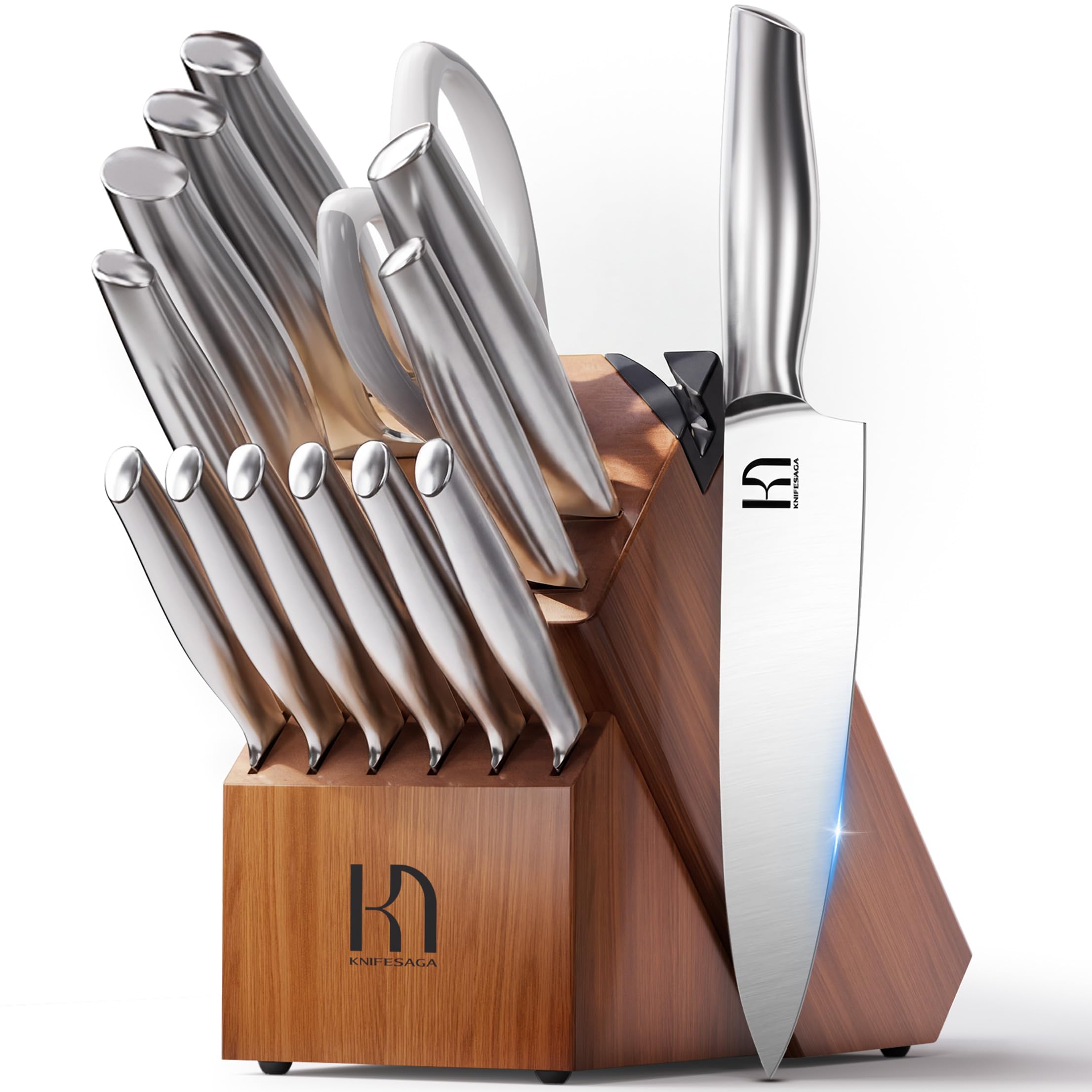
KnifeSaga’s 14-piece set delivers a complete kitchen cutlery solution at a mid-range price point without cutting corners on steel quality. Each blade is forged from high-carbon stainless steel and sharpened to a 10-degree angle per side — an aggressive edge that enables clean, push-through slicing of dense vegetables and boneless meats. The set includes an 8-inch chef knife, 8-inch bread knife, 8-inch slicing knife, 7-inch santoku, 5-inch utility knife, 3.5-inch paring knife, six 4.5-inch serrated steak knives, kitchen shears, and a built-in sharpener housed in an angled solid acacia wood block.
The acacia block adds a warm grain aesthetic to the countertop, and the non-slip bottom keeps the block stable when pulling knives in and out. The built-in sharpener is a practical inclusion for users who do not own separate sharpening equipment, though it removes more metal than a manual stone and should be used sparingly. The full-tang construction runs through all the fixed blades, delivering consistent balance across the set.
Cooks who entertain frequently will appreciate the six steak knives, which match the rest of the set visually and perform well at the table. Hand washing is recommended to preserve the blade edges and the acacia wood block finish, even though the individual blades could technically survive a dishwasher cycle.
Why it’s great
- Comprehensive 14-piece set covers every kitchen cutting task
- Acacia wood block with built-in sharpener offers convenience
- Aggressive 10-degree edge cuts through dense produce cleanly
Good to know
- Built-in sharpener removes more metal than ideal for long-term care
- Acacia block may warp if exposed to standing water
5. Dalstrong Kiritsuke Chef Knife – 8.5″ Gladiator Series

Dalstrong’s Gladiator Series Elite Kiritsuke brings a unique flat-profiled blade — traditionally a Japanese specialty — to a forged German high-carbon steel construction. The 8.5-inch blade is hand-polished to a 14-to-16-degree edge per side and tempered to a hardness of 56-plus Rockwell. The tall blade height, measuring over 2 inches at the heel, provides generous knuckle clearance that prevents your fingers from hitting the cutting board during chopping — a detail that heavy-handed cooks appreciate immediately.
The G10 handle is a glass-fiber-reinforced composite that resists moisture, heat, and impact far better than wood. It is triple-riveted to the full tang and polished smooth for a sanitary surface that does not trap food debris. At 252 grams (roughly 8.9 ounces), the knife has a satisfying heft without feeling cumbersome, and the balance point falls at the pinch grip area for controlled slicing.
This knife is NSF certified, meaning it meets commercial kitchen sanitation standards, and it ships with a fitted sheath for safe storage. The satin-finished blade resists staining well, though prolonged contact with acidic ingredients should still be followed by immediate wiping.
Why it’s great
- Tall blade profile offers exceptional knuckle clearance
- NSF-certified G10 handle is hygienic and durable
- Hand-polished edge at 14-16° provides low-resistance cutting
Good to know
- Kiritsuke flat profile requires adaptation for rock-chopping technique
- Sheath is functional but basic; no edge guard included
6. KYOKU Shogun Series 8″ Chef Knife

KYOKU’s Shogun Series chef knife pairs a 67-layer Damascus VG-10 steel core with a cryogenic treatment process that enhances carbide distribution for improved toughness. The blade is sharpened using the traditional Honbazuke method to an 8-to-12-degree edge, resulting in a razor profile that parts meat, fish, and vegetables with negligible resistance. At 58-60 HRC, the steel is hard enough for long-lasting sharpness but not so brittle that it cannot withstand standard kitchen use.
The fiberglass-reinforced handle with mosaic pin is stable across temperature extremes and resists the corrosion that plagues some handles in humid environments. Weighing 1.39 pounds, the knife has a rear-weighted balance that suits cooks who prefer a handle-heavy feel for controlled slicing. The included sheath and case provide secure storage, and the knife has been praised in user reviews for holding its edge through a full year of regular use with only occasional stropping.
This single chef knife is an excellent choice for cooks who want one high-performance blade rather than a full set. The Damascus pattern is purely aesthetic but adds visual appeal that draws compliments during shared meal prep.
Why it’s great
- VG-10 Damascus core with cryogenic treatment extends edge life
- Sharpened to 8-12° for exceptionally low cutting resistance
- Includes sheath and storage case for safe handling
Good to know
- Handle-heavy balance may not suit cooks who prefer blade-forward feel
- Damascus layers require gentle cleaning to preserve finish
7. Astercook 14-Piece Kitchen Knife Set
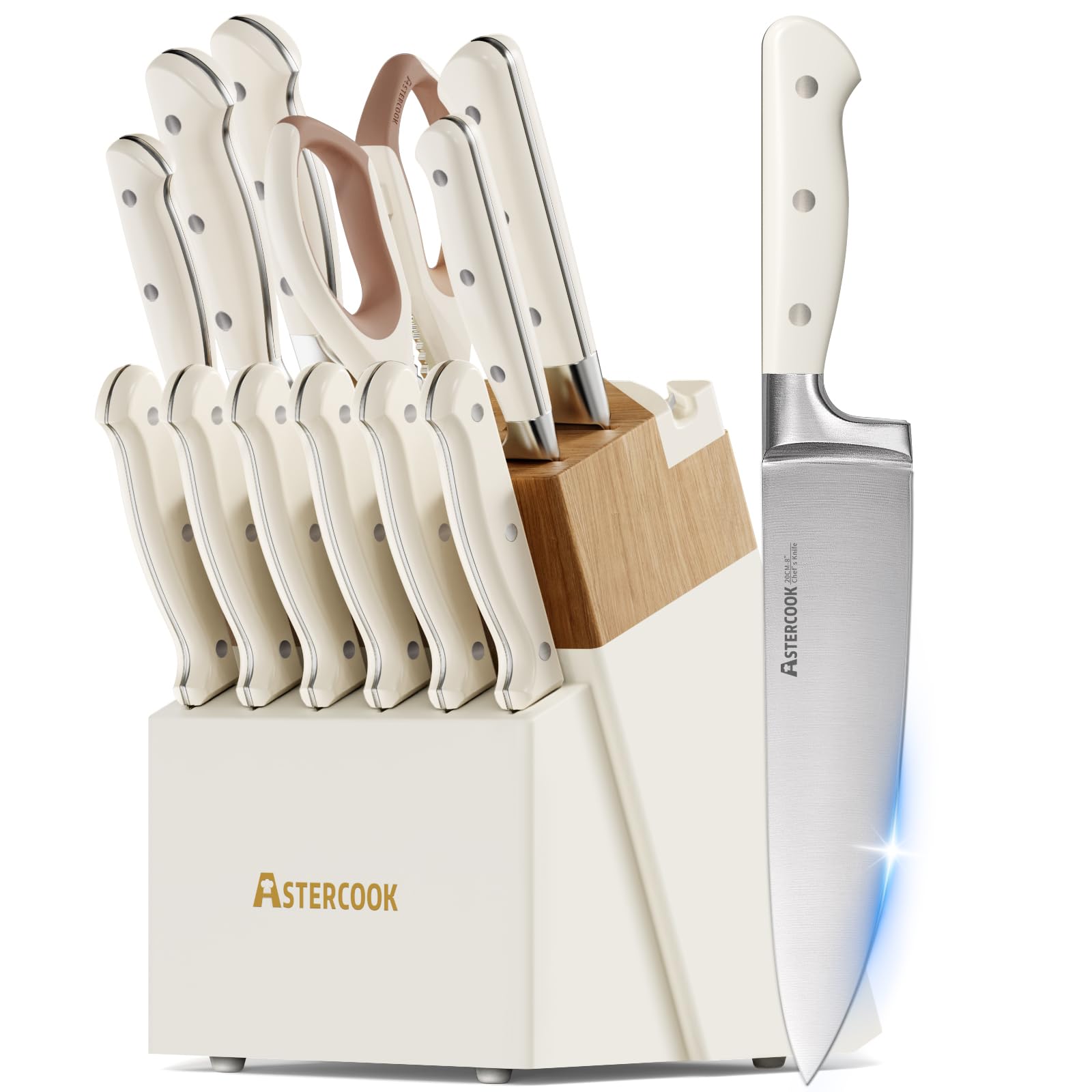
Astercook’s 14-piece set offers an entry-level path to a fully stocked knife block without sacrificing full-tang construction. The blades are made from high-carbon stainless steel, and the set includes an 8-inch chef knife, 8-inch slicing knife, 8-inch serrated bread knife, 5-inch utility knife, 3.5-inch paring knife, six 4.5-inch serrated steak knives, kitchen shears, and a hardwood block with an integrated sharpener. The cream-white aesthetic with engineered stainless steel handles gives the block a clean, modern look that stands out against traditional dark handles.
The full-tang design across all fixed blades reduces fatigue compared to partial-tang budget sets, and independent lab testing cited by the manufacturer indicates 30 percent lower fatigue rates. The built-in sharpener in the block is a practical feature for maintaining the edge without additional equipment, though as with any pull-through sharpener, it is best used sparingly to avoid removing excessive metal.
The 99-year warranty and dishwasher-safe components (though hand washing is recommended for longevity) provide reassurance for first-time knife set buyers. The serrated steak knives perform well for their category, making this set suitable for households that host dinners and want a unified table presentation without a premium price tag.
Why it’s great
- Full-tang construction across all blades reduces hand fatigue
- 14-piece set covers all basic kitchen and table cutting needs
- Built-in sharpener and 99-year warranty add peace of mind
Good to know
- High-carbon steel won’t match premium alloys in edge retention
- Engineered stainless steel handle lacks the warmth of wood or G10
FAQ
What does full-tang construction mean and why does it matter?
Can I put high-carbon stainless steel kitchen knives in the dishwasher?
What is the practical difference between German and Japanese kitchen knives?
How many knives do I actually need in a set?
Final Thoughts: The Verdict
For most users, the best kitchen knives winner is the WÜSTHOF Classic 2-Piece Chef’s Knife Set because it delivers forged German steel with precise heat treatment, outstanding edge retention, and a proven track record spanning decades of home and professional use. If you want the precision of a Japanese blade with Damascus aesthetics, grab the KYOKU Shogun Series 8″ Chef Knife. And for a complete ready-to-go solution that covers every knife need in a family kitchen, nothing beats the KnifeSaga 14-Piece Set.