That frustrating moment when a knife splits a ripe tomato rather than cleanly slicing through it is the exact reason vegetable prep demands a different blade geometry than a standard chef’s knife. Japanese vegetable knives—specifically the Nakiri and Usuba styles—use a flat, double-bevel edge that drops straight through produce without the rock-and-chop motion of Western knives, delivering paper-thin cuts from a daikon radish to a head of cabbage.
I’m Mohammad Maruf — the founder and writer behind AirfryerBite. I’ve spent years analyzing blade steels, edge retention ratings in HRC, handle ergonomics, and the forge processes behind the seven contenders that define the current market for precision vegetable knives.
After cross-referencing core materials from VG10 to AUS-10V, handle durability across Santoprene and Pakkawood, and real-world performance data, this guide pinpoints the japanese knife for cutting vegetables that delivers the straightest push-cut experience for your setup.
How To Choose The Best Japanese Knife For Cutting Vegetables
Buying a Japanese vegetable knife is different from picking a Western chef’s knife. The blade geometry, steel hardness, handle shape, and intended cutting motion all shift toward one goal: a perfectly straight push-cut through dense produce. Three factors determine whether a knife fits your prep style.
Blade Steel and Hardness (HRC Rating)
Japanese vegetable knives typically use harder steels than their German counterparts, with HRC ratings between 58 and 63. Higher HRC means the blade holds a razor edge longer but becomes more brittle if chipped against bones or frozen food. VG10 (around 60-61 HRC) offers an excellent balance of sharpness and stain resistance. AUS-10V pushes edge retention higher at 62+ HRC. For heavy daily chopping of root vegetables, a core steel in the 60-62 HRC range is the sweet spot between edge longevity and ease of sharpening on whetstones.
Blade Geometry: Flat Edge Versus Curved Edge
The defining characteristic of a Nakiri or Usuba is its completely flat cutting edge. Unlike a chef’s knife that rocks on its belly, a flat edge contacts the cutting board across its entire length with each stroke. This eliminates incomplete cuts where a piece of vegetable hangs by a thread. Look for a blade with minimal belly and a blunt or squared-off tip that prevents accidental piercing. Knuckle clearance around 45-55mm blade width also matters for comfortable chopping without your fingers scraping the board.
Handle Material and Balance
Western-style handles (full tang, riveted) provide a heavier, more balanced feel that many home cooks prefer. Traditional Japanese octagonal or oval handles (Wa-style, often magnolia or Ho wood) shift the balance forward for a lighter, blade-forward motion. Santoprene and G10 handles offer slip resistance for wet hands. Pakkawood delivers moisture resistance without the cold feeling of metal. Choose a handle that matches your grip style: a heavy pinch grip benefits from a Western handle, while a lighter thumb-index pinch suits Wa-style handles.
Quick Comparison
On smaller screens, swipe sideways to see the full table.
| Model | Category | Best For | Key Spec | Amazon |
|---|---|---|---|---|
| Shun Premier Grey | Premium | Pro-grade precision with VG-MAX core | VG-MAX core, 68-layer Damascus, 5.5″ blade | Amazon |
| Dalstrong Shogun Elite | Premium | AUS-10V super steel with hammered finish | AUS-10V core, 66 layers, 62+ HRC, 6″ blade | Amazon |
| WÜSTHOF Classic Nakiri | Premium | German build with hollow-edge anti-stick | High-carbon stainless, PEtec, 5″ blade | Amazon |
| Yoshihiro VG10 Damascus | Mid-Range | Handcrafted artisan Nakiri with hammered finish | VG10 core, 16-layer Damascus, 60 HRC, 6.5″ | Amazon |
| KYOKU Shogun Series | Mid-Range | Damascus VG10 with included saya sheath | VG10 core, Damascus cladding, 7″ blade | Amazon |
| Mac Japanese Vegetable Cleaver | Mid-Range | Thin molybdenum steel for low friction | Molybdenum steel, 6.5″, Pakkawood handle | Amazon |
| Mercer Culinary Genesis Nakiri | Budget | Entry-level forged German steel Nakiri | High-carbon German steel, 7″, Santoprene | Amazon |
In‑Depth Reviews
1. Shun Cutlery Premier Grey Nakiri Knife 5.5″

Shun’s proprietary VG-MAX cutting core is a significant step up in edge retention compared to standard VG10, holding a 16° double-bevel edge through heavy weekly chopping of carrots, celery, and onions without noticeable dulling. The 68-layer Damascus cladding with a hammered Tsuchime finish creates micro-pockets that reduce stiction, so sliced potatoes release from the blade rather than sticking.
The 5.5-inch blade length is shorter than most Nakiri knives, but the 48mm blade width provides full knuckle clearance for a comfortable push grip. The contoured Pakkawood handle resists moisture absorption and offers precise control for thin julienne work. The straight spine and blunt tip make it exceptionally safe for the fast up-and-down chop common in vegetable prep.
Shun recommends hand-washing and sharpening with water whetstones. The 60+ HRC hardness means this knife should never scrape across a board or hit a bone. For the cook who wants artisan craftsmanship with a modern high-performance core steel, this is the definitive choice.
Why it’s great
- VG-MAX core outperforms standard VG10 in edge holding
- Hammered finish actively reduces food sticking to the blade
- Perfectly balanced Western-style handle with secure pinch grip
Good to know
- 5.5″ blade may feel short for large-volume prep
- High HRC requires proper whetstone technique for sharpening
2. Dalstrong Nakiri Vegetable Knife – Shogun Series Elite – 6 inch

Dalstrong’s Shogun Elite uses AUS-10V vacuum-treated Japanese super steel at 62+ Rockwell, a hardness that competes directly with premium VG10 formulations but adds vanadium for finer grain structure and improved wear resistance. The 66-layer high-carbon Damascus cladding is paired with a hand-finished mirror-polished edge at 8-12° per side using the Honbazuke method, producing a scalpel-like initial sharpness out of the box.
The hammered Tsuchime finish serves the same anti-stick purpose as the Shun’s, but Dalstrong uses a wider 55mm blade that offers superior knuckle clearance for larger hands. The full-tang G10 handle is triple-riveted and ergonomically contoured, providing a secure grip even when hands are greasy from prepping multiple ingredients. The included saya sheath adds storage protection.
At 292 grams, this knife feels weightier than the Shun, which some cooks prefer for chopping through dense squash. The edge is brittle enough that users should stick to wooden or soft plastic cutting boards. For chefs who demand max edge retention in a six-inch format with aggressive geometry, this is the stronger pick.
Why it’s great
- AUS-10V super steel holds a working edge longer than standard VG10
- 55mm blade width gives exceptional knuckle clearance
- Full-tang G10 handle offers zero-slip ergonomics
Good to know
- Hard 62+ HRC edge is more prone to chipping on hard surfaces
- Aggressive 8-12° angle requires careful whetstone maintenance
3. WÜSTHOF Classic 5″ Hollow Edge Nakiri Knife
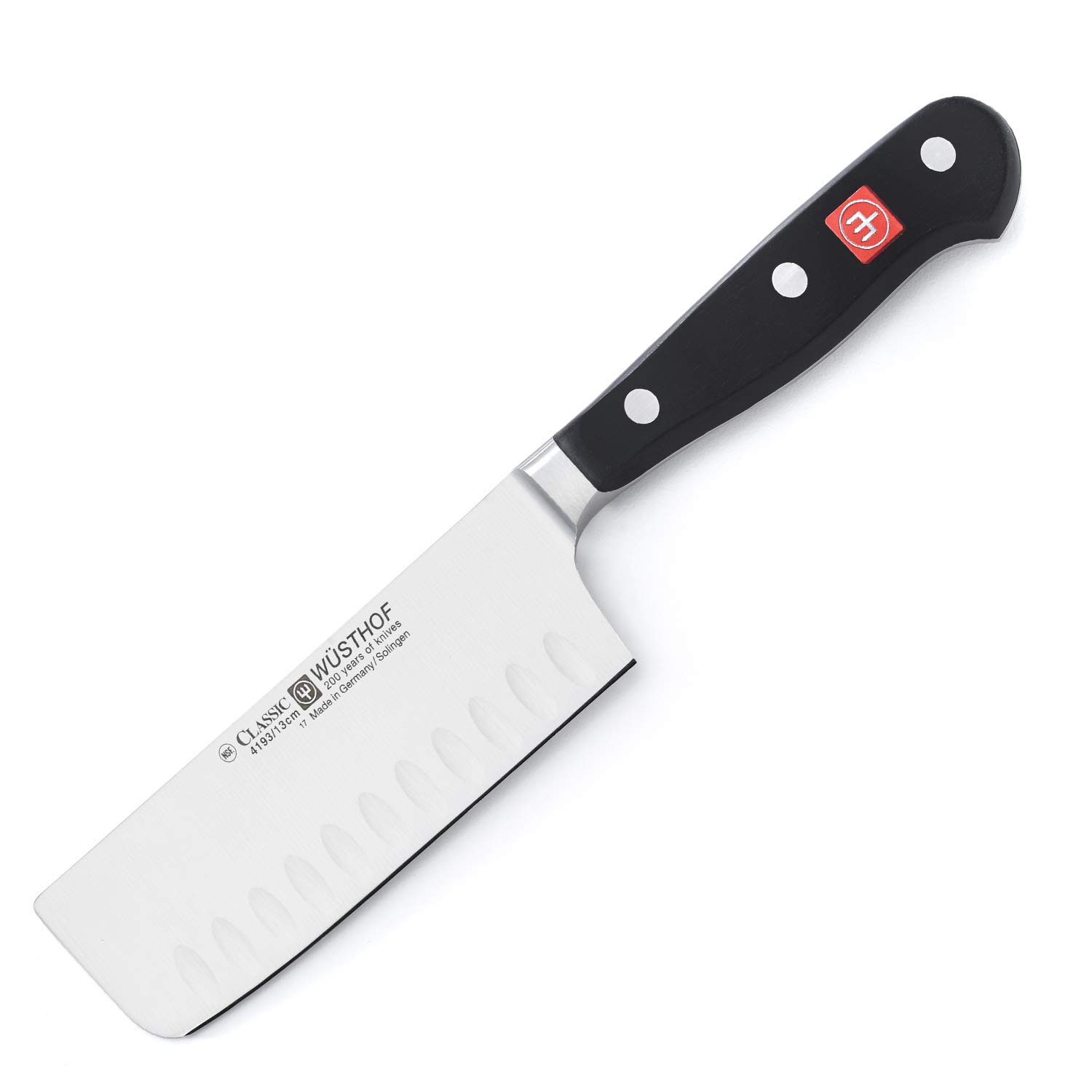
WÜSTHOF takes a different approach by forging a 5-inch Nakiri from a single block of high-carbon stainless steel with Precision Edge Technology that yields a blade 20% sharper with double the edge retention of earlier Classic models. The most distinctive feature is the hollow edge (Granton-style) with vertical indentations that create air pockets between the blade and sticky starchy vegetables like potatoes.
The full bolster and finger guard provide a safety stop that traditional Japanese knives lack, which matters for cooks transitioning from Western chef’s knives. The synthetic polypropylene handle resists fading and impact, and the triple-riveted full tang gives it a heavier balance point that some users find more stable for consistent chopping rhythm.
The 58 HRC hardness is softer than Japanese super steels, which makes the WÜSTHOF more forgiving against accidental contact with cutting board edges or garlic skins. The tradeoff is that it needs honing more frequently. For cooks who want a German-built Nakiri with proven durability and a lifetime warranty, this is the most accessible premium option.
Why it’s great
- Hollow edge reduces sticking on starchy vegetables like potatoes
- Full bolster and finger guard for safe transition from Western knives
- Softer 58 HRC steel is more forgiving and easier to hone
Good to know
- 5″ blade is shorter than most Nakiri designs
- Heavier balance reduces the nimble feel some prefer for fine cuts
4. Yoshihiro VG10 16 Layer Hammered Damascus Nakiri 6.5″

Yoshihiro handcrafts each Nakiri in Japan with a VG10 stainless core clad in 16 layers of Damascus steel, then applies a hammered finish that reduces drag and food release. The 60 HRC hardness places it squarely in the performance zone where the blade takes a fine edge without becoming brittle, making it a balanced middle ground for daily home use.
The 6.5-inch blade is the traditional Nakiri length that allows a full chopping stroke without lifting the heel. The mahogany Western-style handle with full tang provides a comfortable pinch grip and shifts the balance slightly forward, which aids the straight push-cut motion. The double-bevel geometry means left-handed users can sharpen and use it without modification.
Yoshihiro explicitly advises against using the knife on bones, nutshells, or frozen foods, and recommends only water whetstone sharpening. The hammered Damascus pattern is unique per knife, making each piece a one-of-a-kind work. For those who value artisan forging with a proven VG10 core at a mid-range investment, this knife delivers the highest aesthetic-to-performance ratio in this guide.
Why it’s great
- Handcrafted 16-layer Damascus with unique hammered pattern
- 6.5″ blade provides ideal Nakiri length for efficient push cuts
- 60 HRC balances sharpness with edge toughness
Good to know
- Not suitable for cutting around bones or hard squash shells
- Mahogany handle requires dry storage to prevent cracking
5. KYOKU Nakiri Knife – Shogun Series – 7″ Damascus VG10
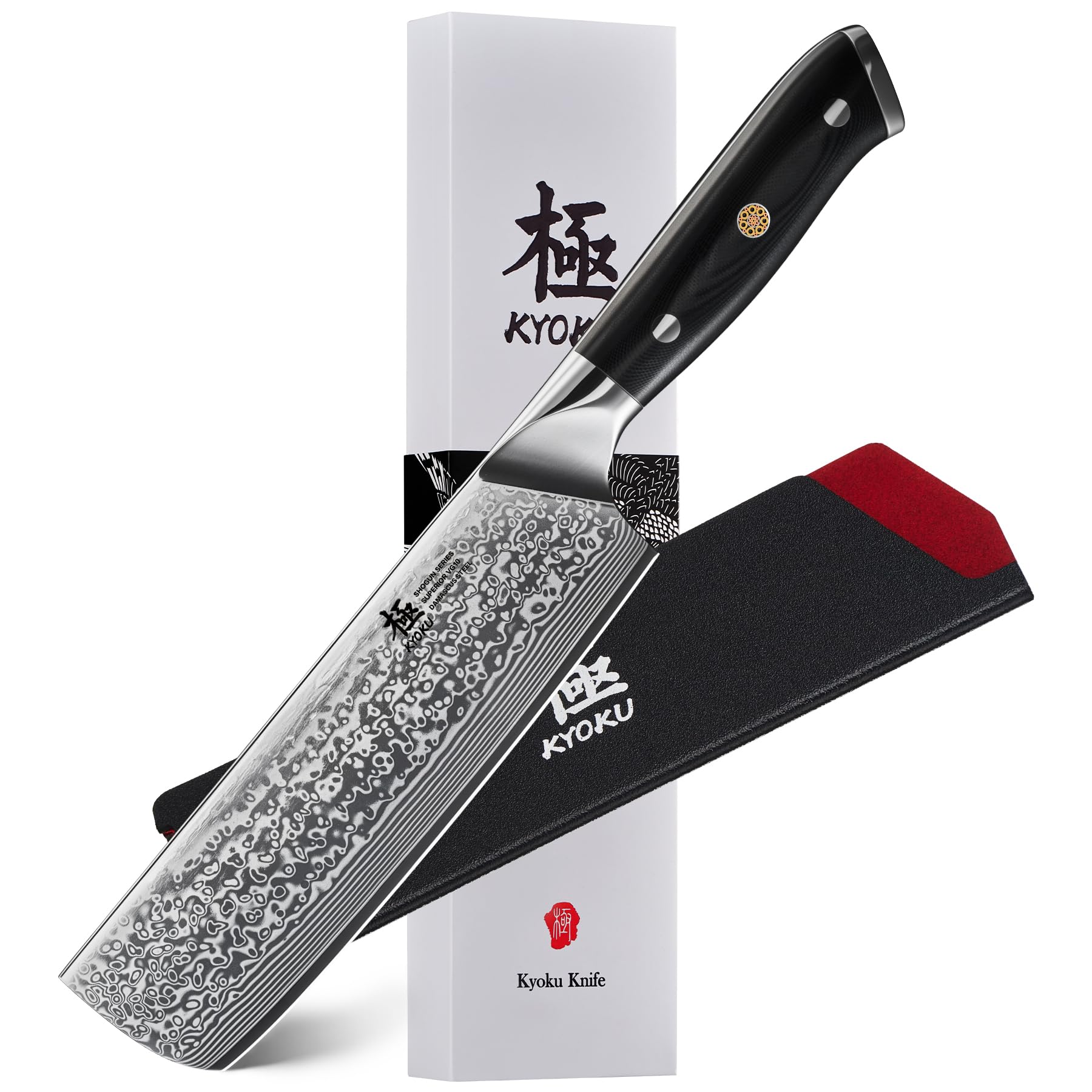
KYOKU’s Shogun Series brings a VG10 core wrapped in Damascus cladding at a competitive price point, making it one of the most accessible ways to get a Japanese-style Nakiri with a genuine high-carbon core. The 7-inch blade is the longest in this guide, providing extra reach for larger produce like cabbage wedges or butternut squash halves.
The G10 handle is a military-grade glass-fiber-reinforced polymer that resists temperature changes, moisture, and impact far better than wood or synthetic polypropylene at the same price. The full-tang construction gives it a solid, balanced feel that doesn’t feel cheap. An included saya sheath and gift case add storage value that premium competitors charge extra for.
The Damascus pattern is laser-etched rather than forged, which affects aesthetic depth but not cutting performance. The VG10 core still holds a sharp edge well at the specified HRC. For the budget-conscious cook who wants a genuine VG10 blade without paying the artisan premium, this is the most practical entry into the Japanese vegetable knife category.
Why it’s great
- 7″ blade provides the longest cutting surface in this guide
- G10 handle is durable, moisture-proof, and comfortable
- Includes saya sheath and storage case for protection
Good to know
- Damascus cladding is etched, not forged
- VG10 core at this price may not match premium HRC precision
6. Mac Knife Japanese Series Vegetable Cleaver, 6-1/2-Inch

Mac Knife takes a different route with their Japanese Series Vegetable Cleaver, using a stamped molybdenum steel blade that is only 2.5mm thick. This thinness reduces wedging in dense vegetables like carrots and beets, allowing the blade to pass through produce with noticeably less resistance than thicker forged knives. The thin edge also means less material to sharpen through over time.
The Pakkawood handle is contoured for a comfortable pinch grip and resists moisture well, though it lacks the full tang of Western-style handles. The 6.5-inch blade length is standard, but the cleaver-style profile adds blade height for scooping up chopped ingredients. The double-bevel edge is sharpened at a relatively acute angle out of the factory.
The molybdenum steel does not reach the hardness of VG10 or AUS-10V, so it will need more frequent honing between sharpening sessions. For cooks who prioritize a thin, nimble blade that glides through vegetables without crushing cells, this lightweight cleaver is a unique alternative to the standard Nakiri form factor.
Why it’s great
- 2.5mm thin blade reduces drag and wedging in dense produce
- Lightweight design reduces fatigue during long prep sessions
- Pakkawood handle offers good moisture resistance
Good to know
- Molybdenum steel does not hold an edge as long as VG10
- Stamped construction lacks the heft and balance of forged knives
7. Mercer Culinary M21067 Genesis 7″ Granton Edge Nakiri

Mercer Culinary’s Genesis series uses precision-forged high-carbon German steel with a taper-ground edge, producing a 7-inch Nakiri that punches above its class in build quality. The Granton edge (hollow indentations) serves the same anti-stick purpose as the WÜSTHOF’s hollow edge, making it a strong alternative for cooks who work with starchy vegetables on a tight budget.
The Santoprene handle is the most slip-resistant in this guide, even with wet or oily hands, and the ergonomic contour reduces fatigue during extended chopping sessions. The forged construction gives it a weight and balance that feel more premium than the price suggests. It comes razor-sharp out of the box and takes a fine edge easily.
The high-carbon German steel is softer than Japanese super steels (approximately 56 HRC), so the edge will roll rather than chip under abuse. This makes it the most forgiving option for beginners learning push-cut technique. For the home cook who wants a reliable, comfortable Nakiri without investing in a VG10 core, this entry-level pick delivers consistent results.
Why it’s great
- Forged German steel offers surprising performance at an entry-level price
- Santoprene handle stays secure even with wet hands
- Granton edge reduces sticking without the premium price tag
Good to know
- Softer steel requires more frequent sharpening than VG10 options
- Does not include a sheath or storage guard
FAQ
What is the difference between a Nakiri and a Usuba knife for vegetables?
Can a Japanese vegetable knife cut through butternut squash or pumpkin?
How often should I sharpen a Japanese vegetable knife?
Why do Japanese vegetable knives have a hammered finish?
Final Thoughts: The Verdict
For most users, the japanese knife for cutting vegetables winner is the Shun Premier Grey Nakiri because its VG-MAX core delivers superior edge retention at a versatile 5.5-inch length with professional-grade Damascus cladding. If you want a harder super steel with better knuckle clearance, grab the Dalstrong Shogun Elite. And for an entry-level forged knife that still provides Granton-edge anti-stick performance, nothing beats the Mercer Culinary Genesis Nakiri.