The difference between a flat, watery pod shot and a dense, syrupy espresso with a lasting crema comes down to the pump pressure and thermal stability of your machine. A good pod machine delivers 19 to 20 bars of pressure and heats water to a precise 90–92 degrees Celsius in under 30 seconds, which is the narrow window where real espresso flavor lives.
I’m Mohammad Maruf — the founder and writer behind AirfryerBite. I’ve spent years analyzing the hardware specifications of countertop coffee gear, from thermoblock materials to pump ratings, to help buyers separate marketing claims from actual brew performance.
After comparing nine models across different pressure ratings, brew temperature ranges, and capsule compatibility, I’ve identified the machines that consistently deliver the thick crema and balanced extraction you expect from a quality espresso pod machine.
How To Choose The Best Espresso Pod Machine
Choosing the right pod machine is about more than picking the brand name you recognize. Three specific criteria—pump pressure, brew temperature range, and capsule system compatibility—define whether your daily shot will rival a café pour or fall flat.
Pump Pressure: 19 Bar vs. 20 Bar
Espresso requires pressure between 9 and 15 bars at the coffee puck. Pod machines compensate for the lower resistance of pre-ground capsules by starting with a higher pump rating—typically 19 or 20 bar. A 20-bar pump (like the CHULUX or CASABREWS units) forces water through the capsule faster, which can produce a thicker crema in as little as 20 seconds. A 19-bar pump, found on the Nespresso Pixie models, still hits the required brew pressure but may extract slightly slower. Neither is inherently better; the key is consistency across your entire brew cycle, not just the peak number on the spec sheet.
Brew Temperature Stability
The ideal extraction temperature for espresso sits between 90 and 92 degrees Celsius. If the water is cooler, the shot turns sour; if it’s hotter, it tastes bitter and burnt. Look for machines that advertise a rapid-heating thermoblock—this design heats water on demand rather than storing it in a boiler, which gives you a fresher brew and less temperature drift across consecutive shots. The Cutesun model explicitly targets 90–92°C, while most De’Longhi and Breville Pixie machines heat to the same range via their thermoblock systems.
Capsule Compatibility and Versatility
Most pod machines are locked to a single capsule system—usually Nespresso Original Line, which is the most widely available. The Divinocaffé 3-in-1 model breaks this rule by accepting Nespresso Original, Lavazza Blue, Lavazza Expert capsules, and even ground coffee via a reusable filter. If you want the widest flavor variety without changing hardware, that flexibility is worth the slight trade-off in brew consistency compared to a single-system machine. For everyone else, sticking to a dedicated Nespresso Original machine ensures the best pressure seal and most consistent extraction.
Quick Comparison
On smaller screens, swipe sideways to see the full table.
| Model | Category | Best For | Key Spec | Amazon |
|---|---|---|---|---|
| De’Longhi Nespresso Pixie EN127.S | Premium | Daily rich espresso with fast heat-up | 19 bar / 1260W / 0.7L tank | Amazon |
| Nespresso Pixie by Breville | Premium | Compact counter fit + Titan finish | 19 bar / 25s preheat / 0.7L tank | Amazon |
| Nespresso Pixie by De’Longhi (Dark Blue) | Premium | Brews espresso + lungo with industrial design | 19 bar / 2-minute auto-off / 0.7L tank | Amazon |
| Cutesun Mini Espresso Machine | Mid-Range | Thick crema with wide capsule support | 19 bar / 0.8L tank / 90–92°C brew temp | Amazon |
| CASABREWS CM7036E | Mid-Range | Four brew sizes in a 3.9-inch footprint | 20 bar / 21 oz tank / 25s preheat | Amazon |
| Divinocaffé 3-in-1 Espresso Maker | Mid-Range | Multi-capsule + ground coffee flexibility | 19 bar / 1450W / 1.2L tank | Amazon |
| CHULUX Compact Espresso Machine (Gray) | Value | Budget-friendly dual-size brewing | 20 bar / 1400W / 24 oz tank | Amazon |
| CHULUX Upgrade Bafè-Pro | Value | Fast heat-up + auto capsule eject | 20 bar / 1400W / 24 oz tank | Amazon |
| beanglass Espresso Pod Machine | Value | Lightweight compact for small spaces | 20 bar / 1350W / 22 oz tank | Amazon |
In‑Depth Reviews
1. De’Longhi Nespresso Pixie EN127.S
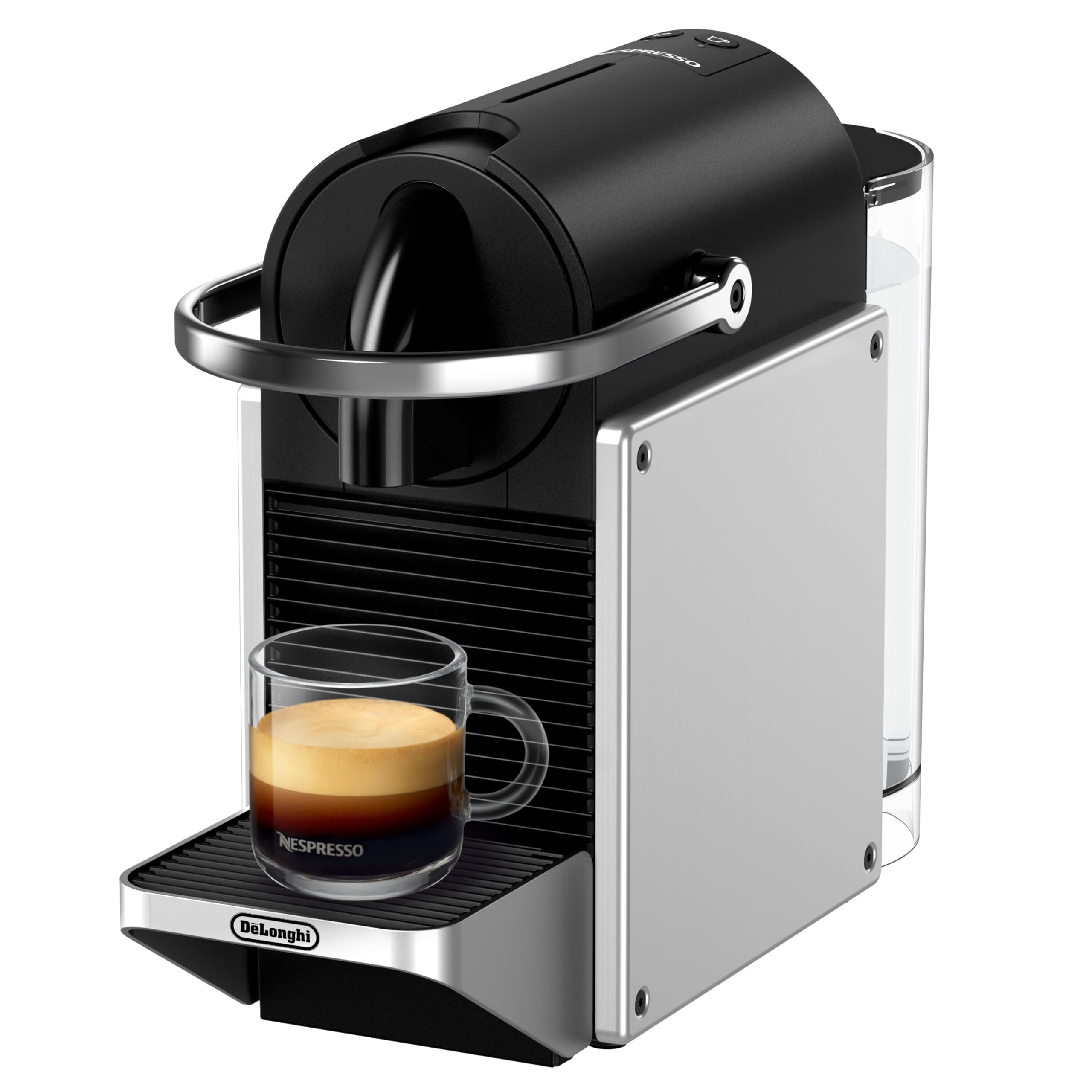
The Pixie EN127.S combines a 19-bar pump with a fast-heating thermoblock that reaches brew temperature in about 25 seconds. Its 1260-watt heating element ensures the water stays in the 90–92°C range throughout the extraction, which is exactly where espresso oils emulsify into a stable crema. The machine’s compact aluminum body measures just 4.6 inches wide, making it the narrowest premium option on this list.
Two programmable buttons let you select espresso (roughly 1.35 oz) or lungo (roughly 3 oz) with automatic flow stop—no need to hover and press stop manually. The 0.7-liter water reservoir holds enough for about 6 cups, and the used-capsule bin stores up to 11 spent pods before needing a trip to the sink. The 9-minute auto-shutoff is aggressive but ensures you never waste power.
What sets this model apart from cheaper alternatives is the build quality: the hammered-metal side panels and sturdy drip tray feel solid, and the thermoblock delivers consistent heat shot after shot. The included welcome set of Nespresso capsules gives you a good starting range to test extraction quality right out of the box.
Why it’s great
- Fast 25-second heat-up with stable 90–92°C brew temp
- Compact 4.6-inch width fits tight counters
- Included Nespresso capsule starter set
Good to know
- Small 0.7L water tank requires frequent refills
- Only compatible with Nespresso Original capsules
2. Nespresso Pixie by Breville, Titan
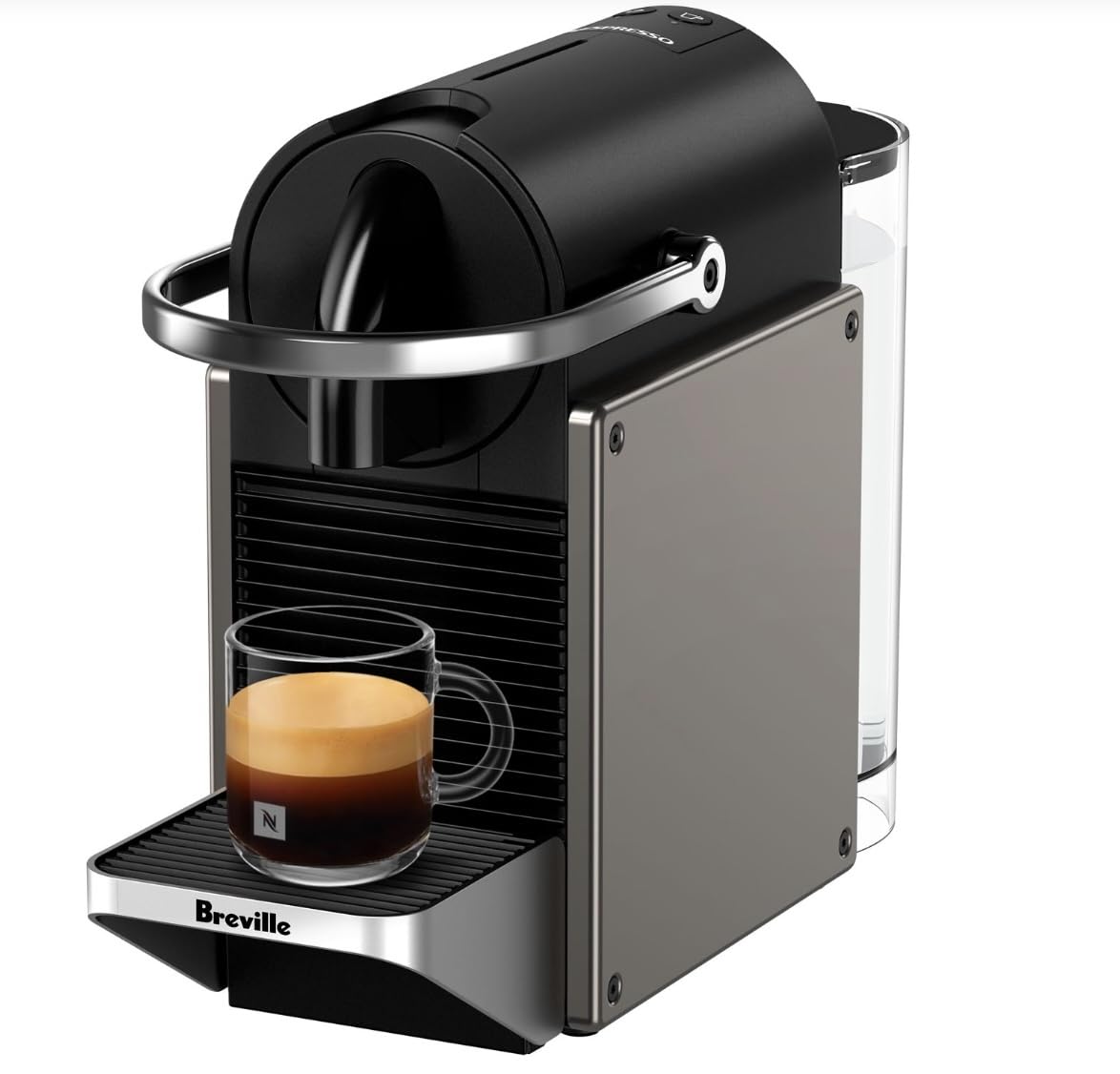
Breville’s version of the Pixie shares the same 19-bar pump and thermoblock heating system as the De’Longhi iteration, with a fast 25-second heat-up and two programmable buttons for espresso and lungo. The Titan finish—a brushed metallic gray—resists fingerprints better than glossy plastics, and the machine’s 6.8-inch depth is slightly deeper than the De’Longhi model, but still small enough for a crowded kitchen corner.
The 0.7-liter tank and 11-capsule bin are identical to the De’Longhi Pixie, which means the same refill rhythm. What tips the scale for some buyers is Breville’s slightly larger drip tray clearance, which accommodates taller cups without removing the tray. The included starter capsule set lets you sample five different Nespresso blends before committing to a full sleeve.
Both Pixie models produce the same extraction quality, so the choice here is mostly about aesthetics and brand preference. The Breville version also has a slightly longer auto-shutoff timer—9 minutes versus the 2-minute timer on the De’Longhi Dark Blue model—which can matter if you tend to step away mid-brew.
Why it’s great
- Consistent 19-bar extraction with fast preheat
- Brushed Titan finish resists fingerprints
- Better cup clearance than some compact rivals
Good to know
- Same small water tank as other Pixie models
- No descaling indicator light
3. Nespresso Pixie by De’Longhi, Dark Blue
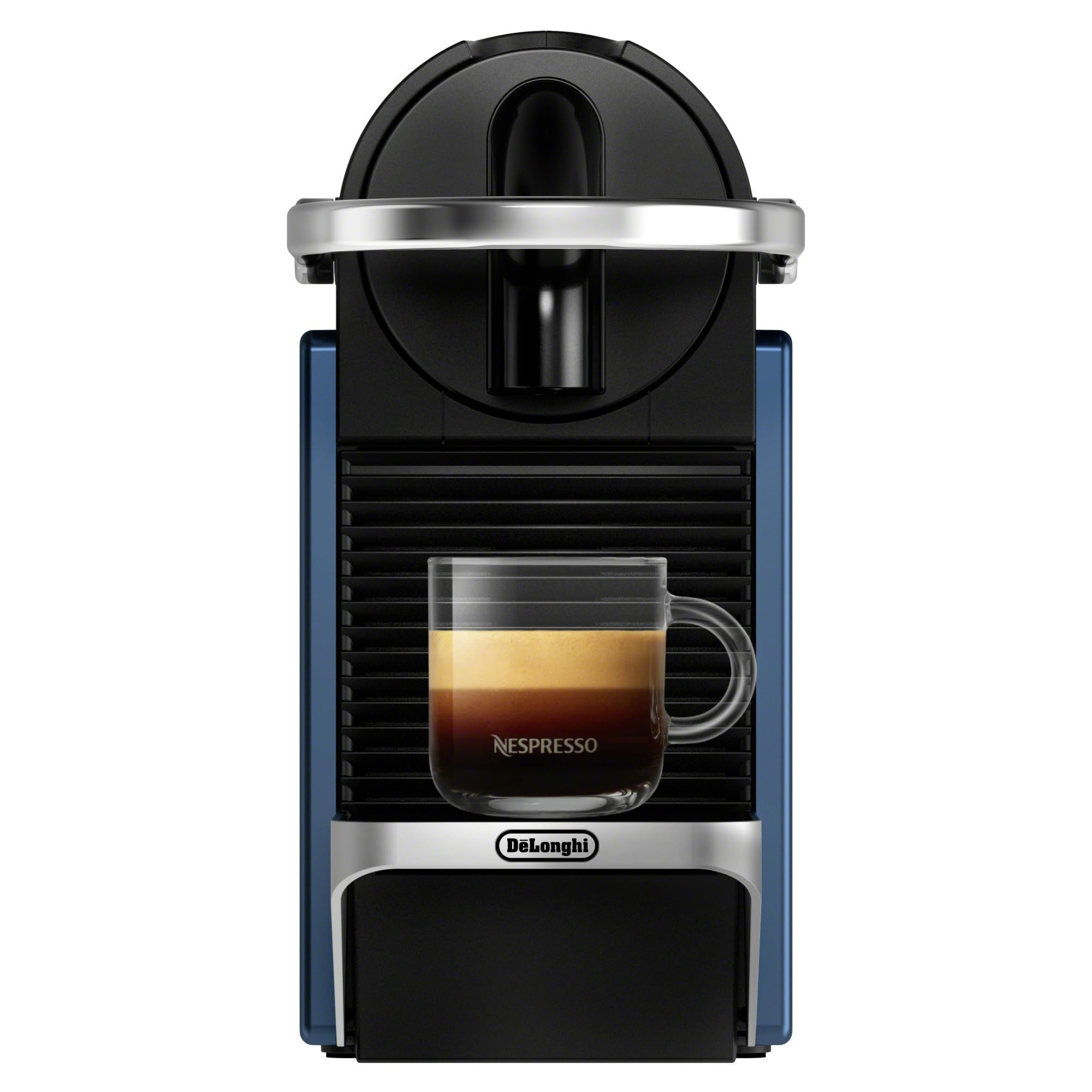
The Dark Blue Pixie stands out visually with its hammered-metal side panels—a textured finish that hides scratches and smudges better than any glossy or brushed surface. Mechanically it’s the same 19-bar, 1260-watt platform as the other Pixie models, with a 0.7-liter tank and two programmable brew buttons. The standout difference here is the 2-minute auto-shutoff timer, which is the most aggressive energy-saving setting among all the machines tested.
For security-conscious users or those who frequently forget to turn off appliances, the 2-minute timeout is a genuine advantage. It activates after the last brew or any button press, so if you walk away after pouring a lungo, the machine powers down in 120 seconds. The trade-off is that if you want a second shot immediately, you’ll need to wait for a 25-second reheat before the next brew cycle.
The build quality matches the industrial look: a solid steel chassis, aluminum top plate, and a drip tray that feels substantial when locking into place. Like all Pixie models, the capsule bin holds 11 used pods and slides out from the front for easy emptying.
Why it’s great
- Hammered metal panels resist scratches well
- 2-minute auto-shutoff for maximum energy savings
- Sturdy, premium build with metal chassis
Good to know
- Short auto-off timer may require frequent restarts
- Same small tank as other Pixie machines
4. Cutesun Mini Espresso Coffee Machine

The Cutesun machine targets crema enthusiasts by explicitly stating a 90–92°C brew temperature and a 19-bar pump that achieves extraction in 35 seconds. The 0.8-liter water tank is slightly larger than the Pixie’s, and the machine supports Nespresso Original capsules along with third-party brands like Bestpresso, Gourmesso, Jones Brothers, and Peet’s—making it the most capsule-flexible option among the standard-pressure machines.
A touchscreen interface controls two programmable sizes: espresso (2 oz) and lungo (4.2 oz). The machine also includes a self-cleaning function that flushes the system when activated, and the auto-shutoff kicks in after 25 minutes of inactivity—far more relaxed than the Pixie’s timer, which suits users who brew multiple shots throughout a morning. The metallic exterior and compact 4-inch width keep it low-profile on any counter.
Where this machine pulls ahead of the CHULUX and beanglass models is its attention to brew temperature accuracy. Most budget pod machines simply heat water to boiling and hope for the best; the Cutesun unit actively targets the 90–92°C sweet spot, which translates to noticeably less bitterness and more balanced acidity shot after shot.
Why it’s great
- Explicit 90–92°C brew temperature for balanced extraction
- Compatible with many third-party capsules
- 0.8L tank is larger than many compact rivals
Good to know
- 25-minute auto-off may be too long for energy purists
- Touchscreen interface may feel less tactile than buttons
5. CASABREWS CM7036E Espresso Machine

CASABREWS’ CM7036E packs a 20-bar pump into an ultra-slim 3.9-inch wide body, making it the narrowest machine in this lineup by a significant margin. The standout feature here is the four programmable brew modes: Ristretto (0.9 oz), Espresso (1.2 oz), Lungo (3.9 oz), and Americano (5.3 oz). That last mode automatically adds hot water after the espresso shot, which saves you a trip to the kettle if you prefer diluted coffee.
The 21-ounce water tank brews roughly 12 single shots before needing a refill, and the 8-capsule bin holds more spent pods than the Pixie’s 11-capacity despite the smaller machine footprint. Preheating takes about 25 seconds, and the machine includes an automatic descaling reminder that alerts you when mineral buildup starts affecting flow—a feature absent from most entry-level and mid-range pod machines.
One trade-off: the CM7036E is slightly deeper at 12.5 inches, so while it slides into tight horizontal spaces, it needs more counter depth than the CHULUX or beanglass models. The plastic body feels less premium than the Pixie’s metal construction, but the brew consistency and four-size flexibility make it a strong pick for households where different drinkers want different volumes.
Why it’s great
- Four brew sizes including an Americano mode
- Automatic descaling reminder extends machine life
- Ultra-narrow 3.9-inch footprint
Good to know
- 12.5-inch depth requires more counter space
- Plastic construction feels less durable than metal
6. Divinocaffé 3-in-1 Espresso Maker
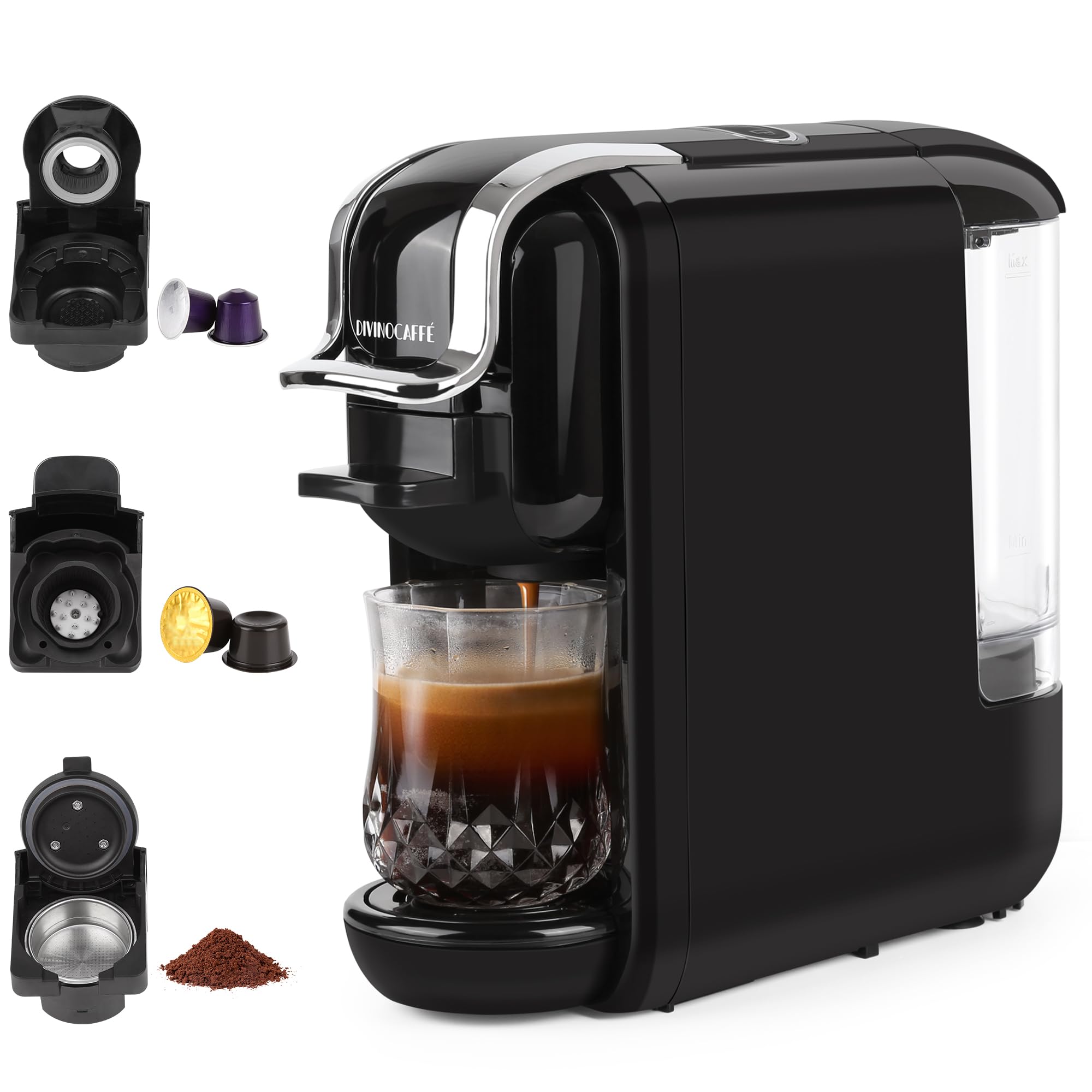
The Divinocaffé 3-in-1 is the only machine on this list that accepts three capsule types—Nespresso Original, Lavazza Blue, and Lavazza Expert—plus ground coffee via a reusable filter basket. That level of flexibility means you’re not locked into a single pod ecosystem, which is rare in this category. The 19-bar pump and 1450-watt boiler deliver consistent pressure for all formats, and the 1.2-liter removable water tank is the largest reservoir among the machines reviewed here.
Brewing with capsules is straightforward: insert the pod, press the button for espresso or lungo, and the machine produces a shot in roughly 30 seconds. The ground-coffee option requires a bit more effort—fill the basket, tamp lightly, and lock it in place—but it opens the door to freshly ground beans, which can dramatically improve flavor compared to pre-filled capsules. The glossy black finish is prone to fingerprints, but the overall build feels solid for its price tier.
Two practical downsides: the machine is wider than the slim CHULUX or CASABREWS units, and the included reusable filter is basic rather than precision-machined. If you plan to use ground coffee regularly, consider upgrading to a finer-mesh basket for better extraction. For users who want one machine that handles Nespresso, Lavazza, and their own beans, this is the most versatile option available.
Why it’s great
- Works with Nespresso, Lavazza Blue, and ground coffee
- Largest 1.2L water tank in this comparison
- 19-bar pump handles all three capsule types
Good to know
- Wider footprint than single-system machines
- Reusable filter basket could be higher quality
7. CHULUX Compact Espresso Machine, Mystic Gray
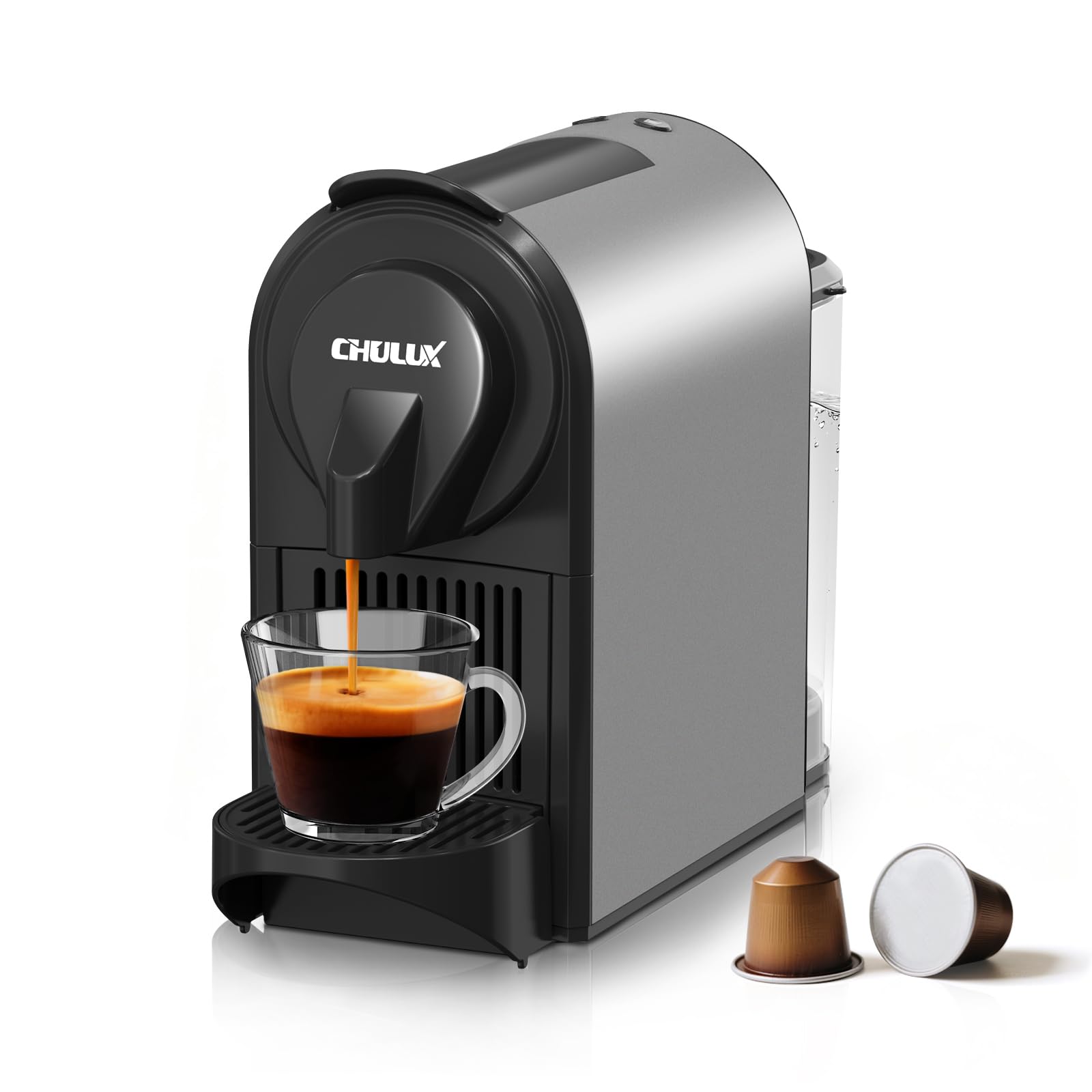
CHULUX’s compact model squeezes a 20-bar pump and 1400-watt heating into a 4.57-inch-wide body with a 24-ounce water tank that brews 6 to 17 cups depending on your size selection. The machine offers two brew modes—espresso and lungo—controlled by two simple buttons. Preheating takes 15 to 20 seconds, and the capsule drawer holds up to 15 used pods before needing to be emptied.
The Mystic Gray plastic body is lightweight at 6.17 pounds, making it easy to slide out from under a cabinet for refills. The foldable drip tray accommodates taller travel mugs, and the removable water tank, drip tray, and capsule container are all dishwasher-safe for easy maintenance. The auto-shutoff activates after 5 minutes of inactivity, which is a sensible balance between energy saving and usability.
Compared to the CASABREWS CM7036E, this CHULUX model lacks the four brew sizes and descaling alerts, but it matches the 20-bar pressure and offers a slightly larger water tank. The build uses more plastic than the Pixie machines, but at this price point the trade-off is expected. For a compact, no-fuss pod machine that delivers consistent crema, this is a solid entry-level pick.
Why it’s great
- 20-bar pump delivers thick crema in 20 seconds
- Dishwasher-safe removable parts simplify cleaning
- Holds 15 used capsules before emptying
Good to know
- Plastic build lacks premium feel
- Only two brew sizes compared to rivals
8. CHULUX Upgrade Bafè-Pro Espresso Machine
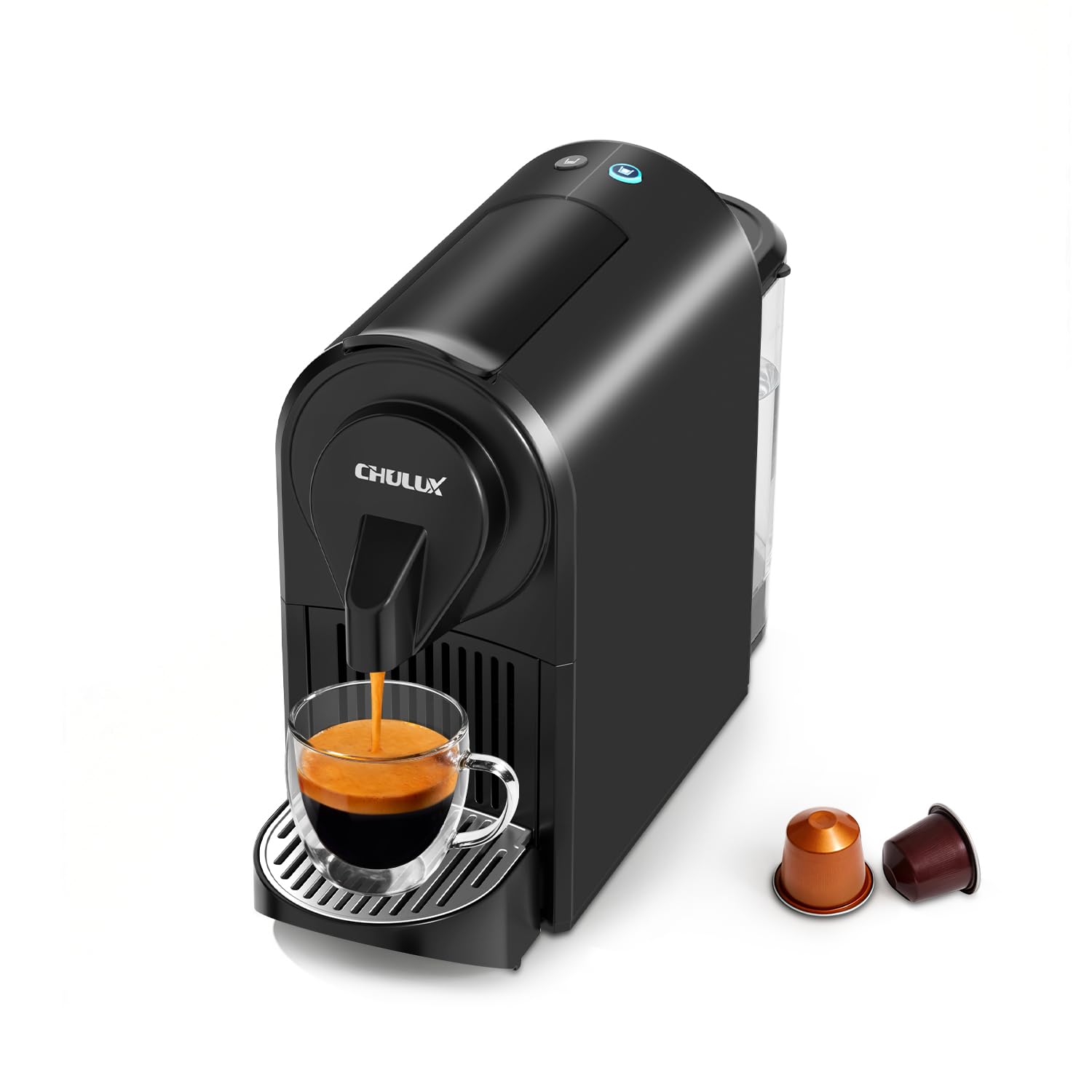
The Bafè-Pro upgrade retains the same 20-bar, 1400-watt platform as the standard CHULUX but adds an auto-eject feature for used capsules: after brewing, the spent pod drops into a dedicated drawer, so you don’t have to lift the lever and manually eject it. That small convenience saves time during back-to-back brews and keeps the capsule area cleaner.
The 24-ounce water tank, 5-minute auto-shutoff with overheat protection, and dishwater-safe drip tray and capsule container are identical to the standard CHULUX model. The machine reaches preheat temperature in 15 to 20 seconds and brews a full espresso in about one to two minutes, depending on the selected size. The foldable drip tray accommodates taller cups, and the compact footprint at 13.94 inches deep by 4.57 inches wide is similar to the standard version.
The key difference between this and the standard CHULUX is the auto-eject mechanism. If you brew multiple espressos in quick succession, the Bafè-Pro saves you maybe 5 seconds per shot, but over a busy morning that adds up. The plastic build and simple two-button interface are the same, so the extra cost goes entirely toward that convenience feature.
Why it’s great
- Auto-eject capsule drawer for faster cleanup
- 20-bar pressure with 1400W rapid heating
- Overheat protection and energy-saving auto-off
Good to know
- Higher cost for same basic platform as standard CHULUX
- Plastic construction still feels budget-level
9. beanglass Espresso Pod Machine

The beanglass machine weighs only 5.7 pounds, making it the lightest unit in this comparison. Its 20-bar pump and 1350-watt heating element produce acceptable crema, though at a slightly slower 35-second brew time compared to the CHULUX and CASABREWS units. The 22-ounce water tank is mid-sized, and the used-pod container holds 9 to 11 capsules before needing emptying.
Two programmable buttons offer espresso and lungo modes, each adjustable for personal preference. The compact curved body measures 13 inches deep by 4.5 inches wide and fits easily into small kitchens, dorm rooms, or office break areas. The auto-shutoff timer is set to 30 minutes, which is the longest among all the machines—great for users who step away frequently but less ideal for those focused on energy conservation.
The beanglass lacks the descaling alerts, multiple brew sizes, or auto-eject features found on other machines. It’s a straightforward, no-extra-features pod brewer that gets the job done for someone who wants a basic espresso without complexity. The plastic build is comparable to the CHULUX models, but the slightly lower wattage results in a marginally slower heating cycle.
Why it’s great
- Lightweight 5.7 pounds for easy moving
- 20-bar pump produces decent crema
- Compact curved design fits small counters
Good to know
- 30-minute auto-off timer may waste energy
- Slower 35-second preheat than competitors
FAQ
Can I use any brand of capsule in a Nespresso Original machine?
Why does my espresso look watery with a new pod machine?
How often should I descale my espresso pod machine?
What is the difference between a thermoblock and a boiler in a pod machine?
Final Thoughts: The Verdict
For most users, the espresso pod machine winner is the De’Longhi Nespresso Pixie EN127.S because it combines a consistent 19-bar pump, rapid 25-second heat-up, and premium metal construction in the most compact footprint available. If you want four programmable brew sizes including Americano mode, grab the CASABREWS CM7036E. And for multi-capsule flexibility plus ground coffee capability, nothing beats the Divinocaffé 3-in-1 Espresso Maker.