The surface your knife meets dictates the lifespan of its edge. An end grain cutting board, built from vertically aligned wood fibers, absorbs blade impact instead of resisting it, preserving sharpness while its structure self-heals from shallow cut marks. For serious cooks, this is the difference between replacing cutlery annually and keeping an edge razor-sharp for years.
I’m Mohammad Maruf — the founder and writer behind AirfryerBite. I’ve analyzed hundreds of cutting board constructions, comparing wood density, grain orientation, glue bond integrity, and oil finishes to determine which end grain builds deliver true durability without dulling your kitchen knives.
Whether you’re breaking down whole roasts, prepping delicate herbs, or presenting a charcuterie spread, the right foundation matters. This guide isolates the best end grain cutting board based on measurable specs that protect your blades and withstand daily use.
How To Choose The Best End Grain Cutting Board
Selecting an end grain board requires balancing dimensional stability, wood hardness, and maintenance commitment. These parameters directly affect how the board performs under heavy chopping and how long the surface remains smooth and flat.
Board Thickness and Warping Resistance
A board thinner than 1.5 inches risks cupping or bowing as it absorbs and releases ambient moisture. Thicker slabs, in the 1.5-to-1.7-inch range, distribute impact forces more evenly and resist dimensional change. Heavier boards also stay planted on the counter without shifting during aggressive cuts.
Wood Species Hardness and Grain Density
Walnut offers a Janka hardness around 1,010 lbf — soft enough to be gentle on edges yet dense enough to resist deep scoring. Acacia is harder at roughly 1,750 lbf, making it more scratch-resistant but slightly less forgiving on blade steel. Teak sits near 1,000 to 1,155 lbf and brings natural oils that resist moisture absorption, reducing the oiling frequency.
Juice Groove Depth and Layout
Boards used for meat or juicy fruit benefit from a groove that holds at least 3 to 4 fluid ounces. Shallow channels overflow quickly, defeating the purpose. Grooves set close to the edge maximize the usable flat surface, while those positioned further inward limit the chopping area.
Finish and Maintenance Requirements
Pre-oiled boards with linseed, beeswax, or mineral oil finishes are ready for immediate use. Unfinished boards require an initial conditioning cycle. Walnut and acacia boards typically need oiling every 3 to 4 weeks depending on climate and wash frequency. Teak’s natural oil content extends that interval significantly.
Quick Comparison
On smaller screens, swipe sideways to see the full table.
| Model | Category | Best For | Key Spec | Amazon |
|---|---|---|---|---|
| Sonder Los Angeles Alfred | Premium | Sorting compartments & pro-grade build | 1.5 in thick, 3.5 fl oz groove | Amazon |
| BABILONIA Black Walnut | Premium | Extra-thick 1.7 in stability | 1.7 in thick, includes oil & plate | Amazon |
| Yes4All Teak | Mid-Range | Teak’s natural moisture resistance | 1.5 in thick, 20 x 15 in surface | Amazon |
| Cozifa Dark Walnut | Mid-Range | Gift-ready packaging & reversible design | 1.6 in thick, linseed oil finish | Amazon |
| HOMESTEAD Acacia | Mid-Range | Extra-large 23 x 18 in surface area | 1.5 in thick, acacia wood build | Amazon |
| Ironwood Gourmet Carolina | Mid-Range | Heirloom-quality acacia construction | 1.5 in thick, 14 x 14 in square | Amazon |
| Artistic Chef’s Kitchen Walnut | Budget | Artistic 3D pattern & compact size | 0.75 in thick, 15 x 11 in | Amazon |
In‑Depth Reviews
1. Sonder Los Angeles Alfred Cutting Board
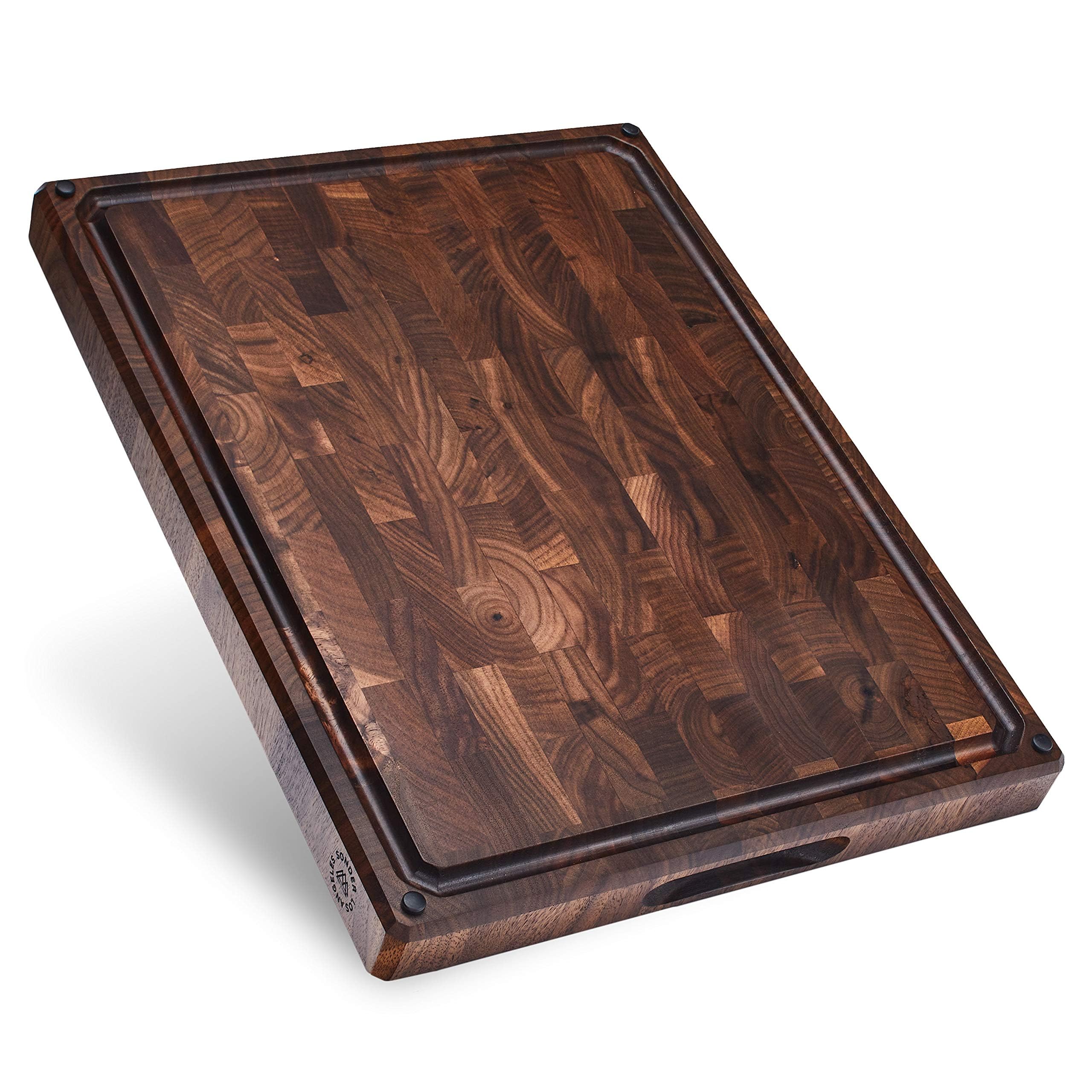
Three built-in sorting compartments distinguish this American black walnut board from conventional flat slabs. The deep wells let you stage diced onions, minced garlic, and chopped herbs side by side while the 1.5-inch end grain construction absorbs each knife stroke. Rubber feet hold the board steady even during heavy cleaving, and the front-side juice groove holds roughly 3.5 fluid ounces — enough for a whole roasted chicken’s runoff.
Walnut’s tight grain at roughly 1,010 lbf Janka hardness strikes the right balance: soft enough to prevent edge roll but dense enough to resist deep gashes from daily chopping. The self-healing property of end grain fibers means surface marks close up after washing and oiling, so the board maintains a smooth appearance longer than edge grain alternatives. The included gift box adds a premium unboxing experience for gifting.
Maintenance requires hand washing and oiling every three weeks. The board arrives pre-conditioned, so it is ready for immediate use. For cooks who value workflow organization alongside blade preservation, the three-well layout eliminates the need for separate prep bowls.
Why it’s great
- Three sorting compartments streamline mise en place
- Deep 3.5 fl oz juice groove prevents counter spills
- American black walnut offers ideal balance of hardness and edge protection
- Removable non-slip feet add stability
Good to know
- Requires oiling every three weeks per manufacturer recommendation
- Compartments reduce usable flat cutting area compared to a solid slab of same dimensions
2. BABILONIA American Black Walnut Cutting Board
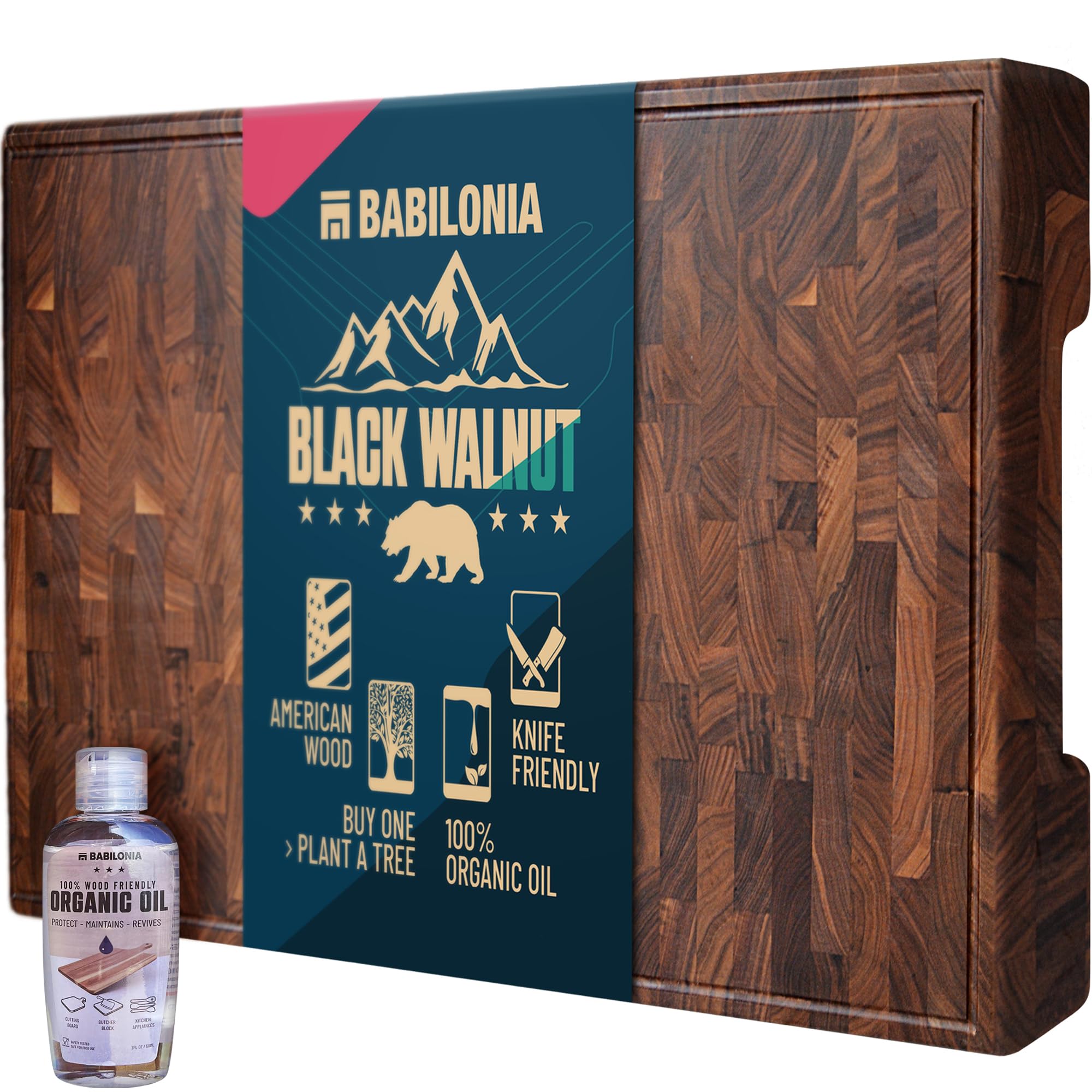
At 1.7 inches thick, this board sits firmly in the heavy-duty category where warping is virtually eliminated by sheer mass. The end grain construction uses 100% American black walnut sourced in the United States, finished with a food-grade oil that is ready for contact immediately out of the box. A slide-out plate and notch let you sweep chopped produce directly into a bowl or pot without lifting the board.
The reversible design offers a juice groove on one side for meat prep and a flat surface on the reverse for pastry or serving duty. An included organic conditioning oil bottle extends the life of the board between manual oiling sessions. The 8.8-pound weight keeps the board planted without rubber feet, though some users prefer adding a damp paper towel under the board for extra grip on smooth countertops.
BABILONIA backs this unit with a two-year warranty and money-back guarantee. For cooks who want a thick foundation that resists moisture ingress over years of heavy use, the 1.7-inch slab provides peace of mind that thinner boards cannot match.
Why it’s great
- Extra-thick 1.7-inch slab resists warping long-term
- Included oil bottle and stainless steel plate add value
- Reversible surface expands prep options
- 2-year warranty backs the purchase
Good to know
- No non-slip feet — may shift on polished stone counters
- Heavy at 8.8 pounds, less portable for frequent moving
3. Yes4All Large Teak Cutting Board

Teak’s naturally high oil content reduces water absorption, making this board less demanding in maintenance compared to walnut or acacia equivalents. The end grain construction at 1.5 inches thick provides the same blade-protecting vertical fiber orientation, while the 20-by-15-inch surface area accommodates large-scale prep — whole briskets, multiple watermelons, or full sheet-pan quantities of vegetables.
Built-in handles cut into the edges simplify lifting and carrying, and the deep juice groove captures runoff from juicy fruits and meats. Teak’s Janka hardness of roughly 1,000 to 1,155 lbf means the surface is gentle on knife edges without being too soft to sustain frequent heavy chopping over years. The board is handcrafted, so each piece shows unique grain patterns and color variations.
Because teak naturally resists moisture and microbial growth, the board does not require oiling as frequently as walnut. Washing and drying promptly after each use remains the primary care routine. For buyers who prefer lower maintenance without sacrificing end grain performance, teak’s innate properties deliver a practical advantage.
Why it’s great
- Teak’s natural oils reduce required oiling frequency
- Large 20 x 15-inch surface handles big prep jobs
- Deep juice groove and integrated handles
- Gentle on knife edges while durable against deep scoring
Good to know
- Teak is slightly harder than walnut, may cause marginally more blade wear over very long periods
- Natural oil content can occasionally cause minor surface stickiness if over-oiled
4. Cozifa American Dark Walnut Cutting Board
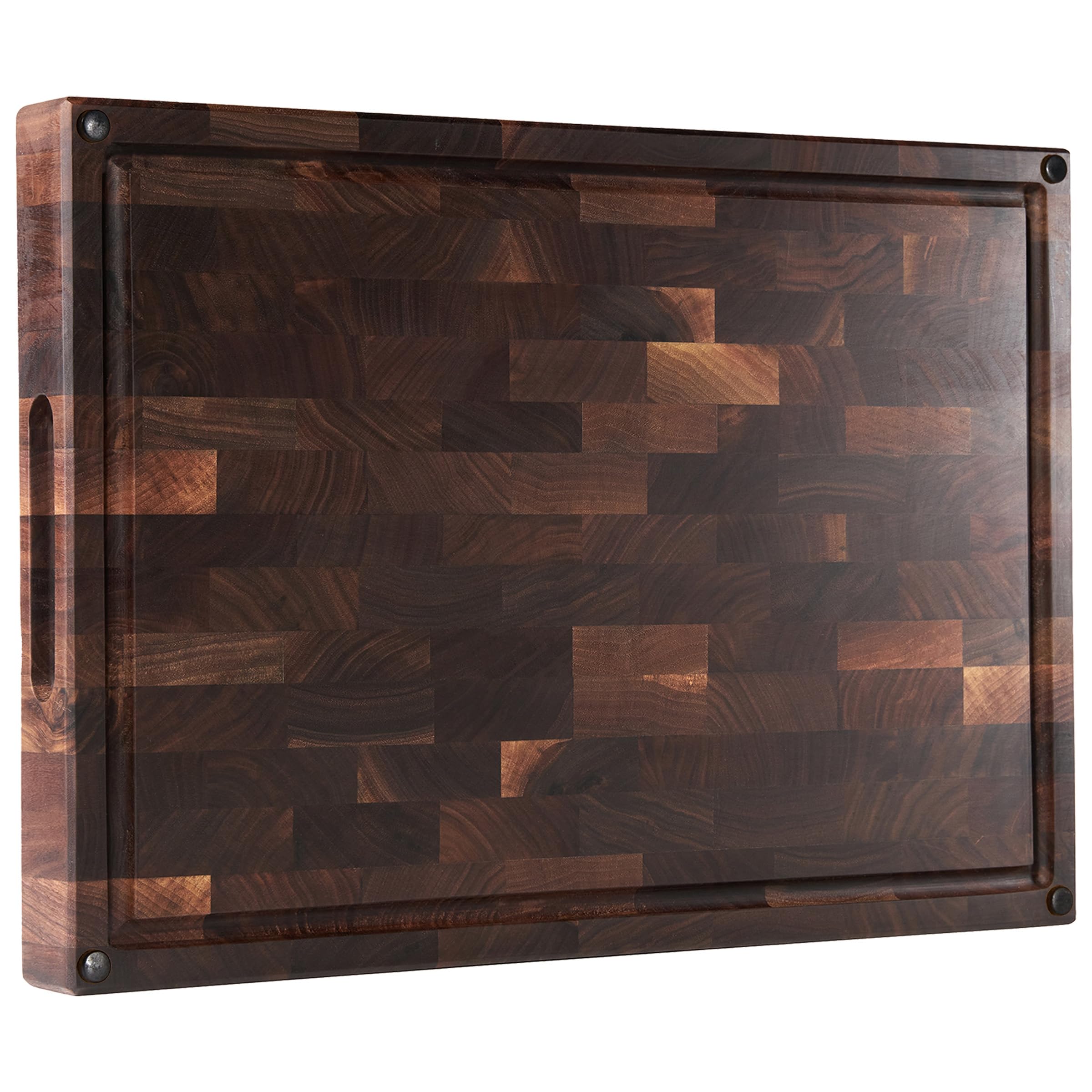
This board arrives finished with linseed oil, beeswax, and carnauba wax, creating a smooth, water-resistant surface that requires no initial conditioning. The 1.6-inch thickness places it above the common 1.5-inch standard, adding extra mass for stability and warp resistance. The dark walnut color with visible grain patterns gives it a furniture-grade appearance suitable for table-side serving.
The reversible design features a deep juice groove on one side and a completely flat surface on the reverse, letting you switch between meat prep and charcuterie presentation. Built-in handles cut into the sides make carrying comfortable, and the board fits inside the included gift box, making it a strong option for housewarming or wedding gifts. The 7.7-pound weight feels substantial without being unmanageable.
Cozifa offers a one-year replacement warranty for manufacturing defects. The board requires hand washing and oiling one to two times per month. For buyers seeking a finished, presentation-ready board that can double as a serving piece, the linseed-beeswax treatment eliminates the break-in period.
Why it’s great
- Pre-finished with linseed oil, beeswax, and carnauba wax
- Reversible design with groove and flat sides
- Gift box packaging included
- 1.6-inch thickness resists warping
Good to know
- Grain pattern varies between units due to natural walnut
- Requires monthly oiling despite initial wax finish
5. HOMESTEAD End Grain Acacia Cutting Board
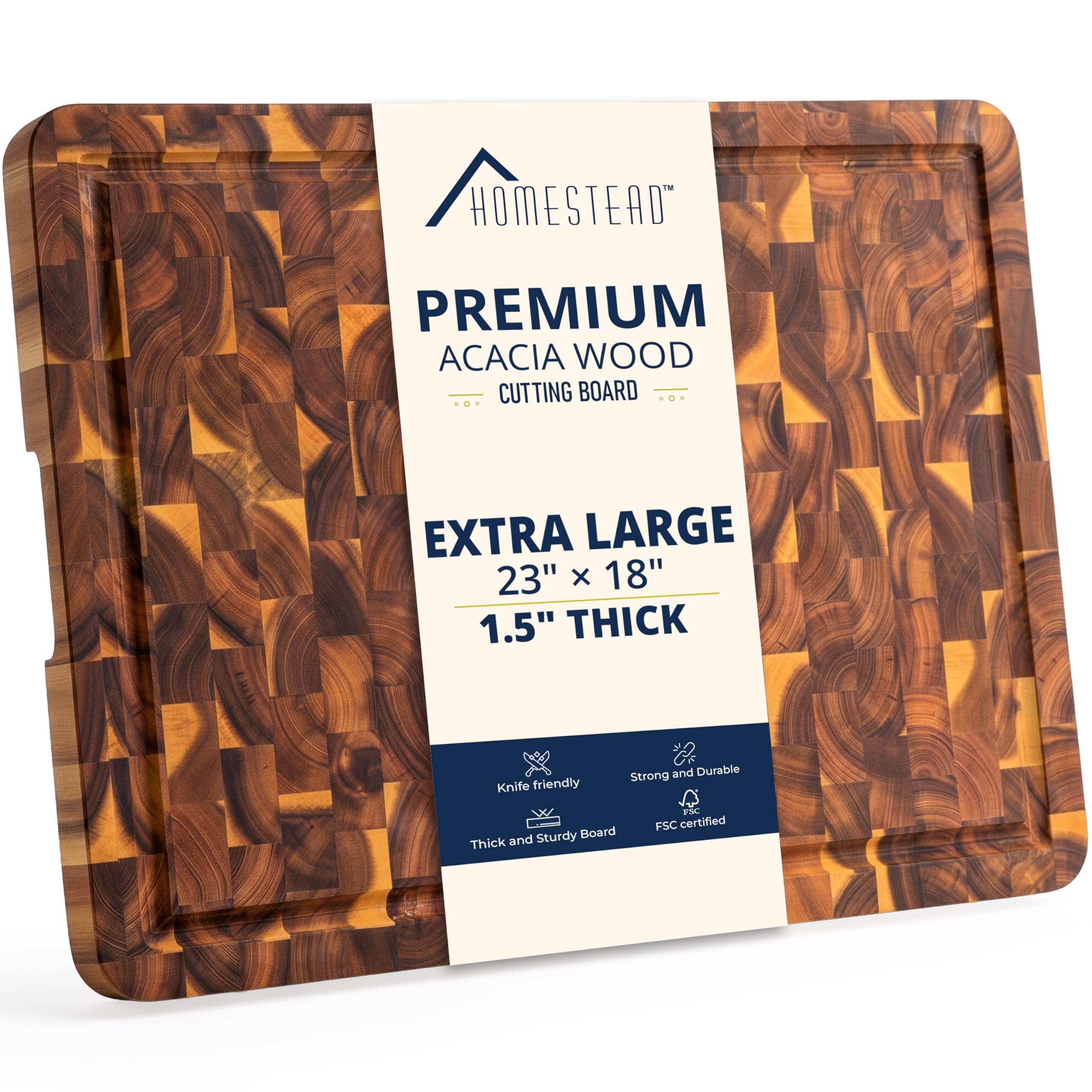
The 23-by-18-inch surface area is the largest in this selection, providing enough room to break down a full brisket or prep a holiday feast without crowding. The end grain acacia construction at 1.5 inches thick keeps the board stable under heavy loads, and the interlocking fiber structure absorbs impact from cleavers and heavy chopping knives. Acacia’s Janka hardness around 1,750 lbf makes it more scratch-resistant than walnut, though slightly less forgiving on blade edges over extended use.
A deep juice groove runs near the perimeter to catch drippings from meat and fruit, while integrated side handles make lifting this sizable board manageable. The board can double as a large serving platter for bread, cheese, or charcuterie when guests are around. The natural acacia color variations — ranging from light golden to medium brown — add visual interest to the countertop.
Care requires hand washing and occasional food-grade mineral oil application. The board is not dishwasher safe. For kitchens that regularly process large quantities of meat or vegetables, the 23-by-18-inch real estate reduces the need to shuffle ingredients between multiple prep zones.
Why it’s great
- Largest surface area at 23 x 18 inches
- Acacia is scratch-resistant and durable
- Deep juice groove prevents counter mess
- Side handles simplify moving the heavy board
Good to know
- Acacia’s higher hardness may accelerate blade dulling compared to walnut
- Board requires significant counter space to store or use
6. Ironwood Gourmet Carolina Acacia Chopping Board

The square 14-by-14-inch format offers an unusual symmetrical workspace that fits well on narrow counters or islands. End grain acacia construction at 1.5 inches provides the same knife-friendly vertical fiber orientation as the larger boards, while the checkered pattern from the end grain layout adds visual depth. The juice groove surrounds the perimeter to catch runoff during meat slicing.
Customer feedback highlights five years of regular use with the board maintaining structural integrity and appearance. The acacia wood shows rich contrasting light-to-dark grain patterns that darken slightly over time with oiling. Ironwood Gourmet has received specific praise for responsive customer service regarding board care questions.
This board is best suited for home cooks who want heirloom-quality construction in a manageable format. The square shape works well for both prep and serving, and the 1.5-inch thickness provides sufficient mass for stability without dominating the countertop. Hand washing and periodic mineral oil application keep the surface conditioned.
Why it’s great
- Square 14 x 14-inch shape fits tight counter spaces
- Proven long-term durability from customer feedback
- Rich acacia grain patterns with contrasting colors
- End grain construction protects knife edges
Good to know
- 14 x 14 inches may feel small for large roasts or multiple ingredient prep
- Acacia is harder than walnut, slightly less gentle on blades
7. Artistic Chef’s Kitchen End Grain Walnut Cutting Board

This 0.75-inch-thick board ranks as the thinnest option in the selection but compensates with a striking three-wood pattern made from walnut, ebony, and beech. The checkered 3D-like pattern turns a utilitarian surface into a visual centerpiece, and the four non-slip rubber feet prevent shifting during use. Side handles make the lightweight board easy to carry from kitchen to table.
The 15-by-11-inch size suits small kitchens, apartment counters, or serving charcuterie for smaller gatherings. The board is handcrafted, so each piece has unique grain arrangement. The thin profile, while visually appealing, reduces the board’s long-term resistance to warping compared to the 1.5-inch-plus competitors, and heavy chopping may produce more noise and vibration due to the reduced mass.
Care requires hand washing and avoidance of dishwasher or soaking. The board should be oiled monthly with food-grade mineral oil. For buyers who prioritize aesthetics and compact storage over heavy daily chopping, the 3D pattern offers a decorative option that still uses genuine end grain construction.
Why it’s great
- Unique three-wood 3D pattern is visually distinct
- Non-slip rubber feet improve stability
- Compact size suits small kitchens or serving duty
- Lightweight with easy-carry side handles
Good to know
- 0.75-inch thickness is prone to warping in humid conditions
- Thin profile transmits more impact to countertop during heavy chopping
FAQ
How often should I oil my end grain cutting board?
Can end grain boards handle cleaver use without splitting?
What is the difference between end grain and edge grain cutting boards?
Final Thoughts: The Verdict
For most users, the best end grain cutting board winner is the Sonder Los Angeles Alfred because its three sorting compartments, deep juice groove, and American black walnut construction balance professional-grade organization with blade protection. If you want a heavy, warp-resistant foundation with extra thickness, grab the BABILONIA Black Walnut Board. And for a low-maintenance teak option with natural moisture resistance, nothing beats the Yes4All Teak Cutting Board.