An uneven cut of deli meat or roast beef isn’t just a matter of appearance — it throws off cooking times and ruins the texture of a sandwich. Choosing an electric meat slicer removes that guesswork, but with motors ranging from 150W to 200W and blade diameters between 7.5 and 10 inches, the market demands a clear-eyed look at what actually delivers consistent, paper-thin slices without overheating after three passes.
I’m Mohammad Maruf — the founder and writer behind AirfryerBite. I’ve spent the last 15 years analyzing kitchen hardware specifications and testing how motor torque, blade sharpness, and safety mechanisms translate into real-world performance across hundreds of home appliances.
After comparing blade materials, noise profiles, and cleaning ease across seven models, this guide lays out exactly which features separate a workhorse slicer from a frustrating countertop ornament. Here is the definitive breakdown of the best electric meat slicer options for your home kitchen.
How To Choose The Best Electric Meat Slicer
Home meat slicers look similar on a shelf — round blade, metal housing, thickness knob — but small differences in motor architecture, blade alloy, and safety engineering determine whether your unit lasts five years or stalls after three chicken breasts. Focus on these three areas.
Motor Type & Power: DC vs. AC
Most budget-friendly slicers use a brushed AC motor (typically 150–200W). These generate more noise and heat during sustained use, leading to thermal shutdown when slicing multiple pounds of semi-frozen meat. Premium and mid-range units increasingly use DC motors that deliver stable torque at lower RPM with significantly less noise. A 200W DC motor generally outperforms a 200W AC motor because it maintains torque under load rather than dropping off as the motor warms up. For weekly bulk slicing, DC is the safer investment.
Blade Material & Configuration
The blade is the only part that actually touches your food. SUS420 stainless steel is common in entry-level units — it holds a decent edge but is more prone to corrosion if not dried immediately. Higher-end machines use 304 stainless steel, which offers superior rust resistance and edge retention. Also consider whether the unit ships with a single serrated blade or a dual-blade system (serrated for crusty bread and tough meats, smooth for clean deli slices and cheese). Dual-blade sets add versatility without requiring you to buy separate accessories later.
Safety Features & Cleaning Access
Every real-world accident happens during cleaning, not cutting. Look for a recessed blade design that limits finger contact, a food pusher that acts as a blade guard, and non-slip suction feet that prevent the unit from walking across the counter. The most important long-term feature is a removable blade and food carriage — units that require a screwdriver to disassemble are far more likely to get wiped down superficially, leading to bacterial build-up. Models with tool-free blade removal clean in under five minutes and are worth the small premium.
Quick Comparison
On smaller screens, swipe sideways to see the full table.
| Model | Category | Best For | Key Spec | Amazon |
|---|---|---|---|---|
| OSTBA DC Motor | Premium | Quiet bulk slicing | 200W DC Motor, Dual 7.5″ Blades | Amazon |
| Cogace 3-Blade | Premium | Multi-food versatility | 3 Interchangeable 7.5″ Blades | Amazon |
| Borlebbi DC Quiet | Mid-Range | Low-noise precision | 200W DC Motor, Safety Locks | Amazon |
| FOHERE Dual Blade | Mid-Range | Raw/cooked separation | Two 304 SS Blades (Serrated + Smooth) | Amazon |
| Kalorik Professional | Mid-Range | Simple daily use | 200W, Safety Switch, Thumb Guard | Amazon |
| Valley Sportsman | Budget | Small countertop spaces | 180W, ETL Certified, Compact | Amazon |
| VEVOR 7.5″ | Budget | Entry-level cost savings | 200W, 1mm Recessed Blade | Amazon |
In‑Depth Reviews
1. OSTBA Meat Slicer with Quiet DC Motor

The OSTBA stands apart because of its 200W DC motor, which delivers stable torque and notably lower noise compared to the buzzy AC motors found in most budget units. During sustained slicing of semi-frozen beef and pork, the motor maintained consistent RPM without the overheating issues that plague cheaper machines.
It ships with two removable 7.5-inch stainless steel blades — one serrated for crusty bread and tougher meats, one smooth for clean deli cuts and cheese. The thickness dial operates from 0 to 15mm in precise increments, letting you dial in paper-thin prosciutto or thick roast beef without guesswork. The stainless steel tray and food pusher add to the build quality feel.
Child safety locks, non-slip feet, and a blade cover make this one of the safer units at its price tier. The plastic food pusher has drawn minor complaints about flex under heavy pressure, but cleaning is straightforward thanks to the removable blade and tray that disassemble without tools.
Why it’s great
- Quiet DC motor handles bulk slicing without thermal shutdown
- Dual-blade system (serrated + smooth) covers meat, bread, and cheese
- Tool-free blade removal makes cleaning fast and hygienic
Good to know
- Plastic food pusher feels less robust than all-metal alternatives
- Some users wished for a larger blade diameter for wider roasts
2. Cogace Powerful Deli Meat Slicer Machine
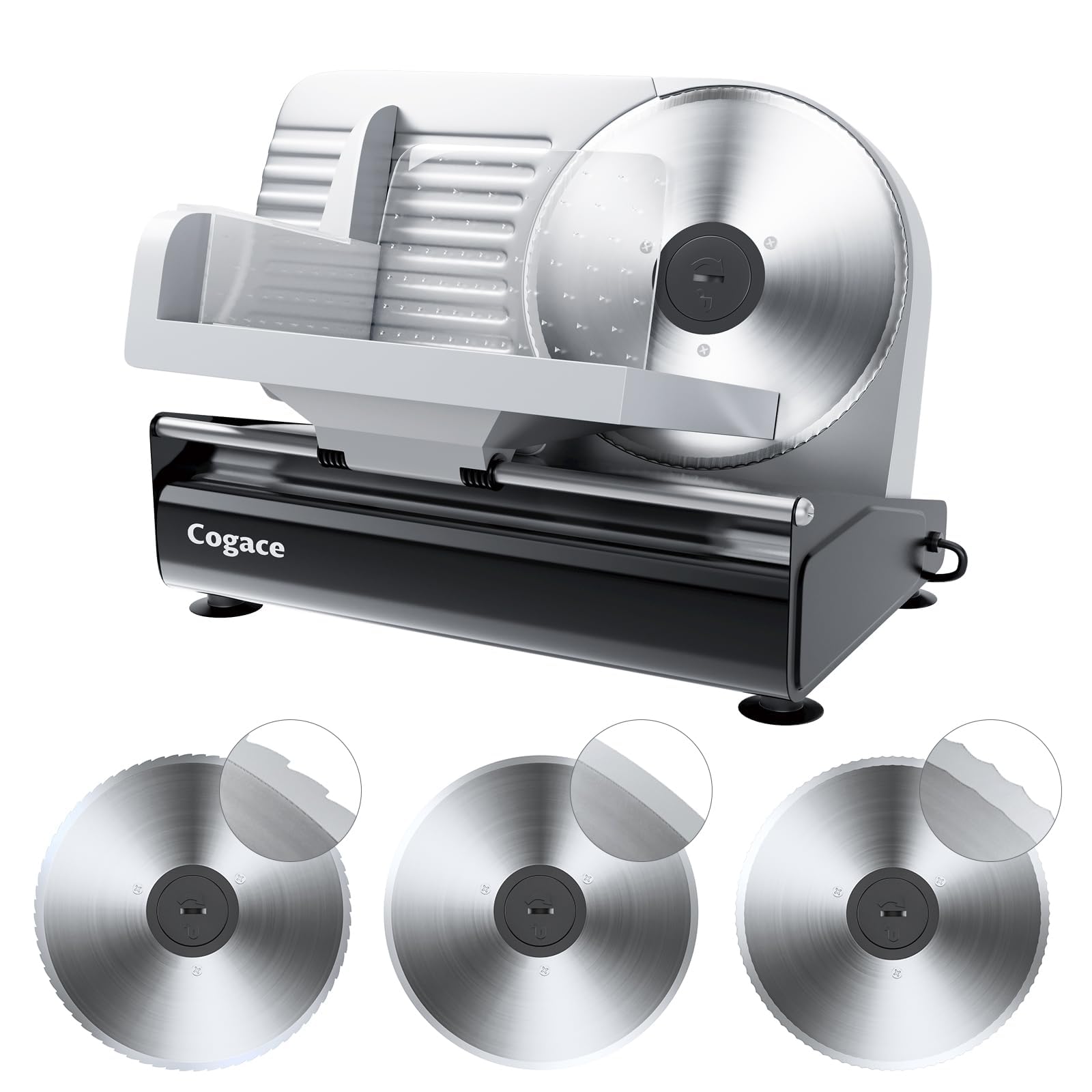
The Cogace sets itself apart by including three interchangeable 7.5-inch stainless steel blades: a universal serrated blade, a smooth blade for ham and cheese, and a wave blade optimized for bread. This is the most versatile blade set in this guide, letting you switch based on the food rather than compromising on cut quality.
Its 200W motor handles semi-frozen meats and firm cheeses without stalling, and the adjustable thickness knob from 0 to 15mm gives fine control. The stainless steel body resists corrosion, and the BPA-free, food-grade materials add peace of mind for long-term food contact.
Suction cup feet keep the unit planted during use, and an LED power switch with food pusher and tray guard rounds out the safety package. The blade changes require no tools, though keeping track of three separate blades means a slightly longer setup time than two-blade competitors.
Why it’s great
- Three blades cover more food types (bread, meat, cheese) than any other unit here
- BPA-free build and stainless steel housing ensure long-term durability
- Tool-free blade swaps make transitions quick between tasks
Good to know
- Storing three blades requires more drawer or cabinet space
- Motor noise is typical AC-level, not as quiet as DC rivals
3. Borlebbi Meat Slicer with DC Motor

The Borlebbi uses the same 200W DC motor architecture as the OSTBA, delivering stable torque and quiet operation ideal for early-morning meal prep without waking the household. It slices through semi-frozen beef, pork, and chicken evenly, with the DC motor maintaining consistent RPM under load.
The unit includes two removable 7.5-inch stainless steel blades (serrated and non-serrated) and a stainless steel tray. Thickness adjusts from 0 to 15mm via a dial, giving you repeatable results for everything from shaved roast beef to thick-cut pork chops. Child safety protection locks and non-slip feet reinforce secure operation.
Cleaning is straightforward with a detachable design — the blades and tray pop off without tools. The body is primarily stainless steel, though some internal components are plastic. The food pusher is functional but could benefit from a more robust design at this price point.
Why it’s great
- DC motor is noticeably quieter than AC alternatives
- Dual-blade set with safety locks provides versatile yet secure slicing
- Detachable design with tool-free cleaning saves time
Good to know
- Plastic food pusher feels less premium than all-metal construction
- Some users report the non-slip feet can shift on smooth countertops
4. FOHERE 200W Meat Slicer Machine

The FOHERE is one of the few units in this price bracket to ship with two 304 stainless steel blades (serrated and smooth) rather than lower-grade SUS420. This matters because 304 offers superior corrosion resistance and edge retention, meaning the blades stay sharper longer and resist rust even if not dried immediately after washing.
Its 200W motor is adequate for home use, though it uses an AC motor that generates more noise and heat than DC competitors. The thickness control adjusts from 0 to 15mm, and the die-cast aluminum housing feels solid on the counter. FDA-compliant materials on the pusher and non-slip feet add safety credibility.
The unit is compact at roughly 16 by 10 by 10 inches, making it a good fit for smaller kitchens. The blade and food carriage are removable for cleaning, though the process requires more steps than the tool-free designs on premium models. Some users note the serrated blade can tear delicate items like soft cheese.
Why it’s great
- Two 304 stainless steel blades resist rust better than SUS420 alternatives
- Compact footprint works well for limited counter space
- FDA-compliant materials on food-contact surfaces
Good to know
- AC motor is louder and runs hotter than DC options
- Cleaning disassembly requires more steps than tool-free rival designs
5. Kalorik Professional Electric Food and Meat Slicer

The Kalorik Professional is a straightforward, no-frills slicer that focuses on reliable performance with standard features. Its 200W motor and 7.5-inch stainless steel serrated blade handle home slicing duties — deli meats, roast beef, bread — without the complexity of multi-blade systems.
The removable blade and food carriage make cleaning simpler than many units at this price, and the safety switch with thumb guard provides a layer of protection during operation. The cutting width goes up to 6.7 inches, which accommodates most standard roasts and loaves.
Build quality is good for the price tier, though the motor is AC-based and produces the typical buzz of a home slicer. The plastic components feel adequate but not premium. For users who want a single-purpose slicer without managing multiple blades, this unit delivers consistent results with minimal fuss.
Why it’s great
- Removable blade and food carriage simplify cleaning routines
- Thumb guard and safety switch add real accident prevention
- Straightforward design with no extra parts to manage
Good to know
- Single serrated blade limits versatility for smooth cuts on cheese
- AC motor is louder and more prone to heat buildup during long sessions
6. Valley Sportsman Meat Slicer Machine

The Valley Sportsman runs on a 180W motor, which is slightly less powerful than the 200W standard across the rest of this guide, but it manages standard home slicing tasks — deli meats, bread, cheese — without major issues. The 7.5-inch serrated stainless steel blade cuts adequately, though the serrated edge leaves slightly rougher surfaces on soft items.
Its defining strength is the small footprint: the unit is compact enough to fit on crowded countertops and stores easily in cabinets. ETL, CE, GS, and EMC certifications indicate it meets USA and EU safety standards, which is reassuring at this price point. The seamless design and removable blade, food carriage, and food pusher make cleaning relatively easy.
Customer feedback highlights that the rubberized suction feet can slide on smooth surfaces, and the 0–15mm thickness adjustment can drift slightly during heavy use. For occasional home slicing where counter space is the primary constraint, this unit hits a reasonable balance of functionality and size.
Why it’s great
- Compact dimensions save significant counter and storage space
- Multiple safety certifications (ETL, CE, GS) confirm build quality
- Seamless design with removable parts simplifies cleaning
Good to know
- 180W motor lacks the torque for sustained slicing of dense semi-frozen meats
- Small blade diameter limits the size of roasts you can slice
7. VEVOR Meat Slicer, 7.5″ Electric Deli Slicer
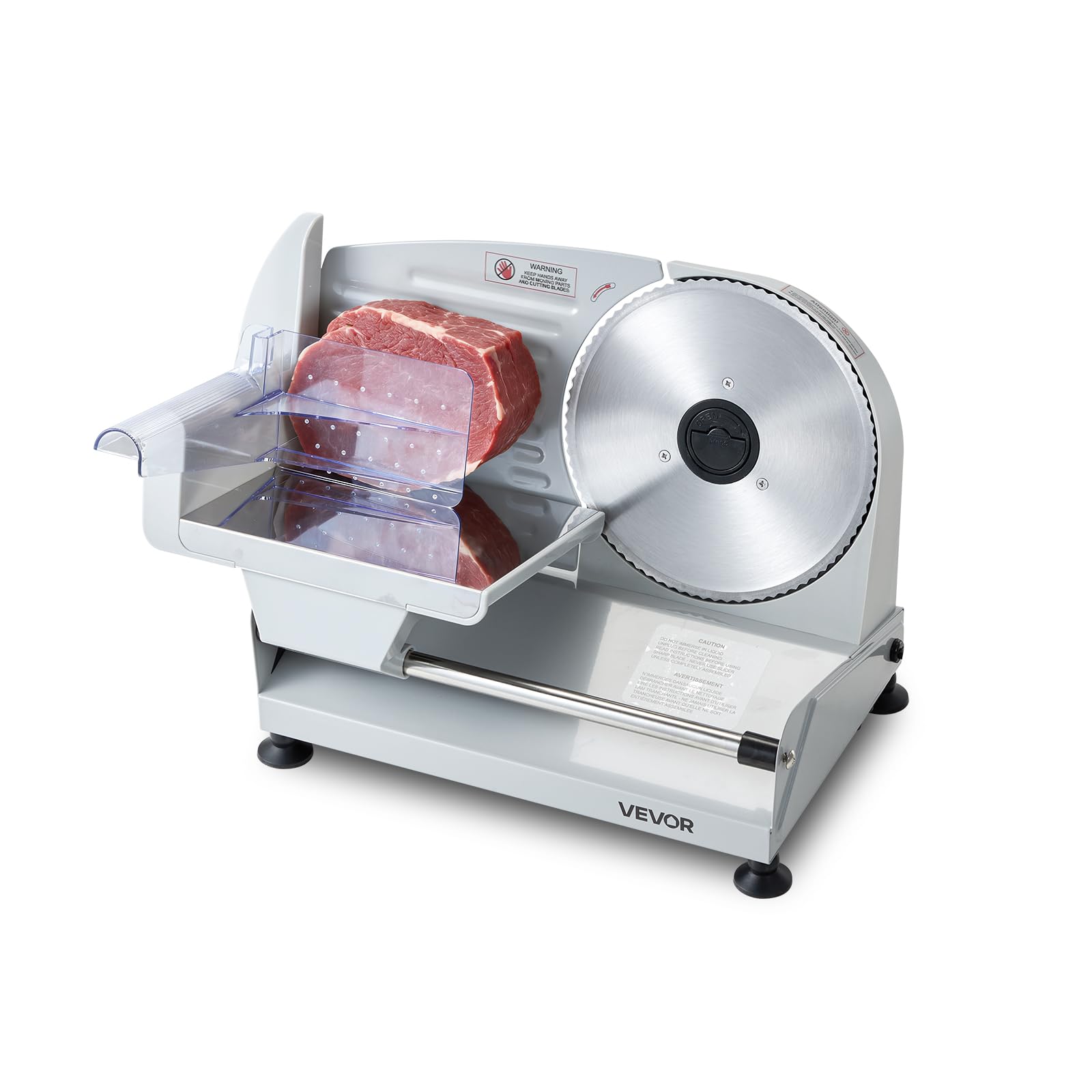
The VEVOR 7.5-inch slicer is the most budget-friendly entry in this guide, offering a 200W motor and a SUS420 stainless steel serrated blade at a compelling price. The motor operates at 70–100 RPM, which is slower than most competitors, and while it handles standard slicing of ham, steak, and baguettes, it struggles with sustained runs — multiple user reviews report overheating after just two to three chicken breasts.
The thickness adjustment knob controls slices from 0 to 0.6 inches (0–15mm), and the 1mm recessed blade design adds a useful safety margin. The blade, food pusher, and slide bar extender are removable for cleaning, though the process is less intuitive than tool-free premium designs. Strong suction cup feet keep the unit stable during operation.
Build quality reflects the price point: the body is functional but not premium, and several customer reviews cite poor documentation quality and inconsistent slice thickness across the length of the cut. For occasional, low-volume slicing where budget is the overriding constraint, the VEVOR works — but expect limitations on throughput and precision.
Why it’s great
- Recessed blade design adds meaningful finger protection
- Removable blade and carriage for basic cleaning access
- Suction cup feet keep the unit planted during slicing
Good to know
- Motor overheats quickly under sustained load (2–3 chicken breasts)
- SUS420 blade is more prone to corrosion than 304 stainless steel
FAQ
Can a 200W electric meat slicer handle semi-frozen meat?
How often should I sharpen the blade on my electric meat slicer?
Is a serrated blade or a smooth blade better for deli meat slicing?
Final Thoughts: The Verdict
For most users, the best electric meat slicer winner is the OSTBA Meat Slicer with Quiet DC Motor because it combines a quiet, torque-stable DC motor with dual 7.5-inch blades and tool-free cleaning at a fair mid-range price. If you want three interchangeable blades for maximum food versatility, grab the Cogace 3-Blade Slicer. And for a compact, budget-friendly unit that fits tight counter spaces, nothing beats the Valley Sportsman Meat Slicer.