Dragging a blade across a worn-out stone or a pull-through V-notch often leaves you with a “sharp enough” edge that dulls after one meal prep session. The real problem isn’t your knife — it’s the abrasive surface you’re trusting to cut steel. Diamond abrasives change that equation entirely by biting into the hardest super-steels — CPM-S30V, M390, Elmax — without loading up or going out of flat.
I’m Mohammad Maruf — the founder and writer behind AirfryerBite. Over the past five years, I’ve analyzed over 300 sharpening systems, poring through micron ratings, electroplating processes, and real-user edge-retention data to separate devices that actually cut from those that just burnish.
In this guide, I’ll break down the key specs that separate a true best diamond knife sharpener budget friendly options from the rest, comparing diamond plate size, grit combos, and build quality so you can confidently invest in a system that lasts longer than your next set of blades.
How To Choose The Best Diamond Knife Sharpener
Every diamond sharpener claims to last forever, but not all diamonds are created equal. The size of the plate, the bond used to hold the particles, the grit progression, and the flatness of the substrate determine whether your edge comes back razor-sharp or just shiny. Below are the three specs you should weigh before you buy.
Plate Size Matters More Than You Think
A 3″ x 1″ diamond rod can touch up a pocket knife serration, but it’s nearly useless for an 8″ chef’s blade. Larger plates—roughly 8″ x 3″ or bigger—give you consistent stroke length and better angle control, especially when working on kitchen knives or long hunting blades. A cramped surface forces you to sharpen in short, choppy passes, which lead to uneven bevels and wasted time.
Grit Pairing Determines Result Quality
Grit progression is the single most overlooked factor. A single fine diamond plate (like 1000 grit) will polish an already-sharp edge, but it can’t remove chips or set a new bevel. Look for a two-sided or multi-plate system that starts at 300-400 grit for repair and finishes at 800-1000+ grit for refinement. Going from coarse to extra-fine in one stone saves money and keeps your workflow simple.
Plate Flatness And Diamond Bonding Method
Cheap diamond stones are often stamped onto uneven steel, creating a convex surface that rounds the edge. High-end brands use precision-ground substrates (±0.002″) and electroplating that locks particles into the nickel layer rather than simply gluing them on. Plated monocrystalline diamonds fracture less and cut longer, while loose or poorly bonded particles shed rapidly, leaving you with a bare plate in a few months.
Quick Comparison
On smaller screens, swipe sideways to see the full table.
| Model | Category | Best For | Key Spec | Amazon |
|---|---|---|---|---|
| SHARPAL 168H | Dual-Grit Plate | All-purpose kitchen & tool sharpening | 8″ x 3″ plate; 325/1000 grit | Amazon |
| HORL 3 Cruise | Rolling System | Ultra-fine kitchen edge with magnetic guide | Diamond & steel disc; 15°/20° angles | Amazon |
| Warthog V-Sharp A4 | V-Rod System | Fixed-angle guided sharpening for hunters | Spring-loaded rods; 4 angle settings | Amazon |
| Atoma #400 | Premium Diamond Plate | Professional-grade flattening & sharpening | 8″ x 2.77″; #400 medium grit | Amazon |
| Goodjob GB-3D | Triple-Grit Stone | Entry-level multi grit in one package | 400/1000/8000; angle guide included | Amazon |
| DMT Diafold FSKF | Folding Rod | Serrated & outdoor edge touch-up | 4″ tapered cone; fine 600 mesh | Amazon |
| EZE-LAP Brass Rod | Retractable Rod | Portable field sharpening for campers | 3.25″ x 0.25″ diamond rod; fine grit | Amazon |
In‑Depth Reviews
1. SHARPAL 168H Dual-Grit Diamond Sharpening Stone
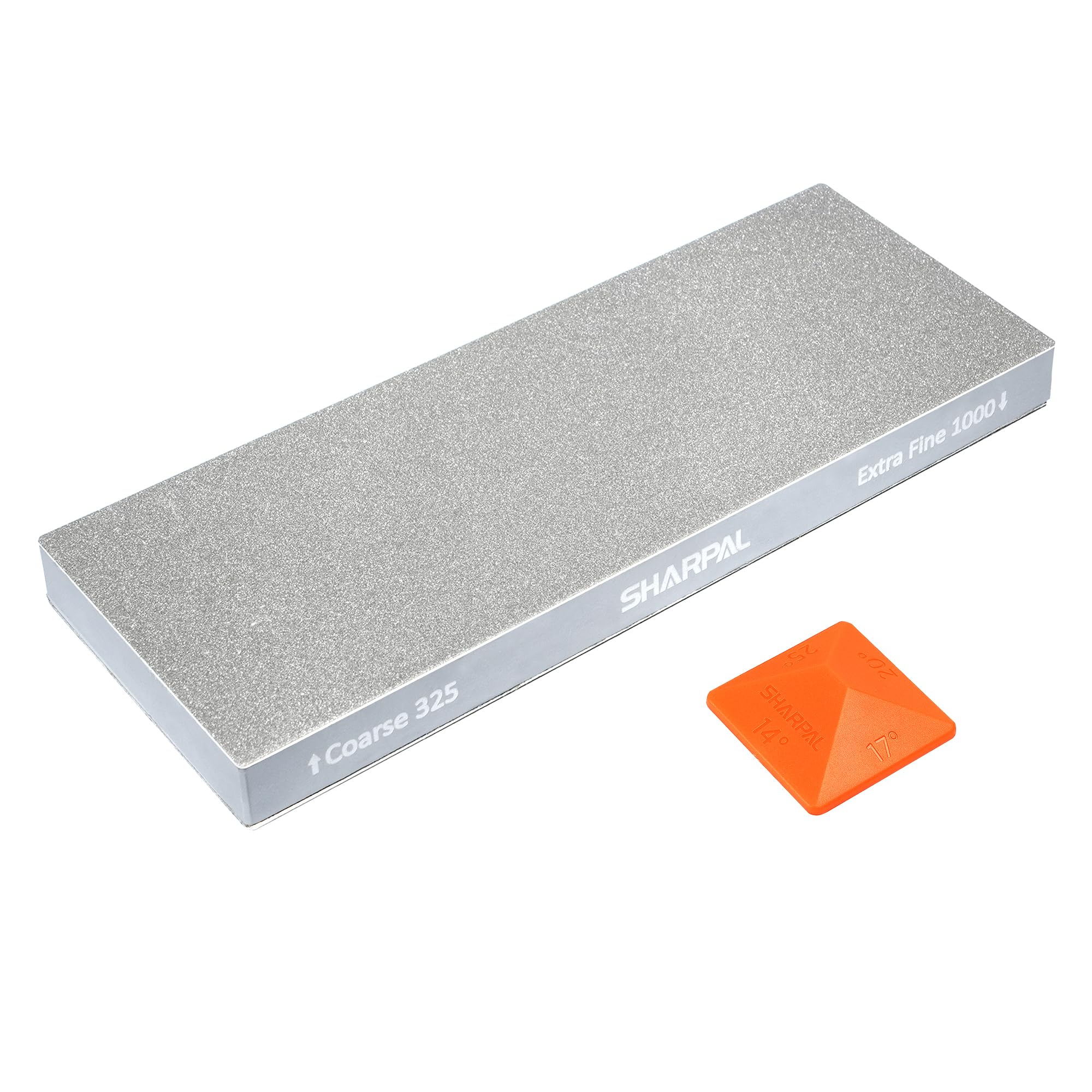
The SHARPAL 168H delivers the largest working surface in the mid-range bracket at 8″ x 3″, letting you run a full chef’s blade in a single continuous stroke. The dual-sided plate pairs a 325-grit (45-micron) coarse side for bevel setting and chip removal with a 1000-grit (15-micron) extra-fine side for a shaving-sharp finish. Unlike bonded whetstones, the monocrystalline diamond particles are anchored through a three-times electroplating process that prevents shedding even under heavy pressure.
Its MirrorFlat substrate is precision-ground to a flatness tolerance of ±0.002″, which guarantees uniform blade contact across the entire stone — something you won’t find on economy plates that bow in the middle. The included angle pyramid guide lets you lock in 14°, 17°, 20°, or 25° angles, making it a strong teaching tool for beginners and a consistent jig for experienced sharpeners alike.
The non-slip silicone pad keeps the stone planted on wet or dry surfaces, and the entire package weighs just over a pound, making it easy to store in a drawer without sacrificing rigidity. For the price, the combination of plate size, dual grit, and certified flatness puts this stone in a class well above its tier.
Why it’s great
- Large 8″ x 3″ surface handles long blades without choppy strokes.
- MirrorFlat substrate ensures even diamond exposure for predictable results.
- Coarse/extra-fine pairing suits both repair and finishing in one tool.
Good to know
- Not designed for serrated edges or curved gut hooks.
- Angle guide works best with consistent hand pressure; heavy rocking can still alter the bevel.
2. HORL 3 Cruise Rolling Knife Sharpener

The HORL 3 Cruise takes a radically different approach to the sharpener market by using a rolling disc mechanism instead of a stationary stone. A diamond-impregnated grinding disc rotates as you draw the knife across a magnetic angle support, which removes material from the blade edge without the sweeping arm motion required by conventional plates. The system is built around two interchangeable settings — 15° for delicate kitchen edges and 20° for robust outdoor blades — giving you flexibility without guesswork.
The industrial diamonds bonded into the grinding disc claim up to 80% more abrasion per pass than standard diamond stones, according to the manufacturer. The secondary stainless steel disc serves as a honing rod, refining the edge after the diamond side does the heavy lifting. The neodymium magnetic pad holds blades as short as a paring knife firmly in place, preventing chatter that could ruin the bevel.
This unit is best for cooks who value convenience and repeatability over speed. Because the disc removes metal in a controlled rolling contact, you can over-grind a thin blade faster than with a hand stone if you apply too much downward force. The polypropylene body feels solid but not heavy, and the compact footprint will fit in a crowded drawer.
Why it’s great
- Rolling disc action removes the guesswork from angle consistency.
- Dual disc system combines grinding and honing in one pass.
- Magnetic pad grips very small blades securely.
Good to know
- Premium price limits its appeal to casual home cooks.
- Not ideal for repairing chipped edges; disc works best on already reasonable edges.
3. Warthog V-Sharp A4 Knife Sharpener

The Warthog V-Sharp A4 uses a patented V-rod system that sharpens both sides of the blade simultaneously, eliminating the need to flip the knife and re-establish your angle. Two spring-loaded diamond rods cradle the edge from both sides while you pull the blade through, with adjustable stops at 15°, 20°, 25°, and 30°. This makes it equally useful for a thin filet knife and a thick bushcraft blade.
Included are a 325-grit natural diamond hone for material removal and a hardened steel rod for final honing. The metal frame with powder-coat finish and solid rubber base give the unit substantial heft — it won’t slide around on the counter even during aggressive passes. The spring tension is calibrated to maintain consistent rod pressure, so heavy-handed users can’t accidentally overshoot the bevel width.
While the V-Sharp design is fast and foolproof, it leaves a slightly convex edge profile compared to the flat bevel produced by a hand stone. This matters less for kitchen and field knives but can be an issue for woodworking chisels that require a perfectly flat primary bevel.
Why it’s great
- Dual-sided sharpening cuts sharpening time in half.
- Adjustable angles cover everything from sushi knives to machetes.
- Sturdy metal frame with non-slip base stays planted during use.
Good to know
- Convex edge profile not ideal for chisels or plane blades.
- Replacement diamond rods are a proprietary size from Warthog.
4. Atoma Diamond Sharpener Medium #400

Atoma is often the benchmark that professional knife makers and sharpening enthusiasts turn to for flattening water stones and setting primary bevels. The #400 medium plate offers a dense monocrystalline diamond surface that cuts fast without clogging. The nickel electroplating is dense and uniform, which means the plate retains its cutting aggression far longer than cheaper alternatives that lose particles after a dozen uses.
The 8″ x 2.77″ plate sits on a precision-ground steel substrate that stays dead flat even when used on a damp surface. This flatness is critical when you use the Atoma to flatten other sharpening stones — a bowed plate would transfer that unevenness to your expensive JNAT or Shapton. The aluminum base plate adds rigidity without excessive weight, coming in at just over half a kilogram.
Note that the #400 is a single-grit plate. You’ll need a separate finishing stone or strop if you want a polished, mirror edge. For users who already own a set of finer stones and need a fast, durable coarse plate for repair work and lapping, the Atoma is the gold standard.
Why it’s great
- Exceptional diamond retention through dense electroplating.
- Substrate flatness makes it a professional-grade lapping plate.
- Medium grit removes steel quickly without skipping.
Good to know
- Single grit — must be paired with a finer stone for a finished edge.
- Price positions it strictly for serious sharpening enthusiasts.
5. Goodjob Diamond Sharpening Stone GB-3D

The Goodjob GB-3D packs three grit surfaces — 400 diamond, 1000 diamond, and 8000 ceramic — onto a single whetstone-shaped base, offering a complete progressive sharpening workflow at an entry-level price point. The 400 grit coarse side tackles edge repairs and bevel resetting, while the 1000 grit medium refines the burr. The 8000 grit ceramic side acts as a polishing hone, producing a mirror-like finish that rivals much pricier Japanese water stones.
The kit includes a clear plastic angle guide with 14°, 17°, and 20° settings, plus a non-slip silicone base that prevents the stone from shifting during use. The diamond and ceramic surfaces require only water as a lubricant — no messy oils needed. The block dimensions (10.35″ x 4.15″) provide enough length for comfortable strokes on 8″ chef’s blades.
The trade-off comes in diamond quality and plate flatness. The diamonds are bonded rather than plated, which means they can wear faster under heavy pressure, and the steel substrate isn’t precision-ground to the same ±0.002″ tolerance you’d see from SHARPAL or Atoma. That said, for the price, the triple-grit setup gives beginners the entire grit progression in one stone without buying three separate plates.
Why it’s great
- Three grits cover repair, sharpening, and polishing in one stone.
- Angle guide and non-slip base included, so no extra purchases needed.
- Large surface area supports longer strokes on chef’s knives.
Good to know
- Bonded diamond wears faster than plated monocrystalline stones.
- Substrate flatness is not certified; may develop a slight crown over time.
6. DMT Diafold Serrated Diamond Knife Sharpener (FSKF)

Most diamond sharpeners rely on flat plates that can’t reach into the scalloped valleys of a serrated bread knife or a gut hook. The DMT Diafold FSKF solves that with a 4″ tapered cone that tapers from 1/4″ down to 1/16″ in diameter, letting you match the rod to each serration pocket individually. The fine diamond surface (25 micron / 600 mesh) delivers a razor edge without needing to remove excessive metal from the scallop edge.
The fold-and-go handle protects the diamond surface when closed and locks rigidly when open. It’s light enough to toss into a camping pack, weighing just 0.64 ounces, making it one of the most portable diamond sharpeners in this lineup. The monocrystalline diamond surface cuts dry or with a splash of water — no oil required.
Because the rod is narrow and round, it’s not suited for straight-edge knives except as a quick touch-up. If you primarily sharpen traditional chef’s and utility knives, a flat plate will serve you better. The Diafold shines in the specific niche of serrated maintenance and small curved tools.
Why it’s great
- Tapered cone reaches all serration sizes from bread knives to scalloped shears.
- Ultra-portable fold-and-go design fits in a pocket or tackle box.
- No lubrication needed — sharpen dry for convenience.
Good to know
- Not designed for large straight-edge knives or bevel repair.
- Fine grit only; cannot remove chips or set a new edge.
7. EZE-LAP 3-1/4″ x 1/4″ Diamond Round Sharpener

The EZE-LAP retractable diamond rod is a throwback design that has been in continuous production for decades, and for good reason. The 3-1/4″ rod with a 1/4″ diameter slides into a solid brass handle, which protects the diamond surface during storage and provides a comfortable grip during sharpening. The fine-grit surface handles edge touch-ups on pocket knives, garden tools, fishhooks, and small kitchen blades with predictable ease.
Because it’s made in the USA from synthetic diamond bonded to a round steel core, the rod offers consistent cutting without requiring water or oil. The brass handle won’t rust, so it’s a reliable companion in damp environments like a fishing vest or camping kit. The total weight — 1.6 ounces — makes it essentially unnoticeable in a pack.
The obvious limitation is the rod’s small diameter and short length. It’s excellent for field touch-ups but cannot replace a full-size plate for serious edge repair or bevel setting on chef’s knives.
Why it’s great
- Rust-proof brass handle and retractable design for longevity.
- Lightweight and compact, easy to carry in any field kit.
- Proven design with decades of positive user feedback.
Good to know
- Too small and narrow for serious kitchen knife sharpening.
- Fine grit only — no coarse side for chip repair.
FAQ
Can I use a diamond knife sharpener on ceramic knives?
What grit should I start with for a very dull knife?
Do diamond sharpening stones need oil or water?
How do I maintain my diamond sharpening stone?
Can I sharpen serrated knives on a flat diamond plate?
Final Thoughts: The Verdict
For most users, the best diamond knife sharpener winner is the SHARPAL 168H because it combines a large 8″ x 3″ plate, dual 325/1000 grit, and precision-ground flatness at a mid-range price that outperforms most multi-hundred-dollar systems. If you want the convenience of disc-based sharpening with a magnetic guide, grab the HORL 3 Cruise. And for a professional-grade lapping plate that doubles as a fast bevel setter, nothing beats the Atoma #400.