Tap water carries a load of invisible baggage—chlorine taste, heavy metals, sediment, even forever chemicals. A water purifier pitcher is the simplest countertop weapon against that, transforming what comes out of your faucet into something you actually want to drink.
I’m Mohammad Maruf — the founder and writer behind AirfryerBite. I’ve spent hundreds of hours cross-referencing independent test data, NSF certifications, and real-world filter longevity reports to understand which pitchers actually do the work they claim.
Whether you need to remove PFAS or simply want water that tastes fresher than a plastic bottle, picking the right water purifier pitcher comes down to understanding filter media, certified contaminant reduction, and how many gallons the cartridge can handle before it taps out.
How To Choose The Best Water Purifier Pitcher
Every pitcher is a trade-off between filtration depth, flow rate, and how often you spend on replacement cartridges. Nail these three factors, and you will never second-guess your tap water again.
Filter Media: Standard Carbon vs Multi-Stage Ion Exchange
Basic activated carbon pitchers remove chlorine taste and odor, making water palatable but leaving heavy metals, fluoride, and PFAS untouched. Multi-stage filters—combining ion-exchange resin, carbon blocks, and mechanical layers—capture lead, mercury, copper, and even dissolved solids. If your water report shows elevated contaminants beyond chlorine, a single-stage carbon filter is not enough.
Certification: NSF/ANSI Standards Tell the Real Story
Marketing language like “reduces lead” means nothing without third-party verification. NSF/ANSI Standard 42 covers aesthetic effects like taste and odor. Standard 53 tackles health-related contaminants, including lead, mercury, and VOCs. Standard 401 addresses emerging compounds like pharmaceuticals. A filter certified to 53 or 401 is a step above anything that relies only on manufacturer claims.
Filter Life and Total Cost Per Gallon
A 40-gallon cartridge that must be replaced every two months is standard. A 200-gallon cartridge—common in premium models like the Waterdrop PT-04B—drastically reduces long-term cost and hassle. Do the math: a cheap pitcher with expensive monthly filters costs more over two years than a mid-range unit with a 200-gallon cartridge. Look at annual filter expense, not just the upfront price of the pitcher.
Quick Comparison
On smaller screens, swipe sideways to see the full table.
| Model | Category | Best For | Key Spec | Amazon |
|---|---|---|---|---|
| Waterdrop PT-04B 10-Cup | Premium | Long filter life & style | 200-gallon cartridge life | Amazon |
| Clearly Filtered Pitcher Replacement Filter | Premium | Maximum contaminant removal | 365+ contaminants removed | Amazon |
| Culligan with ZeroWater Technology 10-Cup | Mid-Range | Zero TDS & built-in meter | 5-stage ion exchange + TDS meter | Amazon |
| Brita Wave Berrylicious 10 Cup | Mid-Range | Everyday chlorine reduction | 10-cup capacity, easy pour | Amazon |
| Waterdrop ED06W Electric | Mid-Range | Instant electric dispensing | Rechargeable, 0.7 L/min flow | Amazon |
| Brita Standard 6-Pack Filters | Budget | Low-cost replacement packs | 40-gallon filter per cartridge | Amazon |
| PUR 7-Cup PPT710BA | Budget | Compact fridgable design | NSF 42/53 certified, filter light | Amazon |
In‑Depth Reviews
1. Waterdrop PT-04B 10-Cup Pitcher

The Waterdrop PT-04B solves the biggest headache of pitcher ownership: frequent filter swaps. Its cartridge lasts an exceptional 200 gallons, roughly five times longer than the industry-standard 40-gallon cartridge, which translates to fewer purchases and less environmental waste over a year of use. The unit is NSF 42 certified for chlorine reduction of up to 97.4%, and third-party testing confirms reduction of PFOA and PFOS, iron, and metal ions.
The natural wood handle adds a tactile upgrade over the ubiquitous all-plastic grip, and the hands-free spout lid lets you refill without lifting the top off—a dust-resistant design that keeps unfiltered water separate until you pour. The large unfiltered basin permits continuous filling while filtered water is dispensed, so you never wait for the reservoir to empty before adding more tap water. The unit measures 10.4 inches tall and 5 inches wide, fitting most refrigerator door shelves.
Some users report the top reservoir lid pops off when pouring if the pitcher is full, and the filter does not lower TDS, so if total dissolved solids are a concern, you will need a different approach. Replacement filters (model WD-PF-01A) are straightforward to install, and the overall build quality—thick, food-grade plastic—feels a tier above budget competitors.
Why it’s great
- 200-gallon filter life far exceeds standard 40-gallon cartridges
- Wooden handle provides comfortable, slip-resistant grip
- NSF 42 certified for chlorine and PFOA/PFOS reduction
- Hands-free spout lid keeps contaminants out of filtered water
Good to know
- Lid can pop off during pouring when pitcher is full
- Does not reduce TDS; retains dissolved solids
- Heavier than typical plastic pitchers when full
2. Clearly Filtered Pitcher Replacement Filter
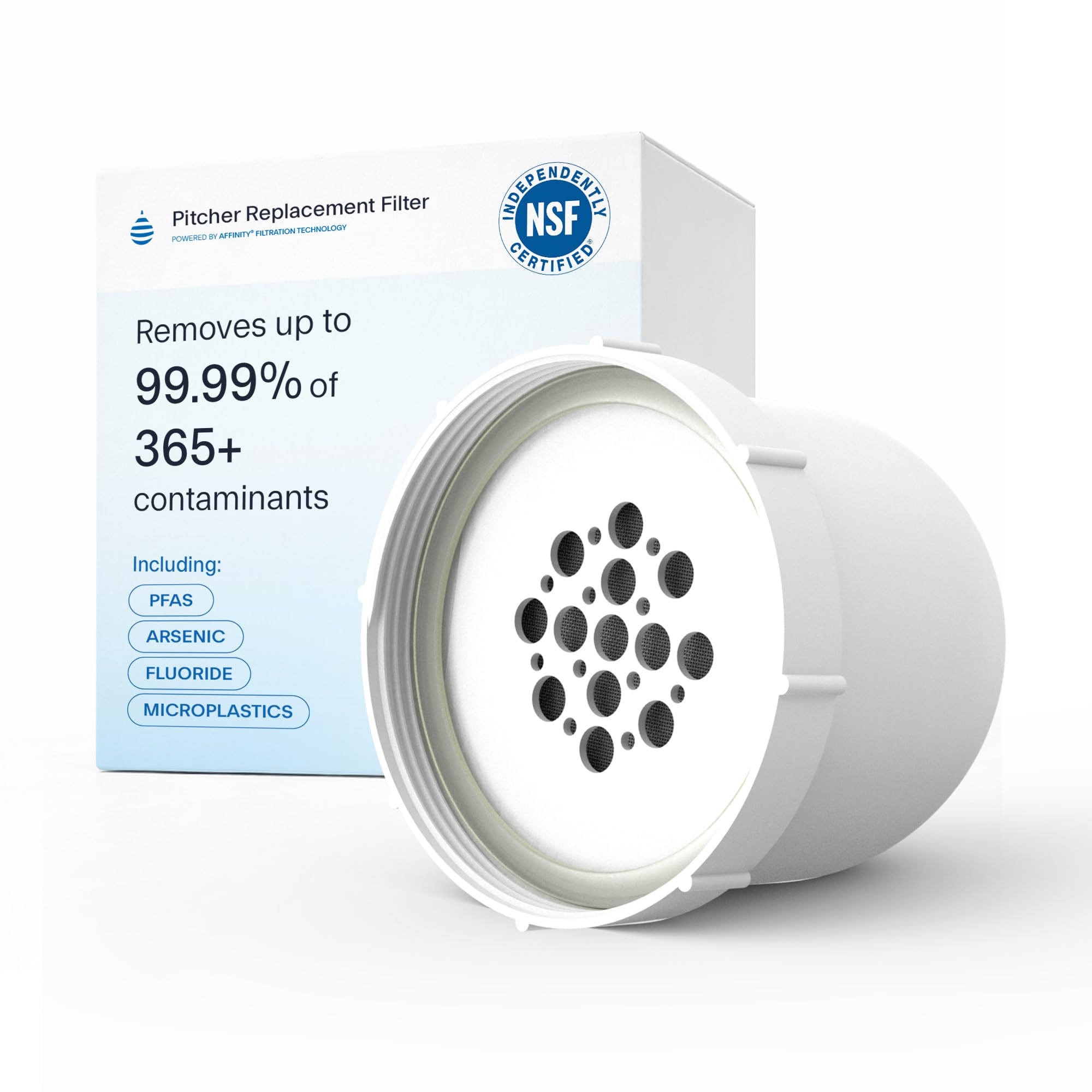
The Clearly Filtered replacement cartridge is the gold standard for people who need to remove more than just chlorine. Its proprietary Affinity Filtration Technology targets 365+ contaminants, including fluoride, lead, arsenic, BPA, PFAS, microplastics, and pharmaceuticals—verified through independent third-party lab testing and NSF certification to standards 42 and 372. This is the cartridge you buy when your tap water has more than aesthetic issues.
Each filter handles 100 gallons, roughly four months of use for a typical household, and the medical-grade, BPA-free recycled plastic body is 100% non-leaching, meaning no endocrine disruptors leach into your water from the housing itself. The priming process requires a bit of patience—some users note the gasket can leak if not seated perfectly—but once installed, the dynamic water pathway produces water that tastes noticeably cleaner than standard carbon filters.
At the premium end of the spectrum, the upfront cost is higher, but the filter lasts long enough that the per-gallon expense is comparable to mid-range competitors. If you are on a private well or have tested positive for heavy metals or volatile organic compounds, this cartridge is the most robust single-buy option available in a pitcher format.
Why it’s great
- Removes over 365 contaminants including fluoride and arsenic
- NSF 42 and 372 certified for safety and performance
- 100-gallon filter life with medical-grade BPA-free plastic
- Independent testing results publicly available
Good to know
- Higher upfront cost than basic carbon filters
- Priming gasket can leak if not properly aligned
- Slower flow rate compared to standard carbon-only filters
3. Culligan with ZeroWater Technology 10-Cup
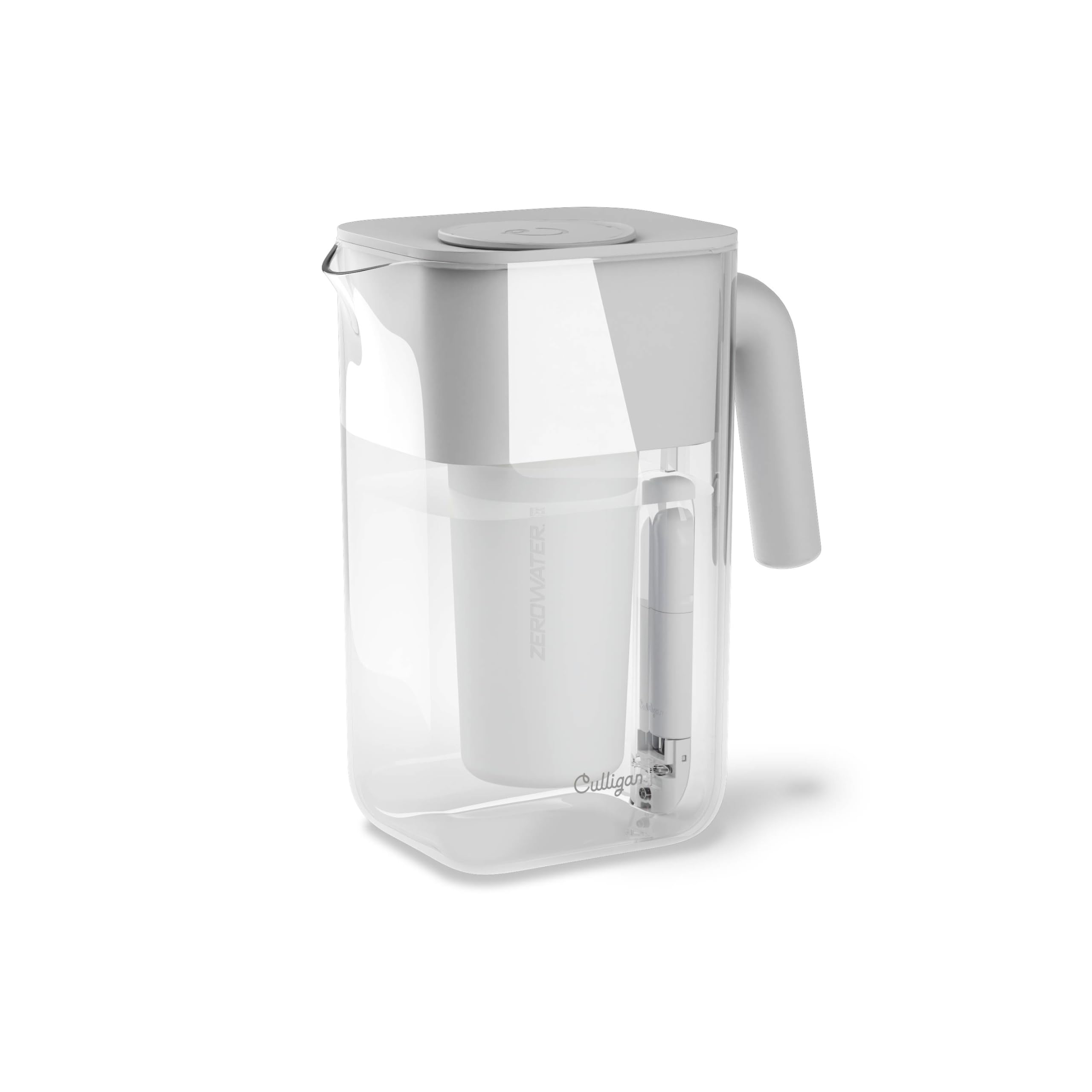
The Culligan with ZeroWater Technology distinguishes itself with a built-in TDS meter that reads total dissolved solids instantly, alerting you when the filter needs replacement. The 5-stage ion-exchange and activated-carbon filter is certified by IAPMO to reduce lead, total PFAS, mercury, fluoride, and chlorine, and it removes 99.9 percent of dissolved solids—so the TDS meter reads zero when the filter is fresh.
The 10-cup (80 fl oz) capacity is slightly smaller than some 10-cup competitors, but the plastic and polystyrene build feels more durable than typical budget pitchers. The concave top lid prevents pooled water from dripping, and the sliding lid design is simpler to remove than many Brita-style hinged covers. The filter action is noticeably slower than a standard carbon filter because of the dense multi-stage media—expect to wait a minute or two for a full glass.
Replacement filters run at a premium, and some users report the TDS meter battery compartment can corrode from moisture if water is left on the exterior. The meter is removable and powered by a single AAA battery. For anyone concerned about dissolved solids—whether for taste, CPAP machines, or specific health reasons—this pitcher provides quantitative feedback that no other standard carbon filter offers.
Why it’s great
- Built-in TDS meter gives instant dissolved-solids reading
- 5-stage filtration removes 99.9 percent of dissolved solids
- IAPMO certified to reduce lead and total PFAS
- Durable build with concave top to prevent water pooling
Good to know
- Slower filtration speed due to dense multi-stage media
- Meter battery compartment can corrode from moisture
- Replacement filters are expensive compared to basic carbon
4. Waterdrop ED06W Electric Pitcher

The Waterdrop ED06W is the only electric option in this lineup, dispensing filtered water instantly at the push of a button rather than waiting for gravity-fed filtration. The built-in rechargeable battery lasts up to 20 days on a single charge, and the one-button control automatically starts and stops the flow, making it ideal for users who want filtered water without the typical pour-and-wait cycle.
The filter media consists of coconut-shell activated carbon, ion-exchange resin, and an activated carbon fiber layer, reducing 20+ contaminants including chlorine, copper, calcium, magnesium, sediment, and large particles. It softens water by reducing hardness minerals, which is a distinct advantage if you have hard tap water that leaves scale on appliances. The 6.7 x 9.5 x 10.4-inch footprint is compact, and the tall design allows most bottles and cups to fit under the spout.
The filter lasts 40 gallons or about two months, and the replacement cartridges are more expensive than standard carbon inserts. The electric pump adds a slight mechanical hum during operation, and the unit must be charged via USB-C, so it requires outlet proximity in the kitchen. For high-consumption families or anyone who finds gravity pitchers frustratingly slow, the instant dispense feature is a genuine quality-of-life upgrade.
Why it’s great
- Instant electric dispensing eliminates gravity-filter waiting time
- 20-day rechargeable battery reduces cable clutter
- Reduces 20+ contaminants including copper and calcium
- Softens water by reducing hardness minerals
Good to know
- Filter life is standard 40 gallons, not extended
- Electric pump creates audible hum during operation
- Requires USB-C charging near an outlet
5. PUR 7-Cup PPT710BA

The PUR 7-Cup PPT710BA delivers NSF 42 and 53 certification in a compact, fridge-friendly package at a budget-friendly price point. Its 3-in-1 filtration reduces microplastics, chlorine, and other chemical and physical substances, and the genuine PUR cartridge is the only filter certified for this pitcher, ensuring consistent contaminant reduction with every replacement. The 7-cup capacity is ideal for 1–2 person households or RVs where counter space is at a premium.
A stay-tight lid lets you pour while water is still filtering, so there is no need to wait for the reservoir to drain before serving. The filter indicator light provides a visual alert when the 40-gallon, two-month lifespan is near its end. The unit measures 9.6 x 4.5 x 10.1 inches, slipping easily into tight fridge door shelves.
Some users report that the internal filter holder can be installed backward, causing the lid to misalign, and the flow rate slows noticeably as the cartridge ages. The handle design allows one-handed pouring with minimal wrist strain, and the BPA-free, dishwasher-safe construction simplifies maintenance. For someone wanting certified filtration without the premium price tag, this is a solid, no-frills option.
Why it’s great
- NSF 42 and 53 certified for health-related contaminants
- Compact 7-cup size fits small fridges and RVs
- Filter indicator light removes guesswork
- Stay-tight lid allows pouring while filtering
Good to know
- 7-cup capacity requires frequent refills for larger households
- Filter holder orientation can be confusing during installation
- Flow rate slows significantly toward end of filter life
6. Brita Wave Berrylicious 10 Cup

The Brita Wave remains a household name for a reason—it is a reliable, straightforward chlorine-reduction pitcher that makes tap water taste noticeably better. The 10-cup capacity is the sweet spot for a family of 2–4, and the filter installs without presoaking, which is a small but meaningful convenience. The activated carbon media targets chlorine taste and odor, copper, cadmium, and mercury, and each cartridge lasts 40 gallons or two months.
The Wave design features a slightly wider body that feels stable even when full, and the spout door on the lid dispenses water without needing to hold a flap open. Some users mention the spout door can stick and cause water to spill onto the cabinet if it fails to open fully—a known irritation that can be mitigated by ensuring the spout moves freely before pouring. The build is sturdier than budget Brita models, and the BPA-free plastic feels dense rather than flimsy.
It is an entry-level workhorse that handles the most common tap water issues—chlorine, bad taste, and odor—without attempting to solve heavy metal or PFAS contamination. If your water report is clean except for chlorination, the Brita Wave delivers dependable results at a low ongoing filter cost.
Why it’s great
- 10-cup capacity suits families of 2–4
- Filter installs without presoaking
- Sturdy build feels more durable than basic Brita models
- Low filter cost with widespread availability
Good to know
- Spout door can stick and cause spillage
- Only reduces chlorine, copper, cadmium, and mercury
- Does not remove heavy metals or PFAS
7. Brita Standard 6-Pack Filters
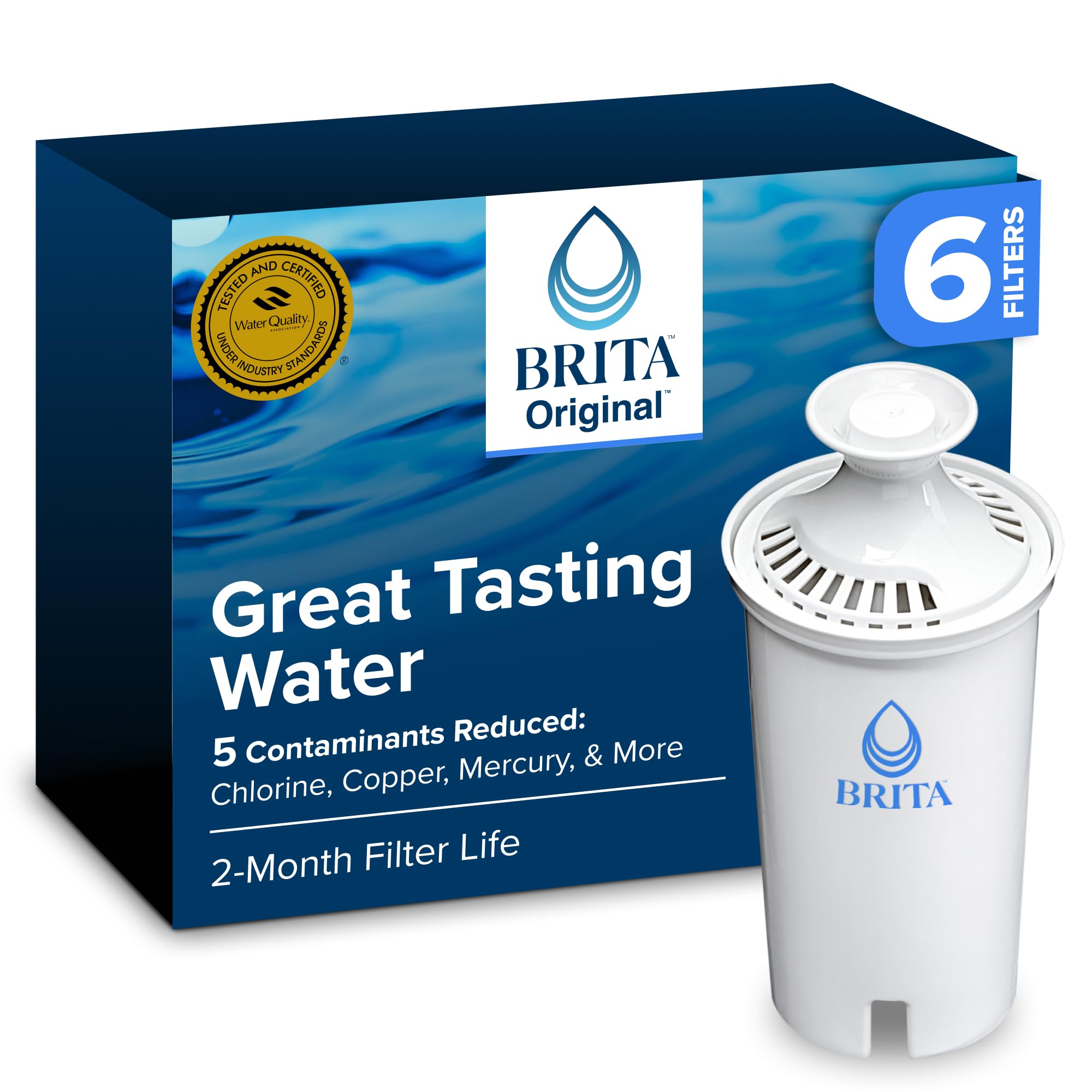
The Brita Standard 6-pack is a bulk replacement filter bundle designed for existing Brita pitchers and dispensers (excluding Stream models). Each cartridge lasts up to 40 gallons or two months, and the multi-pack provides a full year of filtration for a family using one pitcher. The activated carbon media reduces chlorine taste and odor, copper, cadmium, and mercury, and the filters install without presoaking—pop them in and start filtering immediately.
These filters fit the entire Brita ecosystem—from the Amalfi and Aqualux to the Grand and Ultramax dispensers—making them the easiest substitution for anyone who already owns a Brita pitcher. The 30-day money-back guarantee adds a layer of risk-free reassurance, and the per-filter cost is lower than buying individual replacements at retail. Flow rate inconsistency has been noted across batches; some filters run fast while others feel sluggish out of the box, likely due to variations in carbon compaction.
For users whose primary goal is chlorine removal and taste improvement— and who do not need reduction of PFAS, lead, fluoride, or heavy metals beyond what standard carbon can handle—this is the most cost-effective way to keep a Brita system running. The 6-pack saves trips to the store and reduces plastic waste from individual filter packaging.
Why it’s great
- Six filters provide one year of ready replacement supply
- No presoak installation—filters work immediately
- Fits all Brita pitchers and dispensers except Stream
- Lowest per-filter cost for Brita system owners
Good to know
- Flow rate can vary between individual filters
- Does not filter heavy metals or PFAS
- Carbon-only media, not multi-stage
FAQ
Does a water purifier pitcher remove fluoride?
How often should I replace the filter in my purifier pitcher?
Final Thoughts: The Verdict
For most users, the water purifier pitcher winner is the Waterdrop PT-04B because the 200-gallon filter life eliminates the bi-monthly cartridge swap hassle and the wooden handle and hands-free lid make daily use genuinely pleasant. If you want maximum contaminant removal including fluoride and arsenic, grab the Clearly Filtered replacement cartridge. For those who need real-time feedback on dissolved solids or have well water, nothing beats the Culligan with ZeroWater Technology.