That metallic aftertaste from tap water isn’t just annoying — it’s a sign of dissolved solids, chlorine, and potential contaminants flowing through your kitchen faucet. A dedicated reverse osmosis system strips away over 99% of these impurities, delivering water that’s cleaner than most bottled brands without the plastic waste or recurring cost.
I’m Mohammad Maruf — the founder and writer behind AirfryerBite. I’ve spent over a year analyzing water filtration hardware, comparing filter certifications, real-world TDS reduction data, and long-term maintenance costs across dozens of RO systems to build this guide on what actually works in a home setting.
Whether you’re dealing with hard water scaling, concerns about PFAS and lead, or simply want better-tasting drinking water, the right reverse osmosis water filter for home transforms your tap into a reliable source of pure, mineral-balanced hydration.
How To Choose The Best Reverse Osmosis Water Filter For Home
Selecting the right RO system involves more than just picking a brand. You need to balance filtration stages, water waste, flow rate, and installation type. Here are the three critical factors that separate a great home RO system from one that will frustrate you every day.
Countertop vs. Under-Sink: Which Fits Your Kitchen?
Countertop models like the DREO and Aigerri require zero plumbing — you plug them in and fill a reservoir. Their compact footprint works for renters, small kitchens, and anyone who dislikes drilling holes. Under-sink systems (Stokk, SimPure, Waterdrop, iSpring, Home Master) hide completely out of sight and can feed a dedicated faucet or your refrigerator’s ice maker. The trade-off: under-sink units demand a power outlet beneath the cabinet, a drilled hole for the faucet, and a drain connection. If you own your home and want permanent, high-volume filtration, under-sink is the standard. For flexibility, countertop wins.
Pure-to-Drain Ratio: How Much Water Do You Waste?
Traditional RO systems dump 3 to 4 gallons of wastewater for every gallon they produce — a shocking inefficiency. Modern systems now achieve ratios of 2:1 (Waterdrop D6, iSpring RO500AK-BN), 3:1 (DREO, Stokk, Waterdrop G3P800), or even 5:1 (Aigerri). A higher pure-to-drain ratio means less water goes down the drain, lowering your water bill and environmental footprint. If you live in a region with water scarcity or high utility rates, prioritize a system with at least a 2:1 ratio. The 5:1 ratio on the Aigerri is the most conservation-friendly option on this list.
Filtration Stages and Remineralization: Do You Need Minerals Back?
RO water is exceptionally pure — often near 0 TDS — but that purity comes at the cost of natural minerals like calcium, magnesium, and potassium. Some systems, such as the SimPure T1-400ALK, Home Master TMHP, and iSpring RO500AK-BN, add a remineralization stage that restores those minerals and raises the pH slightly. This produces water that tastes smoother and more like natural spring water. If you prefer neutral-tasting, ultra-pure water for cooking or coffee, a system without remineralization (SimPure T1-400UV, Waterdrop G3P800) is a better fit. If you prioritize taste and mineral content, look for an alkaline filter stage.
Quick Comparison
On smaller screens, swipe sideways to see the full table.
| Model | Category | Best For | Key Spec | Amazon |
|---|---|---|---|---|
| iSpring RO500AK-BN | Under Sink | High-flow alkaline water | 500 GPD, 0.4 GPM flow | Amazon |
| Waterdrop G3P800 | Under Sink | Massive capacity, smart display | 800 GPD, 3:1 ratio | Amazon |
| Home Master TMHP | Under Sink | 9-stage filtration with UV | 2-pass remineralization | Amazon |
| SimPure T1-400ALK | Under Sink | Alkaline water on a budget | 400 GPD, UV + pH+ | Amazon |
| SimPure T1-400UV | Under Sink | Near 0 TDS, space-saver | 400 GPD, UV sterilization | Amazon |
| Waterdrop D6 | Under Sink | Reliable 600 GPD workhorse | 600 GPD, smart faucet | Amazon |
| Stokk S2 | Under Sink | Fast 800 GPD tankless | 800 GPD, 8-stage | Amazon |
| Aigerri UV Countertop | Countertop | Eco-friendly 5:1 waste ratio | 5:1 pure to drain | Amazon |
| DREO RO Filter 112 | Countertop | Entry-level countertop simplicity | 3:1 ratio, auto-fill pitcher | Amazon |
In‑Depth Reviews
1. iSpring RO500AK-BN

The iSpring RO500AK-BN delivers a rare combination that serious home filtration buyers value: certified NSF 58 performance, a 500 GPD flow rate that fills an 8-ounce cup in roughly 10 seconds, and a tankless design that reclaims under-sink space. Its three-stage filtration includes a carbon alkaline filter that reintroduces calcium, magnesium, and potassium, lifting the pH without leaving the water tasting artificial — a meaningful upgrade over standard RO output.
Installation is DIY-friendly for anyone comfortable with a drill and basic plumbing. The reinforced integrated water route minimizes leak potential, and filter swaps are tool-free. Users consistently report that the TDS drops from above 400 ppm to below 25 ppm, and the 2:1 pure-to-drain ratio cuts wastewater by roughly 400 percent compared to older RO systems. It also includes an automatic self-cleaning cycle that flushes the membrane after 24 hours of inactivity, extending filter life.
Customer support from the Atlanta-based team gets frequent praise for handling warranty issues and sending replacement parts quickly. A few users noted that initial setup instructions could be clearer regarding the faucet faceplate, but the overall reliability and water quality make this a top recommendation for anyone wanting alkaline water without the bulk of a storage tank.
Why it’s great
- NSF 58 certified for TDS reduction — verified performance, not marketing hype.
- 500 GPD flow rate with 2:1 waste ratio balances speed and conservation well.
- Alkaline remineralization stage adds back beneficial minerals for smoother taste.
Good to know
- Requires an electrical outlet under the sink; not suitable for cabinets without power.
- DIY installation takes around an hour and needs a drilled hole for the faucet.
2. Waterdrop G3P800
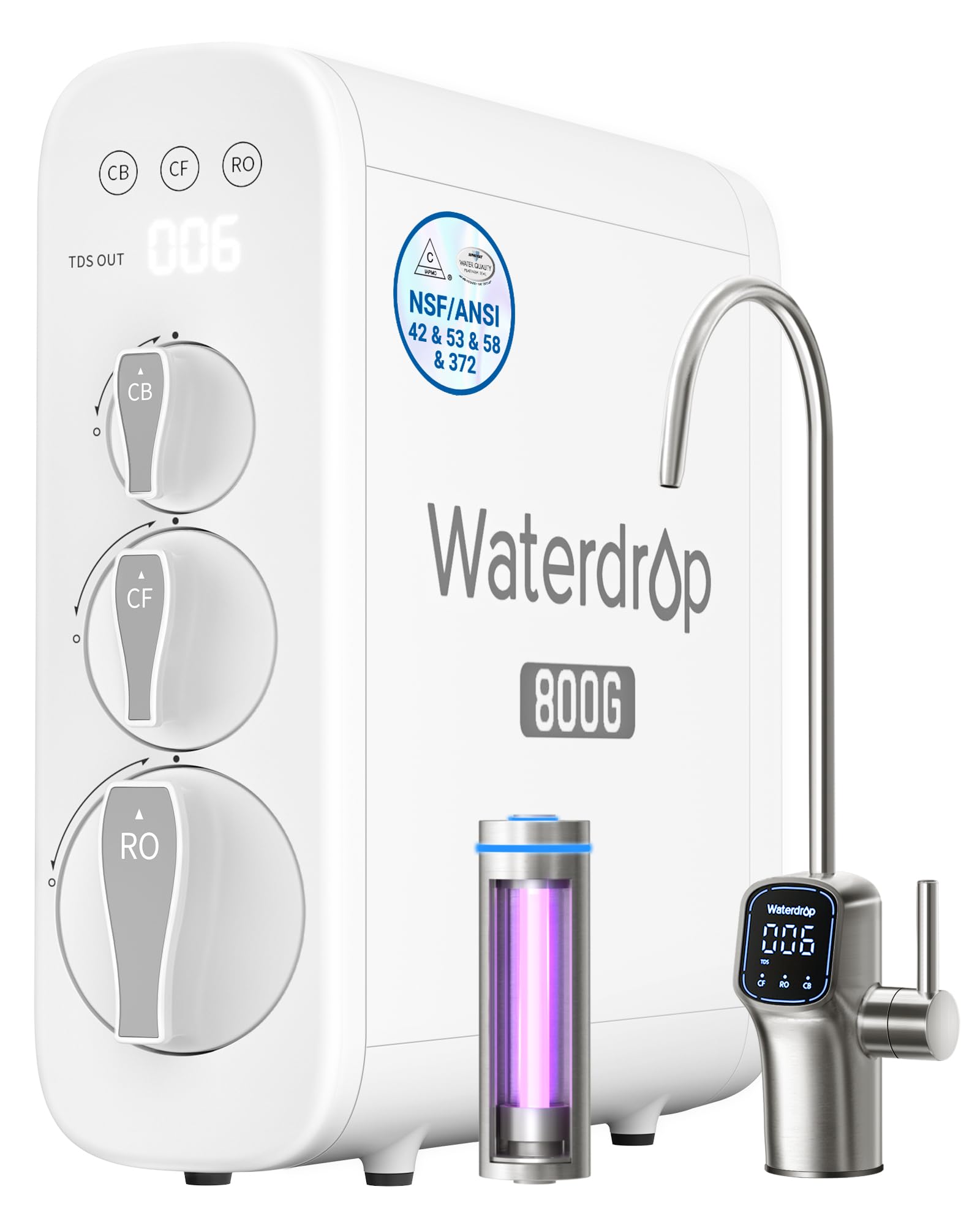
The Waterdrop G3P800 is the highest-capacity unit in this lineup, pushing 800 gallons per day with a 3:1 pure-to-drain ratio and a full suite of NSF certifications covering chlorine reduction (42), contaminant reduction (53), TDS reduction (58), and lead-free materials (372). Its 10-stage filtration includes a remineralization filter that produces water with a TDS reading typically between 6 and 20 ppm from a tap reading of 150 ppm or higher — verified by multiple long-term users.
The smart faucet displays real-time TDS levels and filter life, with a high-visibility LED that activates during water flow and has a rated lifespan of 50 years. Installation requires two drilled holes — one for the faucet and one for the drain connection — and a power outlet. Once installed, filter changes are twist-and-push, taking under five seconds per cartridge. Owners who connected the system to their refrigerator’s ice maker reported crystal-clear ice and improved beverage taste.
A small number of units arrived with a damaged UV sterilizer or a pinhole in tubing, but Waterdrop’s customer support team responded quickly with replacements. The pump noise is barely audible inside a closed cabinet. For families needing high-volume, certified filtration with a polished user interface, the G3P800 is a premium long-term investment.
Why it’s great
- 800 GPD capacity means you’re never waiting for a refill, even with fridge ice maker demand.
- Four separate NSF certifications provide the most thorough validation on this list.
- Smart faucet with TDS display and long-life LED gives instant feedback on water quality.
Good to know
- Requires professional installation or advanced DIY skills — two holes to drill.
- Replacement filters are proprietary and cost more than generic alternatives.
3. Home Master TMHP HydroPerfection

The Home Master TMHP HydroPerfection is a serious investment for anyone who wants the most thorough filtration possible. Its nine-stage process includes a patented two-pass alkaline remineralization system that adds calcium and magnesium back into the water after RO stripping, resulting in a finished product that tastes noticeably softer and cleaner than single-pass remineralizers. The UV sterilizer is EPA-registered (97952AZ1), providing an additional 99.9 percent kill rate on microorganisms.
Users report feed water TDS levels dropping from around 430 ppm to about 25 ppm with a membrane rejection rate above 97 percent. The non-electric permeate pump achieves a 1:1 waste ratio without consuming power, which is rare among systems in this class. Installation is straightforward thanks to color-coded tubing and push-to-connect fittings, and the annual filter change is simple enough for most homeowners. The included iron prefilter extends RO membrane life in areas with high sediment.
Customer service receives near-universal praise for replacing UV bulbs under warranty and providing responsive technical support. The system comes with a 2,000-gallon capacity rating, meaning replacement intervals are generous. It does require under-sink space and electrical access, and the permeate pump makes a soft rhythmic sound that some users find noticeable. For pure health-conscious performance, this system is hard to beat.
Why it’s great
- Two-pass remineralization restores mineral balance better than single-stage alkaline filters.
- EPA-registered UV sterilization adds germ-killing confidence.
- Non-electric permeate pump achieves 1:1 waste ratio with zero power draw.
Good to know
- Bulky under-sink footprint — measure your cabinet space carefully before ordering.
- Permeate pump emits a soft humming noise during operation.
4. SimPure T1-400ALK

The SimPure T1-400ALK is one of the most cost-effective ways to get mineral-enhanced alkaline water from an under-sink RO system. It combines a 400 GPD tankless design with UV sterilization and a dedicated alkaline remineralization filter that enriches water with calcium, magnesium, and potassium. The result is water with a higher pH and noticeably improved mouthfeel compared to standard RO output, without the steep price tag of premium alkaline systems.
SGS testing confirms it meets NSF/ANSI 58 standards for TDS reduction, and users see their feed water drop from 176 ppm to around 70 ppm after filtration — a lower final TDS than standard alkaline filters because the system’s RO membrane does the heavy stripping before the mineral stage. The tankless housing saves significant under-sink space and prevents bacterial growth associated with storage tanks. Installation takes roughly an hour and requires a dedicated faucet hole and power outlet.
Some users reported that the alkaline filter is modular, meaning you can swap it for a standard T33 filter if you prefer near-zero TDS water instead. A minority experienced pump noise louder than expected, and one user documented a defect that caused nitrate breakthrough after a month. SimPure’s US-based support team in Seattle handles replacements promptly. For the price, the T1-400ALK offers unusual flexibility between alkaline and standard RO modes.
Why it’s great
- Alkaline remineralization adds back essential minerals for improved taste and pH balance.
- UV sterilization provides microbiological protection at no extra cost.
- Modular filter design lets you switch between alkaline and standard RO filtration.
Good to know
- TDS will not reach zero ppm — expect 50–80 ppm due to mineral addition.
- Some units produce noticeable pump vibration under the sink.
5. SimPure T1-400UV

If your goal is the purest possible water without any mineral aftertaste, the SimPure T1-400UV delivers near-zero TDS — users report readings between 0 and 14 ppm from tap water starting at 180–270 ppm. Its eight-stage filtration includes a UV sterilizer that activates automatically based on water flow, and the tankless design fits neatly into tight under-sink spaces. SGS certification against NSF/ANSI 58 confirms it removes over 99.99 percent of 1,000+ contaminants.
The built-in booster pump maintains consistent pressure even in homes with low incoming water pressure, and the 400 GPD output fills a standard glass in about 12 seconds. The 1.5:1 pure-to-drain ratio is respectable, though not as efficient as the 3:1 or 5:1 units on this list. Installation is straightforward for intermediate DIYers, though the included O-rings on early units were prone to damage — several users reported that the four filter O-rings arrived cracked, causing leaks. SimPure includes spare O-rings in the package, and once properly seated, the system runs leak-free.
Long-term users praise the system’s ability to completely eliminate chlorine taste and odor, with one reviewer noting that after 1.5 years, TDS remained at 10–14 ppm with no bacterial growth in stored water bottles. The filter set lasts roughly 12 months for a family of four, and replacements are reasonably priced. If you want the closest thing to distilled water from your tap without buying a distiller, this is the most practical option.
Why it’s great
- Achieves near-zero TDS readings consistently, rivaling distilled water quality.
- UV sterilization adds microbial protection without additional cartridges.
- Compact tankless design saves 50 percent or more under-sink space versus tank systems.
Good to know
- O-rings on the filter canisters may arrive damaged — inspect and replace before installation.
- Requires a 1–2 minute initial flush each morning to clear TDS creep from the membrane.
6. Waterdrop D6
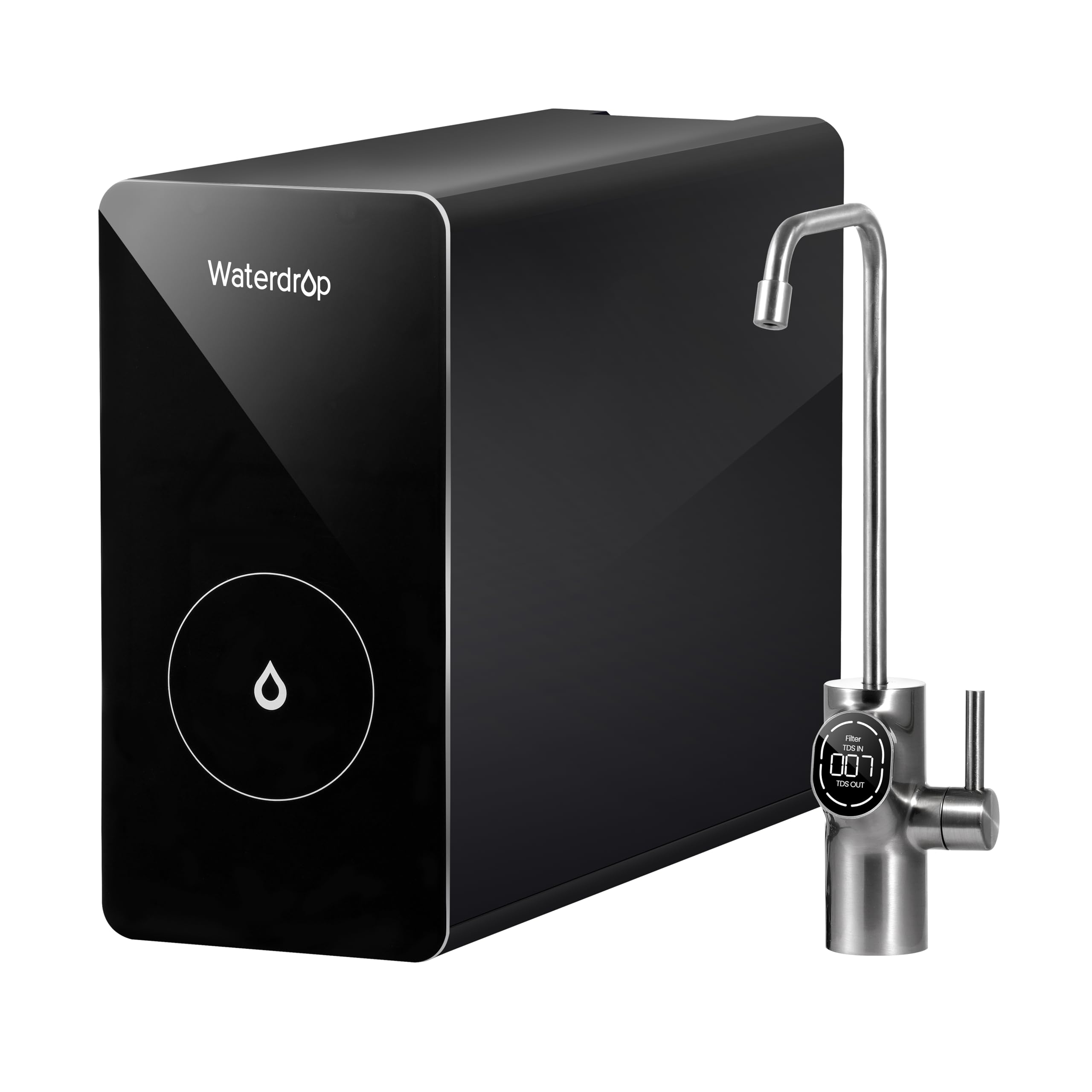
The Waterdrop D6 has been a reliable mid-range option for years, and for good reason. Its 600 GPD flow rate fills a cup in roughly 8 seconds, and the six-stage composite filter uses a 0.0001-micron RO membrane to reduce chlorine, microplastics, salt, and radioactive substances like radium. The smart faucet displays real-time TDS and remaining filter life, with a waterproof screen that eliminates electrical leakage worries.
The tankless design saves roughly 70 percent of under-sink space compared to traditional tank systems, and the push-in filter replacement takes about two seconds without moving the unit. Users report TDS dropping from 400 ppm to around 25 ppm, though the system takes about a minute of steady flow to stabilize readings after initial startup. The 2:1 pure-to-drain ratio is good but not best-in-class — expect one cup of wastewater for every two cups of pure water produced.
Installation requires a power outlet, a drilled hole for the faucet, and a drain connection. A few users noted that the included water line is thick and may need the plastic end trimmed to fit the push-connect fittings. The pump produces a low hum during operation that some owners muffle with a foam pad. At this price point, the D6 offers the best balance of certified filtration, flow speed, and compact footprint for families who don’t need alkaline remineralization.
Why it’s great
- 600 GPD flow rate is genuinely fast for an under-sink system — 8 seconds per cup.
- Six-stage filtration includes reduction of radium and microplastics, not just basic contaminants.
- Smart faucet display is waterproof and provides real-time TDS and filter life data.
Good to know
- 2:1 pure-to-drain ratio is decent but not as water-efficient as newer 3:1 models.
- Some users report the pump noise is noticeable inside the cabinet during operation.
7. Stokk S2 Tankless

The Stokk S2 delivers an 800 GPD flow rate — among the fastest in this roundup — with a 3:1 pure-to-drain ratio that keeps water waste low. Its eight-stage filtration uses a 0.0001-micron RO membrane and claims to remove 99.99 percent of 1,000+ contaminants including PFOA, PFOS, and fluoride. The smart display faucet shows live TDS readings and tracks remaining filter life, and the tankless design cuts under-sink space requirements by half compared to traditional tank systems.
Installation is rated as moderately difficult and takes about an hour for most DIYers. The system requires an electrical outlet, a drilled hole for the smart faucet, and a drain saddle connection. Users report TDS readings dropping from roughly 160 ppm to 8–12 ppm after a 30- to 60-second flush, though the initial startup does need a brief purge to stabilize TDS. The 24/7 water cycle timed flush feature keeps the membrane clean and eliminates the need to discard the first glass of water each morning.
The main concern raised by long-term owners is filter availability and cost. Replacement cartridges are proprietary and priced near the cost of the original system — one customer noted that filters run around , which is steep for a system. Stokk’s US-based support team is responsive, but the high recurring cost is a practical drawback. For buyers who want maximum GPD at a mid-range entry price and don’t mind paying for proprietary filters later, the S2 performs well initially.
Why it’s great
- 800 GPD flow rate fills a cup in about 5 seconds — one of the fastest available.
- 3:1 pure-to-drain ratio is water-efficient and reduces wastewater significantly.
- Automatic timed flush extends RO membrane life and prevents morning TDS creep.
Good to know
- Proprietary filter replacements cost roughly as much as the system itself after the first year.
- Requires drilling two holes for faucet and drain; not ideal for renters.
8. Aigerri UV Countertop
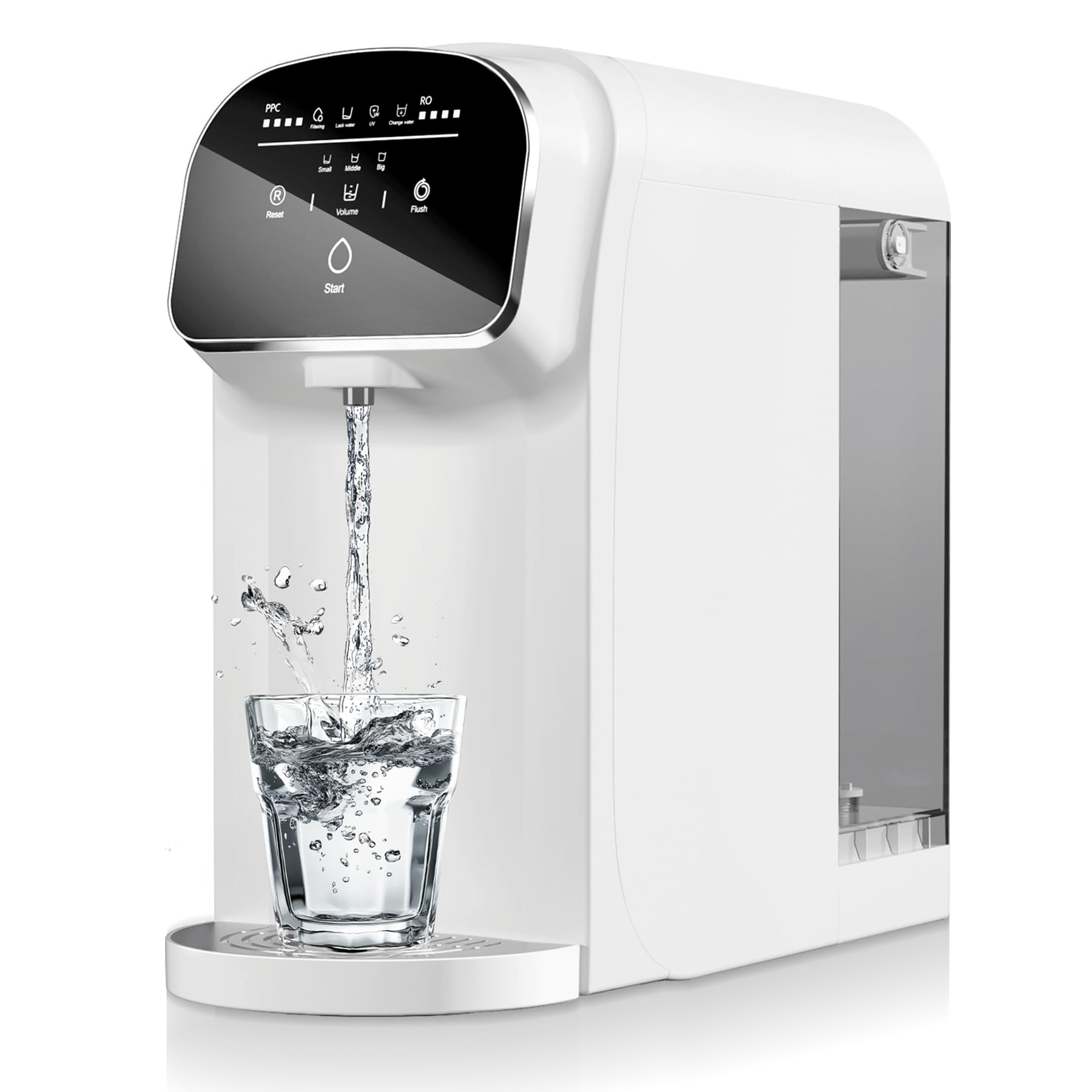
The Aigerri UV Countertop RO system stands out for its industry-leading 5:1 pure-to-wastewater ratio — for every five cups of purified water, only one cup goes down the drain. That’s a dramatic improvement over traditional 1:1 or 1:3 systems and makes this the most water-conserving option on the list. It uses a five-stage RO filtration process plus UV sterilization, and with a 5-liter raw water reservoir and 2-liter purified tank, it can produce up to 529 gallons before filters need changing.
No installation is required — just plug it in, fill the top tank with tap water, and select your volume. The control panel is intuitive, and the system automatically self-cleans. Users coming from more expensive countertop brands like Waterdrop or AquaTru report that the Aigerri delivers comparable water taste and clarity at a significantly lower upfront cost. The UV light provides an extra layer of protection against bacteria, making it suitable for well water or questionable municipal supplies.
The main trade-off is speed. Countertop RO systems are inherently slower than under-sink models, and the Aigerri’s flow rate is moderate — expect to wait several minutes to fill the 2-liter tank. The unit stands about 22 inches tall with the lid open, so verify your cabinet clearance before placing it on a counter under upper cabinets. Some users found the control panel very sensitive to touch. For eco-conscious renters or small households, this is the most efficient countertop RO available.
Why it’s great
- 5:1 pure-to-drain ratio is the most water-efficient of any RO system reviewed here.
- UV sterilization combined with RO provides dual protection against contaminants and microbes.
- Zero plumbing or drilling required — fully portable, ideal for renters.
Good to know
- Flow rate is slower than under-sink systems; filling the 2-liter tank takes patience.
- Requires 22 inches of vertical clearance with the lid open — not suitable for low cabinets.
9. DREO RO Filter 112
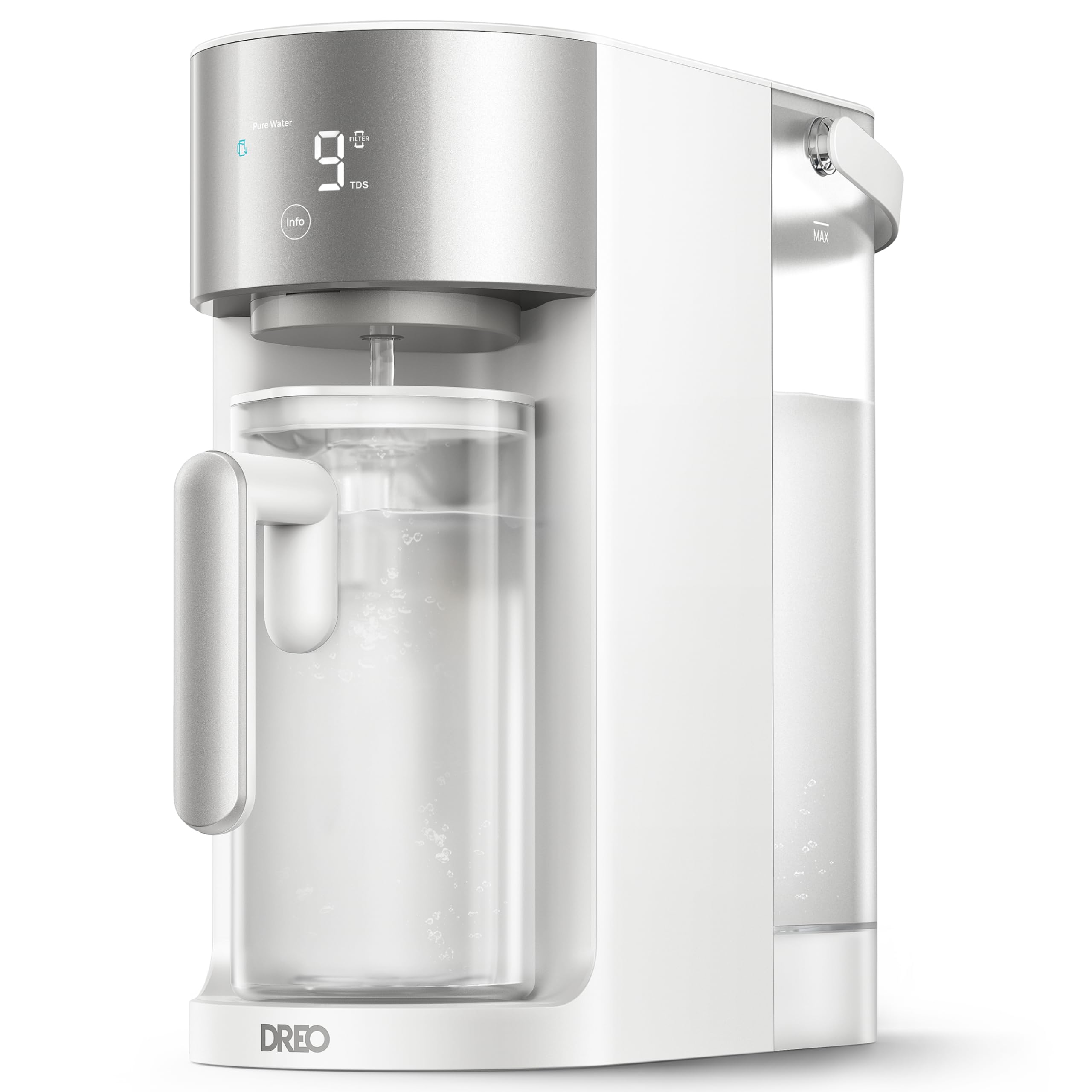
The DREO RO Filter 112 is a countertop system designed for simplicity and small spaces. It combines a 3-liter raw water tank with a 1.1-liter auto-fill pitcher, and its slim footprint (14.5 x 6.7 x 13.4 inches) fits on cramped countertops. SGS testing confirms it meets NSF/ANSI 58 standards for removing 1,000+ impurities including PFOA, PFOS, chlorine, and fluoride — a solid performance for an entry-level unit.
Users report that TDS drops from 375–450 ppm to as low as 12–50 ppm, and the water noticeably loses that chlorine smell and metallic taste. The auto-fill sensor triggers hands-free refills, and the self-cleaning system flushes internal tubes automatically. The 3:1 pure-to-drain ratio is competitive with mid-range under-sink units, and the filter lasts between 6 and 12 months depending on usage. Replacement filters cost roughly 5 per bottle equivalent, making it economical over time.
The biggest limitation is output speed. Filtering takes time — roughly one liter per cycle — and the two-jug system helps by letting you rotate between the purifier and the pitcher. Some users noted TDS readings fluctuate during the fill cycle, spiking above 50 ppm before stabilizing. For one or two people, the DREO is a perfectly capable, no-plumbing entry into RO water. For larger families, the small tank capacity means frequent refills.
Why it’s great
- Minimal countertop footprint — 6.7 inches wide, fits almost anywhere.
- No installation needed; just plug in and add tap water to the reservoir.
- Auto-fill pitcher and self-cleaning system reduce daily maintenance.
Good to know
- Slow filtration speed — the 1.1-liter pitcher takes time to refill completely.
- Total capacity (3L raw + 1.1L purified) is best suited for 1–2 people.
FAQ
Does a reverse osmosis system remove beneficial minerals from water?
How do I know if my home water pressure is high enough for a tankless RO system?
What is TDS creep and does it affect every RO system?
Can I connect a reverse osmosis system to my refrigerator’s ice maker?
How often do I need to replace filters on a home reverse osmosis system?
Final Thoughts: The Verdict
For most users, the reverse osmosis water filter for home winner is the iSpring RO500AK-BN because it combines NSF 58 certification, a fast 500 GPD flow rate, alkaline remineralization, and a 2:1 waste ratio in a compact tankless package that fits most cabinets. If you want the absolute highest water conservation with zero installation hassle, grab the Aigerri UV Countertop. And for the most comprehensive health-focused filtration with UV sterilization and two-pass mineral restoration, nothing beats the Home Master TMHP HydroPerfection.