A high-end chef knife isn’t just a tool; it’s the primary interface between your hand and the ingredient. The difference between a blade that glides through a tomato skin without crushing the flesh and one that requires a forceful push is measured in steel grain structure, edge angle precision, and handle ergonomics that absorb fatigue across a five-hour prep session. This category demands you look past flashy marketing and instead scrutinize Rockwell hardness, blade geometry, and the specific alloy composition that dictates edge retention.
I’m Mohammad Maruf — the founder and writer behind AirfryerBite. I have spent years dissecting the metallurgy, construction methods, and real-world performance data of premium cutlery to help cooks make informed decisions that genuinely upgrade their time in the kitchen.
Whether you are a professional chef building a lifetime kit or a dedicated home cook ready to move beyond stamped blades, finding the right best high-end chef knife means understanding that a higher price tag only translates to better performance if the core materials and craftsmanship match your cutting style.
How To Choose The Best High-End Chef Knife
Selecting from dozens of forged blades requires filtering by steel type, edge angle, handle ergonomics, and your own cutting habits. A premium knife is a long-term investment—here is what separates a wise purchase from an expensive mistake.
Steel Core and Hardness Rating
The heart of any high-end chef knife is its steel alloy. VG-MAX, SG2 powder steel, and FC61 fine carbide steel each offer a distinct balance of hardness and toughness. Look for a Rockwell hardness rating between 58 HRC (German-style, tougher and easier to sharpen) and 63 HRC (Japanese-style, holds a finer edge longer but can be more brittle). A blade that is too soft will need constant honing; one that is too hard may chip on a butternut squash.
Blade Geometry and Edge Angle
Japanese knives typically feature a 9.5- to 16-degree edge angle, producing razor-like sharpness ideal for precision cuts on proteins and vegetables. German knives often use a broader 20-degree angle, trading some sharpness for increased edge durability against hard chopping. The blade grind—convex, hollow, or flat—also dictates how food releases from the blade and how the edge engages with the cutting board.
Handle Construction and Balance
A full-tang construction, where the steel extends through the entire handle, provides better balance and durability. Handle materials like oiled Pakkawood, Karelian Birch, or textured polypropylene each offer different levels of moisture resistance and grip security. The shape should fill your palm naturally without hot spots, especially during extended prep sessions.
Layered Construction and Aesthetics
Many high-end knives use Damascus cladding—multiple layers of steel folded around a harder core. While the layered pattern is visually striking, its functional purpose is to help food release from the blade and to add a degree of corrosion resistance to the core steel. The number of layers (often between 67 and 100) affects the pattern detail but does not directly improve cutting performance on its own.
Quick Comparison
On smaller screens, swipe sideways to see the full table.
| Model | Category | Best For | Key Spec | Amazon |
|---|---|---|---|---|
| Miyabi Birchwood SG2 | Japanese | Ultimate edge retention | 100-layer Damascus, 63 HRC | Amazon |
| Wüsthof Performer 8″ | German | DLC-coated durability | DLC coating, 104 Rockwell surface | Amazon |
| Shun Classic Blonde 3-Piece Set | Japanese Set | Versatile starter set | 68-layer Damascus, 16° edge | Amazon |
| Shun Premier Blonde Kiritsuke | Japanese | Specialty flat-top slicing | VG-MAX core, hammered finish | Amazon |
| Wüsthof Classic 2-Piece Set | German Set | Traditional German value | PEtec edge, 58 HRC | Amazon |
| Miyabi Koh 8″ | Japanese | Entry-level Japanese precision | FC61 steel, 61 HRC | Amazon |
| HexClad Chef’s Knife 8″ | Japanese Hybrid | Damascus build at mid-range | 67-layer, 12° Honbazuke edge | Amazon |
| HOSHANHO 16-Piece Knife Set | Japanese Set | Complete block with sharpener | 10Cr15CoMoV, 58 HRC | Amazon |
| HexClad 6-Piece Essential Set | Japanese Set | Multiple blade types | 67-layer, full tang, honing rod | Amazon |
In‑Depth Reviews
1. Miyabi Birchwood SG2 Japanese Chef’s Knife, 8-inch

The Miyabi Birchwood SG2 represents the pinnacle of Japanese cutlery engineering, pairing a 100-layer flower Damascus pattern with an SG2 micro-carbide powder steel core that hits a remarkable 63 Rockwell hardness. This alloy composition allows for an exceptionally thin blade geometry and a hand-honed Honbazuke edge ground to a 9.5- to 12-degree angle—sharper than nearly any production knife on the market. The Karelian Birch handle is not only visually striking but also naturally moisture-resistant, offering a secure grip even during prolonged prep sessions. This blade glides through salmon skin and butternut squash with equal authority, making it a true workhorse for the serious cook.
The 8-inch profile balances tip agility for fine work like brunoise shallots with enough belly for rock-chopping herbs. The SG2 steel is sintered, meaning its carbide structure is ultra-fine and uniform, which translates to extended edge retention between sharpening sessions. Owners report needing only periodic honing on a ceramic rod before the edge begins to fade—a testament to the powder metallurgy at play. The level of finish on the blade spine and choil is smooth, eliminating hot spots during pinch-grip use.
This knife does require careful maintenance. Hand washing is mandatory, and the thin edge profile demands a cutting board made of wood or soft synthetic—glass or stone boards will cause micro-chipping. The Birchwood is a premium, single-blade investment aimed at cooks who value precision over brute force and are willing to develop a more careful cutting technique to maximize the blade’s lifespan. It is the clear standard-setter in this lineup for pure cutting performance.
Why it’s great
- SG2 powder steel holds a super-fine edge longer than any alloy in this guide
- 9.5-12° Honbazuke edge delivers unmatched initial sharpness
- Karelian Birch handle combines beauty with functional moisture resistance
Good to know
- Requires gentle technique and a soft cutting board to avoid chipping
- Hand wash only; not dishwasher safe
2. Wüsthof Performer 8″ Chef’s Knife

The Wüsthof Performer breaks from traditional German knife design by adding a diamond-like carbon (DLC) coating to its high-carbon stainless steel blade, pushing the surface hardness to a staggering 104 Rockwell. This coating creates what Wüsthof calls the lotus effect—reducing friction so food releases effortlessly while also resisting scratches, acids, and alkalis. The blade core itself is the same Precision Edge Technology (PEtec) found in the Classic line, tempered to 58 HRC, but the DLC layer transforms how the knife interacts with ingredients and how it withstands aggressive kitchen environments.
The handle is where the Performer truly innovates. The Hexagon Power Grip features a non-slip, offset honeycomb texture that locks into your palm even when wet or greasy. This is a massive advantage during high-volume slicing of raw proteins or oily vegetables where handle security is non-negotiable. The 8-inch blade profile is the classic German chef’s shape—a gentle curve that facilitates rock-chopping without catching on the board. The full tang construction runs through the stainless steel handle, creating a perfectly balanced tool that feels heavier than its weight suggests.
The DLC coating does add a layer of maintenance consideration. While it is extremely hard and wear-resistant, the blade should not be subjected to metal honing rods that could scratch the coating over time. Ceramic or diamond honing rods are recommended for edge maintenance. This is a premium knife built for cooks who prioritize durability, corrosion resistance, and a secure grip over the ultra-thin edge of a pure Japanese blade. It is the toughest knife in this roundup by a significant margin.
Why it’s great
- DLC coating provides unmatched surface hardness and corrosion resistance
- Hexagon Power Grip handle locks in wet hands
- Lotus-effect release prevents food from clinging to the blade
Good to know
- Requires ceramic or diamond honing rod to avoid scratching DLC coating
- Heavier feel than thin Japanese blades
3. Shun Classic Blonde 3 Piece Starter Set

The Shun Classic Blonde 3-Piece Starter Set brings the versatility of three essential blade profiles—8-inch chef, 6-inch utility, and 3.5-inch paring—each forged with VG-MAX steel clad in 68 layers of Damascus stainless steel. The VG-MAX core is a refined version of standard VG-10, with added molybdenum and vanadium for finer carbide distribution and improved edge retention. Each blade is hand-sharpened to a 16-degree edge angle, offering a balance between the razor sharpness of steeper Japanese grinds and the durability required for daily home use.
The blonde Pakkawood handles are D-shaped, ergonomically contoured to fit both right- and left-handed users comfortably. The hammered tsuchime finish on the blade surface is present on each knife, reducing food drag and adding a distinct aesthetic that is immediately recognizable in any kitchen. Having three complementary knives in one set means you can use the chef knife for heavy chopping, the utility knife for intermediate tasks like slicing bell peppers or trimming chicken, and the paring knife for precise peeling and coring work without ever reaching for a serrated blade.
This set is handcrafted in Seki, Japan, and comes supported by Shun’s free sharpening service—a significant value add that extends the life of each blade. Like all high-end Japanese knives, these must be hand-washed and should never go in a dishwasher. The 16-degree edge is less brittle than the 9.5-degree edge on the Miyabi Birchwood, making this set a more forgiving entry point for cooks transitioning from German knives. It is the most well-rounded single purchase in this guide for someone building a core knife kit from scratch.
Why it’s great
- Three essential blade sizes cover nearly all kitchen prep tasks
- VG-MAX steel with 68-layer Damascus offers excellent edge retention
- Free sharpening service adds long-term value
Good to know
- Hand wash only; not dishwasher safe
- 16-degree edge still requires careful board selection
4. Shun Premier Blonde 8″ Kiritsuke Knife
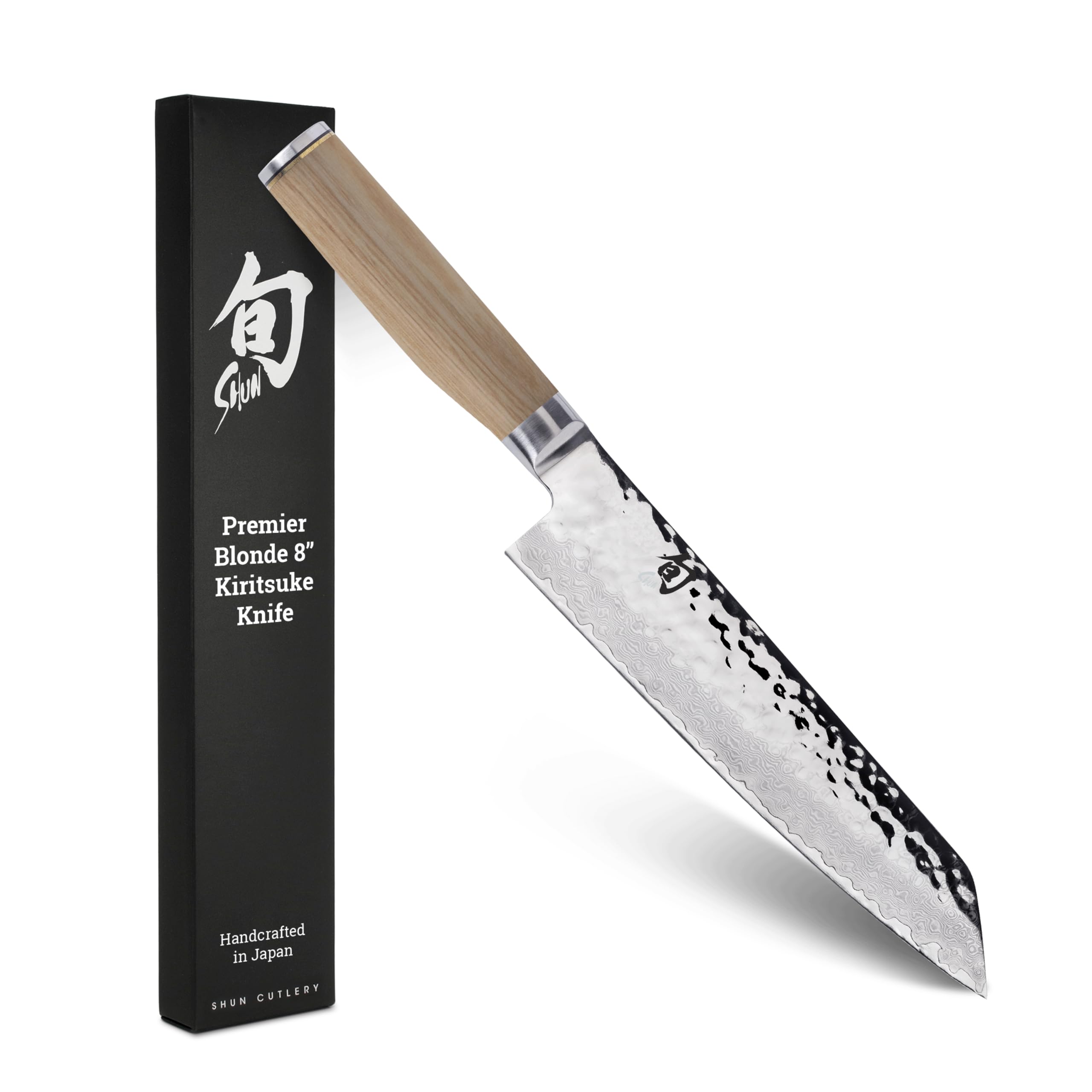
The Shun Premier Blonde Kiritsuke adapts a traditional Japanese blade profile that combines a flat edge perfect for push-cutting vegetables with a slight curve for rocking action on boneless proteins. This 8-inch knife features a VG-MAX core surrounded by 68 layers of Damascus cladding, with a distinctive hammered tsuchime finish that reduces surface tension so sliced foods peel away from the blade rather than sticking. The 16-degree edge angle hits the sweet spot between aggressive sharpness and practical durability for a variety of kitchen tasks.
The blonde Pakkawood handle is contoured with a subtle D-shape that fills the palm evenly, reducing hand fatigue during repetitive slicing tasks. The Kiritsuke profile is particularly effective for horizontal cuts through onions or celery, as the flat blade edge makes full contact with the cutting board without creating angled slices. The hammered finish is not just cosmetic—it creates tiny air pockets between the blade and the food, which significantly reduces drag when slicing through dense vegetables like sweet potatoes or large carrots.
This is a single-blade purchase for cooks who want a specialty profile that can still serve as an all-purpose tool. The Kiritsuke’s flat top does make it less suitable for rock-chopping herbs compared to a traditional chef knife with a curved belly. The VG-MAX steel responds well to honing and sharpening, but the blade is best maintained with a ceramic rod or whetstone. It is a beautiful, performance-oriented knife that excels at precision vegetable work and clean protein slicing.
Why it’s great
- Kiritsuke flat edge excels for push-cutting vegetables
- Hammered tsuchime finish actively reduces food sticking
- VG-MAX core with 68-layer Damascus provides long-lasting sharpness
Good to know
- Flat top profile limits rock-chopping motion
- Requires dedicated maintenance and hand washing
5. Wüsthof Classic 2-Piece Chef’s Knife Set

The Wüsthof Classic 2-Piece Set delivers the benchmark German knife experience with an 8-inch chef knife and a 3.5-inch paring knife, both forged from a single block of high-carbon stainless steel and tempered to 58 HRC. The Precision Edge Technology (PEtec) produces a blade that is 20% sharper than previous Wüsthof generations, with edge retention that holds up through heavy daily use. The full tang, triple-riveted synthetic polypropylene handle is heat- and impact-resistant, making this set a durable workhorse that can survive the rigors of a busy home kitchen.
The 8-inch chef knife features the classic German profile—a generous belly that facilitates rock-chopping, a sturdy spine that can handle light cleaving through chicken bones, and a 20-degree edge angle that resists chipping even on poly cutting boards. The paring knife is an essential complement for peeling, coring, and detail work. The synthetic polypropylene handle has a slightly textured surface that provides a secure grip even when wet, and it will not swell, crack, or discolor over time like natural wood can.
This set is an excellent choice for cooks who prioritize durability and low-maintenance performance over the extreme sharpness of a thin Japanese blade. The 58 HRC steel is easy to sharpen with a standard honing rod and holds a serviceable edge for weeks of regular use. The primary trade-off is that the thicker blade geometry does not slice through ingredients with the same seamless glide as a Japanese knife, but it compensates with unmatched toughness. It is a proven, no-nonsense classic that represents the best of German engineering.
Why it’s great
- Forged high-carbon steel at 58 HRC is tough and easy to sharpen
- PEtec edge offers 20% sharper performance than older models
- Synthetic handle resists heat, impact, and fading
Good to know
- Thicker blade profile does not slice as cleanly as Japanese alternatives
- Only includes two knives—no utility or bread option
6. Miyabi Koh 8-inch Chef’s Knife
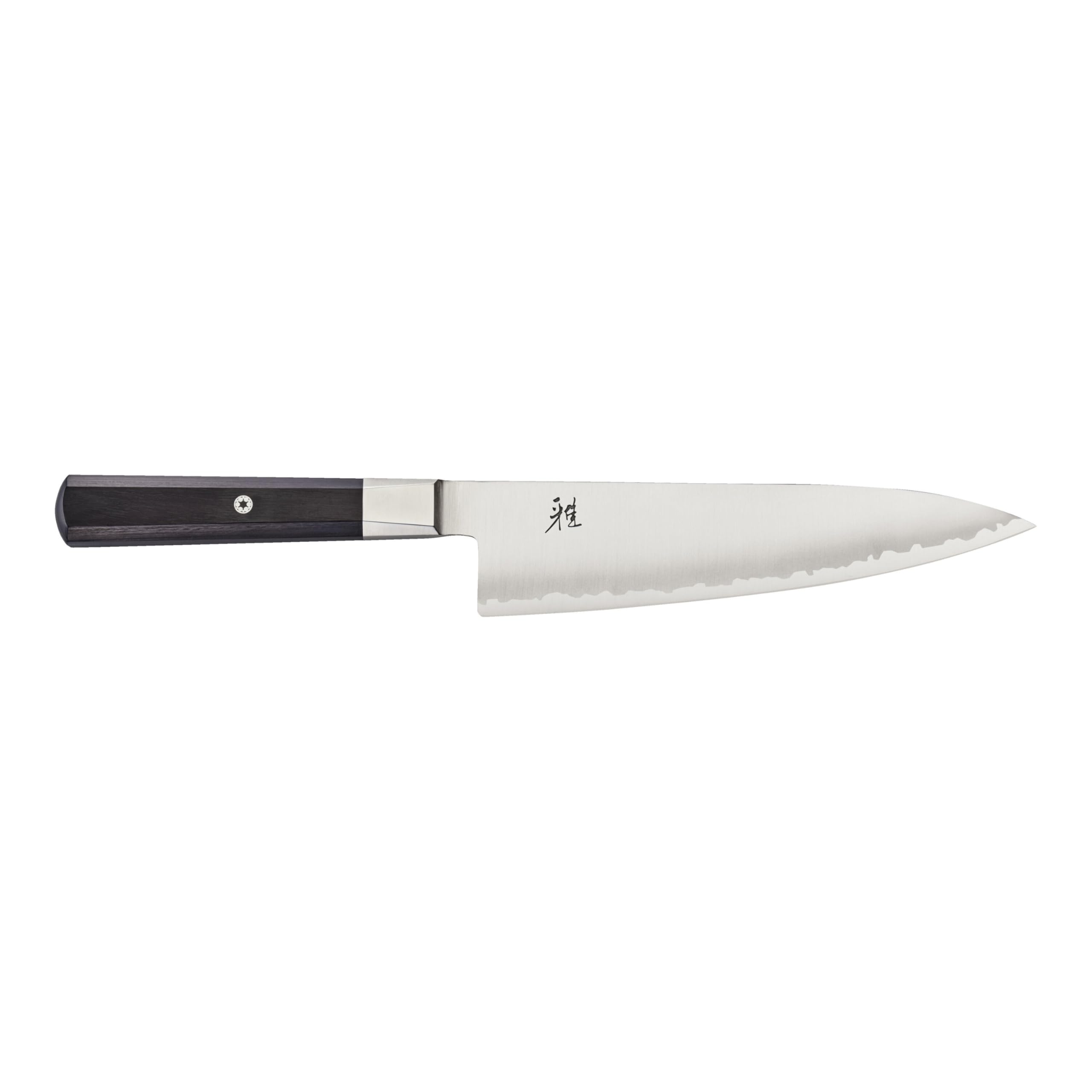
The Miyabi Koh introduces revolutionary FC61 fine carbide stainless steel—a proprietary alloy that achieves 61 Rockwell hardness, placing it above most German knives in edge retention while remaining tougher than SG2 powder steel. The blade undergoes the FRIODURx2 ice-hardening process, which increases both durability and corrosion resistance. Each blade is hand-honed using the Honbazuke method, producing a scalpel-like 9.5- to 12-degree edge angle that is characteristic of Miyabi’s higher-end lines.
The Koh’s handle is crafted from layered Pakkawood with a classic D-shape that provides a secure pinch grip. The blade features a sandblasted katana edge and an embossed MIYABI logo, subtle details that reflect the Seki, Japan manufacturing heritage. At 8 inches, the blade is nimble enough for intricate work on mushrooms and garlic while still offering enough length for slicing through large cuts of meat. The FC61 steel’s fine carbide structure means the edge lasts significantly longer between sharpenings than standard VG-10 alloys.
The Koh sits at an accessible price point for cooks who want authentic Japanese blade geometry without the premium cost of SG2 or VG-MAX knives. The primary consideration is that the thin 9.5-12° edge, while exceptionally sharp, is more susceptible to chipping on hard cutting boards or when cutting through dense squash. A wooden or soft plastic board is essential, and hand washing is mandatory. For the price, it offers a dramatic upgrade in cutting performance over most sub-premium knives.
Why it’s great
- FC61 steel at 61 HRC delivers excellent edge retention for the price
- FRIODURx2 ice-hardening boosts durability and corrosion resistance
- Hand-honed Honbazuke edge is exceptionally sharp
Good to know
- Thin edge needs a soft cutting board to avoid chipping
- Hand wash only; not dishwasher safe
7. HexClad Chef’s Knife, 8-Inch Japanese Damascus

The HexClad 8-inch Chef’s Knife brings 67 layers of Damascus steel with a Japanese geometry to a mid-range price point, utilizing the three-step Honbazuke heat treatment process to achieve a sharp 12-degree cutting edge. The steel formulation prioritizes a combination of hardness and flexibility, making the blade less brittle than many pure Japanese knives while still delivering a noticeably sharper cut than standard stamped blades. The Pakkawood handle is ergonomically shaped and features anti-shrinking technology for long-term dimensional stability.
The blade measures 7.5 inches with a total length of 12.8 inches, offering a balanced feel that favors precision over heavy chopping. The Damascus layers create a visible pattern on the blade surface that also aids in food release. The 12-degree edge angle places it squarely in Japanese territory, but the steel formulation is tuned to resist micro-chipping better than some harder alloys. This makes it a practical choice for cooks who want the aesthetic and sharpness of a Damascus blade without the extreme fragility of a 63 HRC knife.
HexClad backs this knife with a lifetime warranty against manufacturer’s defects, though damage from dishwasher use, hard cutting surfaces, or improper storage voids the coverage. The blade does require frequent honing to maintain its edge, and hand washing is essential. It is a solid mid-range option that brings premium aesthetics and respectable cutting performance to cooks who are not yet ready to invest in a higher-end Japanese blade. The biggest compromise is in long-term edge retention compared to SG2 or VG-MAX steels.
Why it’s great
- 67-layer Damascus construction at a mid-range price point
- 12° Honbazuke edge provides genuine Japanese-level sharpness
- Pakkawood handle with anti-shrinking technology adds durability
Good to know
- Edge retention does not match premium VG-MAX or SG2 steels
- Requires frequent honing to maintain performance
8. HOSHANHO 16-Piece Knife Set, Japanese High Carbon Stainless Steel

The HOSHANHO 16-Piece Set provides a complete kitchen cutlery solution with Japanese 10Cr15CoMoV stainless steel blades that reach 58 HRC after high-temperature forging. This alloy is rich in chromium, molybdenum, vanadium, and cobalt, offering strong stain and rust resistance while maintaining a sharp 15-degree edge angle. The set includes an 8-inch chef knife, 8-inch bread knife, 8-inch carving knife, 7-inch santoku, 7-inch fillet knife, 6-inch utility knife, 3.75-inch paring knife, six 4.5-inch steak knives, a sharpening rod, kitchen shears, and a ventilated knife block.
The handles are made of high-density Pakkawood, shaped to fit the palm naturally and reduce fatigue during extended use. Each blade is sharpened using what the manufacturer describes as the latest sharpening technology, which produces a consistent 15-degree angle that balances sharpness with edge durability. The ventilated knife block design allows air circulation to prevent moisture buildup, a practical feature for long-term storage in humid kitchens. The included sharpening rod is a useful addition for daily edge maintenance.
This set is aimed at cooks who want a complete knife collection, including steak knives and specialty blades, in a single purchase. The 10Cr15CoMoV steel performs well for its hardness class, though it does not match the edge retention of VG-MAX or SG2 alloys found in premium single knives. The set is best suited for home cooks who need variety and are willing to sharpen the blades more frequently than owners of higher-end steel. The inclusion of a bread knife and fillet knife makes this a genuinely versatile block for all kitchen tasks.
Why it’s great
- Complete 16-piece block covers every kitchen cutting task
- 10Cr15CoMoV steel offers good stain resistance and durability
- Ventilated block design prevents moisture buildup
Good to know
- Steel does not match edge retention of premium single-blade options
- Steak knives and shears add bulk to a set focused on prep knives
9. HexClad Essential Knife Set, 6-Piece, Japanese Damascus

The HexClad Essential 6-Piece Set assembles five essential blade profiles plus a 9-inch honing rod, all featuring 67-layer Damascus stainless steel construction with a 12-degree Honbazuke edge. The set includes an 8-inch chef knife, 8-inch bread knife, 6-inch boning knife, 5-inch utility knife, 3.5-inch paring knife, and the honing rod. Full tang construction with triple rivets runs through each Pakkawood handle, providing balanced weight distribution and durability. The handles incorporate anti-shrinking technology to prevent the wood from separating from the tang over time.
The three-step Honbazuke heat treatment applied to each blade achieves the same 12-degree edge angle as the single HexClad chef knife, ensuring consistent cutting performance across the set. The boning knife is a particularly valuable addition for cooks who frequently break down poultry or trim meat, as its flexible blade can navigate joints while maintaining a sharp edge. The bread knife features a serrated edge that cuts through crusty loaves without crushing the crumb. The Pakkawood handles are contoured but not ergonomically specialized for left- or right-handed users.
This set is ideal for cooks who want a coordinated collection of Damascus knives without purchasing each blade separately. The steel formulation is the same as the single HexClad chef knife, meaning edge retention is respectable but will require more frequent honing than premium Japanese alloys. The set does not come with a storage block, so a magnetic strip or knife roll is recommended. It represents a solid mid-range investment for a cohesive Damascus set, with the honing rod being a practical addition for daily maintenance.
Why it’s great
- Five Damascus blades plus honing rod in one coordinated set
- Full tang construction with anti-shrinking Pakkawood handles
- Consistent 12-degree edge angle across all blades
Good to know
- No storage block or knife roll included
- Edge retention requires more frequent honing than SG2/VG-MAX alloys
FAQ
What Rockwell hardness should I look for in a high-end chef knife?
Is a Damascus steel blade actually sharper than a non-layered blade?
Can I use a high-end Japanese chef knife on a glass cutting board?
Final Thoughts: The Verdict
For most users, the best high-end chef knife winner is the Miyabi Birchwood SG2 because its SG2 powder steel core and 9.5-12° Honbazuke edge deliver unmatched sharpness and edge retention for precision-focused cooks. If you want extreme toughness and a secure wet-grip handle, grab the Wüsthof Performer. And for a versatile, complete knife kit that covers all essential blades, nothing beats the Shun Classic Blonde 3-Piece Set.