When the morning line at your juice bar stretches past the register, the last thing you need is a machine that chokes on a handful of kale. Commercial cold press juicers are built for throughput, not hobbies — they must handle whole fruits, leafy greens, and fibrous roots without jamming, overheating, or leaving a soggy pulp that wastes your profit margin. The difference between a machine that pays for itself in three months and one that collects dust in the corner comes down to auger material, motor duty cycle, and how aggressively the manufacturer grinds the cellulose.
I’m Mohammad Maruf — the founder and writer behind AirfryerBite. I’ve spent years analyzing the mechanical specs of professional-grade juicing hardware, comparing gear tolerances, horsepower ratings, and stainless steel grades to separate true commercial units from countertop toys with inflated price tags.
Whether you are outfitting a new café or upgrading a tired station, the right best commercial cold press juicer delivers high yield, quiet operation, and continuous runtime that a residential machine simply cannot sustain.
How To Choose The Best Commercial Cold Press Juicer
Buying a commercial cold press juicer is a capital investment, not a casual purchase. The wrong choice means slow service, excessive pulp waste, and a machine that runs hot under a lunch rush. Focus on five mechanical pillars.
Motor Type and Duty Cycle
A residential juicer might run for 15 minutes before needing a cooldown. Commercial units must sustain operation for hours. Look for motors rated for continuous duty — typically 200W to 250W in slow masticating designs, or 1.25 HP in high-speed centrifugal commercial machines. The Kuvings CS600 and the Angel AG-7500 both feature advanced cooling systems that prevent thermal shutdown during back-to-back batches.
Auger and Gear Material
Plastic augers wear down and can leach BPA over time. Serious commercial machines use food-grade stainless steel — SUS-304 for standard durability, SUS-316 surgical grade for maximum corrosion resistance against acidic juices like lemon and ginger. The Angel AG-8500 uses SUS-316 for all wet-contact parts. Ultem and Tritan are acceptable for certain housing components, but the auger and strainer must be metal for daily commercial punishment.
Self-Feeding and Anti-Jamming Systems
Every second spent pushing produce down a chute is labor cost. A self-feeding hopper — like the one on the Hurom H400 — lets you load whole fruits and walk away. Even more critical is the auto-reverse anti-jamming function. When a piece of beet or carrot wedges, a manual reversal requires your attention; an automatic reversal clears the jam and resumes without intervention, a feature standard on both Angel models and absent on many budget-tier machines.
Pulp Dryness and Juice Yield
Commercial margins depend on extraction efficiency. A juicer that leaves wet pulp is throwing your inventory into the trash. Slow masticating technology (50–82 RPM) literally squeezes cellulose like a hand press. The Hurom H320 and Angel AG-8500 both advertise bone-dry pulp, meaning more juice per pound of produce. Compare pulp moisture levels by inspecting customer photos of spent fiber — wet pulp means a lower-yield design.
Ease of Cleaning and Assembly
If a juicer takes 15 minutes to disassemble and scrub, your staff will skip cleanings, leading to clogged strainers and bacterial buildup. Look for strainer-free designs (Hurom H400), dishwasher-safe metal parts (Angel AG-7500), or included brush kits (Kuvings AUTO10). The fastest cleaning cycles come from units with fewer total components and wide-open chambers that don’t trap fiber.
Quick Comparison
On smaller screens, swipe sideways to see the full table.
| Model | Category | Best For | Key Spec | Amazon |
|---|---|---|---|---|
| Angel Juicer AG-8500 | Premium Twin-Gear | Surgical-grade hygiene & max yield | SUS-316, 3 HP, 82 RPM | Amazon |
| Angel Juicer AG-7500 | Premium Twin-Gear | High-volume continuous operation | SUS-304, 3 HP, 82 RPM | Amazon |
| Kuvings CS600 | Commercial Grade | 24/7 operation in busy juice bars | 88mm feed chute, cooling system | Amazon |
| Hurom H400 | Mid-Range Easy Clean | Strainer-free, quick daily cleaning | Self-feeding hopper, 2-part auger | Amazon |
| Hurom H320 | Mid-Range Quiet | Low-noise family/light commercial | Ultem auger, coarse strainers | Amazon |
| Kuvings AUTO10 | Mid-Range Self-Feed | Hands-free operation, large batches | 100 oz capacity, 240W motor | Amazon |
| Robot Coupe J80 Ultra | High-Speed Centrifugal | Fastest throughput for soft produce | 3000 RPM, 1.25 HP, 6.5 Qt | Amazon |
In‑Depth Reviews
1. Angel Juicer AG-8500

The AG-8500 sits at the top of the commercial cold press hierarchy because every wet-contact part is built from SUS-316 surgical-grade stainless steel. That means the twin gears, housing filter, and splash guard resist corrosion from acidic citrus and ginger root far better than standard SUS-304. The 3 HP motor drives the shattering helical gear (SHG) system at 82 RPM, grinding cellulose into a fine paste that releases fiber-bound nutrients ordinary juicers leave behind.
The anti-jamming auto-reverse function is a genuine labor saver: when a piece of beetroot overloads the gears, the motor automatically reverses for a few seconds to clear the jam, then resumes forward rotation without you touching a button. The automatic press force sensor adjusts pressure based on the ingredient density, so you get consistent yield from soft spinach to rock-hard carrots. Juice retains its color and flavor for up to 48 hours in the refrigerator, which is critical for batch prep in a commercial setting.
Assembly and disassembly take three steps, and all stainless parts are dishwasher-safe. The only real consideration is the footprint — at 19.5 inches deep, it requires dedicated counter space — and the acquisition cost reflects its professional-grade engineering. For a juice bar or café that treats juicing as a primary revenue stream, the AG-8500 is the gold standard.
Why it’s great
- SUS-316 surgical steel resists acidic corrosion indefinitely
- Auto-reverse function clears jams without operator intervention
- Dishwasher-safe metal parts simplify sanitation
- 3 HP motor delivers bone-dry pulp for maximum yield
Good to know
- Premium investment; not for occasional home use
- Large footprint requires stable, deep counter space
- 180W power draw is modest despite 3 HP rating
2. Angel Juicer AG-7500

The AG-7500 shares the same 3 HP twin-gear platform and 82 RPM slow grinding speed as the AG-8500, but uses SUS-304 food-grade stainless steel instead of surgical-grade 316. For most commercial operations — juice bars, cafés, and smoothie shops that rotate through citrus and leafy greens — SUS-304 offers excellent corrosion resistance at a lower entry point. The SHG shattering helical gear technology still pulverizes fibrous stalks into a fine mash, and the LSCS low-speed cone screw system ensures minimal heat generation.
Like the 8500, this model includes automatic press force adjustment, anti-jamming auto-reverse, and six built-in safety features including a thermostat that prevents motor overheating and a clutch that protects the engine from foreign objects. The motor runs quietly — a low hum rather than a screech — and the juice holds its color for up to 48 hours post-extraction. The included silicon sealing O-ring set extends the life of the connection points.
The 10-year warranty signals confidence in the drivetrain. Cleaning is straightforward: the twin gears, housing filter, and splash guard come apart in three steps and are dishwasher safe. The only trade-off is the slightly lower corrosion ceiling compared to the 316 steel, but unless you are running a dedicated lemon-and-ginger shot bar, the AG-7500 is the smarter financial play.
Why it’s great
- Full 3 HP twin-gear performance at a lower investment than surgical-grade models
- Auto-reverse and automatic press force for consistent extraction
- Quiet operation suitable for front-of-house juice stations
- 10-year warranty on motor and drivetrain
Good to know
- SUS-304 may show wear faster with highly acidic produce
- Same large footprint as AG-8500
- Dishwasher safe but heavy parts to handle
3. Kuvings CS600 Whole Slow Juicer

The CS600 was the world’s first vertical commercial whole-fruit juicer, and its design remains unique: an 88mm flip-gate feed chute that swallows whole apples, beets, and even small pineapples without pre-cutting. This dramatically reduces prep labor in a busy kitchen. The patented low-speed masticating technology operates with a deceleration motor that generates minimal noise and vibration, and the state-of-the-art cooling system allows 24-hour continuous operation — a genuine requirement for juice bars running double shifts.
The drip-free Smart Cap lets you mix juices mid-session by stopping the flow while you switch ingredients, and the extra top set enables quick recipe changes without disassembly. Beyond juicing, the CS600 handles baby food and sorbets using optional blank and smoothie strainers, adding revenue stream versatility. The construction uses stainless steel, Ultem, and Tritan — the Ultem auger is lighter than all-metal designs but still durable for commercial duty cycles.
Cleanup involves a rotating cleaning brush that works with the strainer to dislodge fiber. The 20.5-pound weight makes it stable on countertops, and the 7.5-inch depth is relatively compact for a commercial unit. The limitation is the 400 mL capacity — it processes in batches rather than continuous feed — but the 24-hour cooling system compensates by letting you run it all day without rest.
Why it’s great
- 24-hour continuous operation cooling system for uninterrupted service
- 88mm flip-gate feed chute accepts whole fruits and vegetables
- Drip-free Smart Cap allows mid-session ingredient swaps
- Relatively compact footprint for a commercial machine
Good to know
- 400 mL juice capacity requires batch processing for high volume
- Auger is Ultem plastic, not full stainless steel
- Not dishwasher safe; requires manual brush cleaning
4. Hurom H400 Cold Press Juicer

Hurom’s H400 eliminates the single most annoying part of juicer maintenance: the strainer. Instead of a fine mesh that clogs with fiber and requires aggressive scrubbing, the H400 uses a two-part auger that meshes together to strain pulp directly inside the chamber. The result is pulp-free juice without a strainer component. The Easy Clean chamber set reduces total cleaning time by roughly half compared to traditional masticating designs, which is a genuine advantage for a commercial station that cycles through multiple daily batches.
The large self-feeding hopper accepts whole produce and features a wider opening and inlet so you can add ingredients while the machine runs. The gauge window on the front lets you monitor juice level in the chamber without opening the lid. The slow squeeze technology minimizes oxidation and preserves nutrients, yielding juice that stays fresh for up to 72 hours — the longest shelf life in this lineup.
The 6-kilogram weight makes it lighter than the Angel and Kuvings commercial units, so it is more portable but slightly less stable during heavy use. The stainless steel blade and BPA-free construction meet food safety standards. The primary trade-off is that the H400 is not a true continuous-duty commercial machine — it is better suited to high-end cafés or juice bars that prioritize ease of cleaning over marathon runtime.
Why it’s great
- Strainer-free design eliminates the hardest cleaning step
- Self-feeding hopper with wide inlet for hands-free operation
- Juice stays fresh in refrigerator for up to 72 hours
- Gauge window lets you see juice level at a glance
Good to know
- Not rated for 24-hour continuous commercial use
- Lighter build may shift on countertop under continuous operation
- 550 mL capacity means smaller batch volumes
5. Hurom H320 Cold Press Juicer

The H320 is the quietest unit in this review — the AC motor runs at a whisper that will not disturb a café atmosphere or wake staff during early-morning prep. That matters in setting where noise carries. Like all Hurom slow squeezers, it uses patented low-speed masticating technology that minimizes oxidation and maximizes nutrient retention. The auger squeezes produce like a manual hand press, leaving bone-dry pulp that indicates excellent extraction efficiency.
The self-feeding hopper fits whole produce, and the control lever combined with fine and coarse strainers lets you dial in the exact pulp level — from silky smooth to a more textured drink. The 0.5-liter capacity is family-sized but modest for heavy commercial throughput; it is a strong choice for a high-volume side station or a juice bar that makes fresh juice to order rather than batch prepping.
Assembly is straightforward with fewer parts than many competing designs, which reduces the learning curve for new staff. The Ultem auger is durable and BPA-free. The catch is that the strainer requires manual cleaning, and the plastic housing, while well-built, does not match the longevity of all-stainless commercial machines. For light commercial use or a premium grab-and-go counter, the H320 is an excellent quiet workhorse.
Why it’s great
- Near-silent AC motor ideal for noise-sensitive environments
- Adjustable pulp level with fine and coarse strainers
- Bone-dry pulp indicates high juice yield
- Easy assembly reduces staff training time
Good to know
- Plastic housing less durable than all-metal commercial units
- Strainer requires manual scrubbing after each use
- 0.5-liter capacity limits batch production speed
6. Kuvings AUTO10 Cold Press Juicer
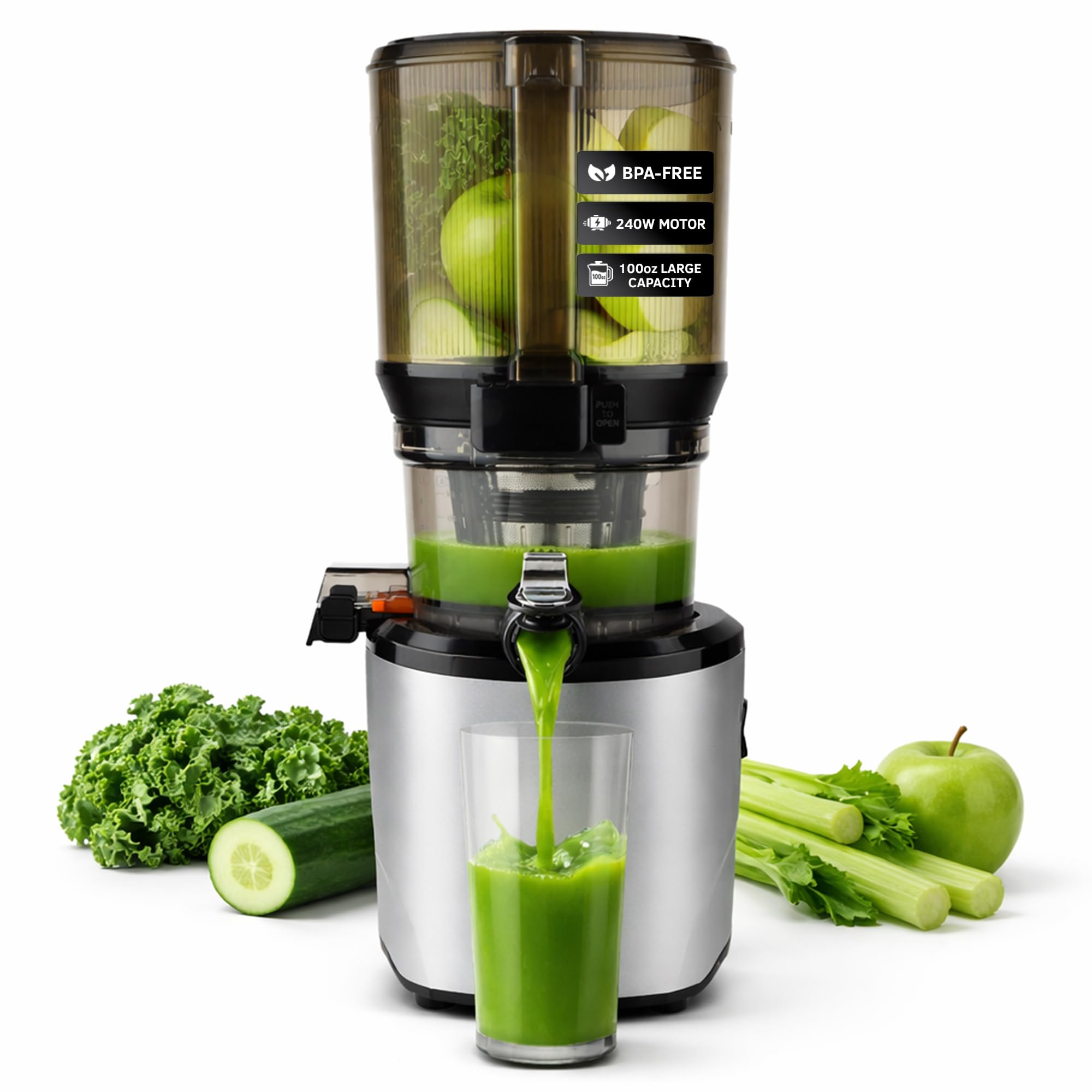
The AUTO10 is built around a 100-ounce juice collection capacity — the largest in this review — which makes it practical for making multi-day batches or serving a busy household without constant emptying. The auto-cut, self-feeding mechanism uses a double-crushing blade that cuts and feeds whole produce into the press, so you can load a full apple and walk away while it processes. The 50 RPM slow press delivers silky, low-pulp juice with upgraded auger geometry for maximum extraction.
The 240W motor is engineered for up to 30 minutes of continuous operation, which is sufficient for moderate commercial use — think a smoothie bar or a café that goes through 20–30 pounds of produce per shift. The included cleaning tools and simplified part design make post-service cleanup faster than many competitors. The 15-year assurance from Kuvings backs the build quality with an extended warranty.
The acrylic/plastic build is lighter and more affordable than full stainless units, but that material choice means the blade and internal components are plastic, not metal. This limits durability for hard, fibrous produce over years of daily commercial abuse. The AUTO10 is a strong contender for a high-volume home kitchen or a light commercial setting that does not process roots and stalks continuously.
Why it’s great
- 100 oz juice capacity reduces need for frequent emptying
- Auto-cut self-feeding handles whole fruits hands-free
- 240W motor with 30-minute continuous runtime
- 15-year assurance warranty from manufacturer
Good to know
- Plastic blades and components less durable than stainless steel
- Acrylic construction may crack under heavy commercial loads
- Not dishwasher safe; requires included brush kit for cleaning
7. Robot Coupe J80 Ultra Automatic Juicer
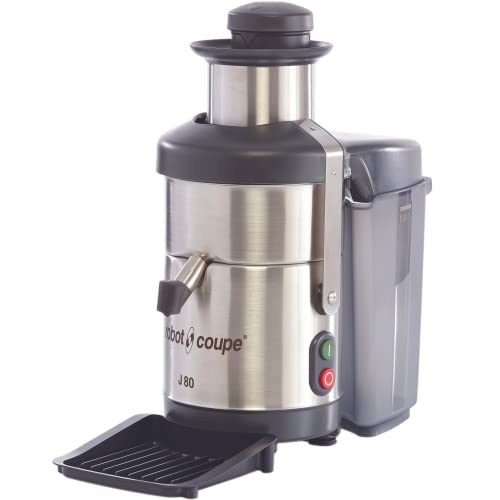
The J80 Ultra is a centrifugal juicer, not a cold press masticating machine — and that distinction matters. It operates at 3000 RPM with a 1.25 HP motor, which means it processes celery stalks and oranges in seconds rather than minutes. The auto-feed system with direct pulp ejection keeps the workflow moving: you drop produce in the top, juice flows out the anti-drip spout, and pulp shoots into the 6.5-quart container that you empty at intervals rather than stopping to scrape a strainer.
This unit is purpose-built for speed in a restaurant or juice bar where throughput is the priority over nutrient preservation. The 2.5 mm grating disc and fine mesh filter basket produce clear juice from soft fruits and vegetables, but the high-speed centrifugal action introduces oxygen and heat, which reduces shelf life to hours rather than days. That is acceptable for immediate consumption but not for batch prep or retail bottle sales.
The stainless steel motor base and polycarbonate components are built for dishwasher-safe commercial cleaning. The machine is quieter than a blender but louder than any cold press in this lineup. If your business model revolves around pulling shots of fresh orange juice on demand, the J80 Ultra is the fastest path from whole fruit to glass — just understand that it is not a cold press and does not preserve nutrients the same way.
Why it’s great
- 3000 RPM centrifugal extraction is the fastest in this comparison
- Auto-feed with direct pulp ejection enables continuous operation
- 6.5 Qt waste container reduces downtime
- Stainless steel motor base and polycarbonate parts are dishwasher safe
Good to know
- Centrifugal action oxidizes juice, reducing shelf life to hours
- Not a true cold press — generates heat during extraction
- Louder operation than slow masticating models
FAQ
What is the difference between a cold press juicer and a centrifugal juicer for commercial use?
Can I run a commercial cold press juicer continuously for 8 hours?
Why does pulp dryness matter in a commercial juicer?
Is a twin-gear juicer better than a single-auger design for commercial use?
Final Thoughts: The Verdict
For most users, the best commercial cold press juicer winner is the Angel Juicer AG-8500 because its SUS-316 surgical-grade construction, 3 HP twin-gear drivetrain, and auto-reverse anti-jamming system deliver the highest yield and longest lifespan of any machine tested. If you want the same performance at a lower investment, grab the Angel Juicer AG-7500 with its SUS-304 steel and identical grinding mechanics. And for a fast centrifugal option that prioritizes speed over nutrient preservation, nothing beats the Robot Coupe J80 Ultra for pulling fresh juice on demand in a high-volume restaurant setting.