A yanagiba is not a chef’s knife. It is a single-bevel, long-blade slicing tool designed for a very specific task: pulling through raw fish in one clean, undisturbed stroke. The distinction matters because the grind geometry, edge angle, and blade length are engineered for exactly that motion—not for chopping vegetables or hacking through bones. Buying a yanagiba means accepting a performance trade-off that pays off only when you commit to its intended use.
I’m Mohammad Maruf — the founder and writer behind AirfryerBite. I’ve spent years analyzing the metallurgy, cross-referencing Rockwell hardness figures with real edge retention reports, and mapping the differences between traditional Japanese forging methods and modern stainless production to give you a clear, spec-first recommendation.
This guide breaks down nine distinct models across budget-friendly, mid-range, and premium tiers, comparing blade steel, handle material, and single-bevel authenticity to help you find the best yanagiba knife for your specific fish-slicing or sashimi-prep needs.
How To Choose The Best Yanagiba Knife
Selecting a yanagiba requires more than comparing prices. The blade geometry, steel type, and handle material determine whether the knife will deliver the clean, single-pull slice that defines a true sashimi cut. These four factors will steer you toward the right tool for your kitchen.
Single-Bevel vs. Double-Bevel Geometry
A traditional yanagiba has a flat grind on one side and a slight concave relief (urasuki) on the reverse. This asymmetric edge pushes the cut straight without veering, preserving cell structure in raw fish. Double-bevel slicers like sujihiki are more versatile but lack the precise directional control needed for paper-thin sashimi slices. If your goal is authentic Japanese cutting technique, a single-bevel blade is mandatory.
Blade Steel Composition: Carbon vs. Stainless
High-carbon white steel (Shirogami) sharpens to a razor-fine edge and holds it well at a hardness of 62-63 HRC, but it rusts quickly and requires immediate drying and occasional oiling. Stainless options like MBS-26 or AUS-10V offer corrosion resistance and lower maintenance at a slight trade-off in maximum sharpness potential. Your choice should reflect how much care you are willing to perform after every use.
Blade Length and Handle Style
Standard yanagiba lengths are 270 mm (10.6 inches) and 300 mm (11.8 inches). A 270 mm blade handles most home and light professional tasks, while 300 mm suits larger fish like yellowtail and tuna. Traditional wa-style D-shaped magnolia handles offer a lightweight, ergonomic grip that improves control during long slicing motions. Stainless or synthetic handles are easier to clean but may alter the knife balance.
Quick Comparison
On smaller screens, swipe sideways to see the full table.
| Model | Category | Best For | Key Spec | Amazon |
|---|---|---|---|---|
| Yoshihiro 10.5″ (270mm) | Premium | Authentic traditional sashimi | White #2 Steel, 62-63 HRC | Amazon |
| Sakai Takayuki 10.5″ | Premium | Professional-grade Damascus | V Gold No.10 Steel, 10.5″ | Amazon |
| Yoshihiro 11.8″ (300mm) | Premium | Large fish processing | White #2 Steel, 62-63 HRC | Amazon |
| Dalstrong Shogun Elite 10.5″ | Premium | Versatile slicing plus aesthetics | AUS-10V Core, 62+ HRC | Amazon |
| Cangshan YARI 12″ | Mid-Range | Double-bevel versatility | X-7 Damascus, 58 HRC | Amazon |
| Global G-11R 10″ | Mid-Range | Lightweight, rust-free use | CROMOVA 18 Steel, 10″ | Amazon |
| Kai Sashimi Yanagi 10.6″ | Mid-Range | Low-maintenance stainless | High-Carbon Stainless, 10.6″ | Amazon |
| Masahiro Fukui 10.6″ | Budget | Affordable entry-level | MBS-26 Steel, 58-59 HRC | Amazon |
| Kamikoto 13″ | Budget | Extra-long blade novelty | 420J2 Steel, 13″ | Amazon |
In‑Depth Reviews
1. Yoshihiro Shiroko High Carbon Steel Kasumi Yanagi 10.5″ (270mm)
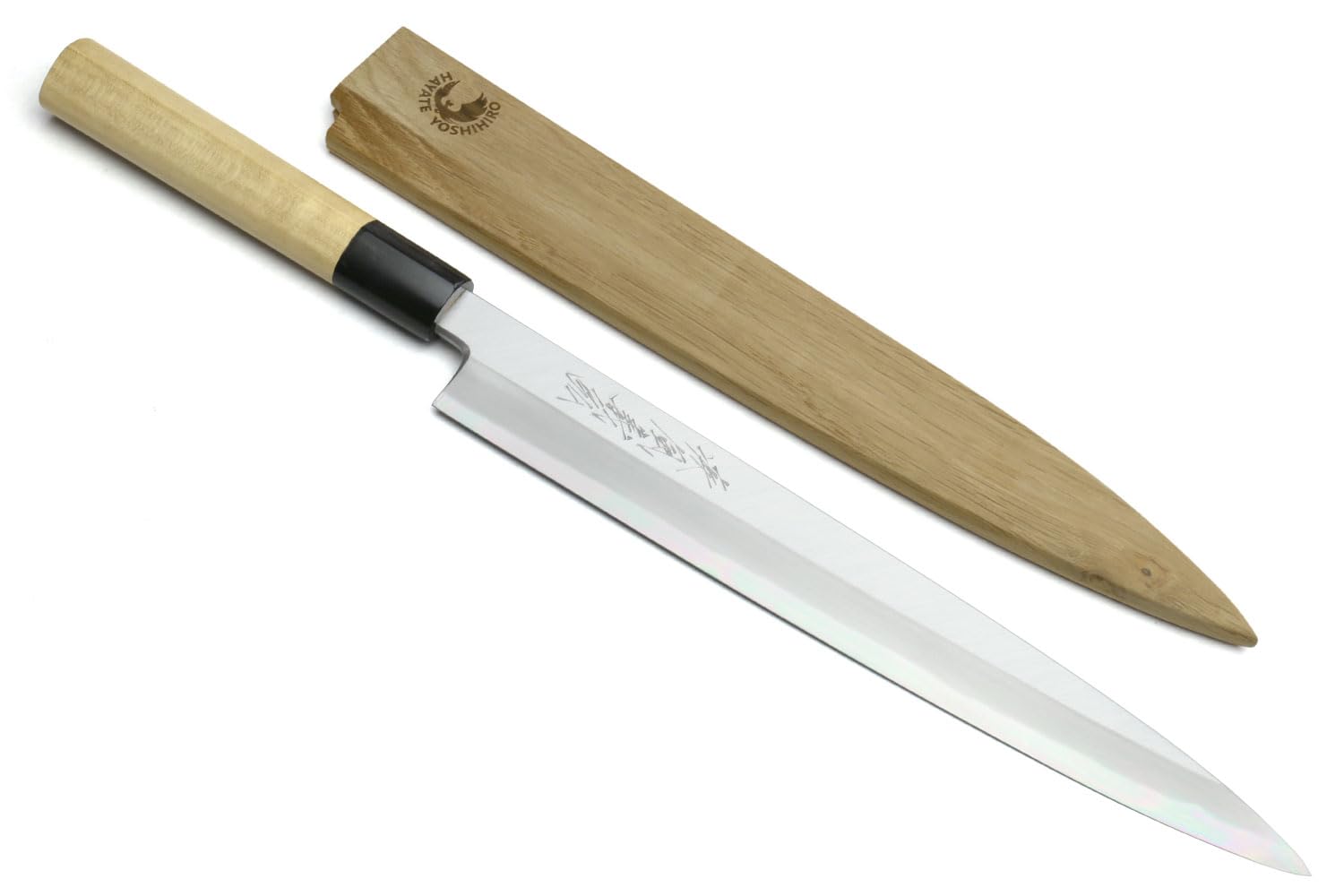
The Yoshihiro 10.5-inch Yanagi represents the closest you can get to a traditional artisan sashimi knife without commissioning a custom smith. Forged from White Steel #2 and hardened to 62-63 HRC, the blade takes a remarkably acute edge that glides through raw fish with minimal cell deformation. The Kasumi finish creates a mist-like pattern on the blade face, and the handcrafted D-shaped magnolia handle provides a secure, natural grip during extended slicing sessions.
Users consistently report that this knife holds its edge through heavy weekly use, though the factory edge is not shaving-sharp out of the box—you will need a water whetstone to unlock its full potential. The single-bevel grind with uraoshi rim is authentic to traditional Japanese technique, meaning the cut will not steer or tear when you pull straight back. This is a tool for someone who respects the craft and is willing to maintain carbon steel.
The included wooden saya (sheath) protects the blade when stored, and the overall fit and finish justify the price for those who prioritize cutting performance over convenience. Professional sushi chefs and dedicated home cooks alike praise its balance and the clean, drag-free slices it produces on everything from salmon to fluke.
Why it’s great
- Genuine single-bevel Japanese geometry for precise sashimi cuts
- White Steel #2 sharpens to an exceptionally keen edge
- Lightweight magnolia handle with ergonomic D-shape
- Includes a protective wooden saya for storage
Good to know
- Carbon steel requires immediate drying and occasional oiling to prevent rust
- Not sharp out of the box; needs whetstone honing
- Fragile edge—avoid bones, frozen food, or lateral stress
2. Sakai Takayuki Damascus Sushi Sashimi Yanagiba 10.5″

Sakai Takayuki is the brand trusted by over 90 percent of professional chefs in Japan, and this 10.5-inch yanagiba demonstrates why. The blade features a stainless Damascus V Gold No.10 steel core clad in layers of high-carbon stainless, producing a striking pattern that also reduces drag through the cut. The double-bevel edge listed in the specs is a point of confusion—many users confirm the actual cutting geometry behaves like a traditional yanagiba for single-pull slicing.
The mahogany wood handle is a standout detail: it darkens naturally over time to a rich reddish-brown, and the fit is flawless in hand. At only 6.5 ounces, the knife feels almost weightless, yet the balance point sits precisely at the pinch grip, allowing fatigue-free slicing during long prep shifts. The paulownia gift box with washi paper accents speaks to the level of craftsmanship invested in this piece.
Professional feedback on this knife is nearly unanimous: it arrives shaving-sharp, holds its edge longer than any other stainless yanagiba in its class, and produces silky, uninterrupted slices on hamachi, maguro, and salmon. If you want a premium tool that doubles as a gallery piece, this is the model to beat.
Why it’s great
- Extraordinary out-of-box sharpness with a refined edge
- Beautiful Damascus cladding reduces sticking during cuts
- Lightweight build (6.5 oz) with near-perfect balance
- Premium mahogany handle that ages gracefully
Good to know
- Double-bevel spec may confuse traditional single-bevel purists
- Significant investment—treat as a lifetime tool
- Handle requires careful drying to maintain wood integrity
3. Yoshihiro Shiroko High Carbon Steel Kasumi Yanagi 11.8″ (300mm)
This 11.8-inch version of the Yoshihiro Kasumi Yanagi is the logical upgrade for anyone who regularly works with larger fish like yellowtail, tuna, or wild salmon. The extra blade length lets you draw a single, uninterrupted cut across a wide fillet, reducing the number of strokes and the risk of tearing delicate flesh. The White Steel #2 core and iron cladding are identical to the 270 mm version, so the heat treatment and edge potential are consistent.
Weighing 12.5 ounces, the 300 mm blade feels noticeably heavier than the 10.5-inch model, but the balance remains neutral at the pinch grip due to the traditional wa-style handle. The handcrafted D-shaped magnolia handle sits comfortably in the palm, and the saya sheath fits snugly. Users note that the longer blade requires more careful honing on a water whetstone to maintain the uraoshi edge, but the payoff in cut quality is substantial.
Reviews from both home sushi enthusiasts and line chefs highlight the knife’s ability to produce translucent slices of hirame and tai without crushing the cell structure. As with any carbon steel yanagiba, you must clean and dry it immediately after use, but those who follow the care regimen report years of exceptional performance.
Why it’s great
- 300 mm blade enables single-stroke cuts on large fish
- White Steel #2 takes an extremely fine edge at 62-63 HRC
- Authentic single-bevel grind with uraoshi rim
- Comfortable wa-style handle with saya included
Good to know
- Carbon steel needs immediate drying and oiling to avoid rust
- Longer blade demands more space and careful storage
- Some units have minor grind inconsistencies near the heel
4. Dalstrong Shogun Elite Sujihiki Slicer 10.5″

The Dalstrong Shogun Elite is technically a sujihiki (double-bevel slicer), but its 10.5-inch blade, Granton edge reliefs, and aggressive 8-12 degree edge angle make it a frequent choice for chefs who want a yanagiba-like slicing experience without the single-bevel maintenance. The AUS-10V super steel core is vacuum-treated and nitrogen-cooled, achieving a hardness of 62+ HRC with excellent corrosion resistance. The 67-layer Damascus cladding adds visual drama and reduces sticking during long slices.
The military-grade G-10 handle resists moisture, heat, and cold, making this a good option for high-volume kitchens where a wooden handle might degrade. Users report that the knife arrives very sharp, though some units have needed a quick pass on a honing rod to reach peak sharpness. The included saya sheath is well-fitted and safe for drawer storage.
Where this knife shines is versatility: it slices raw fish for sashimi with clean results, but it also handles cooked roast beef, smoked brisket, and large vegetables without the steering effect of a single-bevel blade. If you want one slicer that performs across multiple tasks while still delivering near-sashimi-grade cuts, the Shogun Elite is the strongest contender in this list.
Why it’s great
- AUS-10V core holds a sharp edge longer than most stainless blades
- Double-bevel design makes sharpening accessible and prevents steering
- Ergonomic G-10 handle withstands commercial kitchen environments
- Granton reliefs minimize sticking on large cuts
Good to know
- Double-bevel is not a true yanagiba grind for purists
- Edge sharpness out of box varies; some units need honing
- Heavier feel compared to traditional wa-handled knives
5. Cangshan YARI Series 12-inch Sashimi Knife

Cangshan’s YARI Series positions this 12-inch knife as a versatile sashimi and carving tool, and its double-bevel edge and X-7 Damascus steel construction make it approachable for cooks who are not ready to commit to a single-bevel yanagiba. The blade is hand-sharpened to a 16-degree angle per side and clocks in at 58 +/- 2 HRC on the Rockwell scale—softer than traditional carbon steel but tougher and less prone to chipping. The fiberglass handle is NSF-certified, adding durability for commercial use.
User feedback consistently highlights the knife’s extreme sharpness out of the box and the magnetic sheath that secures the blade during storage. The 12-inch blade length is useful for large salmon or tuna sides, though some buyers have noted that the double-bevel grind does not produce the same paper-thin, cell-preserving cut as a true yanagiba. The X-7 Damascus steel pattern is genuine and visually striking.
For the price, you get a well-made, versatile slicer that can handle fish, poultry, and beef with equal competence. The lifetime warranty and NSF certification add confidence for those who need a knife that can stand up to daily commercial prep while still delivering clean, even slices.
Why it’s great
- Genuine Damascus cladding with attractive layered pattern
- Double-bevel edge is easier to maintain and sharpen
- NSF certified for commercial kitchen use
- Includes a magnetic sheath for safe storage
Good to know
- Double-bevel geometry is not a true yanagiba for traditionalists
- Rockwell hardness of 58 HRC is softer than premium carbon steel
- 12-inch length may be cumbersome for smaller hands
6. Global G-11R 10 Inch Right-Handed Yanagi Sashimi Knife

Global’s G-11R is a departure from traditional yanagiba construction—the blade is stamped from CROMOVA 18 stainless steel rather than forged, and the handle is a seamless stainless steel unit filled with sand for balance. This approach prioritizes hygiene and rust resistance over the hand-feel of a wooden wa-handle. The 10-inch blade is hollow-ground on one side, mimicking a single-bevel geometry, and the edge is razor-sharp out of the box.
Professional sushi chefs in the reviews call this knife excellent for clean, non-pulling cuts through all types of fish. The lightweight 0.74-pound build and integrated handle make it easy to sanitize in a commercial dish pit, though Global explicitly recommends hand washing. The stamped construction is durable but cannot be sharpened quite as aggressively as a forged high-carbon blade—expect a slightly thinner edge profile that may need more frequent touch-ups.
The G-11R delivers consistent performance without demanding the maintenance routine that traditional steel requires.
Why it’s great
- Seamless stainless construction prevents rust and bacterial buildup
- Lightweight and well-balanced for fatigue-free slicing
- Excellent out-of-box sharpness for immediate use
- Easy to clean and maintain compared to carbon steel
Good to know
- Right-handed only—no left-handed version available
- Stamped blade may not appeal to forging purists
- Hollow-ground edge can be more difficult to resharpen
7. Kai Sashimi Yanagi Knife 10.6″ (270mm)

Kai Corporation brings its reputation for reliable stainless steel to this 10.6-inch yanagiba, which features a high-carbon stainless steel blade and an 18-8 stainless handle. The monosteel construction eliminates the rust concerns of traditional carbon steel, and the knife is actually labeled dishwasher safe—a rarity in the yanagiba category. The blade is 10.6 inches long with a plain edge that arrives sharp enough for immediate use on sashimi-grade fish.
Japanese domestic reviews highlight the excellent cost performance (コスパ) for the quality level. Professional sushi chefs note that the blade is thinner and lighter than traditional yanagiba designs, which makes it easier to handle but less suited for heavy commercial abuse. The stainless handle provides a secure grip even when wet, and the overall weight of 6.3 ounces keeps fatigue low during extended prep sessions.
This knife is an ideal entry point for home cooks who want a yanagiba profile without the maintenance overhead of carbon steel. The trade-off is that the stainless edge will not reach the hyper-sharp potential of White Steel #2, and the thin blade may flex under heavy pressure on large fish.
Why it’s great
- Dishwasher-safe design simplifies cleaning
- Fully stainless construction resists rust and staining
- Lightweight at 6.3 ounces for easy handling
- Affordable price point for a Japanese-made yanagiba
Good to know
- Thinner blade may flex on large, dense fish
- Stainless steel does not sharpen as acute as carbon steel
- Not a traditional single-bevel grind—closer to a hybrid profile
8. Masahiro Fukui Stainless Steel Yanagi Blade 10.6″

Masahiro’s 10.6-inch yanagiba uses MBS-26 stainless steel, a proprietary blend containing 0.9 percent carbon, 13 percent chrome, molybdenum, and vanadium, hardened to 58-59 HRC. The semi-tang construction and black stainless handle keep the price accessible while delivering a functional single-bevel edge. At 6.1 ounces, it is one of the lightest options in this guide, making it a comfortable choice for home cooks learning the pull-cut technique.
Feedback from busy sushi bars indicates that this knife holds its edge well through a three-month rotation of daily fish slicing, outperforming expectations for its price tier. Some users note that the handle is quite smooth, which can make grip less secure when wet, and the blade thickness is thinner than traditional yanagibas, requiring more careful handling to prevent bending on dense fish like snapper.
For the price, the Masahiro offers a legitimate entry into single-bevel yanagiba cutting. It sharpens well on water stones and produces clean sashimi cuts that will satisfy most home cooks and light commercial users. The trade-offs in handle grip and blade thickness are reasonable given the budget-friendly positioning.
Why it’s great
- Affordable entry into true single-bevel yanagiba cutting
- MBS-26 stainless resists rust better than carbon steel
- Lightweight build reduces fatigue during practice sessions
- Capable of clean sashimi cuts with proper technique
Good to know
- Smooth handle can be slippery when wet
- Thin blade may bend under pressure on large fish
- Not a full tang construction—less robust than premium models
9. Kamikoto 13-inch Yanagiba
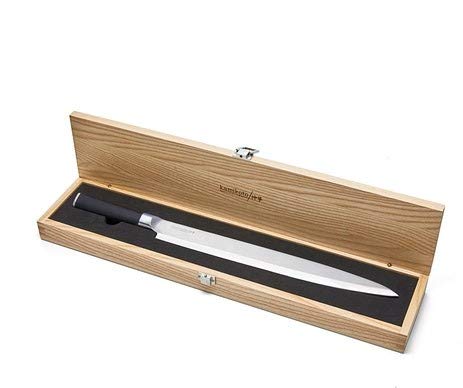
The Kamikoto 13-inch Yanagiba draws attention with its exceptional blade length and handcrafted appearance, but the steel composition is a critical differentiator. The blade is made from 420J2 stainless steel, a budget-grade alloy that sharpens easily but lacks the edge retention of higher-carbon steels. The 13-inch length is genuinely useful for skinning and slicing large whole fish in a single pass, but the steel performance may disappoint users accustomed to premium Japanese metallurgy.
Customer reviews are sharply divided. Some buyers praise the knife’s appearance and sharpness on arrival, while others call the steel quality deceptive for the asking price. The wooden and steel handle provides a decent grip, and the knife is well-balanced despite its length, but concerns about the brand’s authenticity as a Japanese manufacturer have been raised in multiple verified reviews.
The Kamikoto is best suited for someone who wants a conversation piece and a very long slicer for occasional use, rather than a high-performance daily driver. If you need a reliable tool for regular sashimi prep, the Yoshihiro or Sakai Takayuki models will deliver far better edge performance and durability per dollar.
Why it’s great
- 13-inch blade handles very large fish with single strokes
- Attractive handcrafted aesthetic with wood handle
- Comfortable balance for a blade of this length
Good to know
- 420J2 steel lacks edge retention compared to premium alloys
- Brand authenticity as a Japanese manufacturer is disputed
- Significant premium for the steel quality delivered
FAQ
Can I use a yanagiba on cooked meat or vegetables?
How do I sharpen a single-bevel yanagiba?
What blade length should I choose for home use?
Is there a left-handed yanagiba option?
Final Thoughts: The Verdict
For most users, the yanagiba knife winner is the Yoshihiro 10.5″ (270mm) because it delivers authentic single-bevel performance, traditional White Steel #2 edge potential, and a handcrafted wa-handle at a price that balances heritage with accessibility. If you want a low-maintenance stainless option that still produces clean cuts, grab the Kai Sashimi Yanagi 10.6″. And for professional-grade performance with stunning Damascus aesthetics, nothing beats the Sakai Takayuki 10.5″.