Drinking local tap water in a foreign country is a gamble that can sideline an entire trip. Between bacterial threats, protozoan parasites, and chemical aftertastes, the margin for error is razor-thin when your digestive system is the testing ground. A dedicated purifier transforms sketchy spigots, mountain streams, and hotel bathroom taps into a reliable source of hydration.
I’m Mohammad Maruf — the founder and writer behind AirfryerBite. I’ve spent months analyzing micron ratings, UV-C wavelengths, flow rates, and filter lifespans to separate serious travel gear from gimmicks that leave you thirsty.
This guide focuses exclusively on portable hardware that removes or deactivates biological contaminants, not just sediment. After comparing seven distinct approaches, I’ve identified the standout performers in the water purification for travel category based on real-world specs and verified user experiences.
How To Choose The Best Water Purification For Travel
Portable water purifiers vary widely in filtration medium, power source, and throughput. Selecting the right unit means matching the technology to your destination’s water profile, group size, and trip duration.
Filtration vs. Purification – Know the Legal Difference
Filters stop bacteria and protozoa. Purifiers also remove viruses, which are smaller and require a tighter pore size (0.02 microns or less) or UV-C exposure. For travel outside North America and Western Europe, virus removal is essential because municipal tap water may harbor hepatitis A, rotavirus, or norovirus. Look for NSF Protocol P248 certification or a manufacturer claim of virus reduction.
Flow Rate and Filter Lifespan Dictate Daily Convenience
A purifier that pumps 2.5 liters per minute suits a group of four. A personal straw that delivers 0.5 liters per minute works for solo hydration. Total treated volume — measured in liters — determines how often you replace cartridges. The MSR Guardian treats 10,000 liters; the LifeStraw straw treats 4,000 liters. Budget units may require replacement after 1,000 liters.
Power Requirements and Maintenance in the Field
UV-C purifiers like the SteriPEN need batteries or USB recharging. Pump purifiers demand physical effort but run indefinitely. Electric filters with rechargeable batteries offer hands-free operation but add weight. Self-cleaning mechanisms — backflushing on pumps or automatic UV-C cycles on bottles — reduce field maintenance and extend component life.
Quick Comparison
On smaller screens, swipe sideways to see the full table.
| Model | Category | Best For | Key Spec | Amazon |
|---|---|---|---|---|
| MSR Guardian Purifier | Pump Purifier | Group expeditions and global travel | Virus removal, 2.5 L/min, 10,000 L lifespan | Amazon |
| LARQ PureVis 2 | UV-C Bottle | Urban travel and daily hydration | Self-cleaning UV-C, nano-filter straw, app tracking | Amazon |
| SteriPEN Ultra UV Purifier | UV-C Wand | Lightweight solo travelers | Purifies 1 L in 90 seconds, USB rechargeable | Amazon |
| SteriPEN Adventurer Opti UV | UV-C Wand | Backpacking with minimal weight | 8,000 treatments, CR123 batteries, 3.8 oz | Amazon |
| LifeStraw Go Stainless Steel Bottle | Filter Bottle | Travelers wanting taste improvement plus protection | Double-wall insulation, 0.2 micron membrane, 4,000 L | Amazon |
| BKLES BK-2000 Electric Filter | Electric Filter | Car camping and base camp use | 6-stage filtration, 0.01 micron, USB rechargeable | Amazon |
| LifeStraw Personal Water Filter | Straw Filter | Emergency kits and ultralight solo trips | Straw design, 0.2 micron, 4,000 L capacity | Amazon |
In‑Depth Reviews
1. MSR Guardian Water Purifier

The MSR Guardian meets NSF Protocol P248, the U.S. military’s testing standard for water purifiers that remove viruses, bacteria, and protozoa from any freshwater source. Its hollow-fiber membrane pumps 2.5 liters per minute with a self-cleaning mechanism that backflushes on every stroke — no scrubbing or field maintenance required. The 10,000-liter lifespan makes it the obvious choice for extended group trips or global travel where water quality is entirely unknown.
At 17.3 ounces and 8.25 inches tall, the Guardian isn’t the lightest pump on the shelf, but its durability offsets the weight penalty. Users report pumping from beaver ponds and shallow streams without illness. The pump handle uses a plastic C-clip that some users found loud under heavy pace, though performance remains consistent. The wide-mouth Nalgene adapter is a smart inclusion for rapid filling.
Annual maintenance is required to prevent the hollow fibers from drying out, and the kit is sold separately. This unit is overbuilt for solo travelers who only need a straw-sized filter, but for anyone leading a group, traveling to regions with untreated municipal water, or building a serious emergency kit, the MSR Guardian sets the benchmark.
Why it’s great
- Meets military NSF P248 standard for virus removal
- Self-cleaning pump eliminates field maintenance
- Fast 2.5 L/min flow supports group use
- 10,000-liter filter lifespan
Good to know
- Requires separate annual maintenance kit
- Plastic C-clip on pump handle may pop under hard use
- Heavier than personal straw filters at 17.3 oz
2. LARQ PureVis 2 Self Cleaning Water Bottle
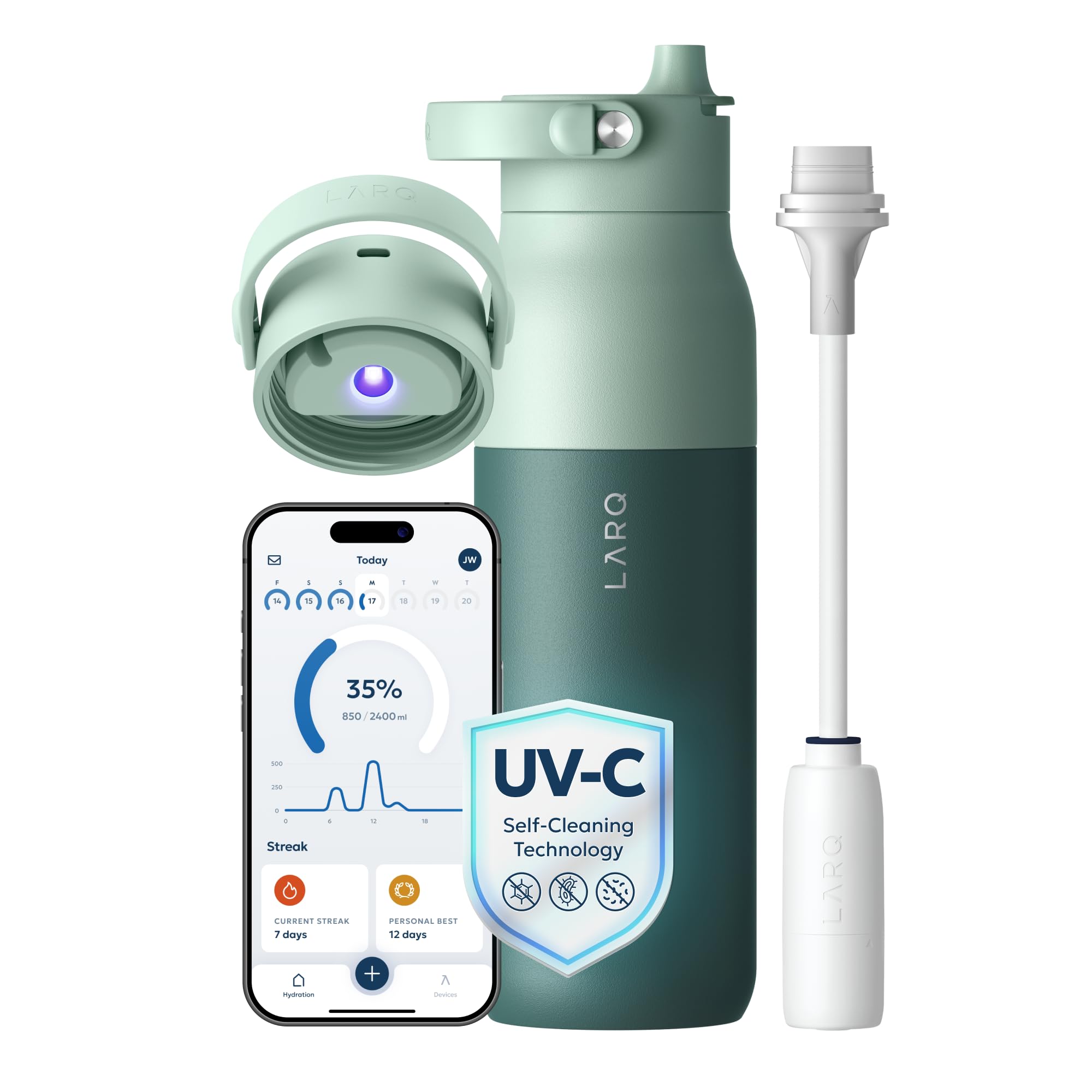
The LARQ PureVis 2 combines a double-wall vacuum-insulated stainless steel bottle with a UV-C LED that activates every two hours to eliminate 99% of bio-contaminants, including E. coli and mold, from both the water and the bottle interior. The included nano-filter straw reduces chlorine, VOCs, and odors for improved taste while the 680-milliliter capacity fits most cup holders. A USB-C charge delivers up to one month of continuous UV-C cycles.
The companion app tracks hydration volume automatically using a sensor that measures when the bottle is placed flat, and it sends gentle reminders to drink. Users consistently praise the sleek aesthetics and the peace of mind that comes from knowing the bottle stays clean without daily scrubbing. The self-cleaning cycle is particularly valuable in humid climates where mold develops quickly in standard bottles.
This bottle is best suited for urban travel, hotel stays, and office use where tap water is treated but may have residual chlorine or biofilm concerns. It is not designed to purify untreated river or lake water — the nano-filter removes chemical contaminants but does not eliminate viruses or protozoa. The initial investment is substantial and replacement filters are required every two months or 40 gallons.
Why it’s great
- UV-C self-cleaning prevents mold and bacteria buildup
- App tracks water intake automatically
- Double-wall insulation keeps water cold for 24 hours
- Detachable handle adds portability
Good to know
- Does not remove viruses or protozoa from untreated water
- Requires monthly charging and filter changes every 2 months
- High price compared to standard insulated bottles
3. SteriPEN Ultra UV Water Purifier
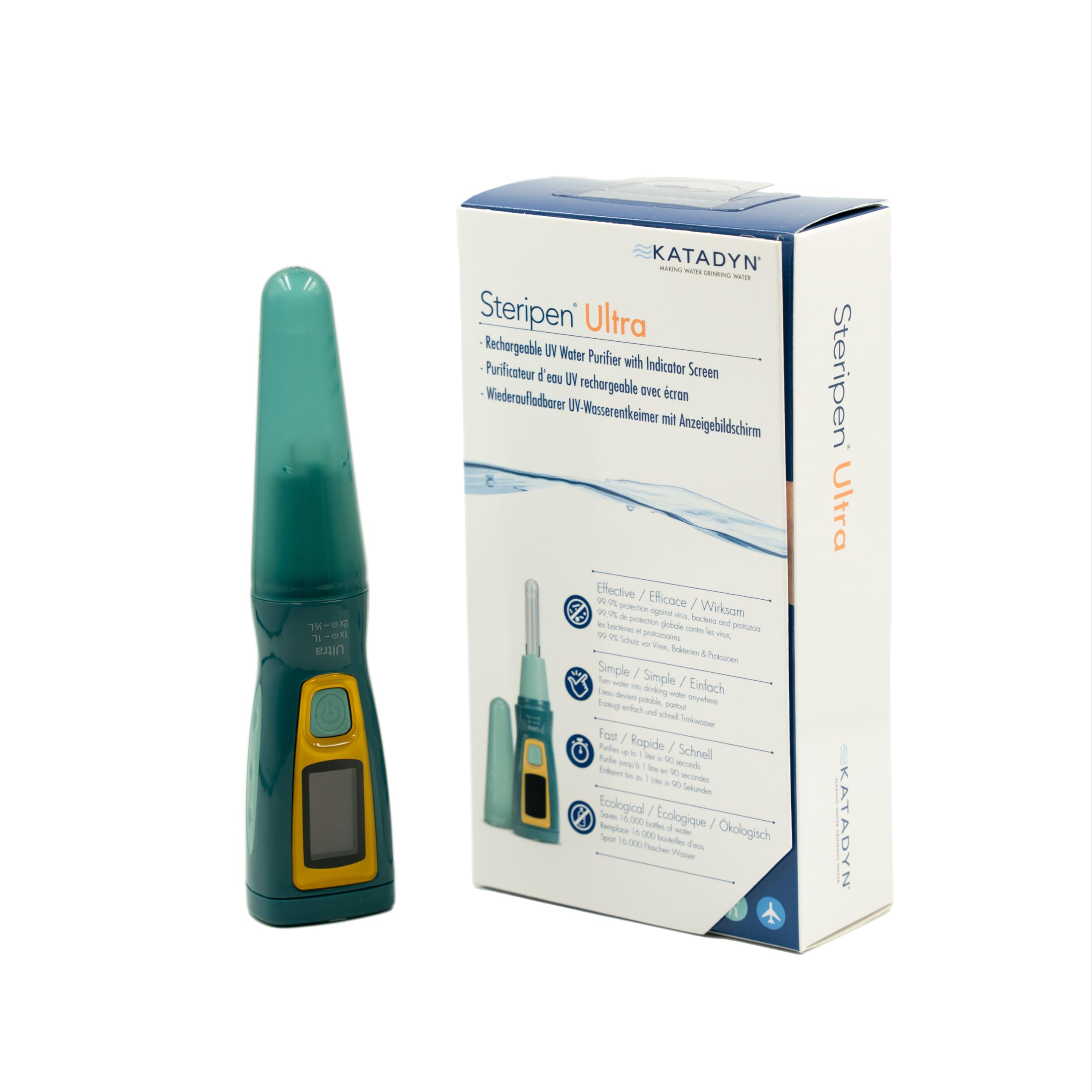
The SteriPEN Ultra uses a powerful UV-C lamp to deactivate 99.99% of bacteria, viruses, and protozoa in under 90 seconds per liter. Its 2,200 mAh rechargeable battery can treat up to 8,000 liters before the lamp needs replacement, making it one of the highest-volume UV options available. The wand design fits into standard wide-mouth bottles and the watertight seals protect the electronics during use.
Users have taken this unit across three continents and report that treated water tastes clean and feels safe. The battery life is excellent — a single charge lasts weeks of daily use. The main workflow requires agitating the wand in the water until the UV cycle completes, which takes about 48 seconds for a half-liter. This is faster than pump filters and far more pleasant than chemical tablets that leave an aftertaste.
The critical reliability concern reported by some users: the Ultra model can fail to start in cold conditions unless the UV sensor is cooled with running water. A small number of units stopped working entirely after a year of use. Use with clear water is required — UV-C cannot treat turbid or silty water. For travelers who prioritize speed and portability and who expect reasonably clear source water, the SteriPEN Ultra delivers exceptional throughput.
Why it’s great
- Purifies 1 liter in 90 seconds — fastest in class
- USB rechargeable battery lasts weeks
- Treats up to 8,000 liters per UV lamp
- Compact wand fits in standard bottle openings
Good to know
- Cannot treat murky or silty water — UV needs clarity
- Some units experience intermittent startup failure
- Replacement lamp availability can vary
4. SteriPEN Adventurer Opti UV Water Purifier

The SteriPEN Adventurer Opti weighs just 3.8 ounces with batteries included, making it a favorite among thru-hikers and ultralight backpackers who count every gram. It runs on two disposable CR123 lithium batteries that provide approximately 60 liters of treatment per set. The UV-C lamp destroys 99.9% of protozoa, bacteria, and viruses in 90 seconds per liter, and the optical sensor doubles as an LED flashlight.
All user reports confirm the device works exactly as advertised: dip the wand in a wide-mouth bottle, press the button, stir until the cycle completes. Treated water shows zero colony-forming units in lab tests. The neoprene case includes a belt loop for easy access. The major trade-off is the battery format — CR123 cells are less common than AA or AAA and cannot be recharged, so carrying spares adds both weight and cost.
The Adventurer Opti is ideal for solo travelers who already carry a treat bottle and want the lightest possible virus-killing solution. It requires clear source water to function effectively. The unit shuts off if the lamp is not fully submerged, which can be frustrating with narrow-mouth containers. For weight-conscious adventurers heading to regions where CR123 batteries are available, this is the most packable UV option on the market.
Why it’s great
- Extremely lightweight at 3.8 oz
- Destroys viruses, bacteria, and protozoa
- Built-in LED flashlight adds emergency utility
- 8,000 treatments per UV lamp
Good to know
- Uses proprietary CR123 batteries — not rechargeable
- Requires clear water; shuts off if not fully submerged
- 60 liters per battery set adds ongoing cost
5. LifeStraw Go Stainless Steel Water Filter Bottle

The LifeStraw Go combines a double-wall vacuum-insulated stainless steel bottle with a two-stage filtration system: a 0.2 micron hollow-fiber membrane that removes bacteria, parasites, and microplastics, plus an activated carbon filter that reduces chlorine and organic chemicals for better taste. The 24-ounce capacity keeps drinks cold for hours, and the integrated filter straw draws water through both stages as you sip.
Users consistently highlight the taste improvement over tap water and the confidence of drinking from local sources while traveling in regions with questionable municipal treatment. The membrane filter lasts up to 4,000 liters and the carbon filter lasts about 100 liters under normal use. The stainless steel construction is much more durable than plastic bottles and avoids the chemical leaching concerns associated with single-use bottles.
The main drawbacks are weight and fit. The 24-ounce stainless steel bottle is noticeably heavy when full, and its diameter does not fit standard car cup holders. Some users on the second-generation model reported a foul smell developing in the mouthpiece due to biofilm buildup in the vacuum-sealed cap area, requiring bleach cleaning. The bottle also leaks slightly if tipped over, which is a concern in a pack.
Why it’s great
- Integrated carbon filter improves taste significantly
- Double-wall insulation keeps water cold for hours
- Stainless steel body is durable and BPA-free
- Long 4,000-liter membrane lifespan
Good to know
- Heavy for its size — 17 oz empty
- Does not fit standard cup holders
- Mouthpiece can develop biofilm odor if not cleaned regularly
6. BKLES BK-2000 Electric Portable Water Purifier

The BKLES BK-2000 uses an electric pump to push water through a 6-stage filtration system that includes PP cotton, KDF, activated carbon, coconut activated carbon fiber, and an ultrafiltration membrane with a 0.01 micron pore size — finer than most portable filters. The pump delivers 700 milliliters per minute, and the built-in rechargeable lithium battery can treat up to 168 liters per charge, enough for 10 to 15 days of solo use. A USB Type-C port allows charging from power banks, solar panels, or car adapters.
Users report that the unit filters a glass of water in about 15 seconds and that the battery life is excellent for multi-day trips. The pre-filter catches large debris before it reaches the main filter, extending cartridge life. The included emergency light is a practical bonus for nighttime filling. The electric backwashing function helps maintain flow rate without disassembly — a significant convenience over manual backflushing systems.
This unit is not a desalination device — it will not remove salt from seawater. Some users noted the auto-shutoff feature can fail to stop the pump before overflowing a 2-gallon collection container if left unattended. The BK-2000 is best for car camping, base camp setups, and international travel where you can set up a gravity-fed or pumped system on a table. It is bulkier than a straw or wand but much faster for producing large volumes.
Why it’s great
- 0.01 micron filtration removes particles most filters miss
- Electric pump delivers 700 mL/min hands-free
- USB rechargeable with long battery life
- Backwashing function keeps flow rates high
Good to know
- Cannot remove salt or dissolved minerals
- Auto-shutoff may fail and cause overflow
- Heavier than straw or UV wand options
7. LifeStraw Personal Water Filter

The LifeStraw Personal Water Filter is the most widely recognized entry-level purifier in the outdoor market. Its hollow-fiber membrane removes 99.999999% of waterborne bacteria and 99.999% of parasites, plus microplastics down to 1 micron. The entire unit weighs 1.6 ounces and measures 12 inches long, making it trivial to stash in a backpack pocket, glove compartment, or emergency kit. Each filter treats 4,000 liters — enough for years of occasional use.
The straw design is dead simple: place the bottom end in the water source and sip. No pumping, no batteries, no chemical taste. Users who tested it on muddy water report clear, drinkable results. The 4-pack configuration allows distribution across multiple bags, vehicles, or family members. For emergency preparedness, having four sealed, shelf-stable filters is more practical than a single device that requires power or cartridges.
The LifeStraw does not remove viruses, chemicals, or dissolved salts, so it is not a standalone solution for travel in developing countries where viral contamination is common. It also cannot be used for water storage — you must drink directly from the source. The flow rate is slower than pump or electric systems, requiring patience during long drinking sessions. For ultralight solo trips, emergency kits, and camping in regions with wildlife but no municipal sewage, this is the most cost-effective biological barrier available.
Why it’s great
- Extremely lightweight at 1.6 oz
- No batteries, chemicals, or moving parts
- 4,000-liter capacity per filter
- 4-pack provides redundancy for family or emergency kits
Good to know
- Does not remove viruses or chemical contaminants
- Requires direct sipping — cannot treat stored water
- Slower flow rate compared to pump or electric systems
FAQ
Can a UV purifier handle cloudy or silty water?
What is the difference between a water filter and a water purifier for travel?
How often should I replace the filter in a travel water purifier?
Final Thoughts: The Verdict
For most users, the water purification for travel winner is the MSR Guardian Purifier because it is the only pump that meets the U.S. military’s NSF P248 standard while delivering 2.5 liters per minute and self-cleaning with every stroke. If you want a rechargeable bottle that keeps water cold and tracks your intake on an app, grab the LARQ PureVis 2. And for ultralight solo travel where every gram counts, nothing beats the SteriPEN Adventurer Opti.