If your tap water carries a faint chlorine whiff, a metallic aftertaste, or you simply don’t trust what’s coming out of the faucet, a dedicated filtration system is the only sane solution. Pitchers, countertop units, and under-sink models each tackle different space constraints and contaminant profiles, and the wrong choice means you are still drinking particles you wanted removed.
I’m Mohammad Maruf — the founder and writer behind AirfryerBite. I have analyzed the internal specs, certifications, and real-world flow rates across dozens of water filtration systems to isolate the units that actually deliver measurable purity without the marketing haze.
Whether you need a simple pitcher for your fridge or a high-flow under-sink system for your main tap, this guide breaks down the category-specific specs that matter for choosing the best water filters for drinking water.
How To Choose The Best Water Filters For Drinking Water
Not every filter removes the same contaminants. The right system depends on what is actually in your tap water and how much filtered water your household needs daily.
Filtration Technology and Stage Count
Single-stage activated carbon pitchers handle basic chlorine taste and odor, but multi-stage systems (4 to 6 stages) incorporate sediment membranes, KDF-55, and carbon blocks to target lead, mercury, chromium, and VOCs. Higher stage counts generally mean broader contaminant reduction, but they also slow flow slightly. For well water or old plumbing, at least three stages is the minimum starting point.
Filter Lifespan and Gallon Capacity
Standard pitcher filters last 40 gallons before the media is exhausted. Countertop and under-sink units range from 8,000 to 20,000 gallons — a difference that dramatically affects long-term replacement costs. If your household drinks two gallons per day, a 40-gallon pitcher requires a new filter every 20 days, while a 20,000-gallon under-sink system goes a full year or more on one cartridge.
Certifications and Contaminant Claims
NSF/ANSI Standard 42 covers aesthetic effects like chlorine taste and odor. Standard 53 covers health-related contaminant reduction (lead, mercury, VOCs). Standard 401 targets emerging compounds like pharmaceuticals and PFOA/PFOS. A filter that lists only Standard 42 on its packaging cannot legally claim to reduce lead, regardless of what the marketing copy says.
Form Factor and Installation
Pitcher filters require zero installation and fit in any fridge, but they occupy counter space and need frequent refills. Countertop units connect directly to the faucet with included adapters and provide high flow rates without drilling. Under-sink models tuck away completely but need access to the cold water line — check whether your cabinet has enough clearance and a dedicated hole for a separate dispenser faucet.
Quick Comparison
On smaller screens, swipe sideways to see the full table.
| Model | Category | Best For | Key Spec | Amazon |
|---|---|---|---|---|
| Brita Wave 10 Cup | Pitcher | Everyday chlorine reduction | 40-Gallon filter lifespan | Amazon |
| ZeroWater 5-Stage (2-Pack) | Pitcher Replacement | 0 TDS water on demand | 5-Stage Ion Exchange | Amazon |
| Brita Large 10 Cup | Pitcher | Fridge-friendly large capacity | 10-Cup / 40-Gallon capacity | Amazon |
| OEMIRY Countertop CF04 | Countertop | Alkaline water without plumbing | 8,000-Gallon / 1.6 GPM | Amazon |
| SimPure V7 Under Sink | Under Sink | Small-cabinet 304 steel system | 20,000-Gallon / 0.5 Micron | Amazon |
| Waterdrop AS13 Under Sink | Under Sink | NSF 42-certified PFAS reduction | 6-Stage / 16,000-Gallon | Amazon |
| Clearly Filtered Pitcher | Pitcher | 365+ contaminant removal | 80 fl oz / NSF 42, 53 | Amazon |
In-Depth Reviews
1. Waterdrop AS13 Under Sink Water Filter System
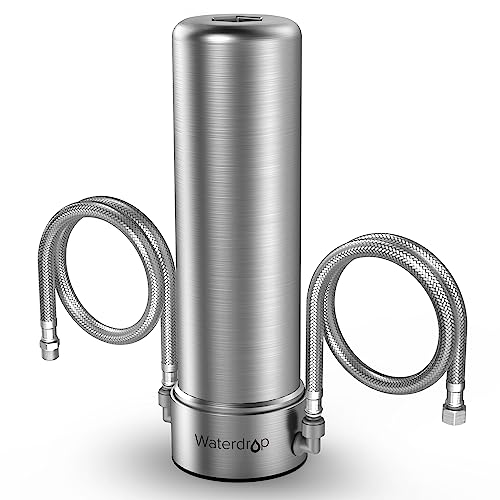
The Waterdrop AS13 packs six filtration stages into a compact stainless steel housing that slips into even the most crowded sink cabinets. Its 16,000-gallon capacity means you replace the cartridge roughly once per year, and the 1.6 GPM flow rate fills a standard glass in under three seconds without the trickle problem typical of older under-sink designs.
Independent IAPMO testing confirms NSF/ANSI 42 certification for chlorine, taste, and odor reduction, plus additional verification for PFAS, PFOA/PFOS, and lead. The 304 stainless steel construction avoids the cracking and chemical leaching risks associated with plastic housings, and the included 3/8″ to 1/2″ converter fittings cover most standard cold water lines without extra parts.
Setup takes about ten minutes with the push-to-connect hoses and does not require drilling a new faucet hole. The integrated smart indicator tracks filter life so you are not guessing when performance drops. Note that this unit retains beneficial minerals and does not lower TDS, which is the intended behavior for a non-RO system.
Why it’s great
- Six-stage filtration with NSF 42 certification for PFAS/lead reduction
- Stainless steel housing resists cracking and corrosion better than plastic
- 16,000-gallon lifespan; one cartridge per year for most households
Good to know
- Does not reduce TDS; retains minerals instead of stripping them
- Access to a dedicated faucet hole required for best results
2. SimPure V7 Under Sink Water Filter System

The SimPure V7 is one of the few under-sink filters in its tier that combines a 0.5-micron filtration accuracy with full 304 food-grade stainless steel housing. Its five-stage composite design uses double sediment membranes, KDF-55, and dual activated carbon blocks to reduce lead, chlorine, bad tastes, and impurities while preserving natural minerals that contribute to mouthfeel.
With a 20,000-gallon rated capacity and a 1.6 GPM flow rate, this unit outperforms most pitcher and countertop options in long-term value. The tool-free installation connects directly to 3/8″ or 1/2″ cold water lines using the included converter fittings, and the slim 3.6-inch diameter profile leaves room for a garbage disposal or cleaning supplies in the same cabinet.
Customer reports consistently highlight the dramatically improved taste and the fact that dogs refused unfiltered water after tasting the V7 output. The metal construction feels substantial compared to plastic alternatives, and SimPure has been serving the US market since 2006, which adds a layer of accountability for replacement filter availability.
Why it’s great
- 0.5-micron accuracy catches sediment and particles that single-stage carbon filters miss
- 20,000-gallon filter life at 1.6 GPM; annual replacement cycle
- Food-grade 304 stainless steel housing with BPA-free construction
Good to know
- Does not lower TDS; not suitable for users seeking RO-level purity
- Some users reported filter life shorter than rated in very poor water conditions
3. Brita Large Water Filter Pitcher (10 Cup)

The Brita Large 10 Cup Pitcher is the baseline entry point for anyone who just wants the chlorine taste gone without committing to an installed system. Its standard filter reduces mercury, copper, zinc, and cadmium, and the 40-gallon lifespan means roughly two months between swaps for a typical household. The BPA-free plastic body fits most refrigerator shelves, and the ergonomic handle with a flip-top lid makes refilling straightforward.
This pitcher is not designed for advanced contaminants like PFAS, pharmaceuticals, or fluoride. Its activated carbon media is optimized for aesthetic improvement — taste and odor — rather than health-related reduction. For users on municipal water with minor chlorine complaints, this is a perfectly adequate solution that keeps filtered water cold and accessible without any installation labor.
Customer feedback consistently praises the improvement in coffee and tea flavor when using filtered water from this pitcher. The replacement filters are widely available at most grocery stores, which eliminates the inconvenience of ordering specialty cartridges online. If your primary concern is crisp taste and not a comprehensive contaminant removal panel, this pitcher delivers the best cost-per-gallon ratio in the list.
Why it’s great
- Lowest upfront cost per gallon among reviewed options
- Fits standard fridge shelves; easy flip-top lid for refilling
- Replaceable filters are widely available in retail stores
Good to know
- Only certified for chlorine taste/odor and a few heavy metals; not for PFAS or fluoride
- 40-gallon filter life requires frequent replacement in high-usage households
4. OEMIRY Countertop Water Filter CF04

The OEMIRY CF04 bridges the gap between a pitcher and a full under-sink installation by connecting directly to your standard kitchen faucet. Its multi-stage alkaline filtration reduces up to 99% of chlorine, heavy metals, and fluoride while adding back beneficial minerals like potassium, calcium, and magnesium. The 8,000-gallon filter lifespan lasts roughly 12 months, and the 1.6 GPM flow rate means filling an 8-ounce glass takes about two seconds.
Installation requires no drilling or permanent modification — the system comes with six adapter sizes and a wrench to fit most standard faucet threads. A simple twist diverter lets you switch between filtered and unfiltered water. The compact 5.5-inch diameter housing sits discreetly beside the sink and produces zero wastewater, unlike reverse osmosis systems.
One limitation: this system does not reduce TDS, so if your goal is to strip all dissolved solids, OEMIRY recommends its RO model instead. Several customer reports on catchment water noted a significant improvement in taste and clarity. The manufacturer advises checking your faucet type before purchasing, as pull-out, handheld, and sensor faucets are not compatible.
Why it’s great
- Tool-free faucet connection; no cabinet space needed
- Alkaline filtration adds beneficial minerals post-filtration
- 8,000-gallon capacity with 1.6 GPM flow rate
Good to know
- Does not reduce TDS; retains dissolved solids
- Incompatible with pull-out, handheld, or sensor faucets
5. Clearly Filtered Filtered Water Pitcher
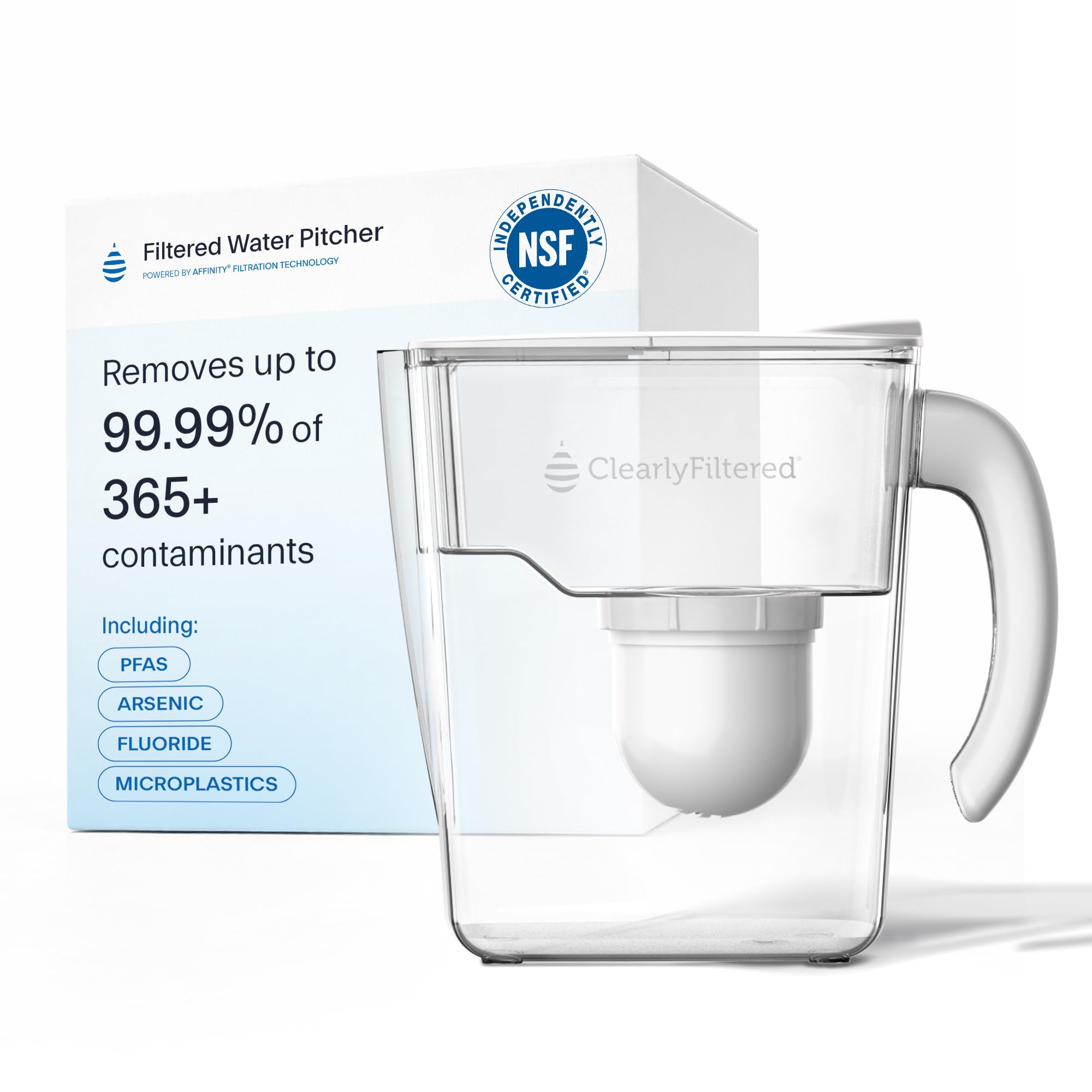
The Clearly Filtered pitcher is the most contaminant-aggressive pitcher on the market, targeting 365+ substances including fluoride, PFAS, lead, arsenic, microplastics, and pharmaceuticals. Its proprietary Affinity Filtration Technology uses ionic binding to capture contaminants while preserving beneficial minerals, and the system is independently tested and NSF certified to Standards 42, 53, 401, and 473 — a range that most pitcher filters cannot touch.
The 80-fluid-ounce (10-cup) capacity uses medical-grade Tritan plastic that is BPA-free, BPS-free, and non-leaching. Each filter handles up to 100 gallons, approximately 200 refills or four months of daily use. The redesigned ergonomic handle and spill-resistant water dam make pouring stable even when the pitcher is full, and the easy-hinge lid simplifies refilling.
The trade-off is price: the filters are significantly more expensive than standard Brita or ZeroWater replacements, though the per-gallon cost is comparable when you factor in the broader contaminant reduction. One caveat reported by a long-term user is that the plastic body developed discoloration after months of use, and the company’s customer service response was inconsistent. For health-conscious users needing fluoride and PFAS reduction without a plumber visit, this pitcher is the strongest option.
Why it’s great
- Removes 365+ contaminants including fluoride, PFAS, and pharmaceuticals
- NSF certified to Standards 42, 53, 401, and 473
- 100-gallon filter life with medical-grade Tritan construction
Good to know
- Replacement filters are expensive compared to standard pitcher filters
- A few users reported plastic body issues after extended use
6. Brita Wave 10 Cup Water Pitcher

The Brita Wave is the classic entry-level pitcher that set the standard for chlorine taste and odor reduction in the US. Its activated carbon filter reduces copper, cadmium, and mercury while removing the chemical aftertaste that makes tap water unappealing. Each standard filter lasts 40 gallons, which translates to roughly 300 standard water bottles per filter — a tangible reduction in single-use plastic waste.
The 10-cup capacity is adequate for individuals or small households, and the flip-top lid simplifies refilling under a standard faucet. The electronic filter indicator tracks how much water has passed through the filter and signals the replacement window, which helps avoid the trap of using an exhausted cartridge that no longer removes contaminants.
A minor ergonomic complaint appears in customer reviews: the pitcher is hard to lift when full, and some units have a spout door that can stick or fail to open properly. These are known manufacturing tolerances that vary unit to unit. For the price, this is a perfectly functional stopgap, but buyers serious about lead or PFAS reduction should look at the Clearly Filtered or an under-sink system instead.
Why it’s great
- Proven chlorine taste/odor reduction at the lowest entry price
- Electronic filter indicator prevents accidental use of spent cartridges
- Each filter replaces ~300 single-use plastic bottles
Good to know
- Filter covers only basic contaminants; no PFAS or fluoride reduction
- Some units suffer from sticky spout door and difficult lifting when full
7. ZeroWater 5-Stage Replacement Filter (2-Pack)

The ZeroWater 5-Stage filter is unique in the pitcher space because it uses ion exchange technology to remove virtually all total dissolved solids (TDS), dropping the reading to 0 on the included meter. This is the same principle used in reverse osmosis systems but without the installation or wastewater output. The five stages handle sediment, foam separation, activated carbon, and two ion exchange layers that pull metals, salts, and minerals out of solution.
Each filter has an estimated 15-gallon lifespan, which is significantly shorter than Brita’s 40-gallon rating, but the trade-off is measurable purity. The included TDS meter lets you verify performance — when the meter reads 006, it is time to swap. The 2-pack covers roughly two months of daily use for a small household, and the IAPMO certification confirms reduction of PFOA/PFOS, lead, chromium, and mercury.
Customer reviews consistently praise the taste improvement and the fact that coffee machines and humidifiers stay scale-free when using ZeroWater. The major drawback is that some batches have defective filters that either block water flow or fail prematurely. If you get a good batch, the performance is impressive; if you get a lemon, the inconsistency is frustrating. Buy from a retailer with a generous return policy.
Why it’s great
- Ion exchange technology drops TDS to 0 for measurable purity
- IAPMO certified for PFOA/PFOS, lead, chromium, and mercury reduction
- Included TDS meter confirms when the filter is still working
Good to know
- 15-gallon lifespan per filter; shorter replacement cycle than carbon-only filters
- Some batches have defective units that fail early or block water flow
FAQ
What is the difference between a 40-gallon and a 100-gallon filter?
Do under-sink water filters require a separate faucet hole?
Can a pitcher filter remove fluoride?
How often should I replace my water filter to maintain performance?
Final Thoughts: The Verdict
For most users, the water filters for drinking water winner is the SimPure V7 because it delivers 0.5-micron accuracy in a stainless steel housing with a 20,000-gallon filter life at a mid-range entry point. If you want NSF 42 certification for PFAS reduction with a compact footprint, grab the Waterdrop AS13. And for contaminant-obsessed households that need fluoride and pharmaceutical reduction without any installation, nothing beats the Clearly Filtered Pitcher.