You’ve done the reading on fluoride’s potential health impacts, checked your municipal water report, and now you’re staring down a shelf of filter options that all make big promises. The problem is that standard activated carbon pitchers — the kind sitting on most kitchen counters — simply cannot catch fluoride ions. A serious reduction requires a specific technology, whether reverse osmosis, a specialized gravity-fed element, or a high-grade adsorptive media. Without the correct internal mechanism, the fluoride passes right through and into your glass.
I’m Mohammad Maruf — the founder and writer behind AirfryerBite. I’ve spent years analyzing water filtration hardware, parsing third-party certification data, and comparing removal mechanisms to separate effective designs from marketing claims, so you don’t have to guess which system actually protects your tap.
This guide breaks down the five core technologies, real filter lifespans, and the measurable contaminant-reduction specs that matter most, helping you choose the water filter to remove fluoride that matches your home setup and daily volume without wasting money on the wrong cartridge type.
How To Choose The Best Water Filter To Remove Fluoride
Choosing the right system starts with understanding that fluoride behaves differently than chlorine or sediment. It requires a specific adsorption medium (activated alumina, bone char, or specialty carbon blends) or the tight physical rejection of a reverse osmosis membrane. Before you buy, match the technology to your plumbing constraints, counter space, and willingness to replace filters on schedule.
The Core Technologies That Actually Remove Fluoride
Three methods reliably reduce fluoride: reverse osmosis uses a semi-permeable membrane with 0.0001-micron pores to flush out fluoride ions along with dissolved solids; gravity-fed systems (like Berkey with PF-2 elements) use an adsorptive media cartridge that chemically binds fluoride; and some premium carbon block filters incorporate KDF or specialized alumina media. Standard refrigerator filters and inexpensive pitcher cartridges rarely carry fluoride-reduction certification — check for NSF/ANSI Standard 58 (RO) or independent test data before relying on any claim.
Flow Rate vs. Filter Life — The Real Trade-Off
A system’s flow rate directly impacts your daily convenience. Countertop RO units often produce 0.5 to 1.5 gallons per minute but waste some water as drain discharge. Gravity filters trickle at 0.05 GPM — fine for refilling a pitcher overnight but frustrating if you need a gallon immediately. Meanwhile, filter life varies from 6 months to 6,000 gallons depending on cartridge type and your source water quality. A longer-lasting filter usually costs more upfront but saves replacement hassle over two years.
Installation Type and Space Constraints
Countertop systems require zero drilling and sit beside your sink — ideal for renters or small kitchens. Under-sink RO units need access to a cold-water supply line and often a dedicated faucet hole, plus space under the cabinet (roughly 13 by 6 by 18 inches minimum). Gravity-fed countertop units need only counter space but stand taller — the Crown Berkey reaches 30 inches. Measure your available clearance before deciding on a tall gravity model.
Quick Comparison
On smaller screens, swipe sideways to see the full table.
| Model | Category | Best For | Key Spec | Amazon |
|---|---|---|---|---|
| Waterdrop T3-M | Under-Sink RO | Mineral-enhanced RO water | 9-stage RO + remineralization | Amazon |
| DREO Countertop RO | Countertop RO | No-install smart RO | TDS display, 3:1 ratio | Amazon |
| Aigerri UV Countertop RO | Countertop RO | Efficient water conservation | 5:1 pure-to-drain ratio | Amazon |
| AquaTru Carafe | Countertop RO | Compact certified RO | 4-stage, 64 oz carafe | Amazon |
| Frizzlife DS99 | Countertop Carbon | Quick-fix countertop filter | 0.5-micron, 2 GPM flow | Amazon |
| Waterdrop TST-UF | Under-Sink UF | Under-sink without drain | 0.01-micron UF membrane | Amazon |
| Purewell Gravity | Gravity Countertop | No-electricity fluoride reduction | 8-stage, 90% fluoride reduction | Amazon |
| Big Berkey 2.25 Gal | Gravity Countertop | Trusted gravity-fed system | Black Berkey + PF-2 elements | Amazon |
| Crown Berkey 6 Gal | Gravity Countertop | High-volume household use | 6-gallon capacity | Amazon |
In‑Depth Reviews
1. Waterdrop T3-M Remineralization RO System

The Waterdrop T3-M combines a high-flow 450 GPD tankless RO membrane with a post-filtration remineralization stage that adds calcium and magnesium back into the water. This means you get the fluoride rejection of a true 0.0001-micron membrane without the flat taste that RO skeptics complain about. The unit is certified to NSF/ANSI 372 for lead-free construction, and the all-in-one cartridge design makes filter swaps a simple twist — no wrenches or shut-off valves to fiddle with.
Setting it up under the sink requires access to a cold-water line and a dedicated faucet hole, but the smart LED alerts and auto-flush feature handle ongoing maintenance automatically. The 2:1 pure-to-drain ratio is solid for a tankless system, wasting less water than older RO designs. The overall footprint is 13.4 by 6.2 by 18 inches, so check your cabinet clearance before ordering.
Replacement cadence breaks down to a CF filter every 6 months, a CB filter every 12 months, and the RO membrane lasting up to 24 months. Over two years, the total cartridge cost is reasonable for the performance level, especially if you are serious about eliminating fluoride while keeping a mineral-balanced profile for drinking and cooking.
Why it’s great
- Tankless design saves under-sink space and eliminates standing water in a tank.
- Remineralization stage adds calcium and magnesium for better taste.
- Smart LED indicators and auto-flush system reduce manual upkeep.
Good to know
- Requires a drilled faucet hole and under-sink space of at least 18 inches height.
- Plug-in needed for the electric pump — not suitable for non-powered setups.
2. DREO Countertop Reverse Osmosis System
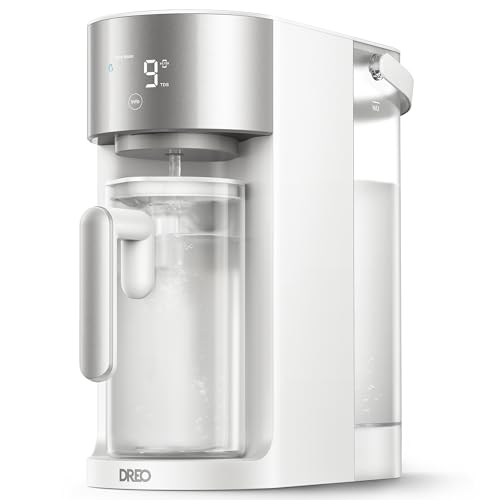
The DREO countertop RO system skips the installation headache entirely — you fill the 3-liter raw water tank, plug the unit in, and select your dispensing volume. It is tested by SGS to meet NSF/ANSI 58 standards, meaning the 7-in-1 filter cartridge has a verified track record for reducing fluoride, chlorine, PFOA/PFOS, and over 1,000 other impurities. The real-time TDS display lets you watch the raw versus purified reading change, giving immediate feedback on performance.
Its auto-fill pitcher sensor refills the 1.1-liter glass carafe hands-free when you place it back on the base, and the self-cleaning cycle flushes the internal tubing to prevent biofilm buildup. The 3:1 pure-to-drain ratio is noticeably more efficient than many older countertop RO units, and the filter lasts between 6 and 12 months depending on your water quality. The compact footprint (14.5 by 6.7 by 13.4 inches) fits under most standard kitchen cabinets with the lid closed.
This is a mid-range investment that delivers RO-level fluoride rejection without permanent plumbing changes.
Why it’s great
- True NSF/ANSI 58-certified RO filtration for fluoride reduction.
- No installation and no drilling — works out of the box on any counter.
- Auto-fill sensor and self-cleaning cycle reduce daily effort.
Good to know
- Small raw water tank (3 liters) means frequent refills for households.
- Plastic body is less durable than stainless steel countertop options.
3. Aigerri UV Countertop Reverse Osmosis Filter

Aigerri’s countertop RO system stands out for its water conservation numbers — a 5:1 pure-to-drain ratio means you waste only one gallon of water for every five gallons of clean water produced, which is industry-leading for a non-plumbed unit. The 5-liter raw water reservoir is the largest among the countertop RO models in this roundup, reducing how often you need to walk to the sink to refill. The system uses a 5-stage RO process that includes a preliminary PP sediment filter, a carbon block, and an RO membrane with 0.0001-micron pores.
Measuring 16.4 inches tall with the lid closed, it fits under most cabinets, though you need 22 inches of vertical clearance if you plan to open the top lid fully. The unit includes two replacement filter cartridges in the box — a PPC filter and an RO filter — and a change filter indicator takes the guesswork out of maintenance timing. Build quality uses BPA-free food-grade materials, and the self-cleaning function flushes the RO membrane periodically to extend its service life.
This is a premium countertop option that balances high capacity with low water waste, making it a solid pick for eco-conscious buyers who want RO-level fluoride removal without installing any plumbing.
Why it’s great
- 5:1 pure-to-drain ratio minimizes wastewater compared to most RO systems.
- Large 5-liter raw water tank reduces daily refill frequency.
- Self-cleaning cycle and filter change indicator simplify maintenance.
Good to know
- Requires 22 inches of vertical clearance for full lid opening.
- Plastic body may feel less premium than stainless steel alternatives.
4. AquaTru Carafe Countertop Water Purifier
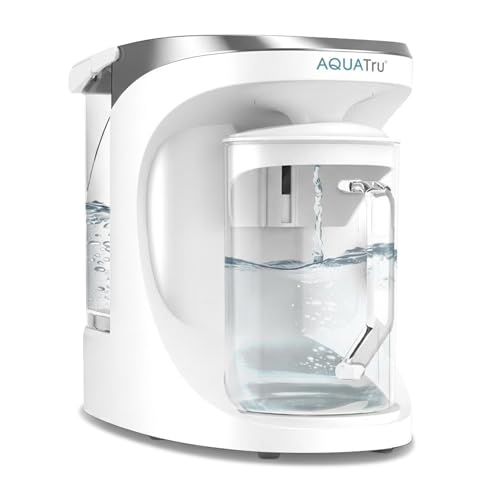
The AquaTru Carafe is a compact countertop reverse osmosis purifier certified by IAMPO to NSF standards specifically for fluoride, lead, PFOA/PFOS, and 84 other contaminants. Its 4-stage filtration process includes a sediment pre-filter, a carbon VOC filter, an RO membrane, and a final carbon post-filter. The 64-ounce glass carafe is borosilicate, meaning no plastic leaching into your stored water, and the entire unit is about the size of a mid-range coffee maker.
No plumbing or drilling is needed — just fill the upper reservoir and press start. The system processes water in batches, so you get a full carafe of RO-purified water in roughly 15 minutes. Each filter set lasts 6 months to 2 years depending on usage and replaces up to 4,500 plastic bottles over its life. The machine’s pump does produce some noise during operation, but the automatic shutoff means you can fill it before bed and wake up to a full carafe.
This is the most proven countertop RO design in the consumer market, with a long track record of reliable fluoride rejection. The trade-off is batch processing speed — if you need more than 64 ounces at once, you wait for the next cycle.
Why it’s great
- Third-party certified fluoride and contaminant reduction to NSF standards.
- Glass carafe avoids plastic taste and chemical leaching concerns.
- Tool-free filter replacement and simple batch operation.
Good to know
- Batch processing limits continuous draw — must wait for next cycle.
- Pump noise is audible during the filtration cycle.
5. Frizzlife DS99 Countertop Water Filter
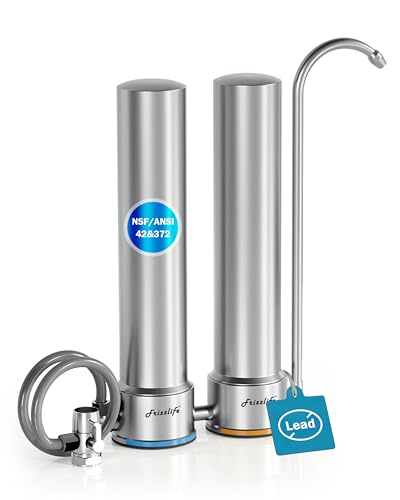
The Frizzlife DS99 is an 8-stage countertop filter that attaches directly to your existing faucet with a diverter valve, giving you instant filtered water at 2 gallons per minute. Its 0.5-micron carbon block includes KDF media and activated coconut shell carbon, which the manufacturer states reduces fluoride along with chlorine, lead, and heavy metals. The entire system is built with lead-free 304 stainless steel housings that are corrosion-resistant and have passed 100,000-cycle water hammer tests.
Installation takes about five minutes — unscrew your aerator, screw on the included adapters, and snap the diverter valve into place. No drilling, no electricity, and zero wastewater. The two-stage filter design uses a sediment pre-filter (DSF01) lasting up to 8 months and a finer carbon block (DSF02) lasting up to 12 months or 8,000 gallons. This is the fastest-flowing filter on this list bar none, making it ideal for filling a pot for cooking in seconds.
While the DS99 is certified by NSF 42 and 372 for material safety and chlorine reduction, its fluoride claim is based on internal testing rather than NSF Standard 58. It is a capable entry-level option for reducing some fluoride, but if you need maximum and confirmed fluoride removal, an RO system is the safer bet.
Why it’s great
- Exceptionally fast 2 GPM flow rate — fills a glass in 2-3 seconds.
- Stainless steel construction with tested durability and corrosion resistance.
- No electricity, no wastewater, and tool-free installation.
Good to know
- Fluoride reduction is based on manufacturer testing, not NSF/ANSI 58 certification.
- Requires specific faucet thread compatibility — check before ordering.
6. Waterdrop TST-UF Under Sink Water Filter

The Waterdrop TST-UF is a 6-layer under-sink filtration system that uses a 0.01-micron ultrafiltration membrane to reduce sediment, chlorine, heavy metals, and odors. Its all-stainless-steel housing (lead-free 304) is a clear upgrade over plastic filter canisters that can crack or leak over time. The system does NOT require a drain line — it connects directly to your cold-water supply with 3/8-inch or 1/2-inch fittings, so it works on municipal tap water without the wastewater concern of an RO system.
Filter lifespans are generous: the PP sediment filter runs 6-8 months, the UF membrane lasts about a year, and the coconut-shell carbon block (CT filter) goes 12-24 months. Flow rate is decent at 1.59 GPM — that is 2.3 seconds for an 8-ounce glass. Installation is drill-free and can be mounted on the cabinet wall or placed on the floor, giving flexibility for tight spaces.
The important limitation here is that UF membranes do NOT remove dissolved fluoride ions. The system is designed to reduce larger particles and chlorine, improving taste and clarity, but it cannot physically block fluoride at the ionic level. If your primary goal is fluoride reduction, this filter is not the right tool — look at the RO or gravity-based options instead.
Why it’s great
- Sturdy 304 stainless steel housing outlasts plastic filter systems.
- No drain line needed and simple under-sink pipe connection.
- Long filter life reduces annual replacement costs.
Good to know
- Ultrafiltration does NOT reduce dissolved fluoride or TDS.
- Not suitable for well water — designed for municipal supplies only.
7. Purewell 2.25G Gravity Water Filter System

The Purewell system uses gravity-fed 8-stage filtration with two specialized cartridge types: black carbon filters that incorporate a 0.01-micron UF membrane and silver-ion-impregnated carbon block, and white fluoride filters that use a dedicated fluoride reduction membrane and activated carbon to target 90% of fluoride and chlorine. The stainless steel chambers sit on a stand, and a transparent viewing window lets you eyeball the water level without lifting the lid.
With a 2.25-gallon total capacity and dual-chamber gravity flow, you fill the top chamber with tap water and collect filtered water from the lower chamber via the spigot. No electricity, no plumbing — suitable for indoor countertops or outdoor emergencies. The fluoride filters handle roughly 1,000 gallons before needing replacement, while the carbon filters last up to 6,000 gallons. Note that the flow rate is very slow (0.05 GPM) compared to pressurized systems, so plan ahead for filling.
This system is a strong candidate if you want verified fluoride reduction without power or installation, especially for emergency preparedness or off-grid use. The 90% reduction claim is notable among gravity filters, though it is not NSF-certified — rely on the manufacturer’s third-party testing data for confidence.
Why it’s great
- Dedicated fluoride filter elements claim 90% reduction without power.
- Transparent water level window for easy monitoring.
- All-stainless-steel construction with no plastic internals touching water.
Good to know
- Very slow gravity flow — 0.05 GPM requires patience for batch filling.
- Fluoride reduction claim is manufacturer-specified, not NSF/ANSI 58 certified.
8. Big Berkey Gravity-Fed 2.25 Gallon Water Filter
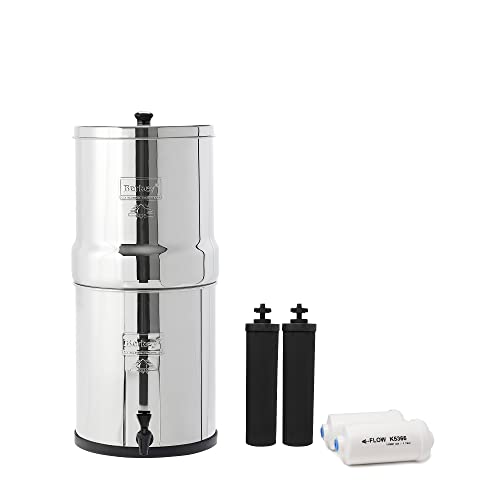
The Big Berkey is the most recognized name in gravity-fed water filtration, and for good reason. Its Black Berkey Elements (the genuine BB9-2) use a proprietary micro-porous media blend tested by third-party labs to remove or dramatically reduce over 250 contaminants. For fluoride-specific reduction, you add the PF-2 Fluoride and Arsenic Reduction Elements, which screw into the bottom of the Black Berkey Elements and adsorb fluoride, arsenic(V), and other heavy metal ions.
The 2.25-gallon stainless steel system sits on any countertop without electricity or plumbing — just fill the upper chamber and let gravity pull water through the filters into the lower chamber. A pair of Black Berkey Elements lasts an exceptional 6,000 gallons before replacement (nearly 2–3 years for a typical family), while the PF-2 elements need changing every 1,000 gallons. Replacement cost per gallon is among the lowest in the filtration market.
Berkey’s widespread use in off-grid, emergency, and international settings speaks to its reliability. The main downside is that genuine Berkey filters have faced distribution changes in recent years — always buy from an authorized seller to avoid counterfeits. And as with all gravity systems, the flow is measured in hours, not minutes, for a full batch.
Why it’s great
- Black Berkey Elements deliver up to 6,000-gallon filter life at low per-gallon cost.
- PF-2 elements provide targeted fluoride and arsenic reduction.
- Proven reliability in off-grid and emergency preparedness communities.
Good to know
- Gravity drip speed is slow — fill the top chamber the night before.
- Counterfeit risks require buying only from authorized Berkey retailers.
9. Crown Berkey 6 Gallon Gravity-Fed Water Filter
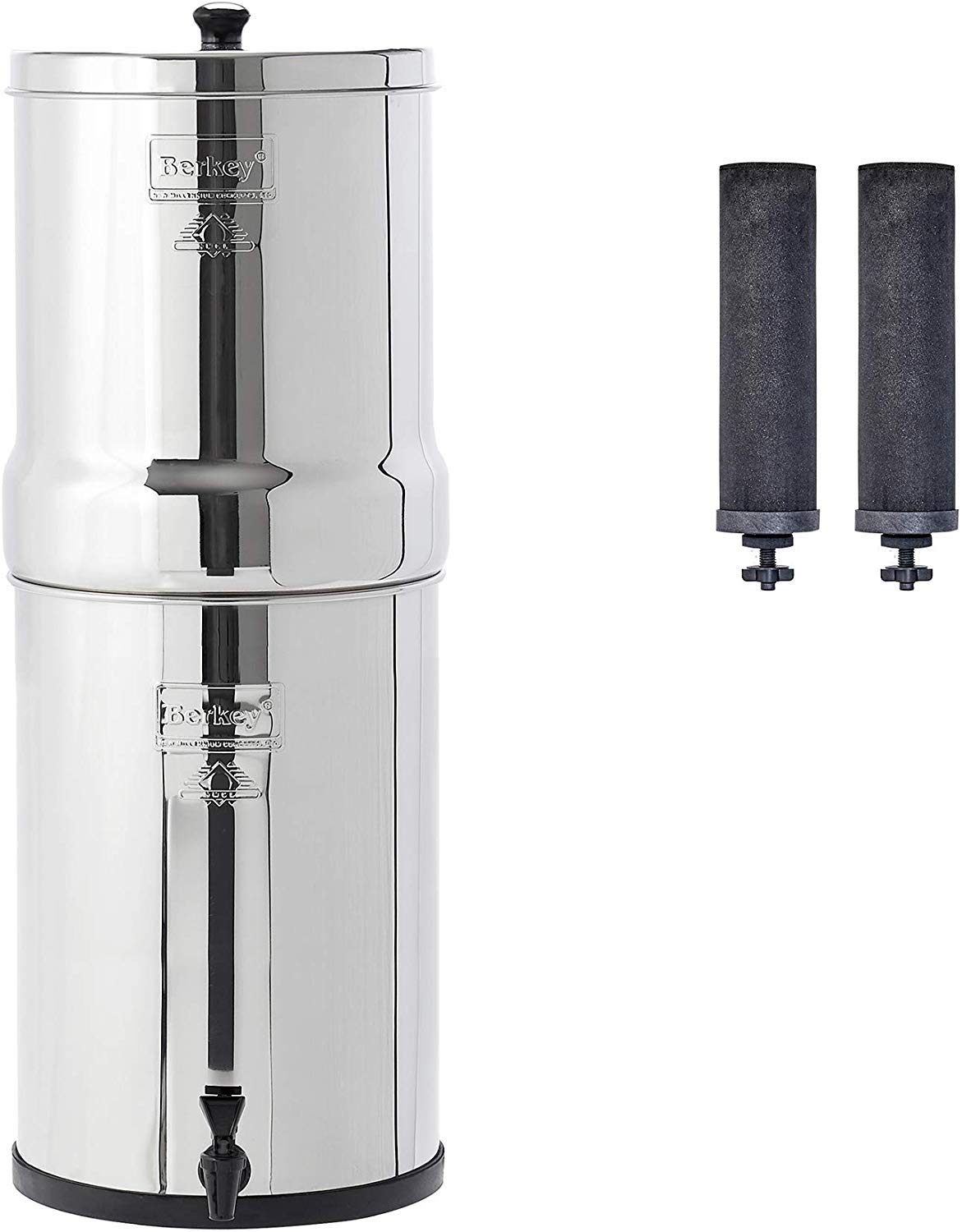
The Crown Berkey is essentially the Big Berkey scaled up to 6 gallons — the same Black Berkey Elements (BB9-2) technology but with a taller stainless steel chamber that holds significantly more water. It includes two Black Berkey Elements in the box, and you can add PF-2 fluoride reduction elements (sold separately) for targeted fluoride removal. The 6-gallon capacity is ideal for families of four or more, letting you filter a full day’s drinking and cooking water in a single gravity cycle.
At 30 inches tall and 11 inches in diameter, the Crown requires generous counter or table space and at least 36 inches of overhead clearance for removing the upper chamber. The build quality is the same heavy-gauge stainless steel as the smaller Berkey models, and the instructions remain straightforward — prime the new filters, assemble the chambers, and fill. Each pair of Black Berkey Elements still provides up to 6,000 gallons before needing replacement, so the larger tank doesn’t reduce filter lifespan.
The Crown Berkey is the definitive solution for high-volume households that want the proven performance of Berkey’s multi-media filtration plus the option of PF-2 elements for fluoride reduction. You pay more upfront for the larger system, but the long filter life and low per-gallon operating cost offset the initial investment over two to three years.
Why it’s great
- Massive 6-gallon capacity supports large families and high daily usage.
- Same long-lasting Black Berkey elements as the smaller models.
- No electricity or plumbing required — works anywhere with counter space.
Good to know
- Tall 30-inch height may not fit under standard upper cabinets.
- PF-2 fluoride elements are sold separately, increasing initial cost.
FAQ
Does a standard Brita or PUR pitcher remove fluoride?
What is the difference between reverse osmosis and gravity-fed fluoride filters?
How do I know if a filter is actually certified to reduce fluoride?
Can an under-sink ultrafiltration (UF) system remove fluoride?
Final Thoughts: The Verdict
For most users, the water filter to remove fluoride winner is the Waterdrop T3-M because its tankless RO membrane delivers verified fluoride rejection while the remineralization stage restores calcium and magnesium for a balanced taste, all in a compact under-sink footprint. If you want a no-install countertop solution that also provides real-time TDS feedback and auto-fill convenience, grab the DREO Countertop RO. And for high-volume household use where you prefer no electricity and no plumbing, nothing beats the Crown Berkey 6 Gallon with PF-2 elements added for targeted fluoride reduction.