If your tap water has a metallic taste or leaves a bluish-green stain on your sink fixtures, copper contamination is the most likely suspect. While trace amounts of copper are essential for health, elevated levels—often from corroding pipes—can cause gastrointestinal distress and, over time, more serious issues. The right filtration system stops copper at the source, restoring clean, great-tasting water.
I’m Mohammad Maruf — the founder and writer behind AirfryerBite. I’ve spent years analyzing filtration hardware, from micron ratings and NSF certifications to flow rates and filter lifespans, to help you separate marketing claims from actual performance.
Whether you’re dealing with an aging home’s plumbing or simply want peace of mind, this guide breaks down the water filter to remove copper options that actually deliver verified results for your specific situation.
How To Choose The Best Water Filter To Remove Copper
Not every water filter reduces copper. Sediment filters and basic carbon cartridges may catch chlorine and odor but will pass dissolved copper right through. You need a system engineered with specific media—KDF (Kinetic Degradation Fluxion), catalytic carbon, or a certified carbon block—that targets heavy metals through chemical reduction rather than simple physical straining.
NSF/ANSI 53 Certification is Your Only Guarantee
Look for systems independently tested and certified against NSF/ANSI Standard 53 specifically for copper reduction. Without this mark, the manufacturer has not proven the filter removes copper to safe drinking levels under controlled lab conditions. Many filters claim “heavy metal reduction” in generic marketing copy; the certification listing tells you exactly which contaminants were tested and at what percentage.
Filter Media Matters: KDF vs. Carbon Block vs. Reverse Osmosis
For targeted copper removal without stripping beneficial minerals, KDF media excels because it uses an electrochemical reaction to convert dissolved copper into insoluble particles that are then trapped in the filter bed. High-quality carbon blocks with a tight micron rating (0.5 microns or finer) also reduce copper when the carbon is activated with appropriate additives. Reverse osmosis systems remove copper completely but also eliminate healthy minerals and require a separate storage tank.
Flow Rate and Filter Lifespan Trade-Offs
A higher flow rate (measured in gallons per minute) is convenient for filling pots and glasses quickly, but high flow can reduce contact time with the filter media, lowering copper removal efficiency. Systems rated for high copper reduction often have slower flow rates. Balance your household’s daily water usage against the filter’s certified flow capacity. Filter lifespan—measured in gallons or months—also varies widely; longer-life filters can be more economical per gallon but may lose efficiency against heavy metals before their nominal end date.
Quick Comparison
On smaller screens, swipe sideways to see the full table.
| Model | Category | Best For | Key Spec | Amazon |
|---|---|---|---|---|
| Brondell Coral UC300 | Under Sink | Certified three-stage filtration | WQA Gold Seal / NSF 42,53,372 | Amazon |
| Waterdrop TST-UF 0.01μm | Under Sink | 0.01μm ultrafiltration precision | 1.59 GPM flow rate, 304 steel | Amazon |
| Aquasana Claryum AQ-MF-1 | Under Sink | 99% of 78 contaminants removed | NSF 42/53 for lead & copper | Amazon |
| Frizzlife MS99 | Inline Under Sink | Compact dual-use fridge & sink | 0.5 micron, 2-year filter life | Amazon |
| Waterdrop 10UB-B | Under Sink | Budget-friendly yearly replacement | 11,000 gallon / 12 month life | Amazon |
| ICEPURE WFS5300A-20 | Under Sink | Ultra-long 5-year filter life | 40,000 gallon capacity, 2.5 GPM | Amazon |
| Express Water Whole House | Whole House | Entire home heavy metal protection | 3-stage KDF + carbon + sediment | Amazon |
In‑Depth Reviews
1. Brondell Coral UC300 Under Sink Water Filtration System

The Brondell Coral UC300 holds the highest certification bar for copper removal in this lineup, carrying WQA Gold Seal verification against NSF/ANSI Standards 42, 53, and 372. Its three-stage process—sediment, pre-carbon, and a dense carbon block—specifically targets heavy metals including lead and copper. The integrated chrome designer faucet includes an LED filter change indicator, a practical convenience that prevents you from running an exhausted cartridge.
Flow rate is moderate at approximately 0.5-0.7 GPM due to the tight carbon block stage, but the trade-off ensures robust contact time for copper reduction. Each cartridge set lasts 12 months or 600 gallons, making annual maintenance predictable and simple. The double O-ring seal on the filter housing adds leak protection that other entry-level systems lack.
The entire setup is designed for DIY installation under your sink with quick-connect fittings. At 24.38 inches tall, it requires adequate cabinet space, so measure your under-sink height before purchasing. The filter housing is constructed from durable plastic rather than stainless steel, which keeps weight down but may feel less premium than some metal-bodied alternatives.
Why it’s great
- WQA Gold Seal certified specifically for NSF/ANSI 53 copper and lead reduction
- Three-stage filtration catches sediment then chemically reduces dissolved heavy metals
- LED indicator on faucet eliminates guesswork for filter replacement timing
Good to know
- Tall housing requires significant under-sink clearance (over 24 inches)
- Flow rate moderate at around 0.5-0.7 GPM due to tight carbon block
2. Waterdrop TST-UF 0.01μm Ultra-Filtration Under Sink Water Filter System

The Waterdrop TST-UF stands apart with its six-layer filtration architecture, culminating in a 0.01-micron ultrafiltration membrane that physically blocks fine particulates while chemically reducing heavy metals through its carbon block and PP stages. The 304 stainless steel housing feels substantial and avoids the plastic degradation concerns of some all-polymer systems, while the 1.59 GPM flow rate is the fastest in this selection—filling a standard glass in about 2.3 seconds.
Copper reduction is achieved primarily through the activated carbon block and the tightly woven PP sediment pre-filter that captures larger metal particles before they reach the UF membrane. The system is designed exclusively for municipal tap water at cold temperatures; it is not suitable for well water or hot water connections. Replacement filters vary in lifespan: the PP filter lasts 6-8 months, the UF membrane lasts 12 months, and the CT carbon block lasts 12-24 months.
Installation flexibility sets the TST-UF apart—it can be hung on the cabinet wall or placed on the floor, and it connects directly to 3/8-inch or 1/2-inch threads without requiring a dedicated faucet. The system does not reduce TDS, and the brand explicitly warns it cannot reduce total dissolved solids, which is typical for non-RO systems. If you use a TDS meter to assess performance, it will not show a drop.
Why it’s great
- 1.59 GPM flow rate delivers fast drinking water without waiting
- Lead-free 304 stainless steel body resistant to corrosion and leaks
- Multiple installation options (wall-hung or floor-placed) increase placement flexibility
Good to know
- Does not reduce TDS—copper molecules must be chemically reduced, not physically strained
- Not for use with well water or hot water sources
3. Aquasana Claryum Direct Connect AQ-MF-1
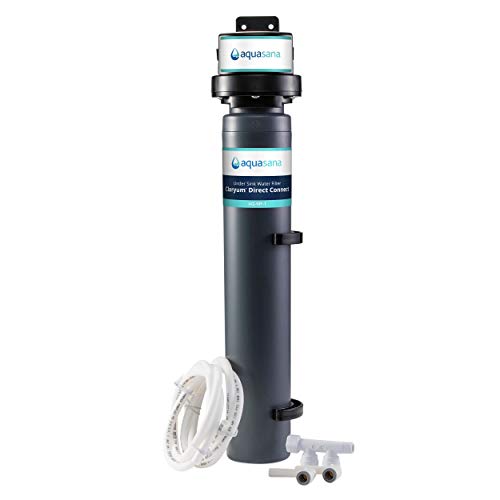
Aquasana’s Claryum filter delivers one of the broadest contaminant reduction claims on the market: 99% of 78 contaminants, including lead, mercury, PFAS, and copper. Crucially, it retains beneficial minerals like calcium, magnesium, and potassium rather than stripping everything out, which is an intentional design choice for those who prefer mineral-balanced water rather than the flat taste of reverse osmosis output.
The direct-connect design does not require a separate dedicated faucet—it ties directly into your existing cold water line and shares the main faucet. This saves countertop space and drilling, but the large filter housing measures 20.5 inches tall, so under-cabinet clearance is essential. Installation is DIY-friendly with the included dual-port adapter for 3/8-inch hoses, though the plumber-installed feedback suggests the plastic adapter can fail under pressure if not seated perfectly.
Flow is noticeably reduced compared to unfiltered tap water— customers report a 10-15% drop, which is typical for a 0.5-micron carbon block. Filter life is certified for 6 months, and the system is backed by a 1-year limited warranty and 90-day satisfaction guarantee. The replacement filters cost more per year than some budget options, but the breadth of certifications and contaminant reduction justifies the premium for households with multiple water quality concerns beyond copper alone.
Why it’s great
- NSF/ANSI 53 certified for copper and lead reduction with third-party testing
- Retains healthy minerals instead of stripping everything out like RO
- Covers 78 contaminants including PFAS, not just heavy metals
Good to know
- Tall 20.5-inch housing may not fit tight under-sink spaces
- Plastic adapter on direct-connect model has some failure reports under high pressure
4. Frizzlife Inline Water Filter System MS99

Frizzlife’s MS99 is a versatile inline filter designed to serve both under-sink faucets and refrigerator ice makers, making it a dual-purpose solution for households with filtered water demands at multiple points. The 0.5-micron compound cartridge is certified by IAPMO against NSF/ANSI Standards 42 and 53, covering chlorine, lead, taste, and odor reduction, with heavy metal targeting through its carbon block formulation.
A standout feature is the compression brass fitting that works with both standard PEX tubing and flexible copper tubing—a specific design choice for older homes that still use copper supply lines. The auto shut-off function allows filter changes without turning off the main water supply, and the twist-in housing makes swapping the cartridge a 30-second task. Each cartridge delivers up to 2 years of service, dramatically reducing ongoing costs compared to systems that need replacement every 6 months.
The maximum flow rate of 1.4 GPM is fast enough to fill a 330ml glass in about 3 seconds. Dimensions of 13.5 x 5 x 5 inches keep the housing relatively compact, though it still requires at least 6 inches of clearance behind the refrigerator if mounted there. The system only filters at the point of installation—it will not reduce copper in water used at other taps in the house unless you install multiple units.
Why it’s great
- Compression brass fittings accommodate older copper supply lines without adapters
- Auto shut-off design lets you change filters without turning off house water
- 2-year cartridge life keeps long-term operating costs low
Good to know
- Does not come with a dedicated faucet—requires existing faucet or fridge connection
- Filter only the specific tap or appliance it’s connected to
5. Waterdrop 10UB-B Under Sink Water Filter System

The Waterdrop 10UB-B is one of the most popular under-sink filters on the market, and for good reason—its 11,000-gallon capacity at a competitive entry price makes it the highest-value option in this guide. It is certified by IAPMO against NSF/ANSI 42 and 372, and tested by a third-party laboratory against NSF/ANSI 53 for lead reduction. While the manufacturer emphasizes lead reduction in its marketing, the multistage filtration system also targets heavy metals broadly through its upgraded activated carbon block from natural coconut shell.
Installation is genuinely tool-free thanks to push-to-connect fittings and a twist-and-lock filter design that clicks into place in seconds. The 0.75 GPM flow rate is slower than some competitors, but the trade-off is extended contact time for better copper and heavy metal reduction. The included lead-free brushed stainless steel faucet saves you the expense of buying a separate dedicated drinking faucet.
One important caveat: Waterdrop explicitly states this system does not reduce TDS, and the activated carbon media may not be sufficient for very high copper levels. If your water test shows copper above the EPA action level of 1.3 mg/L, you may need a system with KDF media or a more aggressive heavy metal stage. The compact 3.9 x 3.6 x 12.3-inch profile fits easily in tight cabinets, and the replacement filters (model WD-RF10) cost significantly less than many competing cartridges.
Why it’s great
- 11,000-gallon capacity with 12-month service life reduces replacement frequency
- Push-to-connect fittings make installation possible without tools or plumbing skills
- Lead-free brushed stainless steel faucet included in the package
Good to know
- 0.75 GPM flow rate is slower than many competing under-sink units
- Primarily designed for chlorine and lead—very high copper levels may need stronger media
6. ICEPURE WFS5300A-20 Under Sink Water Filtration System

The ICEPURE WFS5300A-20 redefines filter longevity with a massive 40,000-gallon capacity rated to last up to 5 years on municipal water. That is roughly four times the lifespan of most competitors, dramatically reducing both the frequency of replacements and the long-term cost of ownership. It is NSF/ANSI 42 and 372 certified for chlorine, taste, odor, and lead-free material compliance, and its 2.5 GPM flow rate at 60 PSI is the fastest in this under-sink comparison.
Copper reduction is handled by the 0.5-micron outer coconut shell carbon block, which traps heavy metals through adsorption. The system connects directly to your existing faucet, meaning you do not need a countertop hole for a separate drinking faucet. Installation is plug-and-play with push-to-connect fittings, and the 2-second twist filter change is the fastest of any system reviewed here.
The main trade-off is the physical size: at 21.1 inches tall, this is one of the tallest under-sink filters available. Measure your cabinet clearance carefully before purchase—many standard kitchen sinks have less than 22 inches of vertical space. The system only works with 1/2-inch or 3/8-inch female NPT cold water lines, and the manufacturer recommends regular replacement even before the 5-year mark if you notice a change in taste or flow rate, as heavy metal removal efficiency can decline before the nominal capacity is reached.
Why it’s great
- 40,000-gallon capacity equals 5 years of filtration on municipal water
- 2.5 GPM flow rate provides nearly unfiltered-level speed
- Direct-connect design eliminates need for separate dedicated faucet
Good to know
- 21.1-inch height will not fit many standard under-sink cabinets
- Only certified for NSF 42—no explicit NSF/ANSI 53 heavy metal certification
7. Express Water Whole House Heavy Metal Water Filter Set

The Express Water Whole House system takes a fundamentally different approach: it treats all water entering your home rather than just one tap. This three-stage setup consists of a sediment pre-filter (4-layer polypropylene), an activated coconut shell carbon block, and a specialized KDF (Kinetic Degradation Fluxion) filter that is specifically engineered for heavy metal reduction, including copper, iron, lead, nickel, and chromium. For homes with copper pipes throughout, this is the only option that protects every faucet, shower head, and appliance from copper corrosion and staining.
The 4.5 x 20-inch standard cartridges are widely available and easy to replace, with a system capacity of up to 100,000 gallons depending on incoming water quality. The KDF media works through an electrochemical process that converts dissolved heavy metals into insoluble particles, which are then trapped by the carbon and sediment stages. This makes it highly effective for copper removal, though it will not reduce total dissolved solids—that requires a separate reverse osmosis system at the point of use.
Installation is more involved than under-sink units because you must cut into your main water supply line. Basic plumbing skills or a professional installer are recommended. The system is best suited for homes with documented copper levels in the water supply, rather than as a preventive measure. While the replacement cartridges are affordable individually, buying all three stages at every change cycle adds up—the sediment filter may need replacement every 3-6 months depending on sediment load, while the carbon and KDF filters last 6-12 months.
Why it’s great
- KDF media is specifically formulated for electrochemical reduction of copper and other heavy metals
- Protects entire home, not just one tap—including appliances and showers
- 100,000-gallon capacity provides years of filtration between full changes
Good to know
- Requires main water line installation—not a simple under-sink DIY job
- Sediment pre-filter needs frequent replacement (every 3-6 months) in high-sediment areas
FAQ
How do I know if my water has dangerous copper levels?
Can any carbon filter remove copper from tap water?
Is reverse osmosis better than a carbon filter for copper removal?
Do I need a whole-house system or just an under-sink filter for copper?
How long does a copper-removal filter last before replacement?
Final Thoughts: The Verdict
For most users, the water filter to remove copper winner is the Brondell Coral UC300 because it carries the WQA Gold Seal certification specifically for NSF/ANSI 53 heavy metal reduction, offers a straightforward three-stage design, and includes an LED indicator on its premium chrome faucet. If you want Waterdrop TST-UF.