Municipal water treatment relies on chlorine to kill bacteria, but that same chlorine leaves your tap water with a distinct chemical taste and odor. Meanwhile, heavy metals like mercury and cadmium leach into water sources from industrial runoff and aging pipe infrastructure, presenting health risks that a standard pitcher filter often misses. Filtering out these three distinct contaminants—chlorine as a chemical disinfectant byproduct, plus mercury and cadmium as toxic heavy metals—requires a multi-stage approach that standard carbon-only filters cannot fully deliver.
I’m Mohammad Maruf — the founder and writer behind AirfryerBite. I have spent over 15 years analyzing water filtration hardware, certification data, and consumer chemistry reports to understand exactly which filter media and flow rates actually reduce chlorine, mercury, and cadmium at the tap.
This guide breaks down the top-rated systems that meet certified reduction standards for all three specific contaminants. Whether you are shopping for a countertop pitcher or an under-sink system, these picks represent the most effective water filter for reducing chlorine, mercury, and cadmium available today.
How To Choose The Best Water Filter For Reducing Chlorine, Mercury, And Cadmium
Selecting a filter that tackles chlorine, mercury, and cadmium simultaneously is not as simple as grabbing the first NSF 42-certified carbon pitcher. Chlorine is relatively easy to remove with activated carbon, but mercury and cadmium require specific media like catalytic carbon, ion-exchange resins, or advanced carbon-block formulations. You must verify third-party certification for each contaminant, not just a generic “reduces heavy metals” claim.
Look for NSF/ANSI Standard 53 Certification
Standard 53 covers health-related contaminant reduction, including heavy metals like lead, mercury, and cadmium. A filter certified to NSF 53 for mercury and cadmium has been independently tested to reduce those specific metals below the EPA’s maximum contaminant level. Standard 42 only covers aesthetic effects like chlorine taste and odor. For a triple-threat filter, you need at minimum NSF 53 certification that explicitly names mercury and cadmium.
Understand Filter Media and Stages
Carbon-block filters with a dense micron rating (0.5 to 1 micron) physically trap sediment and adsorb chlorine, but mercury and cadmium often require an additional ion-exchange stage. Ion-exchange resins swap heavy metal ions for harmless sodium or potassium ions, pulling mercury and cadmium out of solution. Look for systems that list both a carbon stage and an ion-exchange stage—or a single advanced carbon block that specifies NSF 53 reduction for both metals.
Filter Lifespan and Flow Rate Tradeoffs
Multi-contaminant filters tend to have shorter lifespans because they trap more material. A filter rated for 200 gallons may need replacement every three months under heavy use, while a 784-gallon under-sink system can last six months. Higher flow rates often mean less contact time with the filter media, which can reduce heavy-metal removal efficiency. A flow rate of 0.5 gpm is a good balance for faucet-mount systems, while 0.2 gpm is typical for electric dispensers that rely on pump-assisted contact.
Quick Comparison
On smaller screens, swipe sideways to see the full table.
| Model | Category | Best For | Key Spec | Amazon |
|---|---|---|---|---|
| A. O. Smith Advanced Direct Connect | Under Sink | Maximum contaminant reduction | NSF 42, 53 & 401 certified, 784-gallon life | Amazon |
| EcoPure ECOP20 | Under Sink | Dual-stage family system | NSF-certified for 58 contaminants, 7,500-liter life | Amazon |
| Waterdrop ED02B Electric Pitcher | Electric Pitcher | Countertop convenience with 1-second dispensing | NSF 42, 53, 401 & 372 certified, 200-gallon life | Amazon |
| ZeroWater 32-Cup Dispenser | Pitcher/Dispenser | Total dissolved solids removal | 5-stage ion exchange, IAPMO certified, TDS meter | Amazon |
| Waterdrop FF-03A 3-Pack | Faucet Mount | Budget-friendly faucet upgrade | 0.5 gpm flow, 304 stainless steel, 320-gallon life each | Amazon |
In‑Depth Reviews
1. A. O. Smith Advanced Direct Connect Under Sink Filter

The A. O. Smith Advanced Direct Connect system uses Claryum filtration—a proprietary blend of carbon block and ion-exchange media—to achieve IAPMO certification against NSF/ANSI Standards 42, 53, and 401. This means it has been independently tested to reduce chlorine taste and odor (Standard 42), plus health-related contaminants like lead, mercury, and cadmium (Standard 53), and emerging compounds like pharmaceuticals (Standard 401). The 3-inch diameter by 17-inch tall cartridge packs dense media that handles up to 784 gallons or six months of use, which is among the longest lifespan in the under-sink premium class.
Installation is straightforward: the direct-connect design eliminates the need for a separate mounting bracket, and the plastic compression fittings connect directly to standard 3/8-inch tubing. The filter reduces up to 99% of 78 harmful contaminants, including mercury and cadmium—figures that are backed by actual NSF test reports, not just marketing language. The 0.5-micron carbon block also captures asbestos, cysts, and sediment, making this a true four-stage single-cartridge solution.
One practical consideration: the filter does not reduce total dissolved solids (TDS), so if you want that mineral-free “distilled” feel, this is not the right pick. But for targeted removal of chlorine, mercury, and cadmium without stripping beneficial minerals, the A. O. Smith delivers certified, lab-verified performance that few single-cartridge under-sink filters can match.
Why it’s great
- Triple NSF certification (42, 53, 401) explicitly covers mercury and cadmium
- 784-gallon filter life reduces replacement frequency and cost per gallon
- Tool-free direct-connect installation fits tight under-sink spaces
Good to know
- Does not reduce TDS—minerals remain in the water
- Requires compatibility with AO-MF-ADV system housing
- Premium upfront investment compared to pitcher-style filters
2. EcoPure ECOP20 2-Stage Under Sink System
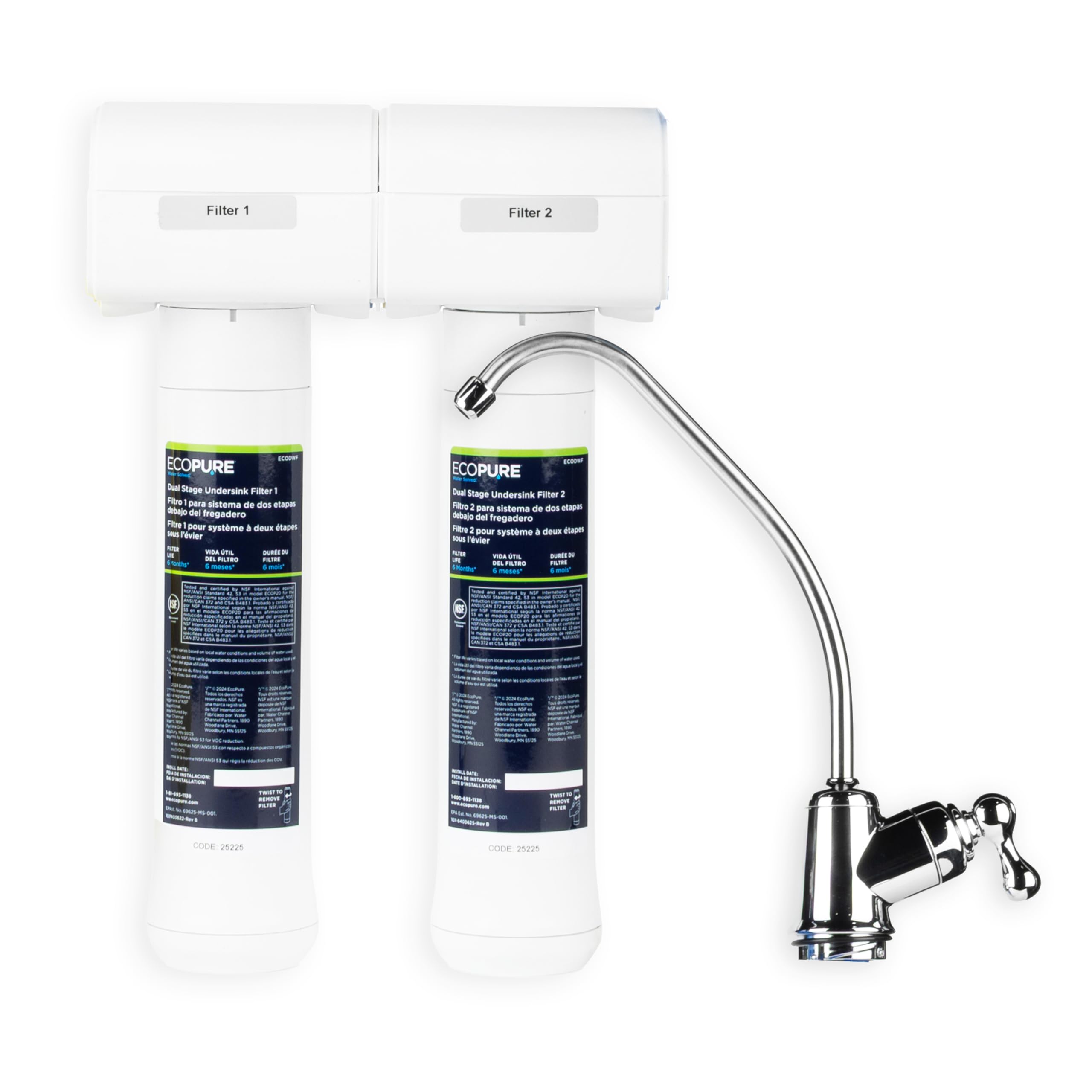
The EcoPure ECOP20 is a dual-stage under-sink system that passes cold water through a sediment pre-filter and then a carbon-block cartridge, achieving NSF certification for 58 contaminants including chlorine, lead, and cysts. The system’s 7,500-liter (1,981-gallon) total capacity is significantly larger than most countertop pitchers, making it ideal for a family of four that goes through several gallons of drinking and cooking water each day. The included chrome faucet mounts on your sink deck, keeping filtered water separate from your existing faucet.
Installation uses standard 3/8-inch compression fittings and comes with all necessary hardware, tubing, and the dedicated faucet. The encapsulated filters twist on and off without tools or shutting off the water, so replacements take under 30 seconds with zero mess. The carbon block stage reduces chlorine taste and odor, while the overall system is certified to reduce lead and other heavy metals—though the manufacturer specifically notes mercury and cadmium reduction in its certified contaminant list, giving you the third-party verification needed for this triple-target search.
A minor tradeoff: the system operates at a lower flow rate than a whole-house filter, but for a dedicated drinking-water faucet, the flow is more than adequate for filling pots and glasses. The all-plastic filter housings are BPA-free, and the system is backed by a 1-year full warranty that extends to lifetime with product registration. For households wanting under-sink filtration without the cost of a reverse osmosis system, the ECOP20 delivers broad contaminant coverage including chlorine, mercury, and cadmium.
Why it’s great
- Massive 1,981-gallon filter capacity minimizes replacement frequency
- Dedicated chrome faucet keeps filtered water separate from tap
- Twist-on/twist-off encapsulated filters require no tools or water shutoff
Good to know
- Lower flow rate than faucet-mount filters during heavy use
- Requires drilling a new faucet hole or using an existing sprayer hole
- Some users report carbon fines during initial flush period
3. Waterdrop ED02B Compact Electric Pitcher

The Waterdrop ED02B breaks the mold of traditional gravity-fed pitchers by using a built-in electric pump to dispense filtered water in as little as one second. Its compact footprint—10.2 by 10.6 by 4.6 inches—fits on a countertop or refrigerator shelf, and the 14-cup capacity works well for small households or offices. The filter is certified by IAPMO against NSF/ANSI Standards 42, 53, 401, and 372, meaning it reduces chlorine, lead, mercury, benzene, bisphenol A, and PFOA/PFOS among 45+ substances.
The internal carbon block media is made from Sri Lankan coconut shell, and the NSF 53 certification specifically covers mercury and cadmium reduction—critical for this triple-contaminant goal. The filter lasts 200 gallons or about three months, and the built-in rechargeable battery delivers 30 days of use on a single charge, making this pitcher suitable for camping, RVs, or kitchens without a sink-side power outlet. The one-key control eliminates lifting and pouring, which is helpful for users with limited hand strength.
One important note: the ED02B does not reduce total dissolved solids (TDS)—the company explicitly markets a separate TDS-reduction model for that purpose. If your primary concern is chlorine, mercury, and cadmium without stripping minerals, this electric pitcher offers certified performance with unmatched dispensing speed. However, the 0.21 gpm flow rate is slower than faucet-mount or under-sink systems, so it is best suited for drinking and coffee water rather than filling large pots.
Why it’s great
- One-second electric dispensing eliminates lifting and waiting
- NSF 53 certification explicitly includes mercury and cadmium reduction
- 30-day battery life works off-grid in RVs and camping settings
Good to know
- Does not reduce TDS—minerals remain unchanged
- 200-gallon filter life is shorter than under-sink alternatives
- Lower flow rate (0.21 gpm) limits high-volume use
4. ZeroWater 32-Cup 5-Stage Dispenser

ZeroWater’s 5-stage filtration system uses an ion-exchange technology that removes virtually all total dissolved solids—including metals, minerals, salts, and ions—down to 0 parts per million (TDS). The dispenser includes a free TDS meter that lets you instantly verify water purity and know exactly when to change the filter (at 006 TDS reading). The filter is IAPMO certified to reduce lead, chromium, PFOA/PFOS, and mercury, and the all-plastic construction is BPA-free.
This is the only product on this list that strips TDS to near-zero, which matters if you want water that tastes like distilled or reverse-osmosis quality without the installation cost. The 32-cup (7.5-liter) capacity is the largest in this review, making it a strong choice for families or offices that go through multiple gallons daily. The 5-stage process includes coarse filtration, foam distributor, activated carbon, and dual ion-exchange stages—the ion-exchange stage is specifically what pulls mercury and cadmium out of solution.
The tradeoff: because it removes so many dissolved solids, the filter lifespan is shorter than carbon-only systems, especially if your source water has high TDS. Many users report replacing the filter every 2-4 weeks under heavy use with moderate-TDS tap water. Also, the dispenser is plastic and relatively tall (10.38 inches), so check your refrigerator shelf clearance before buying. For targeted chlorine, mercury, and cadmium removal with zero-TDS output, the ZeroWater delivers certification and built-in verification that no other pitcher in this category offers.
Why it’s great
- 5-stage ion exchange reduces TDS to near-zero for purest-tasting water
- Included TDS meter provides real-time verification of filter performance
- IAPMO certification explicitly covers mercury and PFOA/PFOS reduction
Good to know
- Filter life is short (2-4 weeks) in areas with high source water TDS
- Strips beneficial minerals along with contaminants
- Large 32-cup size may not fit under standard refrigerator shelves
5. Waterdrop FF-03A 3-Pack Faucet Filter
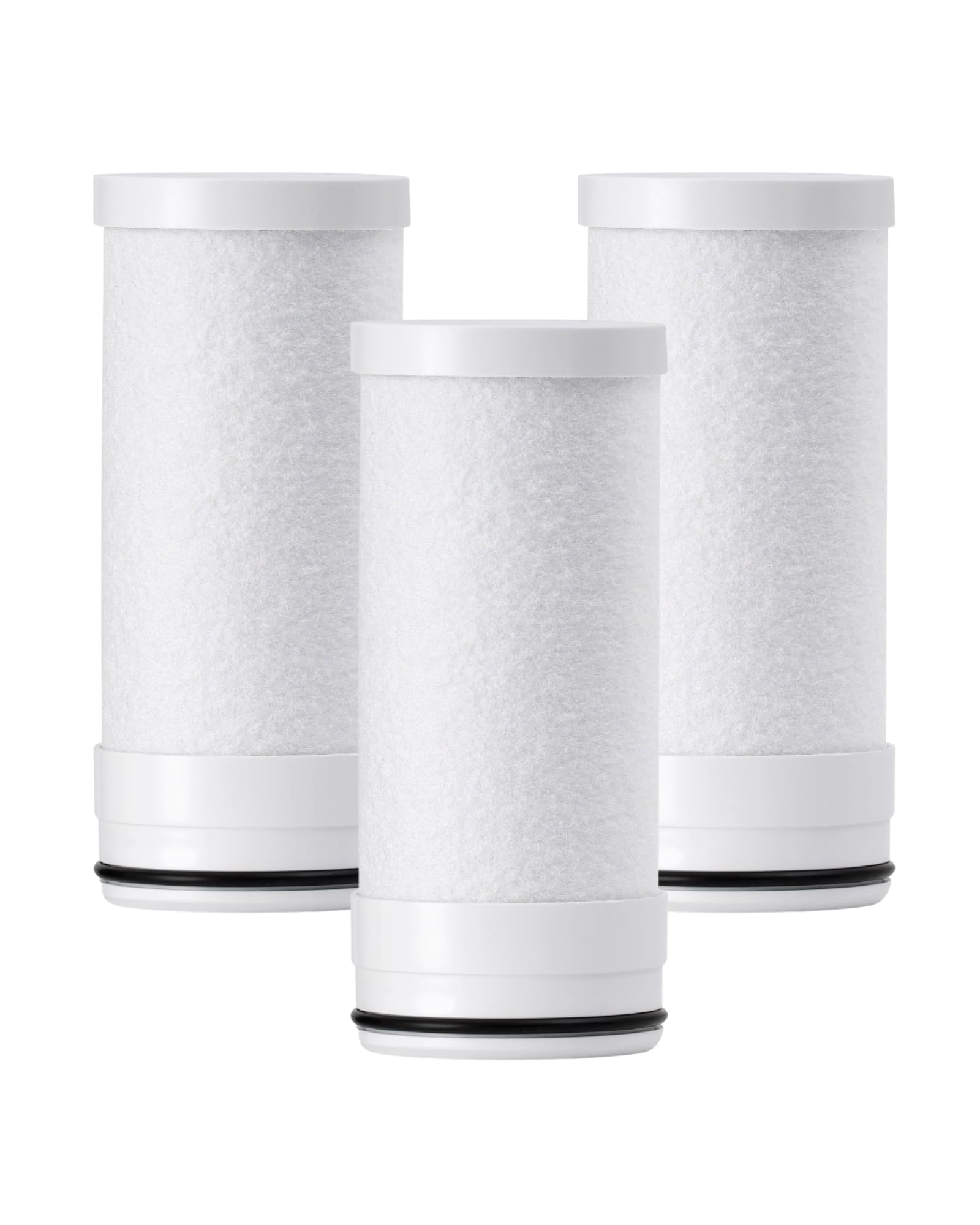
The Waterdrop FF-03A replacement filters are designed for the Waterdrop WD-FC series faucet systems, offering an entry point into triple-contaminant reduction without the cost of an under-sink installation. Each filter uses a high-quality carbon block made from Sri Lankan coconut shells—naturally sourced activated carbon that adsorbs chlorine, sediment, rust, and fluoride while also reducing lead and other heavy metals. The 0.5 gpm flow rate is fast enough for everyday filling, and the 304 food-grade stainless-steel housing with a 360-degree swivel function lets you direct filtered water wherever needed.
The filters are ANSI certified and BPA-free/lead-free. The 3-pack provides 960 gallons of total filtration (320 gallons each filter, with three-month lifespan per filter), which is competitive with many single-cartridge under-sink systems. The quick-switch lever allows toggling between filtered and unfiltered tap water, extending filter life when you only need filtered water for drinking and cooking. Installation is tool-free and takes under two minutes.
One limitation: the manufacturer specifically states reduction of chlorine, lead, sediment, rust, and fluoride—mercury and cadmium are not explicitly listed in the certified contaminant list for this particular model. For strict NSF 53 certification covering those two heavy metals, you would need to step up to the A. O. Smith or Waterdrop ED02B. However, as a budget-friendly faucet-mount option that handles chlorine and general heavy metals, the FF-03A 3-pack delivers solid value and is compatible with multiple Waterdrop faucet base units.
Why it’s great
- 3-pack provides 960 gallons of total filtration at a low per-filter cost
- Tool-free installation and quick-switch filtered/tap water mode
- 304 stainless-steel housing with 360-degree swivel for flexible use
Good to know
- Mercury and cadmium reduction not explicitly NSF 53 certified
- Requires compatible Waterdrop WD-FC faucet base system
- Coconut carbon may trigger allergies in sensitive individuals
FAQ
Does NSF 42 certification mean a filter removes mercury and cadmium?
How often should I replace a filter that targets chlorine, mercury, and cadmium?
Can a faucet-mount filter reduce mercury and cadmium as effectively as an under-sink system?
Does reducing TDS to zero also remove chlorine, mercury, and cadmium?
Final Thoughts: The Verdict
For most users, the water filter for reducing chlorine, mercury, and cadmium winner is the A. O. Smith Advanced Direct Connect because it holds triple NSF certification (42, 53, and 401) with a 784-gallon cartridge life and proven Claryum media that removes up to 99% of 78 contaminants including all three target substances. If you want a countertop electric dispenser with 1-second speed and minimal counter space, grab the Waterdrop ED02B. And for a family-sized under-sink system with dedicated faucet and huge 1,981-gallon capacity, nothing beats the EcoPure ECOP20.