Microplastic particles are small enough to slip through many standard filters, ending up in your drinking glass and, eventually, your body. The health concerns around ingesting these synthetic fragments have pushed water filtration technology to develop more precise barriers, measured in microns rather than general promises.
I’m Mohammad Maruf — the founder and writer behind AirfryerBite. I’ve spent years analyzing water filtration chemistry and real-world contaminant removal data to separate marketing claims from measurable performance, especially regarding microplastic reduction.
This guide breaks down the specific micron ratings, certifications, and membrane technologies that actually matter when choosing a water filter for microplastics, helping you pick a unit that delivers measurable protection without overpaying for features you do not need.
How To Choose The Best Water Filter For Microplastics
Microplastics vary in size, but most fall between 0.1 and 5,000 microns. A standard refrigerator filter may catch large sediment but let smaller particles pass. You need a filter whose physical pore size is smaller than the particles you want to block, paired with a certification that proves the removal rate under real flow conditions.
Start With the Micron Rating
Look for a filter with an absolute pore size of 1 micron or smaller. A 0.5 micron carbon block catches most microplastics, while a 0.01 micron ultrafiltration membrane stops virtually all particles, including nano-sized fragments. The smaller the number, the tighter the barrier — but also the slower the flow rate.
Check for NSF/ANSI Standard 53 (P473)
This specific test protocol measures a filter’s ability to reduce microplastics from drinking water. A filter certified under P473 has been independently verified to remove a minimum percentage of particles in the 1 to 100 micron range. Without this certification, claims about microplastic removal are unverified.
Choose the Right Installation Type
Under-sink systems offer higher capacity and dedicated faucets but require cabinet space and plumbing access. Countertop pitchers are portable and need no installation but have smaller filter volumes and lower flow rates. Reverse osmosis units deliver the highest removal rates but require electricity and produce wastewater.
Quick Comparison
On smaller screens, swipe sideways to see the full table.
| Model | Category | Best For | Key Spec | Amazon |
|---|---|---|---|---|
| AO Smith AO-MF-ADV | Under Sink | P473 certified microplastic reduction | NSF P473 certified, 0.5 micron | Amazon |
| Waterdrop TSU-WB | Under Sink | 0.01 micron ultrafiltration barrier | 0.01 um membrane, 24 month life | Amazon |
| Waterdrop TST-UF | Under Sink | Stainless steel build, no drill needed | 0.01 um UF, 304 stainless housing | Amazon |
| Clearly Filtered Pitcher | Pitcher | Multi-contaminant removal in portable form | Targets 365+ contaminants, 80 oz | Amazon |
| DREO WF511 | Countertop RO | Highest removal rate, no installation | 0.0001 um RO membrane, 7-stage | Amazon |
| Frizzlife SW10F | Under Sink | Budget-friendly 0.5 micron block | 0.5 micron, 8000 gallon capacity | Amazon |
| ICEPURE WFS5300A-20 | Under Sink | Ultra-high capacity, low maintenance | 40,000 gallon life, 0.5 micron | Amazon |
In‑Depth Reviews
1. AO Smith AO-MF-ADV

The AO Smith Claryum Advanced filter is one of the few under-sink systems that holds NSF/ANSI Standard 53 (P473) certification for microplastic reduction, verified to remove 99% of particles. It connects directly to your existing cold water line without a secondary faucet, saving counter space and installation complexity.
The 0.5 micron carbon block reduces 78 contaminants including lead, mercury, asbestos, and pharmaceuticals while retaining beneficial minerals. Flow rate holds at 1.5 gallons per minute at standard pressure, which keeps kitchen tasks moving without the trickle typical of tighter membranes.
Each filter cartridge lasts 784 gallons or roughly six months for a family of four. The annual maintenance cost stays well below premium RO systems, and the 4 by 4 by 20 inch footprint fits most under-sink cabinets if measured beforehand.
Why it’s great
- NSF P473 certified specifically for microplastic reduction
- Direct connect to existing faucet — no extra hole needed
- Retains healthy minerals while removing contaminants
Good to know
- Tall 20 inch housing may not fit shallow cabinets
- Does not reduce TDS — minerals remain
- Filter changes every 6 months require timely replacement
2. Waterdrop TSU-WB

The Waterdrop TSU-WB uses a 0.01 micron ultrafiltration membrane, which is 50 times tighter than a standard 0.5 micron carbon block. This absolute barrier stops virtually all microplastic particles, bacteria, and cysts while allowing dissolved minerals like calcium and magnesium to pass through.
Smart indicator lights on the panel show real-time filter status and water quality at a glance. The integrated waterway design reduces leakage risk, and each filter change takes a simple twist without shutting off the water supply. Filter life is rated at 24 months for the main membrane.
Installation requires drilling a 1-inch hole for the stainless steel faucet, so this system is best suited for homeowners or renters with permission to modify countertops. The 0.6 GPM flow rate is slower than carbon block systems but expected for tight ultrafiltration membranes.
Why it’s great
- 0.01 micron barrier catches even nano-sized plastic fragments
- Smart panel alerts when filters need replacement
- Retains healthy minerals for better taste
Good to know
- Requires drilling a 1-inch countertop hole
- Flow rate capped at 0.6 GPM
- Not compatible with well water
3. Waterdrop TST-UF

The Waterdrop TST-UF shares the same 0.01 micron ultrafiltration membrane as the TSU-WB but wraps it in a heavy-duty 304 stainless steel housing that resists corrosion and impact. The metal construction is a significant upgrade over plastic-bodied filters, especially in humid under-sink environments.
Drill-free installation connects directly to standard 3/8 or 1/2 inch cold water lines with push-fit fittings. The unit can sit on the cabinet floor or hang on the wall, giving flexibility for tight spaces. Flow rate reaches 1.59 GPM, much faster than the TSU-WB, making it practical for daily cooking and drinking.
Filter life spans 6 to 24 months depending on the stage, with a 6-layer filtration media including sediment, carbon, and the ultrafiltration membrane. The coconut shell carbon material improves taste while the stainless housing reduces plastic waste from disposable filter casings.
Why it’s great
- Industrial-grade 304 stainless housing is leak-resistant
- No drilling needed, flexible mounting options
- Faster flow rate than most UF systems
Good to know
- Does not reduce TDS — minerals pass through
- Requires 3/8 or 1/2 female NPT faucet connection
- Not suitable for well water
4. Clearly Filtered Pitcher
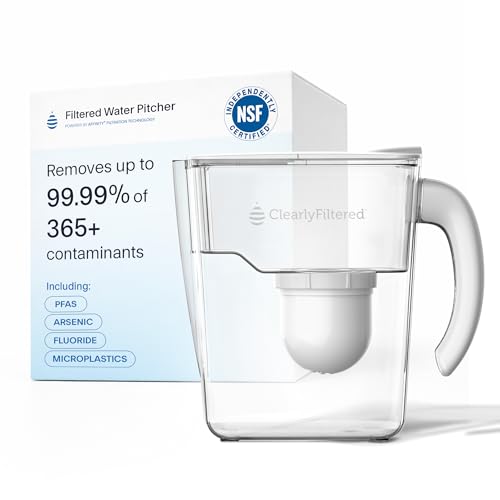
The Clearly Filtered Pitcher stands apart from typical carafe filters by using a proprietary Affinity Filtration Technology that targets 365-plus contaminants including microplastics, PFAS, lead, fluoride, and pharmaceuticals. It holds NSF/ANSI certifications 42, 53, 401, and 473, covering both aesthetic and health-based reduction claims.
The 80-ounce (10 cup) capacity serves a household without constant refilling, and the medical-grade Tritan plastic body is BPA and BPS free. Filter life is rated at 100 gallons, roughly four months for average use, which is longer than most pitcher filters on the market.
No installation is required — just prime the filter, fill the pitcher, and refrigerate. This makes it a strong option for renters, dorm rooms, offices, or anyone who wants microplastic reduction without modifying plumbing. The trade-off is slower filtration speed compared to under-sink systems.
Why it’s great
- One of the few pitchers with NSF P473 microplastic certification
- Removes 365+ contaminants including fluoride and PFAS
- No installation, zero plumbing modifications needed
Good to know
- Slower flow rate than under-sink systems
- Requires refrigerator space for best performance
- Filter replacements add recurring cost
5. DREO WF511
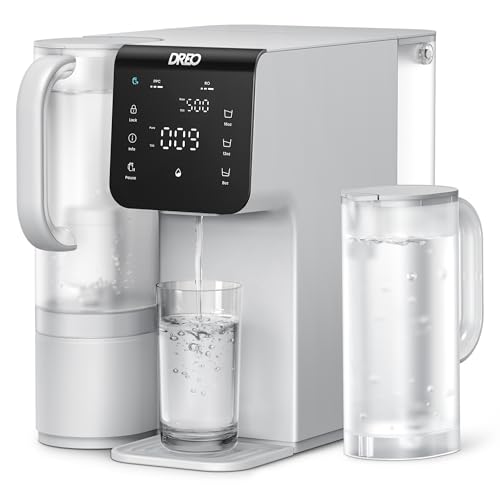
The DREO WF511 is a countertop reverse osmosis system with a 0.0001 micron RO membrane — 100 times tighter than ultrafiltration and thousands of times tighter than carbon block filters. This level of filtration removes 99.99% of over 1,000 contaminants including PFAS, lead, nitrates, and microplastics of any size.
Seven stages of filtration including sediment, carbon, RO membrane, and post-carbon polishing ensure thorough contaminant removal. The unit sits on the counter with zero plumbing required — just plug it in, flush twice, and dispense. A real-time TDS meter on the panel shows water purity instantly.
The 3:1 pure-to-drain ratio minimizes wastewater compared to older RO units, and the system can produce up to 1,050 gallons per set of filters. Two included BPA-free pitchers allow one to auto-refill while you use the other, making it convenient for high-volume households.
Why it’s great
- 0.0001 micron RO membrane removes particles of any size
- No installation needed — plug and dispense
- Real-time TDS monitoring on smart panel
Good to know
- Produces some wastewater (3:1 ratio)
- Requires countertop space and a power outlet
- Higher upfront investment than carbon filters
6. Frizzlife SW10F
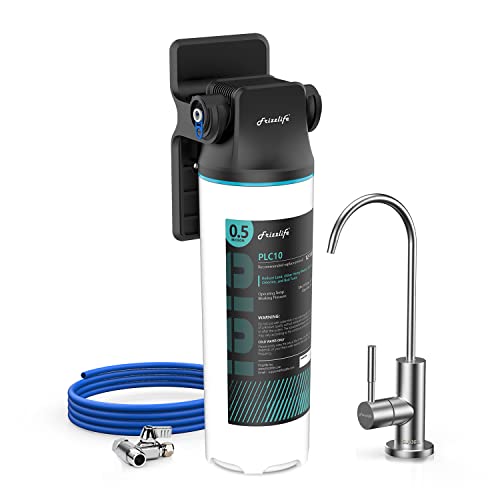
The Frizzlife SW10F is an entry-level under-sink filter that uses a 0.5 micron composite carbon block to reduce chlorine, lead, heavy metals, and larger microplastic particles. It is NSF/ANSI 42 and 53 certified, though not specifically under the P473 microplastic protocol, so removal claims should be viewed with that context.
Each filter cartridge lasts 12 to 16 months or up to 8,000 gallons, which is nearly double the lifespan of many competing carbon systems. The twist-and-change design allows replacement without shutting off water, and the included brushed nickel faucet matches most kitchen aesthetics.
Flow rate hits 1.5 GPM, filling a 12-ounce cup in under four seconds. The system uses a replaceable inner core rather than a full housing replacement, reducing plastic waste over time. However, the 15-inch height requires adequate under-sink clearance and the system is designed for cold water only.
Why it’s great
- 0.5 micron rating catches most common microplastic sizes
- Extended 8,000 gallon filter life reduces replacements
- Easy 3-second twist change design
Good to know
- No specific P473 certification for microplastics
- 0.5 micron may miss smaller nano-particles
- Cold water use only
7. ICEPURE WFS5300A-20

The ICEPURE WFS5300A-20 is built around extreme capacity: 40,000 gallons of filtration, which translates to five years of service before the main filter needs replacing. The 0.5 micron coconut shell carbon block reduces heavy metals, chlorine, sediment, and larger microplastic particles, backed by NSF/ANSI 42 and 372 certifications for material safety.
Installation takes under three minutes with plug-and-play connectors that attach directly to your existing faucet — no dedicated faucet required. The 2.5 GPM flow rate is one of the fastest among under-sink filters, making it suitable for high-demand kitchens. BPA-free and food-grade materials ensure no chemical leaching.
The tall 21.1 inch housing demands careful cabinet measurement before purchase. The system connects to 1/2 or 3/8 inch female NPT threads and is cold water only. Ideal for those who want maximum filter lifespan and minimal maintenance frequency, though the 0.5 micron barrier is less absolute than UF or RO options.
Why it’s great
- Unmatched 40,000 gallon / 5 year filter lifespan
- Fast 2.5 GPM flow rate
- BPA-free, food-grade construction
Good to know
- Tall 21.1 inch housing — measure cabinet height first
- 0.5 micron only — may miss nano-sized particles
- No specific microplastic certification listed
FAQ
Will a 0.5 micron filter catch all microplastics?
What does NSF P473 certification mean for microplastic removal?
Does reverse osmosis remove beneficial minerals along with microplastics?
Final Thoughts: The Verdict
For most users, the water filter for microplastics winner is the AO Smith AO-MF-ADV because it holds the NSF P473 certification for microplastic reduction, connects directly to your existing faucet, and retains beneficial minerals without the cost and complexity of reverse osmosis. If you want absolute barrier protection with a 0.01 micron ultrafiltration membrane, grab the Waterdrop TSU-WB. And for portable, no-install convenience that still targets microplastics, nothing beats the Clearly Filtered Pitcher.