Apartment living comes with compromises — water quality should not be one of them. Whether you are dealing with chlorine taste, hard water scale, or unknown pipe debris, the right filtration system turns your tap into a reliable source without violating a lease or requiring a plumber.
I’m Mohammad Maruf — the founder and writer behind AirfryerBite. I have spent years analyzing water filtration hardware, comparing micron ratings, flow rates, and certification standards to separate real performance from marketing claims in the apartment-friendly category.
After evaluating seven distinct systems — from countertop pitchers to under-sink stainless steel units — I have built this guide to help you find the absolute best water filter for apartment based on your specific water chemistry and available counter space.
How To Choose The Best Water Filter For Apartment
Apartment water filters must solve three constraints simultaneously: physical footprint, installation permanence, and filtration depth. A system that works well in a house with a dedicated under-sink cabinet may be unusable in a rental with cramped plumbing. Here is what to check before buying.
Installation Type: Countertop vs Under Sink vs Faucet-Mount
Countertop dispensers require zero plumbing changes — you fill them manually and they sit on your counter. Under-sink systems connect to the cold water line under the sink and require a small cabinet or floor footprint. Faucet-mount filters attach directly to the aerator thread. For renters, countertop and no-drill under-sink units are safest because they can be removed without leaving evidence of modification.
Filtration Depth: What a Lower Micron Rating Actually Means
Micron rating refers to the pore size in the filter media. A 0.01-micron ultrafiltration membrane catches bacteria and cysts that a standard 0.5-micron carbon block would miss. If your building has old pipes or you are concerned about microbial content, look for 0.01-micron UF or reverse osmosis systems. For basic chlorine and sediment reduction, a 1-micron carbon block is usually sufficient and flows faster.
Flow Rate and Capacity Matching Your Daily Volume
A gravity-fed system produces water slowly — typically 1 to 4 gallons per hour — which is fine for drinking and cooking but not for filling large pots instantly. Pressurized under-sink units deliver 1.5 to 1.6 gallons per minute. Match flow rate to your household size: couples can tolerate slower pitchers, families of four need at least 1 GPM.
Certifications: NSF/ANSI Standards That Actually Matter
NSF/ANSI 42 covers aesthetic effects (chlorine taste and odor). NSF/ANSI 53 covers health-related contaminants like lead and mercury. NSF/ANSI 401 covers emerging compounds like pharmaceuticals and PFOA/PFOS. For apartment water, Standard 42 is the minimum; Standard 53 is recommended if you have lead concerns from old building pipes.
Quick Comparison
On smaller screens, swipe sideways to see the full table.
| Model | Category | Best For | Key Spec | Amazon |
|---|---|---|---|---|
| Waterdrop TST-UF | Under Sink | High flow, minimal cabinet space | 0.01µm UF membrane | Amazon |
| ZeroWater 32-Cup | Countertop | 0 TDS drinking water | 5-stage Ion Exchange | Amazon |
| SimPure V7 | Under Sink | 3-minute tool-free install | 0.5µm, 304 Steel | Amazon |
| Waterdrop ED04W-L | Electric Dispenser | One-button dispensing, large capacity | 27-cup, 200-gallon filter | Amazon |
| Purewell 2.25G Gravity | Countertop Gravity | No-electricity, emergency prep | 0.01µm UF, 2.25gal | Amazon |
| Filtrete 3US-AS01 | Under Sink | Entry-level chlorine removal | Sediment + Carbon block | Amazon |
| AquaTru Carafe RO | Countertop RO | Maximum contaminant removal | 4-stage RO, Glass carafe | Amazon |
In‑Depth Reviews
1. Waterdrop TST-UF 0.01μm Ultra-Filtration Under Sink System

The Waterdrop TST-UF delivers the highest flow rate in this lineup — 1.59 gallons per minute — which translates to filling an 8-ounce cup in just over two seconds. Its 0.01-micron ultrafiltration membrane targets bacteria, cysts, and particles that larger-pore carbon blocks pass through. The stainless steel housing eliminates the plastic degradation concerns common with economy under-sink units.
Installation is genuinely no-drill: the system connects directly to 3/8-inch or 1/2-inch cold water lines using quick-connect fittings. Users report completing the hookup in roughly ten minutes with no additional adapters needed for standard apartment plumbing. The multi-stage filtration includes a PP sediment layer, a granular activated carbon layer, and the UF membrane, followed by a final carbon block for taste polishing.
One catch — this system does not reduce total dissolved solids (TDS). If your primary concern is hard water mineral content, you will need a reverse osmosis unit instead. The replacement filter schedule is also segmented: the PP filter lasts 6-8 months, the UF filter one year, and the CT filter up to two years, requiring you to track three separate change intervals.
Why it’s great
- Lightning-fast 1.59 GPM flow rate fills pots quickly
- 0.01-micron UF membrane catches bacteria and cysts
- Lead-free 304 stainless steel housing resists cracking
- 10-minute tool-free install under standard apartment sinks
Good to know
- Does NOT reduce TDS — retains minerals but not for hard water
- Three separate filter change intervals to track
- Quick-connect fittings can be finicky to seat correctly
- Not compatible with well water or hot water lines
2. ZeroWater 32-Cup 5-Stage Ready-Read Dispenser

The ZeroWater 32-Cup dispenser is the only system in this group that can reduce TDS to zero thanks to its five-stage ion exchange filter. The built-in TDS meter gives you a live reading of dissolved solids every time you dispense, removing the guesswork about when to swap the filter — you replace it when the meter hits 006. Users in hard-water areas like Arizona report dropping from 500 ppm to 3 ppm on the first pass.
With a 7.5-liter capacity, this pitcher holds enough for a couple to drink and cook for two to three days without refilling. The BPA-free plastic body and IAPMO certification against NSF/ANSI 42 standards for lead, chromium, mercury, and PFOA/PFOS make it a safe choice for renters who cannot install under-sink hardware. Each filter replaces up to 110 single-use plastic bottles, which adds up to significant waste reduction over a year.
Filtration speed is the trade-off: the dense ion exchange media slows flow considerably, sometimes taking 30 minutes to overnight for a full batch depending on inlet TDS. Users also note that removing all minerals can make water taste flat, which some fix with mineral drops. The spigot on the dispenser is functional but feels flimsy compared to the rest of the build.
Why it’s great
- Reads live TDS so you know exactly when to change the filter
- Removes virtually all dissolved solids for 0 TDS output
- Large 32-cup capacity minimizes refill frequency
- IAPMO certified for lead, chromium, mercury, and PFOA/PFOS
Good to know
- Slow filtration — can take 30 minutes or more per batch
- Removes beneficial minerals along with contaminants
- Spigot feels less durable than the body
- Filter lifespan short in very high TDS water (about 1 month)
3. SimPure V7 Under Sink Water Filter System

The SimPure V7 is built for renters who want under-sink filtration without drilling holes. The 3.6-inch diameter by 12-inch tall cylinder fits into the tightest cabinet corners, and the tool-free install takes under three minutes using the included 3/8-inch to 1/2-inch converter fittings. Its food-grade 304 stainless steel housing avoids the cracking and chemical leaching risks associated with plastic housings on cheaper units.
Filtration uses a 5-stage composite process: double sediment membranes trap large particles, KDF-55 reduces chlorine and heavy metals, and double activated carbon blocks polish taste and odor down to 0.5 microns. The 1.6 GPM flow rate fills an 8-ounce glass in roughly three seconds, matching unfiltered tap speed. Each cartridge handles up to 20,000 gallons or about 12 months of apartment use.
One reviewer noted that chlorine taste returned after only four months despite low usage, suggesting the carbon block may be closer to 5 microns than the advertised 0.5. SimPure customer service replaced the unit promptly. The system does NOT reduce TDS, so if you need to remove dissolved minerals, look at RO options instead.
Why it’s great
- Ultra-compact 3.6-inch diameter fits tiny under-sink spaces
- Full stainless steel housing — no plastic degradation over time
- 3-minute tool-free install with universal fittings included
- High 1.6 GPM flow rate with zero wait time
Good to know
- Does not reduce TDS — hard water minerals remain
- Some users report faster-than-expected chlorine breakthrough
- No separate faucet — uses existing tap
- Adapter needed for 1/2-inch connections not included in all packages
4. Waterdrop ED04W-L Mega Electric Filter Dispenser

The Waterdrop ED04W-L brings an electric dispensing pump to the countertop pitcher category, eliminating the need to lift a heavy container. The 27-cup capacity is the largest electric pitcher in this test, and the rechargeable battery lasts 30 days per charge, making it practical for kitchens without a convenient outlet near the water station. Filtration is via a carbon block that is NSF/ANSI 42, 53, 401, and 372 certified for 45+ substances including PFOA/PFOS.
The one-key control dispenses water at 0.8 liters per minute, which is slower than under-sink systems but perfectly adequate for filling glasses and coffee carafes. The filter is rated for 200 gallons or roughly three months, which is shorter than the SimPure V7 but typical for electric pitchers. The design includes a water level window and a clear housing so you can see remaining capacity at a glance.
This system does NOT reduce TDS — it filters contaminants while retaining dissolved minerals. Some users reported that the filter indicator light failed after a couple months, but Waterdrop customer support sent replacement units quickly. The electric pump adds complexity compared to passive pitchers, and the plastic components, while BPA-free, are not as durable as stainless steel alternatives.
Why it’s great
- Electric dispensing eliminates heavy lifting — great for elderly users
- Largest capacity in the electric pitcher category at 27 cups
- 30-day rechargeable battery with no cord required during use
- NSF certified for PFOA/PFOS, lead, and chlorine reduction
Good to know
- Does not reduce TDS — hard water minerals stay in
- Filter life is only 3 months or 200 gallons
- Electric pump can fail — some users needed replacement units
- Plastic build less durable than stainless steel filters
5. Purewell 2.25G Gravity Water Filter System

The Purewell 2.25-gallon gravity system is the only entry here that requires zero electricity and zero plumbing. Water flows from the upper chamber through a 3-stage composite filter — 0.01-micron hollow fiber UF membrane, silver ion antimicrobial layer, and activated carbon block — into the lower chamber by gravity alone. The flow rate of 4 gallons per hour is competitive for a gravity system, letting you fill a pitcher in about 15 minutes.
The transparent water level window on the upper chamber lets you see exactly how much untreated water remains without opening the lid. Both chambers and the stand are made from food-grade stainless steel and polypropylene. The pair of black carbon filters are rated for a combined 6,000 gallons, or about 3,000 gallons per filter, which translates to roughly 6 months each depending on inlet water quality.
The 2.25-gallon total capacity sounds generous, but the filters take up significant volume in the lower chamber, reducing the actual usable filtered water capacity below the rating. The gravity system is also slower than pressurized under-sink units — you can not fill a large pot instantly. One reviewer noted that the chlorine taste vanished completely and that the water tasted noticeably better than their previous Brita pitcher.
Why it’s great
- Zero electricity required — works during power outages or camping
- 0.01-micron UF membrane catches bacteria and cysts
- Transparent water level window for easy monitoring
- Long filter life — up to 6,000 gallons total per set
Good to know
- Slow compared to pressurized systems — 4 gallons per hour max
- Filters take up room in lower chamber reducing actual usable capacity
- Requires countertop space — 8.8-inch footprint plus stand height
- Does not reduce TDS — retains minerals
6. Filtrete Standard Under Sink Quick Change System 3US-AS01

The Filtrete 3US-AS01 is the budget-friendly under-sink option for renters who want improved taste without the complexity of multi-stage systems. The ANSI-certified carbon block and sediment filter reduce chlorine taste and odor, rust, sand, soil, and sediment. Installation takes about 15 minutes for basic setups, with the system connecting directly to the cold water line using quick-connect push fittings.
Flow reduction is minimal — users report it drops from about 2 GPM to 1.7 GPM, which is barely noticeable during normal use. The filter cartridge has a standard diameter and height that fits most undersink cabinets. Users with older apartment plumbing and rust-colored water reported significant improvement in clarity and taste after installation, with the water becoming noticeably less discolored.
The main limitation is the basic filtration capability. This system is not certified for heavy metals like lead or for PFOA/PFOS. The plastic housing is less durable than the stainless steel options from Waterdrop and SimPure. Some users with 1/2-inch supply lines needed to purchase additional adapters not included in the box. The filter change schedule is every 3 months, which can add up in ongoing costs.
Why it’s great
- Simple quick-connect install works for most apartment sinks
- Low flow reduction — nearly identical to unfiltered water pressure
- ANSI certified for chlorine taste, odor, and sediment reduction
- Compact 12.25-inch height fits shallow cabinets
Good to know
- Does not reduce lead, PFOA/PFOS, or other heavy contaminants
- Plastic housing prone to aging and potential cracks over time
- 3-month filter cost can exceed the initial system price
- May need separate adapters for 1/2-inch supply lines
7. AquaTru Carafe Countertop Reverse Osmosis System
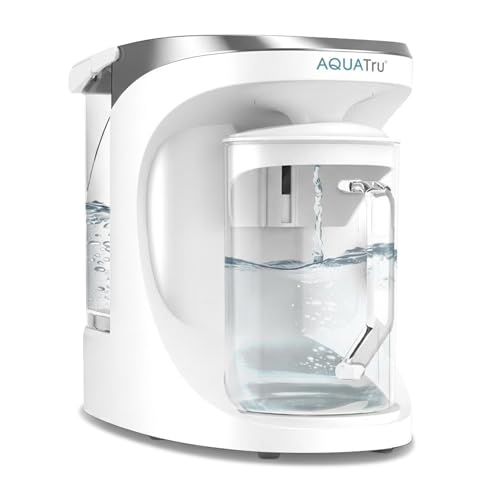
The AquaTru Carafe is the only reverse osmosis system in this roundup and the most effective at removing dissolved solids. Its 4-stage RO process reduces 84 contaminants including fluoride, lead, chlorine, microplastics, and forever chemicals (PFOA/PFOS). The borosilicate glass carafe eliminates the plastic leaching concerns that come with reservoir-style countertop RO units. At 14.7 pounds, it is heavier than any other system here, but the countertop footprint is compact at 14 inches by 7.5 inches.
Setup requires zero plumbing — you fill the top tank, plug the unit in, and it produces about 30 ounces of purified water in roughly 8 minutes. The filter set lasts up to 6 months for a household drinking six carafes per day, replacing up to 4,500 plastic bottles per filter change. The glass carafe also avoids the clouding and scratching that happens with plastic pitchers over time.
The process produces wastewater — about 1 gallon of reject water for every 1 gallon of purified water — which is standard for RO but something countertop users may not expect. One reviewer reported the RO filter failed before 6 months and found customer support difficult to navigate. The input tank is relatively small, requiring constant refilling: you dump the waste water from the back tank, then fill the input tank, then wait for the purification cycle to complete.
Why it’s great
- Only RO system in this test — removes dissolved solids including fluoride
- Glass carafe avoids plastic taste and microplastic concerns
- Certified to reduce 84 contaminants including PFOA/PFOS
- No installation needed — plug and play on any counter
Good to know
- Produces wastewater — 1:1 ratio of waste to purified water
- 8-minute cycle per 30 ounces is slow compared to pressurized units
- Small input tank requires frequent manual refilling
- Premium price — more expensive than all other systems combined
FAQ
How do I install a water filter in an apartment without damaging the plumbing?
What does NSF/ANSI 42 vs 53 certified mean for apartment tap water?
Why would I want a system that does not reduce TDS?
How often should I replace the filter in an apartment water filter?
Final Thoughts: The Verdict
For most users, the best water filter for apartment winner is the ZeroWater 32-Cup because it combines zero-TDS filtration with a live TDS meter that eliminates guesswork, all in a countertop format that needs no landlord approval. If you want a faster under-sink solution with premium stainless steel durability, grab the Waterdrop TST-UF. And for maximum contaminant removal including fluoride and dissolved solids with zero plumbing, nothing beats the AquaTru Carafe RO.