A consistent, repeatable grind is the single most important variable separating a mediocre shot of espresso from a velvety, crema-topped one. The grinder you choose determines extraction yield, clarity of flavor, and how much channeling you fight at the puck. For anyone serious about dialing in espresso at home without spending four figures, the search for a value espresso grinder comes down to burr geometry, adjustability resolution, and real-world retention — specs that define your daily workflow.
I’m Mohammad Maruf — the founder and writer behind AirfryerBite. I’ve spent hundreds of hours cross-referencing burr diameters, step increments, motor types, and anti-static coatings across budget, mid-range, and premium espresso grinders to separate genuine performance from marketing fluff.
This guide covers nine grinders from eighty to three hundred dollars, each evaluated on grind consistency, stepless or stepped adjustability, retention numbers, and build quality — all to help you find the best value espresso grinder that matches your machine and your budget.
How To Choose The Best Value Espresso Grinder
Shaving even a few microns off your grind size changes how water flows through the puck and whether your shot runs in 25 seconds or stalls at 45. For espresso, grind precision is non-negotiable. Here are the specific specs to evaluate when shopping the value tier.
Burr Type and Diameter
Conical burrs run at lower RPMs and generate less heat, which helps preserve aromatic oils in the bean. They also produce a broader particle distribution, which can improve body and reduce channeling in home espresso. Flat burrs, common on higher-end machines like the Eureka Mignon, offer a more uniform particle size and better clarity but run hotter and cost more. For a value espresso grinder, a 40mm conical burr is the most common sweet spot — it delivers consistent fines for crema without overheating the grounds.
Adjustability Resolution
Step size, measured in microns per click, determines how precisely you can dial in a shot. Entry-level grinders with 20–30 steps often skip past the ideal extraction zone, forcing you to dose or tamp differently to compensate. Stepless adjustment, found on the Eureka Mignon Notte, gives near-infinite control and is the gold standard for espresso-only grinders. Among stepped models, look for at least 48 settings or a click value of 16 microns or less — anything coarser makes it hard to pull a balanced shot with medium-light roasts.
Retention and Workflow Mess
Retention — the grams of coffee trapped inside the burr chamber after grinding — wastes beans and introduces stale grounds into your next shot. A value espresso grinder should retain less than 0.5 grams; excellent examples hold 0.1–0.2 grams. Anti-static coatings and bellows systems further reduce cling and clumping. If you single-dose (weigh beans before grinding), low retention saves you a quarter of a gram per dose, which over a month adds up to several wasted shots.
Quick Comparison
On smaller screens, swipe sideways to see the full table.
| Model | Category | Best For | Key Spec | Amazon |
|---|---|---|---|---|
| Eureka Mignon Notte | Premium | Espresso-only precision | 50mm flat burrs, stepless | Amazon |
| 1Zpresso J-Ultra | Premium | Manual espresso control | 8-micron per click, 40g cap | Amazon |
| Viesimple Gen 4 | Mid-Range | Quiet single dosing | 48mm conical, <50 dB | Amazon |
| Aromaster Burr | Mid-Range | Family-sized batches | 3.9 oz capacity, 48 settings | Amazon |
| KINGrinder K6 | Mid-Range | Manual for travel | 16-micron per click, 30g cap | Amazon |
| Tuni G1 | Budget | Electric value with large hopper | 40mm conical, 450 RPM | Amazon |
| SHARDOR Conical Burr | Budget | Entry-level electric | 51 settings, 0.1s timer | Amazon |
| AMZCHEF 48 Setting | Budget | Home versatility | 450 RPM, LED touchscreen | Amazon |
| AMZCHEF Single Dose | Budget | Low retention budget | 75 settings, <0.2g retention | Amazon |
In‑Depth Reviews
1. Eureka Mignon Notte

The Eureka Mignon Notte is the Italian-made benchmark for entry-level prosumer espresso. The 50mm hardened steel flat burrs produce a noticeably tighter particle distribution than any conical grinder near this price, which translates to higher clarity in the cup and a more predictable extraction curve. The stepless adjustment ring lets you dial in by fractions of a turn — no clicks to skip past your sweet spot.
Build is heavy-duty aluminum with a small 5.5-inch footprint, though the plastic bean hopper and portafilter holder feel utilitarian. The dosing is manual: press your portafilter against the activation switch to grind, which gives you full control over dose weight but requires a bit of timing practice. Retention sits around 0.1–0.5 grams, and a simple bellows mod reduces that to near zero.
This grinder is espresso-only — the adjustment range doesn’t open up for French press or cold brew. But for someone who only pulls shots and wants Italian engineering at a mid-range price, the Mignon Notte is hard to beat. Replacement burrs are affordable and rated for decades of home use.
Why it’s great
- 50mm flat burrs for superior uniformity
- Stepless adjustment for precision dialing
- Heavy metal body, small footprint
Good to know
- Noisy operation compared to DC motor grinders
- Plastic hopper feels cheap; some lid rattle
- Espresso-only grind range
2. 1Zpresso J-Ultra

The 1Zpresso J-Ultra is a manual grinder engineered specifically for espresso, and its 8-micron click adjustment is finer than most electric grinders in this price range. Each click shifts the burr gap by 8 microns — that’s tight enough to move from a 28-second shot to a 34-second shot in a single click, giving you real control over extraction without guessing. The coated conical burr produces a high proportion of fines, which creates traditional syrupy body and reduces channeling risk.
Grind speed is impressive for a hand grinder: about 45 seconds for an 18-gram dose in a 54mm basket. The 40-gram magnetic catch cup snaps into place securely and retains less than 0.1 grams. The folding handle collapses for storage, and the included travel case makes this genuinely portable. Tool-free disassembly means cleaning takes under a minute.
The caveat is physical effort: grinding light-roast espresso requires significant arm strength, and some users report the handle is difficult to turn without a stable counter. The catch cup is large enough to not fit snugly under some dosing rings. Still, for sub- precision that rivals grinders costing double, the J-Ultra is exceptional.
Why it’s great
- 8-micron clicks for hyper-fine espresso dialing
- Near-zero retention with magnetic cup
- Compact, portable with travel case
Good to know
- Requires considerable hand strength for light roasts
- Large catch cup doesn’t fit all dosing rings
- Slow for multiple shots back-to-back
3. Viesimple Gen 4
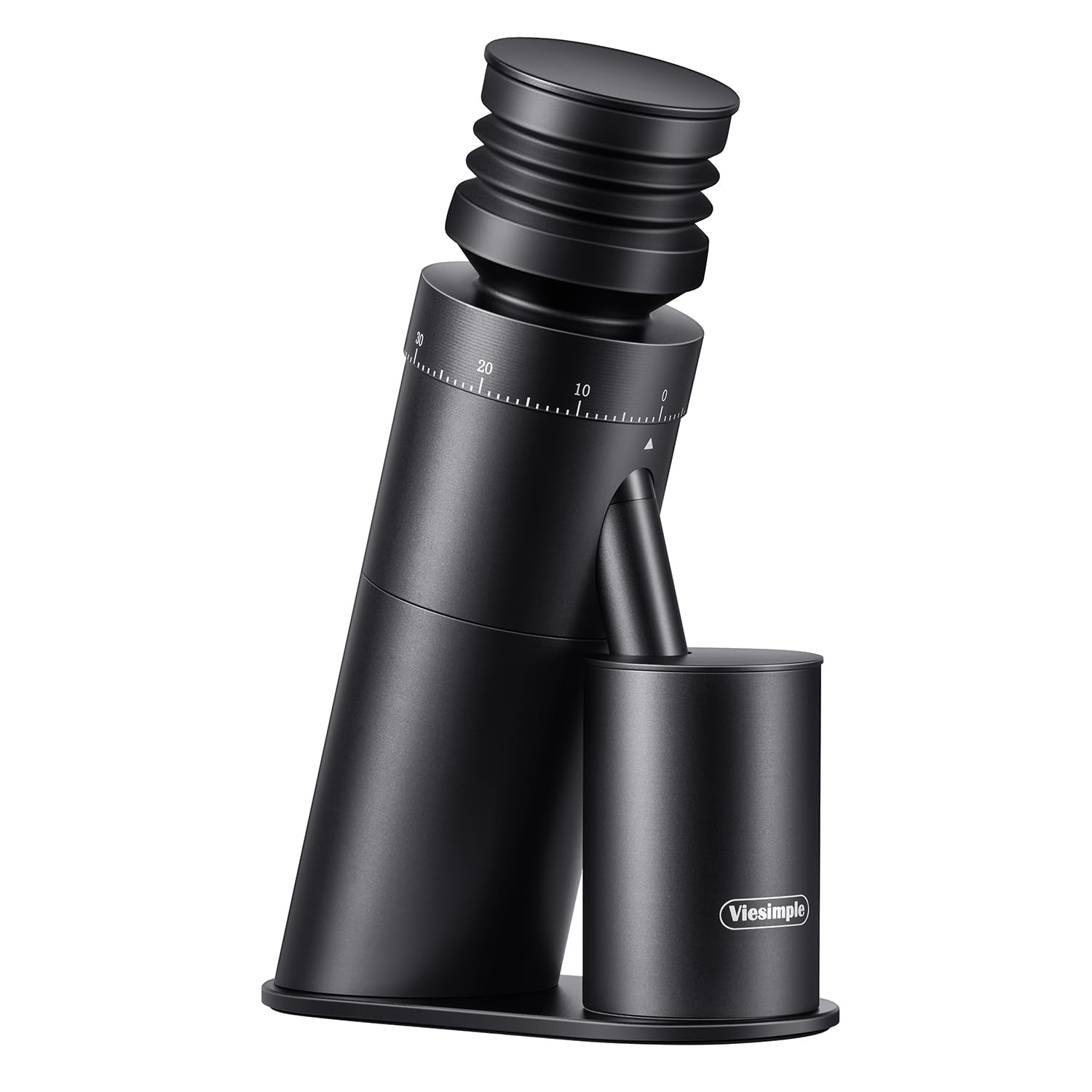
The Viesimple Gen 4 solves the two biggest annoyances of budget electric grinders: noise and static. Its low-RPM DC motor operates at under 50 decibels, which is whisper-quiet compared to the 70–80 dB of most AC-motor grinders. The 48mm conical burr runs slow enough to avoid heat transfer, preserving volatile aromatics in the beans. The food-grade anti-static coating keeps grounds from spraying across the counter.
The single-dose design uses a magnetic dosing cup that seals against the chute during grinding, eliminating powder flyaway. The blow-out funnel bellows push trapped grounds through the chamber, keeping retention under 0.2 grams. A patented anti-clogging channel prevents fines from building up and stalling the exit path.
Grind consistency is solid for espresso — the burrs produce enough fines for good crema, and the adjustment range covers from Turkish-fine to French press. The all-aluminum body adds heft and durability. A minor frustration is the external power brick, and the grind setting markers can be slightly misaligned. But for a quiet, clean, single-dose workflow under , this is a strong contender.
Why it’s great
- Quiet DC motor won’t wake the household
- Anti-static coating and bellows for low mess
- Aluminum body, solid build
Good to know
- External power supply adds clutter
- Grind markers may not match actual setting
- 30g max capacity for single dosing
4. Aromaster Burr Coffee Grinder
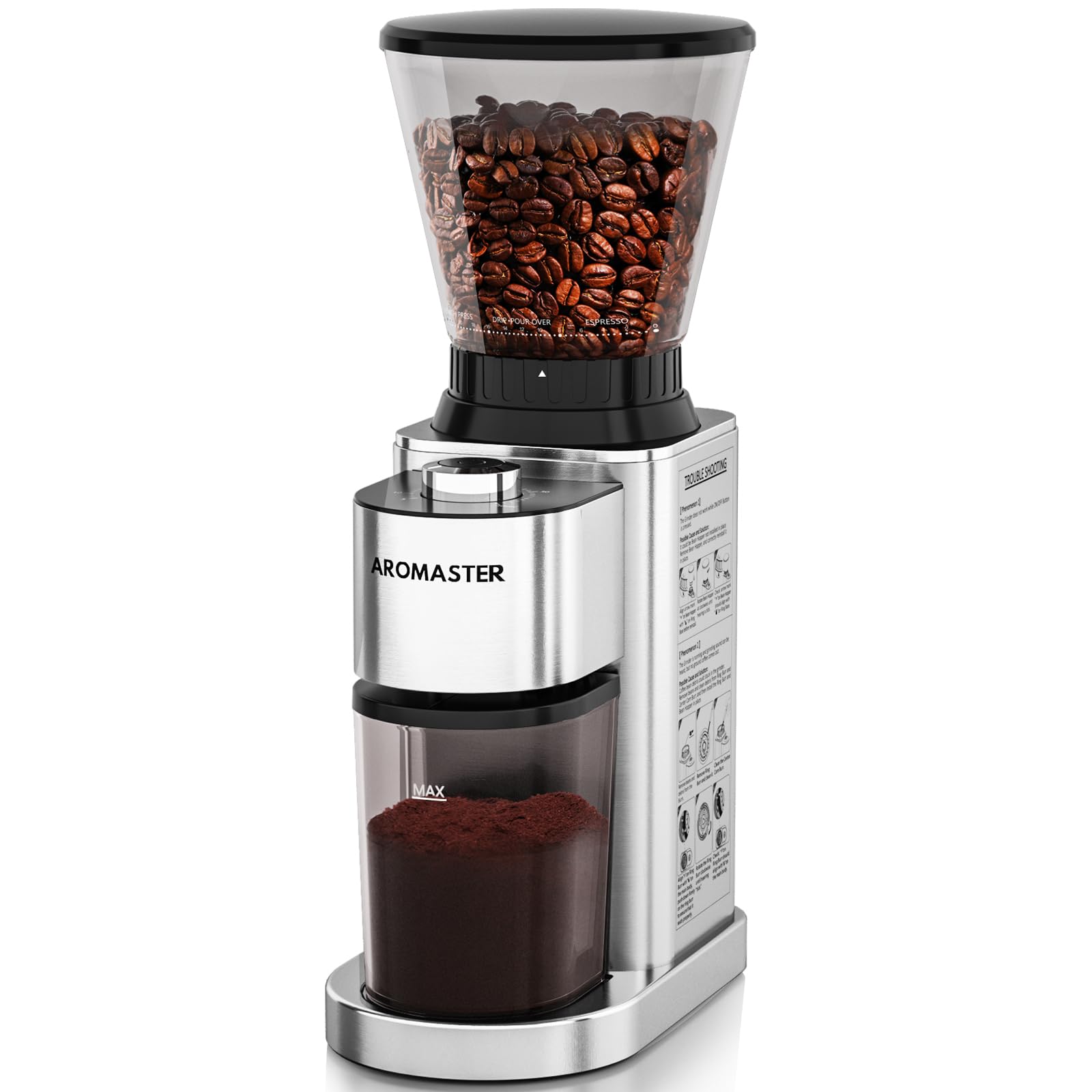
The Aromaster Burr Grinder stands out for its large 3.9-ounce capacity — enough to grind for a full 12-cup drip machine in one batch. The 48 stepped grind settings cover the full range from fine espresso to coarse French press, and the 40-second adjustable timer with 0.5-second increments lets you dial in precise dose weights once you’ve matched the grind setting. The upgrade to anti-static technology works noticeably well: grounds don’t cling to the bin or surrounding countertop.
Grind consistency at espresso settings is good for the price tier, though not as tight as flat-burr grinders. The stainless steel conical burrs run at a moderate speed and handle dark oily roasts without jamming. The removable ring burr and included brush make cleaning straightforward, though reaching all the nooks requires some patience.
One thoughtful touch is the brush attached to the back of the bean hopper lid — always there when you need to sweep the chute. The timer memory function, however, is absent: you have to set the time each session. For a household that brews multiple methods and values the ability to grind a full pot in one go, the Aromaster delivers steady performance.
Why it’s great
- Large 3.9 oz hopper for big batches
- Effective anti-static design
- Consistent grind for drip and French press
Good to know
- Espresso fineness is limited; not for ultra-fine shots
- No timer memory; must set each use
- Cleaning nooks can be fiddly
5. KINGrinder K6

The KINGrinder K6 is a full-metal manual grinder that punches well above its price point. The 16-micron click adjustment, combined with 60 clicks per full rotation, gives you enough resolution to dial in espresso with medium and dark roasts. The aluminum body houses a stainless steel conical burr set supported by dual bearings for wobble-free alignment. At 620 grams, it feels solid but not too heavy to pack for camping or travel.
Grind speed is reasonable: a double shot of 18 grams takes about 40–45 seconds with moderate effort. The zero-retention design ensures no stale grounds mix into your next dose. Particle uniformity is impressive at this price — users report espresso quality that rivals the DF64, with a traditional conical flavor profile that emphasizes body and balance over clarity.
The screw-on catch cup can bind if overtightened, and the straight handle makes for less ergonomic cranking compared to a folded or offset design. Light-roast espresso is especially taxing; you may need a drill adapter or skip to an electric grinder for very hard beans. For the price, few manual grinders offer this level of precision and build.
Why it’s great
- Excellent grind consistency for the price
- Zero retention, perfect single-dose control
- Full metal build, durable and portable
Good to know
- Hand-cranking espresso takes 40+ seconds
- Screw-on catch cup can jam if over-tightened
- Very hard to grind light-roast espresso by hand
6. Tuni G1

The Tuni G1 delivers electric convenience at a price where most competitors are manual. Its 40mm patent-pending conical burr runs at 450 RPM — slow enough to minimize heat and static buildup, fast enough to grind a double shot in under 20 seconds. The 48 grind settings, combined with a 0.5-second timer increment, give you both stepped and timed control over dose size. The anti-static finish on the catch cup works: grounds drop cleanly without clinging.
Retention is exceptionally low for an electric grinder in this bracket — users report 0.1–0.2 grams stuck after each dose. The detachable portafilter holder accommodates 54–58mm baskets and lets you grind directly into the filter, saving a step. The 8.8-ounce bean hopper is generous, and the included dosing ring and brush cover the basics. The large LED touchscreen is easy to read, though the “cups” timer presets are calibrated for Americano servings, not actual espresso volume, so you’ll need to dial in a custom time.
The only real downside is the absence of a physical power switch — the grinder draws a small standby current — and the fact that finer settings for light-roast espresso may require a DIY shim mod. For medium and dark roasts, the G1 grinds fine enough to choke most machines. Considering the performance-per-dollar ratio, it edges out the competition as the overall top pick.
Why it’s great
- Very low retention (0.1–0.2g) for an electric
- Slow 450 RPM burr reduces heat and static
- Portafilter holder works with 54–58mm baskets
Good to know
- No physical on/off switch; vampire draw
- Light roasts may need shim hack for enough fineness
- Cups timer presets don’t match real espresso doses
7. SHARDOR Conical Burr

The SHARDOR Conical Burr Grinder is the most affordable electric option on this list with enough precision for real espresso. The 40mm stainless steel conical burr and 51 grind settings give you a workable range from Turkish-fine to French press, and the 0.1-second timer increments let you dial dose weight with surprising accuracy. The auto-start feature, activated by inserting the portafilter into the cradle, speeds up the morning workflow and reduces counter mess.
Grind consistency at espresso settings is decent for the price — expect some particle size variance compared to mid-range grinders, but nowhere near the utter inconsistency of a blade grinder. The anti-static technology keeps the chamber reasonably clean, though some stray grinds do escape. The included dosing ring, cleaning brush, and residual cleaner cover the basics. Users who pair this with a Breville Bambino Plus report reliable shots without jams after a year of use.
The portafilter holder has a known weakness: the plastic clips that secure it can snap if stressed. SHARDOR’s warranty service has been responsive for replacements, but it’s worth handling the cradle gently. For someone entering espresso on a tight budget, this grinder gets the job done without painful compromises.
Why it’s great
- 51 settings and 0.1s timer for precise dosing
- Auto-start on portafilter insertion saves steps
- Affordable entry into electric espresso grinding
Good to know
- Portafilter cradle clips can break
- Some particle variance at espresso fineness
- Not as static-free as higher-priced competitors
8. AMZCHEF 48 Setting Grinder
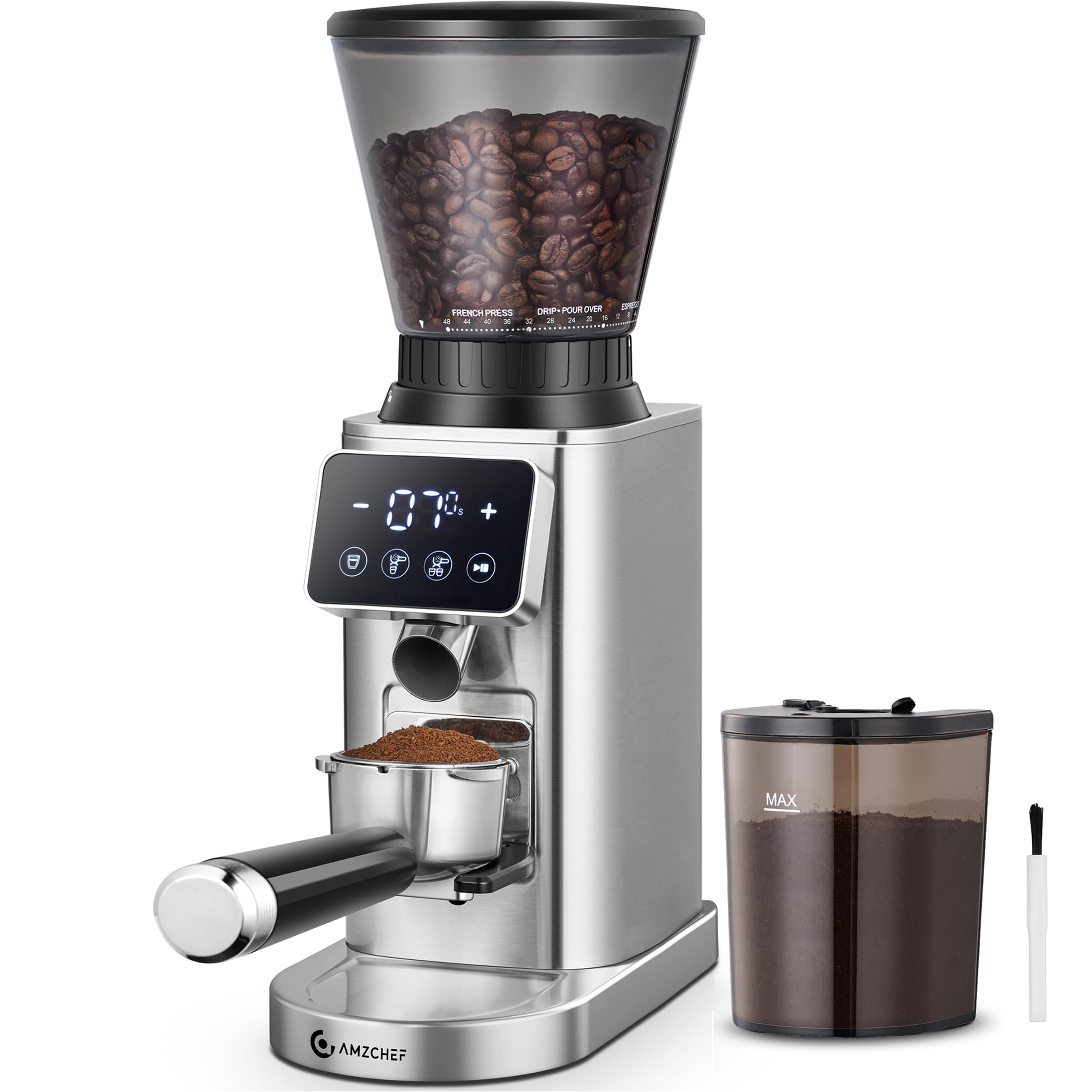
The AMZCHEF 48-Setting Grinder matches the SHARDOR in price but adds an LED touchscreen interface and a dedicated espresso mode with single and double cup presets. The 40mm conical burr runs at 450 RPM and produces consistent grounds across the grind range. The touch panel controls are intuitive once you learn the layout, though some users find the interface confusing during the first few sessions — icons can disappear if not pressed firmly, and the unit doesn’t remember last settings after power loss.
The detachable portafilter holder fits 50mm baskets, and the included photophobic coffee ground container protects beans from UV exposure during storage. Grind retention is moderate — not as low as the Tuni or Viesimple, but acceptable for the price. The anti-static design works reasonably well, but a light spritz of water on the beans before grinding helps reduce clumping further.
At espresso settings (10–12 on the dial), the grind is fine enough for pressurized and non-pressurized baskets alike. The motor runs quietly, especially compared to older budget grinders. The biggest usability friction is the timer system: it grinds by cups (which assume a standard Americano volume) rather than grams, so you’ll need to weigh output and adjust time manually. For a versatile budget grinder that also handles drip and French press, this is a solid choice.
Why it’s great
- Touchscreen with espresso presets
- Quiet 450 RPM operation
- Includes portafilter holder and UV-blocking container
Good to know
- UI can be confusing; no setting memory after power loss
- Portafilter holder fit is loose on some baskets
- Moderate retention; not ideal for single dosing
9. AMZCHEF Single Dose Grinder
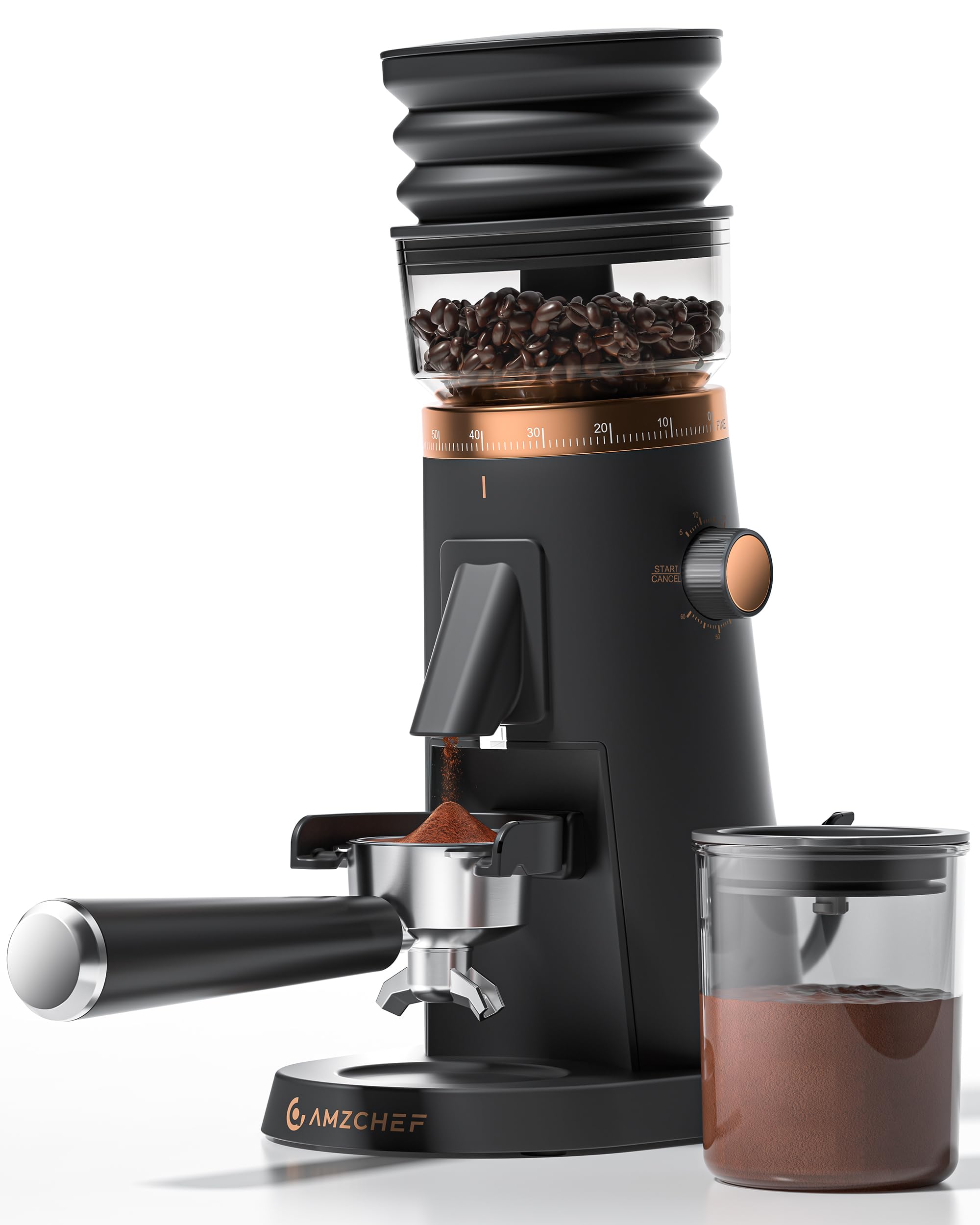
The AMZCHEF Single Dose Grinder brings 75 stepless grind settings to the budget segment — more adjustability than any other electric option under . The 40mm 6-star forged conical burr, combined with the 75-step internal adjustment, allows very fine espresso tuning that rivals the 1Zpresso J-Ultra in resolution, though the burr geometry is different. The magnetic outlet chute snaps off for cleaning and, paired with the knock tool, keeps retention at or below 0.2 grams.
The anti-static coating and included vacuum-sealed storage container (120 grams) address two common budget grinder pain points: mess and bean freshness. The built-in LED illuminates the grinding chamber, which is useful for checking that all beans have passed through. The DC motor runs quieter than most AC-motor grinders, though it’s louder than the Viesimple Gen 4. The timed grinding mode spans 5 to 60 seconds, and the included 51/54mm and 58mm dosing funnel stands cover portafilter sizes.
Build quality is a mix: the burr and gearbox are metal, but the main housing is plastic, which reduces durability compared to all-metal competitors. Some users report static cling even with the anti-static coating on very dry, dark-roast beans. The step mechanism can feel imprecise at the finest end of the range — there’s some play. Still, for single-dosing espresso on a strict budget, the adjustability and retention control are class-leading.
Why it’s great
- 75 stepless settings for precise espresso dialing
- Magnetic outlet and knock tool keep retention low
- Includes vacuum storage container and dosing funnels
Good to know
- Plastic housing reduces overall durability
- Some static on very dry beans
- Step mechanism can feel loose at finest settings
FAQ
Can I use a drip coffee grinder for espresso?
Is a manual grinder better than an electric for value espresso?
How much retention is acceptable in a value espresso grinder?
Final Thoughts: The Verdict
For most users, the value espresso grinder winner is the Tuni G1 because it combines electric convenience, very low retention, and a slow 40mm conical burr at a price that undercuts manual grinders with similar specs. If you want stepless adjustment and Italian build for espresso-only use, grab the Eureka Mignon Notte. And for ultra-fine manual control and portability, nothing beats the 1Zpresso J-Ultra.