The mercury content in tuna is a real health consideration, especially for regular consumers, pregnant women, and young children. While tuna offers lean protein and omega-3 fatty acids, certain species and sourcing methods consistently yield lower mercury levels without sacrificing taste or nutrition.
I’m Mohammad Maruf — the founder and writer behind AirfryerBite. I’ve spent years dissecting the nutritional profiles of canned seafood and cross-referencing them with third-party testing data to identify which products actually deliver on their low-mercury claims.
Navigating the shelf of the grocery store or an Amazon search for tuna with less mercury means knowing which species to choose, which fishing methods matter, and how to read beyond the marketing on the label.
How To Choose The Best Tuna With Less Mercury
The single most effective way to lower mercury intake from tuna is choosing the right species. Larger, longer-living predatory fish accumulate more mercury in their tissues. Smaller species with shorter lifespans, fished responsibly, are the safest bet for regular consumption.
Species Matters More Than Brand
Skipjack tuna, commonly labeled as “chunk light” tuna, consistently tests at mercury levels roughly one-third those of albacore (white) tuna. Yellowfin and bigeye grade higher still. If your priority is minimizing mercury, skipjack should be your default species. Always check the ingredient line for “skipjack” rather than a generic “tuna” listing.
Sourcing and Fishing Method Impact Contaminant Load
Pole-and-line or troll-caught tuna are typically younger fish from healthier, less polluted waters. These methods also avoid bycatch and juvenile fish, meaning the catch skews toward the smaller, lower-mercury end of the population. Products carrying Friend of the Sea or Marine Stewardship Council (MSC) certifications often have more transparent supply chains.
Third-Party Mercury Testing Is the Gold Standard
Some premium brands now publish third-party lab results for mercury content per batch. If a product claims low mercury but offers no testing data or certification, treat the claim as marketing. Pouches and jars with visible batch codes and traceable lot numbers give you a stronger paper trail than generic commodity cans.
Quick Comparison
On smaller screens, swipe sideways to see the full table.
| Model | Category | Best For | Key Spec | Amazon |
|---|---|---|---|---|
| Santo Amaro Artisanal Fillets | Mid-Range | Low-mercury skipjack fillets in olive oil | 120g fillet, pole & line skipjack | Amazon |
| Wild Planet Skipjack Tuna 20oz (4-Pack) | Mid-Range | High-protein skipjack in water, bulk value | 80 oz total, skipjack, no fillers | Amazon |
| Freshé Gourmet Tuna Variety Pack | Mid-Range | Ready-to-eat meals with skipjack and veggies | 4.25 oz tin, skipjack, BPA-free | Amazon |
| Bumble Bee Chunk Light Tuna in Oil (24-Pack) | Budget-Friendly | Bulk pantry staple, skipjack in oil | 5 oz can, skipjack, MSC certified | Amazon |
| Wild Planet Skipjack Tuna Pouches (12-Pack) | Premium | Third-party mercury tested, skipjack pouches | 3 oz pouch, skipjack, sea salt | Amazon |
In‑Depth Reviews
1. Santo Amaro Artisanal Wild Tuna Fillets in Virgin Olive Oil
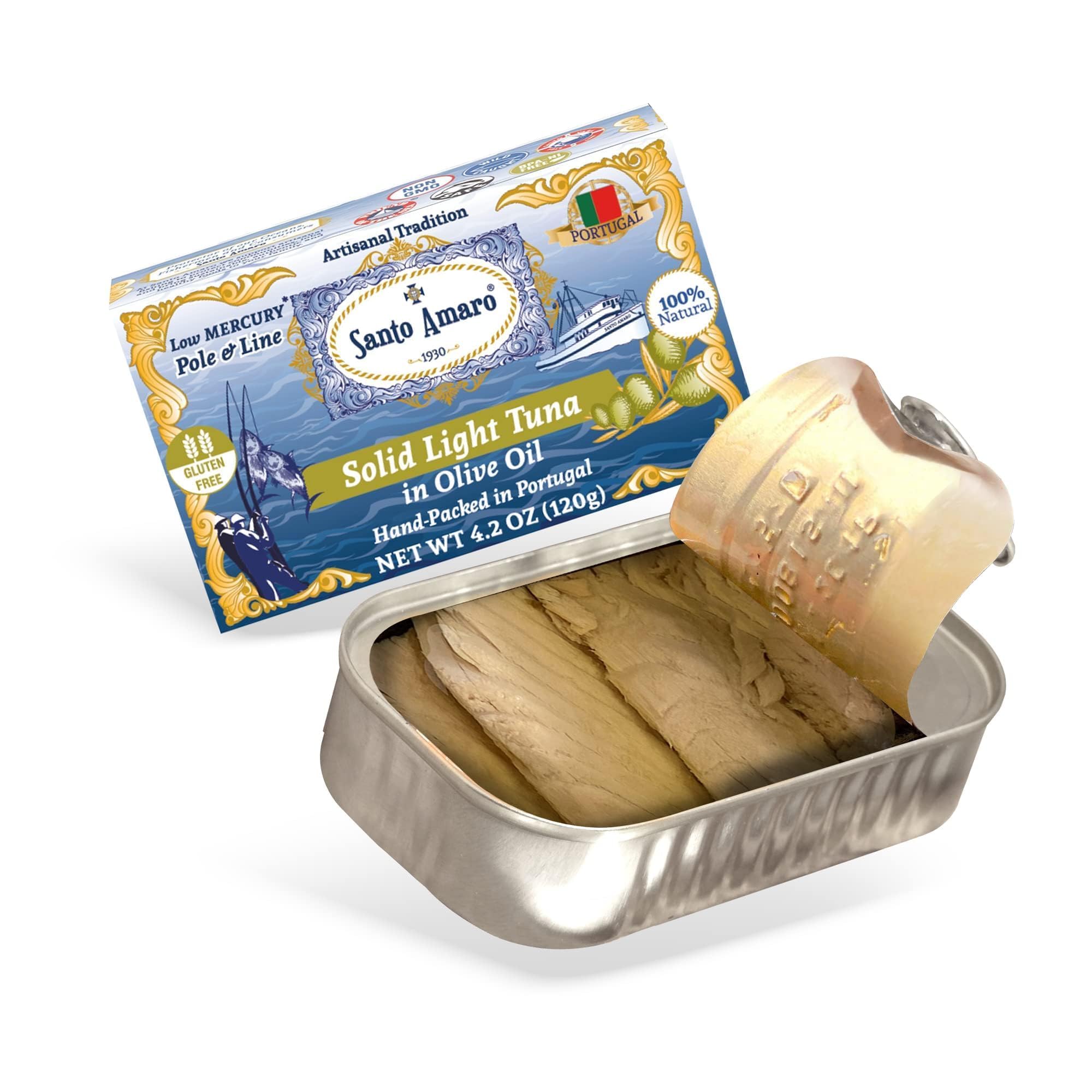
The Santo Amaro fillets stand apart from the commodity chunk-and-dice crowd. These are whole skipjack fillets hand-packed in virgin Portuguese olive oil with nothing but sea salt added. The pole-and-line catch method ensures the fish are young and small, which directly translates to lower mercury content than larger albacore or yellowfin. Each 120-gram tin delivers 22 grams of protein with a clean, mild flavor profile.
What makes this a standout for the low-mercury shopper is the explicit “low mercury content” statement backed by the regenerative fishing model. No vegetable broth, no phosphates, no freezing on the vessel — the fish goes from boat to tin with minimal handling. The texture is firm but tender, far from the mushy shreds typical of mass-market canned tuna.
The fillet format means you get distinct pieces rather than a homogeneous mash. This is ideal for salads, charcuterie boards, or eating straight from the tin with crackers. The olive oil doubles as a dressing base, eliminating the need for added condiments. For anyone prioritizing both low mercury and high-quality fat sources, this is the tightest package on the list.
Why it’s great
- Explicit low-mercury skipjack from pole-and-line fishing
- Whole fillets in virgin olive oil, not shredded chunks
- 22g protein per tin with no fillers or additives
Good to know
- Higher price per ounce than commodity light tuna
- Only 3 tins per pack, not a bulk pantry option
2. Wild Planet Skipjack Tuna, 20 Ounce (Pack of 4)
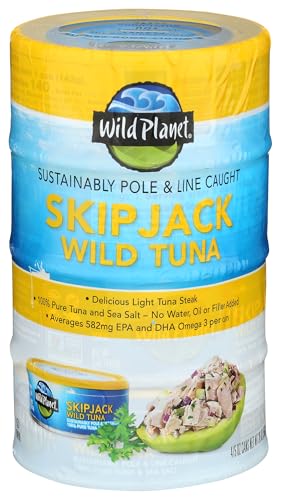
Wild Planet’s skipjack in the 20-ounce can format is a volume play that doesn’t sacrifice low-mercury sourcing. The entire product line uses skipjack as its base, keeping mercury levels well below FDA action limits. These large cans contain whole chunks packed in water with no added oils or fillers, giving you a clean canvas for tuna salad, casseroles, or high-protein lunches.
The four-pack totals 80 ounces, which is a significant amount of tuna for weekly meal prep. Reviews consistently note the lack of fishy odor and the fresh taste compared to conventional brands. Because the tuna is packed in water rather than oil, you control the fat content and seasoning. The skipjack taste is milder than albacore, which makes it more versatile for recipes that call for a neutral protein base.
For the low-mercury-conscious buyer, the key detail is that Wild Planet uses FAD-free pole-and-line fishing methods. This means no fish aggregating devices that attract larger, higher-mercury predators. The product carries no explicit third-party mercury test certification, but the species and method give strong implicit confidence. This is the best per-ounce value for skipjack tuna on the list.
Why it’s great
- 80 total ounces of skipjack at a strong per-ounce value point
- No added oils, fillers, or preservatives
- FAD-free pole-and-line fishing supports low-mercury catch
Good to know
- Not individually packaged for single-serving grab-and-go
- No published third-party mercury lab results
3. Freshé Gourmet Canned Tuna Variety Pack
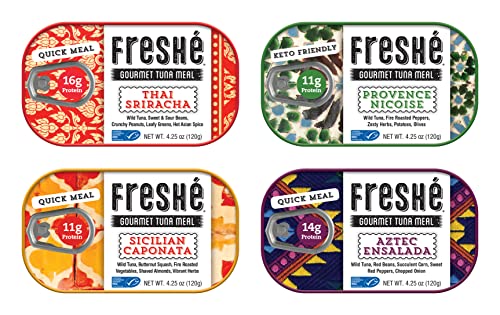
Freshé rethinks canned tuna as a complete meal rather than a sandwich ingredient. The four-tin variety pack includes Aztec Ensalada, Provence Nicoise, Thai Sriracha, and Sicilian Caponata flavors — each built on a base of wild skipjack tuna from Friend of the Sea certified fisheries. Because skipjack is the protein base, the mercury profile stays in the safe zone while the flavor comes from non-GMO vegetables, herbs, and olive oil rather than heavy sauces.
Each 4.25-ounce tin is packed in BPA-free material and has a 4-year shelf life, making this a strong emergency pantry option for those who want a low-mercury protein source that doesn’t require cooking. The tuna-to-vegetable ratio runs about 60:40, meaning you get substantial protein alongside real texture from bell peppers, olives, capers, and legumes depending on the flavor. The Thai Sriracha tin is notably spicy; the Sicilian Caponata leans sweet and tangy.
The main trade-off is cost per gram of protein relative to bulk canned tuna. You are paying for the recipe development, packaging, and convenience of a ready-to-eat meal. For a desk lunch, hiking snack, or a quick dinner that requires zero prep, the peace of mind from knowing your tuna is low-mercury skipjack makes the premium worthwhile.
Why it’s great
- Complete meals with skipjack base and real vegetables in BPA-free tins
- Friend of the Sea certified sustainable fishing
- Four globally inspired flavors prevent taste fatigue
Good to know
- More expensive per serving than plain canned tuna
- Some users find the Thai Sriracha flavor too sour rather than spicy
4. Bumble Bee Chunk Light Tuna In Oil, 24-Pack

Bumble Bee’s Chunk Light Tuna is the most recognizable name on the list, and for good reason. This 24-can case uses skipjack tuna packed in oil, delivering 22 grams of protein per 5-ounce can with MSC Certified Sustainable Seafood certification. For shoppers seeking a low-mercury option on a budget, this is the most cost-effective way to fill a pantry with skipjack without wading into premium brands.
The mercury profile of skipjack is naturally lower than albacore, and Bumble Bee’s standard chunk light line sources from skipjack. The cans are packed in soybean oil, which adds calories but also creates a richer mouthfeel than water-packed tuna. The flaky texture holds up well in casseroles and tuna melts, though it lacks the firm bite of the fillet-style products. The 24-can case provides 120 total ounces, giving you a deep bench for weekly lunch prep.
The limitation here is that Bumble Bee does not publish third-party mercury test results for this run, nor does it emphasize pole-and-line fishing in the same way as Wild Planet or Santo Amaro. The MSC certification provides some supply-chain transparency, but the catch method may involve larger nets that could catch juvenile fish. For the price-conscious buyer who simply wants the lowest-mercury species in a familiar format, this is a solid workhorse option.
Why it’s great
- 120 total ounces of skipjack at the lowest per-ounce cost on the list
- MSC certified and Non-GMO Project verified
- 22g protein per can with a familiar, flaky texture
Good to know
- No explicit low-mercury guarantee or third-party test data published
- Packed in soybean oil rather than olive oil or water
5. Wild Planet Skipjack Tuna Pouches, Sea Salt, 12-Pack

The Wild Planet skipjack pouches represent the most transparent low-mercury option on this list. The packaging explicitly states “3rd Party Mercury Tested,” which is the highest bar a canned tuna product can clear for contaminant-conscious buyers. These 3-ounce pouches contain FAD-free, pole-and-line caught skipjack with no added oil, water, or fillers — just wild tuna and sea salt. The skipjack species combined with the verified testing provides the most scientifically defensible low-mercury profile here.
The pouch format is a practical advantage: no can opener needed, lighter weight for backpacks and travel, and far less storage space than equivalent cans. Each serving delivers 21 grams of protein with 230mg of EPA and DHA omega-3s. The texture is closer to a whole-muscle pate than the shredded chunk of standard cans, which some users find fresher and less processed. The mild skipjack flavor is less assertive than albacore, making it a clean base for salads, wraps, or direct eating.
The cost per ounce is the highest on the list, reflecting the premium for third-party testing, sustainable catch methods, and the convenient pouch packaging. For the buyer whose primary concern is minimizing mercury exposure while maintaining regular tuna consumption, the explicit test verification makes this the most ethically and scientifically sound choice. The 12-pack provides a month’s worth of servings for a single person.
Why it’s great
- Explicit third-party mercury testing on a skipjack base
- Pole-and-line caught, FAD-free with no added fillers
- Pouch format for easy open, no draining, and compact storage
Good to know
- Highest per-ounce cost among the five products reviewed
- Texture is a soft pate, not firm chunks or steaks
FAQ
Why is skipjack tuna lower in mercury than albacore or yellowfin?
Does “lightly smoked” tuna have the same mercury concern as regular canned tuna?
What does “3rd Party Mercury Tested” actually mean on a tuna label?
Final Thoughts: The Verdict
For most users, the tuna with less mercury winner is the Santo Amaro Artisanal Fillets because it combines skipjack species, explicit low-mercury positioning, pole-and-line catch verification, and a clean fillet-in-olive-oil format that outperforms commodity cans on both nutrition and taste. If you want explicit third-party mercury test results, grab the Wild Planet Skipjack Tuna Pouches. And for budget-friendly bulk skipjack that still carries MSC certification, nothing beats the Bumble Bee Chunk Light 24-pack.