The moment the power goes out or a storm hits, your fridge becomes a liability and your pantry feels hollow. Survival food isn’t about bland bars and chalky shakes anymore — it’s about securing real, filling meals that taste good and keep you running when cooking isn’t an option. The difference between a shelf-stable stash that gathers dust and a kit you’d actually reach for comes down to one thing: the quality of the freeze-dried or dehydrated core ingredients.
I’m Mohammad Maruf — the founder and writer behind AirfryerBite. I’ve spent years breaking down the real specs of survival food kits, from freeze-dried entree sourcing to mylar barrier thickness and calorie density per pound, so you know exactly what you’re stacking.
Whether you’re outfitting a go-bag or building a long-term pantry for your family, this guide filters the noise and highlights the best survival food kits that deliver on taste, nutrition, and real shelf-life performance.
How To Choose The Best Survival Food
Survival food isn’t a single category — it spans freeze-dried entrees, dehydrated ingredient blends, and complete ready-to-eat MREs. Your choice depends on whether you need grab-and-go portability or a bulk supply for extended emergencies. Below are the key factors that separate a useful stash from a waste of space.
Freeze-Dried vs. Dehydrated vs. MRE
Freeze-dried meals rehydrate faster and retain more of the original flavor and texture because the process removes moisture at low temperatures. Dehydrated food is lighter and cheaper per serving but often requires longer soaking and tastes less like a real meal. MREs (Meals Ready-to-Eat) require no water at all — they come fully cooked in sealed pouches with flameless heaters, but they are heavier and have a shorter shelf life (typically 5–10 years) compared to freeze-dried options that often last 25 years.
Calorie Density and Serving Sizes
Many survival food kits advertise a high serving count, but the real metric is calories per serving. A pouch claiming “4 servings” might only deliver 250 calories per serving — not enough for an adult in a survival scenario. Look for kits that offer at least 400–500 calories per serving for entrees, and always multiply the total servings by the per-serving calorie count to get the true energy yield. A 360-serving bucket with 200 calories per serving provides only 72,000 total calories — roughly the same as a 60-serving bucket with 1,200 calories per serving.
Packaging and Shelf Life
The packaging determines how long the food stays edible. High-quality survival food uses multi-layer mylar pouches with oxygen absorbers, packed inside a durable bucket. This block moisture, light, and pests effectively. A 25-year shelf life is standard for properly sealed freeze-dried food, but only if the pouches remain intact. If the mylar is punctured or the bucket seal is broken, the shelf life drops dramatically. Stick to kits where each meal is individually sealed inside the bucket — not loose ingredients poured into the bucket itself.
Quick Comparison
On smaller screens, swipe sideways to see the full table.
| Model | Category | Best For | Key Spec | Amazon |
|---|---|---|---|---|
| NuManna Grab-n-Go 3-Pack | Premium | Long-term pantry with high-quality meals | 240 servings, 36 lbs | Amazon |
| ReadyWise 360-Serving Bucket | Premium | Large family emergency supply | 360 servings, 62 lbs | Amazon |
| MRE (2026 Inspection) 24-Pack | Mid-Range | No-water-required grab-and-go | 24 meals, 1,000-1,300 cal each | Amazon |
| Heaven’s Harvest 60 Serving Kit | Mid-Range | Compact 5-day emergency supply | 60 servings, 8,280 total cal | Amazon |
| Ready America 72-Hour Kit | Mid-Range | Complete go-bag with gear + food | 4-person, 3-day, 107-piece FAK | Amazon |
| Harmony House Backpacking Kit | Budget | Lightweight dehydrated veggie base | 70+ servings, 4.5 lbs | Amazon |
| Mountain House Breakfast Skillet 6-Pack | Budget | Tasty breakfast for camping/backpacking | 6 pouches, freeze-dried, gluten-free | Amazon |
In‑Depth Reviews
1. NuManna Grab-n-Go Buckets (240 Servings, 3-Pack)
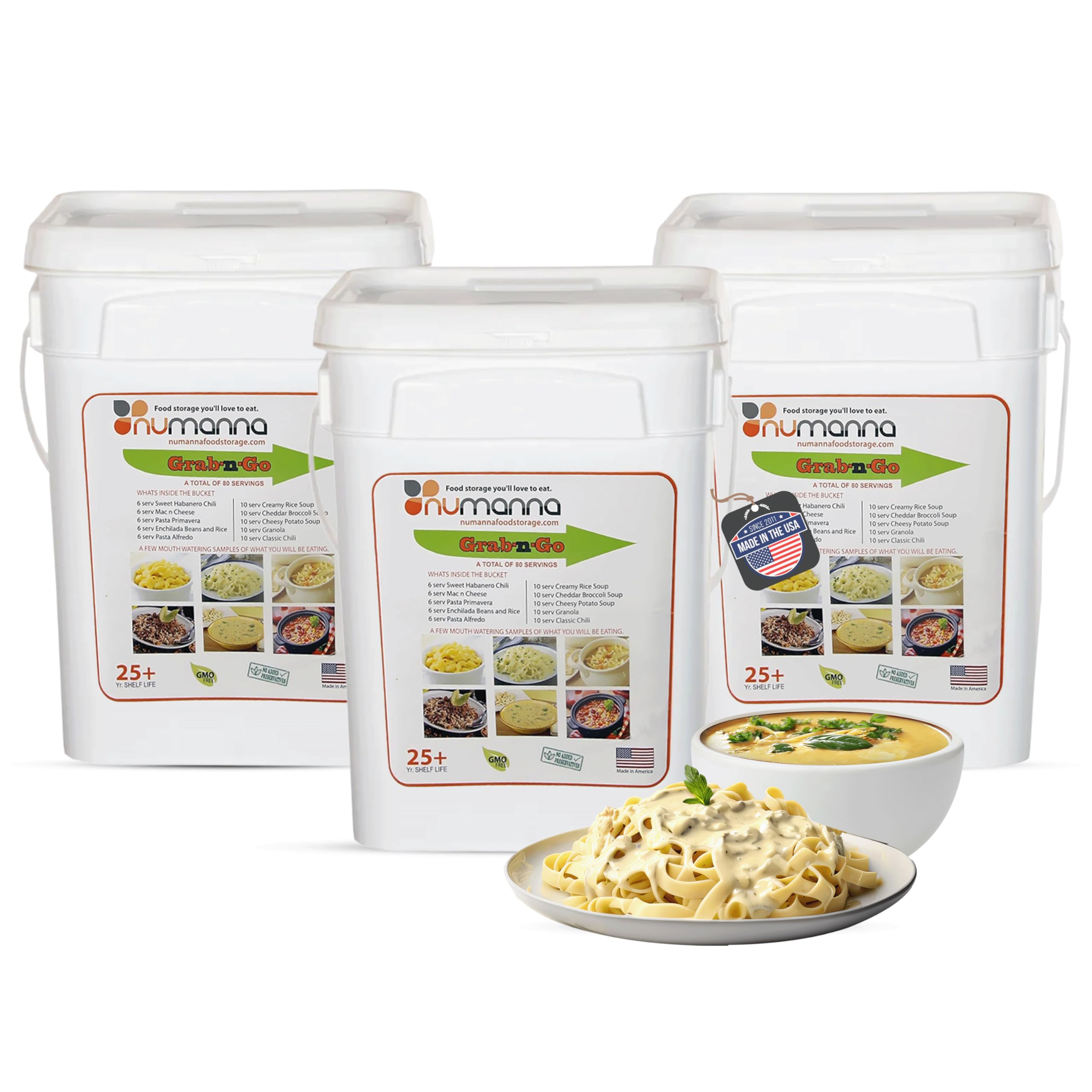
NuManna stands apart because they prioritize non-GMO ingredients and avoid the fillers (sugary oatmeal, cheap grains) that bulk up cheaper kits. Each of the three buckets delivers 10 pouches with 80 servings — but real-world users note that a “serving” is roughly half a cup, so you’ll need more than one to satisfy a hungry adult. The entree lineup includes Sweet Habanero Chili with Pineapple, Cheesy Potato Soup, and Pasta Alfredo, which puts it above the flavor curve for emergency food.
The 25-year shelf life is supported by mylar pouches inside a stackable bucket. Boiling water is the recommended rehydration method, but you can use cold water if needed — just expect longer soak times. At 36 pounds for the three-bucket set, this is a serious pantry addition, not a go-bag item. The lack of trans fats sets a health standard that few competitors meet.
Where this kit loses a step is the calorie density — the half-cup serving size means you’ll consume 2–3 servings per meal, effectively cutting the advertised 240 servings down to 80–120 full meals for an active adult. Still, for someone building a long-term, clean-ingredient emergency pantry, this is the gold standard.
Why it’s great
- Non-GMO, no trans fats, high-quality ingredients sourced in the USA
- 25-year shelf life in sealed mylar pouches inside durable buckets
- Unique entree flavors that actually taste good without heavy seasoning
Good to know
- Small serving size (half a cup) means you’ll use 2-3 servings per meal
- Premium cost per serving compared to budget bulk kits
- Requires boiling water for best results; cold water needs longer soaking
2. ReadyWise 360-Serving Emergency Food Supply (3 Buckets)

ReadyWise is one of the most recognized names in the survival food space, and their 360-serving bucket set is designed for families who want a substantial reserve. The three buckets include two lunch/dinner buckets and one breakfast bucket, featuring cheesy macaroni, lasagna, pasta alfredo, and brown sugar cereal. The split-lid design is a thoughtful touch — the lid doubles as a tray when you open a pouch.
The calorie count per serving averages around 200–250, which is a critical detail. If you’re planning for a 1,500-calorie daily intake, you’ll need 6–7 servings per person per day. That means the 360 servings support one adult for roughly 51 days, not the 120 days implied by the “4 servings per pouch” label. The 25-year shelf life is backed by foil packets inside airtight buckets that are stackable for pantry storage.
Reviewers consistently note that the meals taste better than expected for shelf-stable food, especially the pasta dishes. The main criticism is the low calorie-per-serving ratio, which means you’ll deplete the supply faster than the serving count suggests. For a family of four, this 3-bucket set will last about 12–15 days as a full food source.
Why it’s great
- Massive 360-serving count ideal for family emergency planning
- Split-lid bucket design doubles as a serving tray for convenience
- Good variety of pasta and breakfast options that taste decent
Good to know
- Low calories per serving (200–250) means you’ll need double portions
- Meals require boiling water, not just hot water from a tap
- Heavy at 62 pounds — not portable for evacuation scenarios
3. 2026 Inspection MRE Variety Pack (24 Meals)
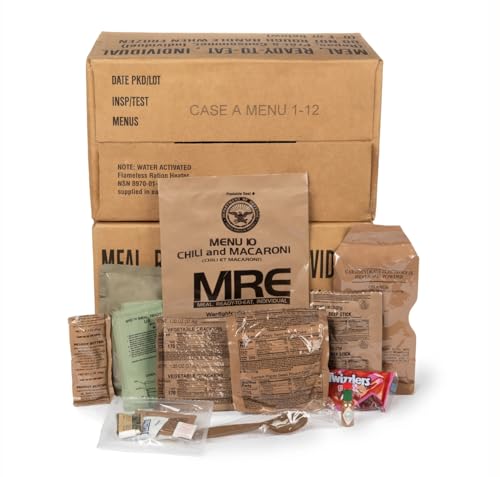
When you need food that works without water, fire, or electricity, MREs are the answer. This 24-meal case from Betterbundle is fresh stock with a 2026 inspection date and a 10-year shelf life from that date. Each meal delivers 1,000–1,300 calories and includes an entree, side, dessert, coffee, and an accessory pack with a flameless ration heater. The variety pack mixes pork, beef, and chicken entrees with sides like jalapeno cashews and Combos.
The flameless heater works well if you add the right amount of water — too much dilutes the heat. Reviewers note that the Skittles desserts sometimes arrive crushed, but the entrees themselves remain sealed and fresh. These MREs are perfect for a car kit, bug-out bag, or camping trip where boiling water isn’t an option. The 24-meal case is heavy at 12 pounds, but the individual pouches are compact and easy to distribute.
The main trade-off is the shorter 10-year shelf life compared to freeze-dried kits that last 25 years. The high sodium content (typical for military MREs) makes them less suitable for daily long-term eating, but they’re unmatched for short-term emergencies where convenience and portability are the top priorities.
Why it’s great
- Completely ready to eat with no water or cooking required
- High calorie count per meal (1,000-1,300) for sustained energy
- Includes flameless heater, dessert, coffee, and accessory pack
Good to know
- 10-year shelf life is shorter than freeze-dried alternatives
- High sodium content typical of military-grade MREs
- Heavy per meal — not the most packable option for long treks
4. Heaven’s Harvest 25-Year Family Food Kit (60 Servings)

Heaven’s Harvest positions their 60-serving kit as a one-week emergency supply for a family, with 8,280 total calories across 11 entree varieties. The freeze-dried food is sourced from US farms and packed in mylar pouches inside a stackable bucket. The standout feature is that the food can be rehydrated with cold water — no heat required — making it suitable for situations where you can’t boil water.
At 8,280 total calories, this kit provides roughly 138 calories per serving. That is very low for a survival scenario — an active adult needs 2,000 calories per day, so the entire kit covers only about 4 days for one person, not 5+ days for a family. Users also note that the 12 pouches inside contain 6 servings each, not the individual single-serving pouches some expect, which makes portion control slightly less convenient for backpacking.
The 25-year shelf life, US-sourced ingredients, and no-heat rehydration capability give this kit a specific niche: a compact, grab-and-go bucket for car trunks, office desks, or small apartments where space is tight and you don’t want to rely on cooking fuel.
Why it’s great
- Can be rehydrated with cold water — no heat or fuel needed
- US-sourced, chemical-free freeze-dried ingredients
- Compact bucket with 25-year shelf life, stackable design
Good to know
- Only 138 calories per serving — very low for active survival
- 12 multi-serving pouches instead of individual single-serve packs
- Total 8,280 calories covers one adult for ~4 days at 2,000 cal/day
5. Ready America 72-Hour Deluxe Emergency Kit (4-Person)

The Ready America kit is not just food — it’s a complete emergency response package. It includes Coast Guard-approved food and water pouches with a 5-year shelf life, a 107-piece first aid kit, a 4-function power station (AM/FM radio, flashlight, siren, cell phone charger), survival blankets, ponchos, a multi-tool, and more. All packed into a durable backpack that’s compact enough for a child to carry. This is the set to grab when you have to evacuate at a moment’s notice.
The food and water included cover 4 people for 72 hours, which is the standard window for emergency response. The water supply is sufficient but reviewers recommend supplementing with extra water tablets or a filtration bottle if you’re in a hot climate. The first aid kit is comprehensive for basic injuries, and the power station is a valuable addition — the hand crank means you never need batteries.
The weak point is the food itself: it’s designed for short-term survival, not long-term comfort. The food rations are basic energy bars and high-calorie packs that will keep you alive but won’t satisfy taste or texture expectations. This kit is built for preparedness — the food is a component, not the star. If you want a turnkey solution for earthquake, fire, or flood evacuation, this is it.
Why it’s great
- Complete all-in-one kit with food, water, first aid, tools, and radio
- Durable backpack keeps everything organized and portable for evacuation
- Includes power station with hand crank — no batteries required
Good to know
- Food is basic survival ration bars, not appetizing for long-term eating
- 5-year shelf life on food/water is shorter than freeze-dried options
- Water supply is minimal for 3 days in hot weather; needs supplementation
6. Harmony House Backpacking Kit (70+ Servings)
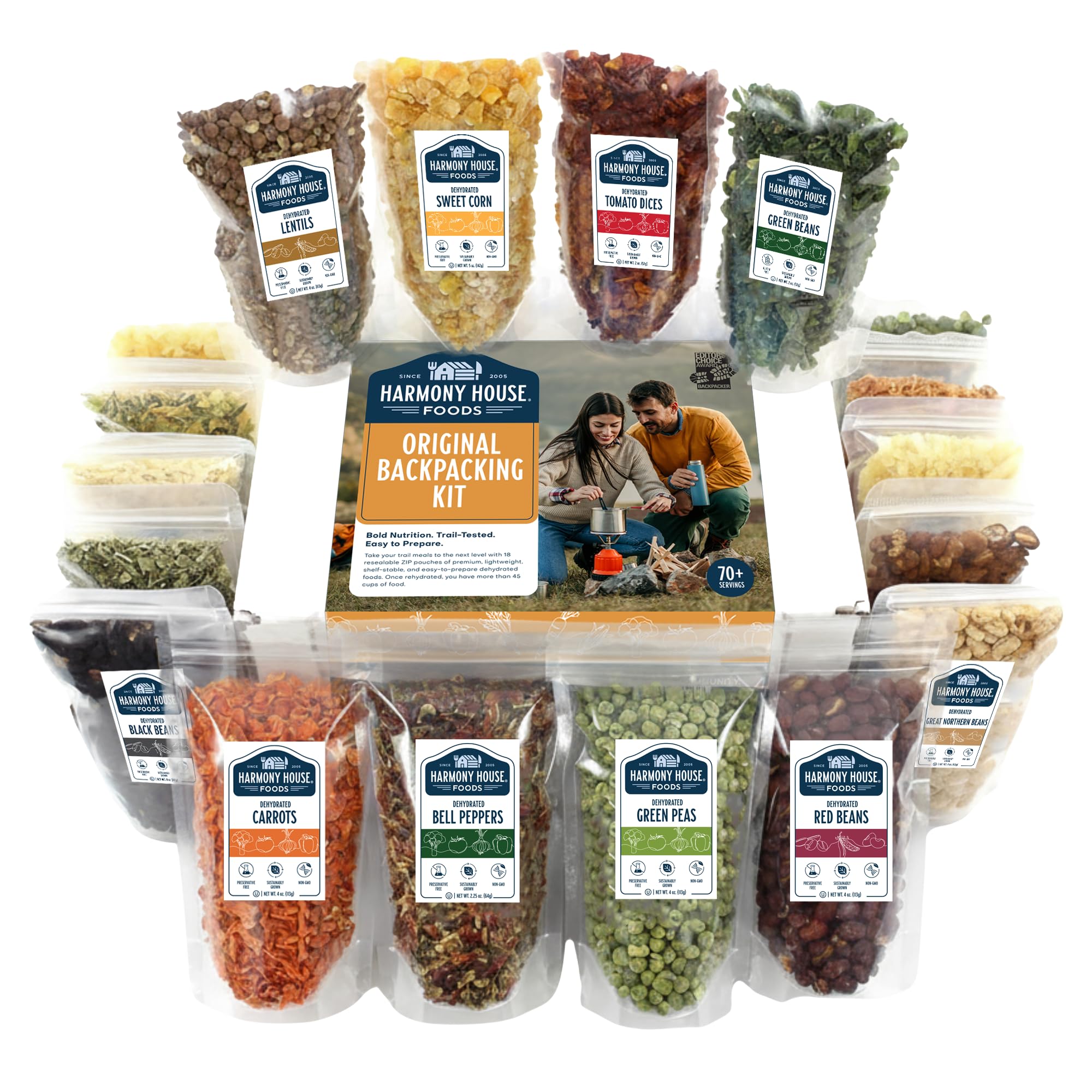
Harmony House takes a different approach: instead of serving you complete meals, they give you dehydrated single-ingredient vegetables, beans, and lentils that you combine yourself. The kit contains 70+ servings across a mix of cabbage, peppers, carrots, celery, onions, beans, lentils, and tomatoes — all non-GMO, gluten-free, and kosher. This is a base builder, not a meal kit, and it’s ideal for backpackers, van dwellers, or anyone who wants to control the seasoning and flavor of their emergency meals.
The total weight is only 4.5 pounds, making it one of the lightest options per serving. Rehydration requires cooking in water, and some reviewers note that peas and green beans take longer to soften than the recommended time. The flavor is entirely dependent on what you add — broth, spices, sauces — so it rewards creative cooking. It pairs excellently with rice or pasta to create complete, filling meals.
This kit won’t serve as a standalone survival pantry because it lacks protein density and calorie density from fats and grains. But as a supplement to a rice-and-bean base, or as a lightweight vegetable source for multi-day backpacking trips, it’s hard to beat. The Editor’s Choice award from Backpacker Magazine reflects its excellence in the lightweight dehydrated category.
Why it’s great
- Ultra-light at 4.5 pounds for 70+ servings — great for backpacking
- Non-GMO, gluten-free, kosher certified, no additives or preservatives
- Single-ingredient design lets you control flavor and seasoning
Good to know
- Requires cooking — not ready-to-eat like MREs or freeze-dried pouches
- Needs supplementation with grains and protein for complete nutrition
- Some vegetables (peas, green beans) rehydrate slowly and can be chewy
7. Mountain House Breakfast Skillet 6-Pack

Mountain House is the benchmark for freeze-dried backpacking meals, and their Breakfast Skillet — a mix of hash browns, scrambled eggs, crumbled pork patty, peppers, and onions — is one of the most popular flavors. The 6-pack contains six 2-serving pouches that each rehydrate with hot water in under 10 minutes. The pouches are designed with a shorter, wider shape that makes eating straight from the pouch easier than traditional tall pouches.
The flavor is solid for a freeze-dried meal, but reviewers consistently note two things: the portion size is small (one “2-serving” pouch is really one serving for a hungry adult), and the texture can be inconsistent — some potato bits stay crunchy while eggs turn mushy if you don’t get the water ratio exactly right. Hot sauce is almost mandatory for palatability, according to long-time users.
At roughly 10 minutes to rehydrate, this is one of the fastest prep options in the freeze-dried category. The gluten-free certification is a plus for those with dietary restrictions. While the pouch design improves the eating experience, the small portion size means you’ll need 2–3 pouches per meal for a backpacking dinner, making it best suited as a quick breakfast or lunch supplement rather than a primary survival food.
Why it’s great
- Fast 10-minute rehydration with hot water — quick turnaround
- Certified gluten-free with no artificial colors or flavors
- Wider pouch shape makes eating straight from the bag easier
Good to know
- Small portion size — the 2-serving pouch is really 1 serving for an adult
- Texture can be inconsistent if water ratio isn’t perfect
- Flavor is bland without added seasoning or hot sauce
FAQ
What is better for survival food: freeze-dried or dehydrated?
How many servings of survival food do I actually need per person per day?
Can I eat survival food without cooking or boiling water?
Final Thoughts: The Verdict
For most users, the best survival food winner is the NuManna Grab-n-Go 3-Pack because it delivers high-quality, non-GMO ingredients with a 25-year shelf life and the best flavor profile in the premium category. If you want high-calorie, no-water-required convenience for short-term emergencies, grab the MRE Variety 24-Pack. And for building a massive family reserve with decent taste and a 25-year shelf life, nothing beats the ReadyWise 360-Serving Bucket on pure value per pound.