A soggy pot of succulent soil is the fastest way to kill a plant that evolved to survive in arid desert cracks. The difference between a thriving echeveria and a mushy, rotting one is almost always the mix you buried its roots in. Standard potting soil holds too much moisture and strangles the roots, making a specialized blend with sharp drainage and large particle sizes non-negotiable for any succulent collector.
I’m Mohammad Maruf — the founder and writer behind AirfryerBite. I’ve spent the last three years analyzing soil composition data, customer feedback, and grower forums to separate the marketing fluff from the formulas that actually prevent root rot and promote compact growth in drought-tolerant plants.
After reviewing hundreds of bags across price tiers and particle profiles, I’ve narrowed the field to the five formulations that deliver consistent aeration and drainage. This guide breaks down everything you need to pick the right succulent potting mix for your specific plant collection and watering habits.
How To Choose The Best Succulent Potting Mix
Selecting the right mix is about matching your watering habits and environment to the soil’s drainage profile. A gritty, chunky blend dries fast and prevents rot, while a finer, organic-heavy mix retains moisture longer. Understanding a few key specs helps you avoid the most common mistake: using dense garden soil that turns to cement around your plant’s roots.
Particle Size and Grit Composition
The single most important factor is the size and variety of inorganic particles in the bag. Look for a mix that contains visible chunks of perlite, pumice, or lava rock measuring at least 1/8 to 1/4 inch. These large particles create air pockets that allow water to drain freely and oxygen to reach the root zone. A mix that looks like fine sand or dust will compact and hold water, which is exactly what succulents cannot tolerate.
Organic Content vs. Drainage Additives
A good mix balances a small amount of organic material — peat moss or coco coir — for slight moisture retention with heavy doses of inorganic drainage agents. Worm castings provide slow-release nutrients without making the soil muddy. Avoid mixes high in fine peat or compost that break down quickly and turn into a dense, water-logging paste. The goal is a mix that feels sharp and gritty between your fingers, not soft and clumpy.
Bag Volume and Value per Pot
Succulent soil is sold in quarts, typically ranging from 1 quart to 8 quarts per bag. A 4-quart bag usually fills two 4-inch pots or one 6-inch pot, depending on root mass. Consider how many plants you plan to repot now and in the coming months. Larger bags often offer better value per quart, but only if you will use the soil before it dries out and loses its structure. Sealed storage extends shelf life significantly.
Quick Comparison
On smaller screens, swipe sideways to see the full table.
| Model | Category | Best For | Key Spec | Amazon |
|---|---|---|---|---|
| Rosy Soil Cactus & Succulent | Premium Organic | Root health & microbial support | 4 qt, peat-free, biochar & worm castings | Amazon |
| DUSPRO 7-in-1 Succulent Mix | Multi-Ingredient | Balanced drainage & nutrients | 1 qt, 7 ingredients including pumice & lava rock | Amazon |
| Midwest Hearth Cactus & Succulent | Professional Grade | Versatile all-purpose repotting | 4 qt, pH balanced, peat-perlite-vermiculite | Amazon |
| Avalution Lava Rock Pumice | Amendment / Top Dressing | Custom mixing & top dressing | 2.4 lb, lava rock pumice pebbles | Amazon |
| Miracle-Gro Cactus, Palm & Citrus | Multi-Pack Value | Large collections & bulk repotting | 3 x 8 qt, fast-draining, feeds up to 3 months | Amazon |
In‑Depth Reviews
1. Rosy Soil Cactus and Succulent Organic Potting Mix
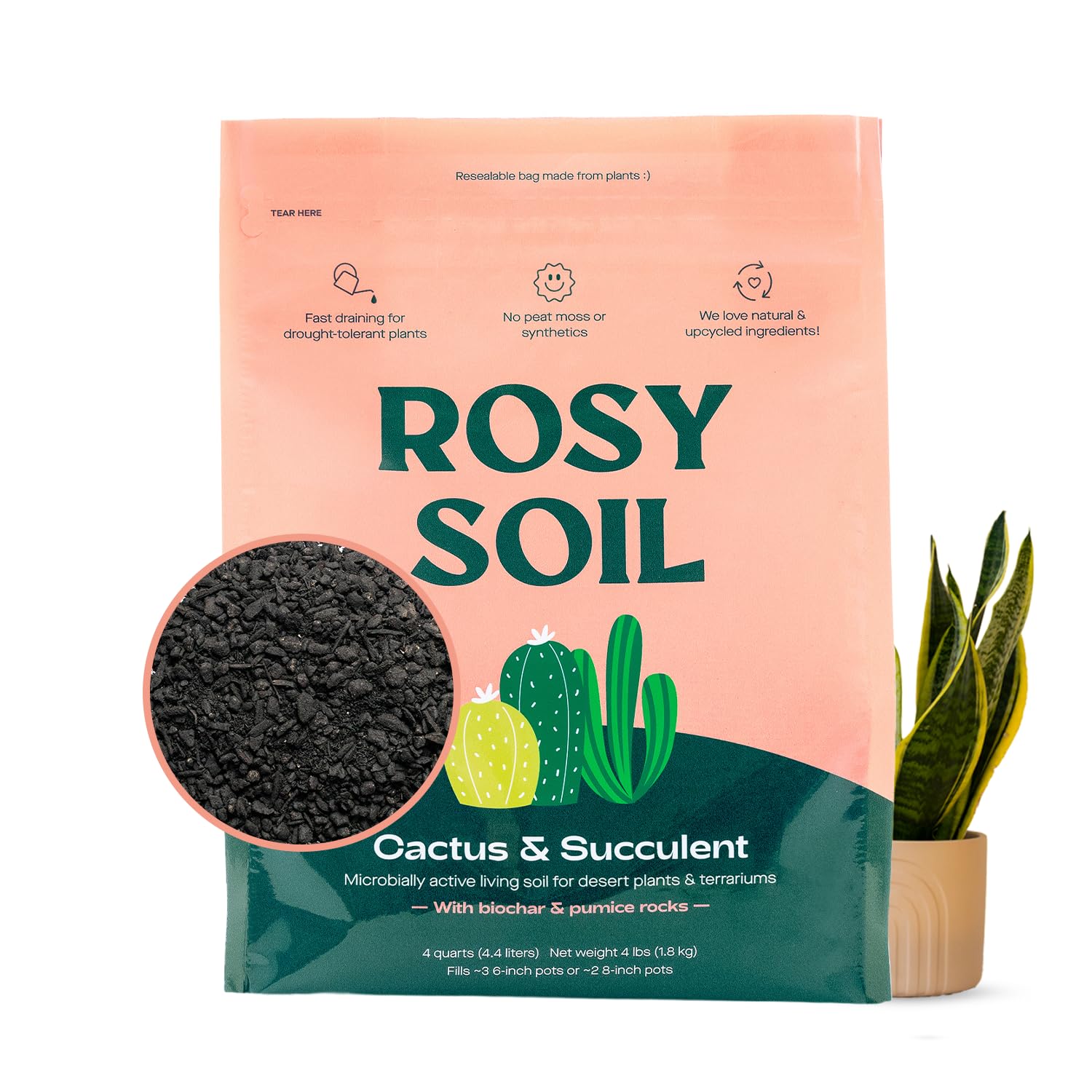
Rosy Soil’s formula shifts the paradigm by replacing peat with biochar and organic worm castings, creating a chunky, fast-draining structure that stays open and airy even after multiple waterings. The distinct grit of pumice and coarse perlite ensures water passes through in seconds rather than pooling at the bottom. This is a living soil, fortified with beneficial fungi and microbes that actively support root colonization and nutrient uptake.
The 4-quart bag is plastic-neutral and resealable, which keeps the mix fresh between uses. Customers consistently report zero pest issues — no fungus gnats or mold — even after storing the bag for weeks. The texture is consistent across batches, with no fine dust settling at the bottom. Users note that it works well for rooting offsets and repotting sensitive genera like Haworthia and Lithops without requiring additional grit amendments.
The primary trade-off is the non-resealable bag design reported by some users, which can lead to moisture loss if the bag is not stored in an airtight container. For the price per quart, this is an investment-grade mix best suited for collectors who value biological activity and want a peat-free alternative. If you maintain a small collection of high-value plants, this mix delivers the cleanest, most consistent drainage profile in this lineup.
Why it’s great
- Peat-free, biochar-based formula resists compaction and fungus gnats
- Beneficial microbes and worm castings provide slow-release nutrition
- Consistent chunky grit ideal for sensitive succulents
Good to know
- Bag is not fully resealable; needs airtight storage to retain moisture
- Higher per-quart investment compared to conventional mixes
2. DUSPRO Succulents Soil Potting Mix 7-in-1

DUSPRO packs seven separate ingredients — perlite, pumice, lava rock, peat moss, pine bark, worm castings, and vermiculite — into a single bag, giving you a truly diverse particle profile without requiring any custom mixing. The inclusion of both pumice and lava rock adds weight and stability, which helps top-heavy plants like jade and aloe stay upright. The pine bark shards contribute to the sharp, angular texture that prevents the mix from settling into a dense mass.
Available in 1-quart, 2-quart, 4-quart, and 8-quart sizes, this mix allows you to buy exactly the volume you need for a single pot or a full collection. The 1-quart bag fills two 4-inch pots, making it an ideal entry point for testing the formula. Users report excellent drainage with no moisture retention issues, and the inclusion of worm castings provides a gentle nutrient boost that lasts several weeks. The pre-blended nature means zero prep time — just open and plant.
Some users note the mix arrives slightly dusty from the fine peat component, and the smaller bags feel relatively expensive on a per-quart basis compared to bulk options. However, the balanced composition of coarse and fine particles makes it suitable for beginners who want a forgiving mix that drains quickly but still retains enough moisture to prevent dehydration during hot weather. If you value ingredient diversity in a single-bag solution, this is a strong mid-range contender.
Why it’s great
- Seven-ingredient blend provides excellent aeration and nutrition
- Available in multiple sizes from 1 to 8 quarts
- Ready to use with no mixing required
Good to know
- Fine peat dust can settle at the bottom of the bag
- Smaller sizes offer less value per quart compared to larger bags
3. Midwest Hearth Cactus Succulent Natural Potting Soil Mix
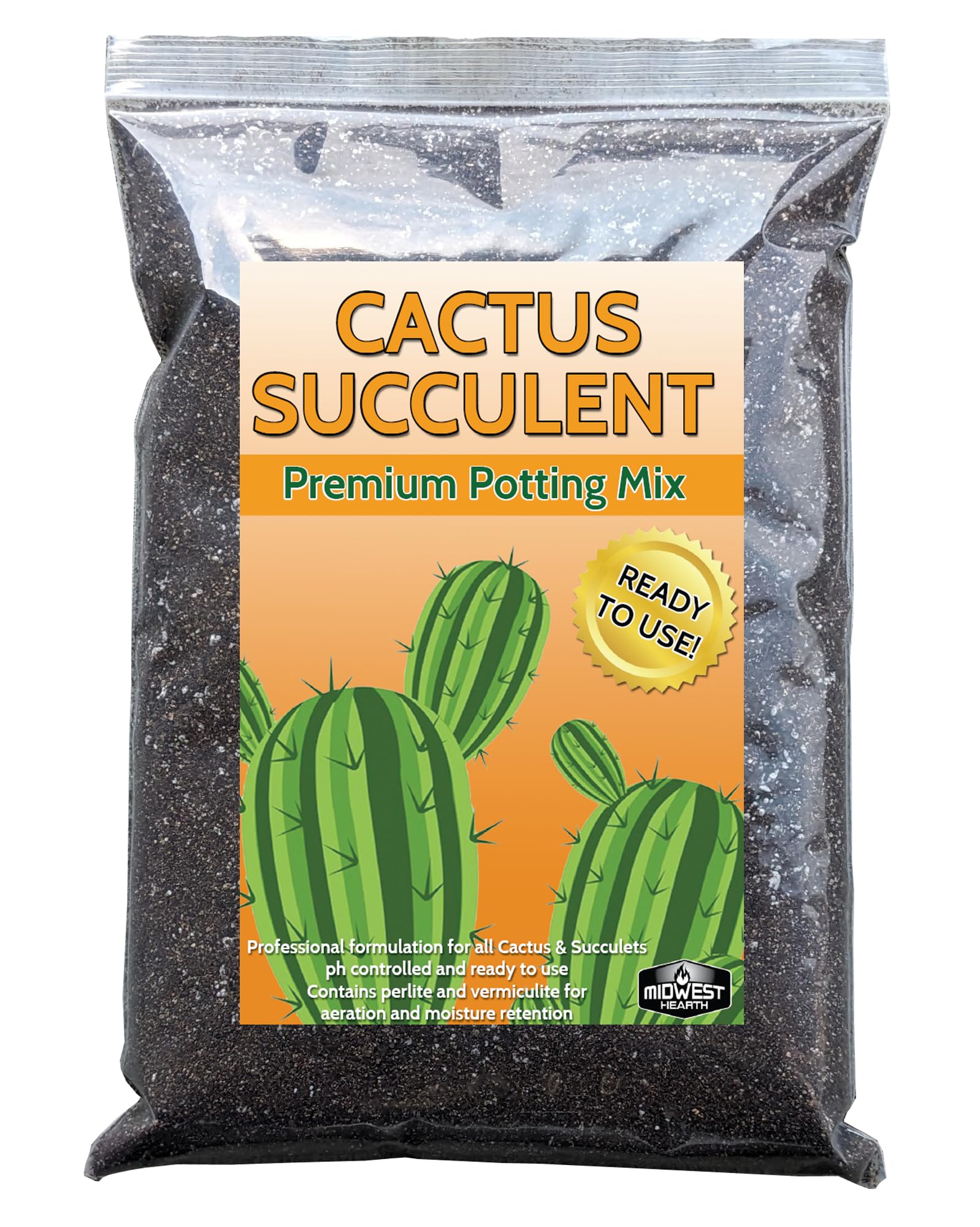
Midwest Hearth delivers a professional-grade formulation that mirrors what commercial growers use, built around a base of peat moss, perlite, and vermiculite. The pH is specifically balanced for cacti and succulents, ranging between 5.5 and 6.5, which helps prevent nutrient lockout and supports healthy root uptake. The mix is pre-moistened to reduce dust during handling, making repotting cleaner compared to bone-dry alternatives.
The 4-quart bag is a practical size for repotting a small to medium collection, and the consistency is reliably uniform — no large bark chunks or uneven particle distribution. Users report that their succulents respond well immediately after repotting, with improved root development and stronger growth over subsequent weeks. The inclusion of vermiculite boosts moisture retention slightly, which benefits newer growers who tend to underwater rather than overwater.
The trade-off is that this mix is not as aggressively draining as formulations with higher pumice or lava rock content. For desert species like Lithops or Ariocarpus that require extremely fast drying, you may need to amend with additional perlite or pumice. But for common succulents like Echeveria, Sedum, and Haworthia, this mix provides a forgiving balance that reduces the risk of both rot and dehydration. A solid all-rounder for the general succulent keeper.
Why it’s great
- pH balanced specifically for cacti and succulents
- Professional grower formulation with consistent texture
- Pre-moistened to reduce dust during repotting
Good to know
- Not as fast-draining as high-grit mixes; may need amendments for sensitive species
- Bag size feels small relative to the price point
4. Avalution 2.4lb Mix Horticultural Lava Rock Pebbles Pumice

This is not a complete potting mix — it is a specialized amendment of grey lava rock pumice pebbles designed to be added to other soil bases or used as a standalone top dressing. The porous nature of lava rock provides exceptional drainage while also retaining trace minerals that benefit slow-growing cacti and bonsai. The pebbles range from 1/8 to 1/4 inch, creating large air channels that prevent any soil from compacting around the root crown.
Users find it invaluable for custom blending their own gritty mix, especially when combined with a base like the Rosy Soil or DUSPRO options. It also works well as a decorative top dressing in clear containers or terrariums, where the subtle grey tones complement green foliage without overwhelming the visual composition. The weight of the lava rock helps stabilize top-heavy plants and prevents them from tipping over in shallow pots.
The primary downside is that the product arrives quite dusty and requires thorough rinsing before use. The 2.4-pound bag covers a limited volume — about 1.5 quarts — so you will need multiple bags for larger blending projects. Still, for anyone who wants to engineer a custom drainage profile or add aeration to an existing mix that feels too dense, this is the most effective amendment in this roundup. Works especially well for semi-hydro setups and sensitive species.
Why it’s great
- Porous lava rock enhances drainage and mineral content
- Works as top dressing, amendment, or semi-hydro medium
- Stabilizes top-heavy plants in shallow pots
Good to know
- Very dusty on arrival; needs thorough rinsing before use
- Small volume per bag limits large-scale mixing projects
5. Miracle-Gro Cactus, Palm and Citrus Potting Mix (3-Pack)

Miracle-Gro’s cactus and palm formulation is the most widely available and familiar option on this list, sold as a three-pack of 8-quart bags for a total of 24 quarts. The blend uses a fast-draining base enriched with Miracle-Gro plant food that feeds for up to three months, making it a convenient choice for large collections where repotting in bulk is the norm. The texture is lighter and less gritty than premium blends, relying on perlite and sand for drainage rather than chunky pumice or lava rock.
For common succulents like aloe vera, snake plants, and various cacti, this mix performs adequately as a standalone medium. The fast-draining formula prevents water from pooling, though the finer particle size means it will dry slower than a true gritty mix. Users with well-established collections often blend this 50/50 with additional perlite or chicken grit to increase aeration for more demanding species. The three-pack provides enough volume to repot an entire windowsill or small greenhouse in one go.
The main drawbacks are the lack of coarse inorganic particles and the addition of synthetic fertilizer, which some organic growers prefer to avoid. For entry-level hobbyists with a few common succulents, this mix is budget-friendly and effective when paired with proper watering discipline. But for collectors of rare, rot-prone genera, this bag serves best as a base to be heavily amended rather than a standalone solution. It is the most economical way to cover volume when you need to repot many plants at once.
Why it’s great
- Three-pack delivers 24 quarts for large-scale repotting projects
- Enriched with plant food that feeds for up to 3 months
- Widely available and familiar to most gardeners
Good to know
- Finer particle texture compacts faster than true gritty mixes
- Contains synthetic fertilizer; not ideal for organic growers
FAQ
Can I use regular potting soil for succulents instead of a specialized mix?
Should I add extra perlite or pumice to my bagged succulent mix?
How often should I repot succulents with fresh potting mix?
Final Thoughts: The Verdict
For most users, the succulent potting mix winner is the Rosy Soil Cactus and Succulent Organic Potting Mix because it combines peat-free biochar with beneficial microbes and a consistently chunky texture that drains fast without drying out completely. If you want a value-packed multi-ingredient blend that works straight out of the bag, grab the DUSPRO 7-in-1 Succulent Mix. And for bulk repotting of a large collection at the most cost-effective volume, nothing beats the Miracle-Gro Cactus, Palm and Citrus 3-Pack when blended with additional perlite for better aeration.