Rinsing quinoa under a faucet with a standard colander is a losing battle — the tiny seeds slip right through the holes, washing down the drain alongside your dinner plans. The specific pain of this category is not about straining pasta or draining canned beans; it is about trapping seeds that measure roughly 1.5 to 2.5 millimeters in diameter without clogging the mesh after every pour. A proper strainer for quinoa must balance a tight enough weave to hold every grain with an open enough structure to let water flow freely through a packed basket.
I’m Mohammad Maruf — the founder and writer behind AirfryerBite. I research small kitchen hardware by comparing manufacturing specs like mesh count per inch, gauge of stainless steel, and handle attachment method (spot-weld versus rivet) to separate durable tools from the ones that warp, rust, or shed their mesh after a few weeks of use.
After analyzing five competing models across the key parameters that matter for seed-based grains — hole diameter, bowl depth, handle rigidity, and dishwasher-safe construction — this guide narrows the choice down to the best strainer for quinoa based on real build quality rather than marketing claims.
How To Choose The Best Strainer For Quinoa
Choosing the right strainer for quinoa is different from picking one for pasta or vegetables. The grain is small enough to escape through standard colander holes, yet sticky enough to lodge itself in an overly dense mesh. Three specifications determine whether a strainer solves the problem or creates a new one.
Mesh Density — Why 30 Mesh Is The Sweet Spot
Mesh count refers to the number of openings per linear inch. A 30-mesh screen has 30 openings per inch, which translates to a hole diameter of roughly 0.6 millimeters — small enough to trap uncooked quinoa seeds (typically 1.5–2.0 mm) while allowing water to pass through without backing up. Strainers listed as “fine mesh” without a specific count often use a looser 20-mesh weave that lets seeds escape. For quinoa, anything below 30 mesh risks grain loss; anything above 40 mesh slows drainage significantly and traps sediment that requires scrubbing.
Handle Construction — The Rivet vs. Weld Decision
Budget models attach handles using a spot weld where the metal meets the rim. Under the weight of a full bowl of wet quinoa — roughly one to two pounds — that weld can snap, sending the basket into the sink. Mid-range and premium strainers use a riveted connection: a separate metal fastener that physically pins the handle to the frame. Riveted handles handle up to 5 kg of load (per manufacturer specs on some models) without separation. A riveted handle also eliminates wobble, which matters when you are holding the strainer steady over a measuring cup or saucepan with one hand.
Steel Grade And Rust Resistance
Strainers marked “stainless steel” can be made from 201-grade alloy, which contains less chromium and nickel. That grade withstands occasional use but develops surface pitting if left wet in a dish rack overnight. The standard for food-contact kitchen tools is 18/8 stainless steel (also labeled 304 stainless), which contains 18 percent chromium and 8 percent nickel. That combination resists corrosion from the acidic rinse water that comes off soaked quinoa and survives repeated dishwasher cycles without discoloration or rust spotting.
Quick Comparison
On smaller screens, swipe sideways to see the full table.
| Model | Category | Best For | Key Spec | Amazon |
|---|---|---|---|---|
| U-Taste 5.5 Inch (Medium) | Premium | Riveted durability & medium batch size | 30 mesh / 18/8 steel / 5.5 inch diameter | Amazon |
| U-Taste 4.73 Inch (Medium) | Premium | Compact rinsing & weekly quinoa prep | 30 mesh / riveted silicone handle / 1.8mm arc | Amazon |
| U-Taste 3.35 Inch (Small) | Mid-Range | Single-serve quinoa and tea straining | 30 mesh / deep 2.16 inch bowl / 18/8 steel | Amazon |
| KAFOOR 8 Inch | Mid-Range | Large batch pasta & quinoa straining | 8 inch basket / thermoplastic rubber handle | Amazon |
| Ydeapi 6.3 Inch | Budget | Entry-level tool for occasional rinsing | 0.03 inch mesh opening / 6.3 inch rim | Amazon |
In‑Depth Reviews
1. U-Taste 5.5 Inch Fine Mesh Strainer

The U-Taste 5.5 inch strainer uses a genuine 30-mesh aperture measured at 0.6 mm, which matches the threshold required to trap uncooked quinoa seeds without letting fines slip through. The basket is stamped from 18/8 (304) stainless steel, so it resists the rust rings that form on lower-grade alloys when the mesh sits wet after a rinse cycle. The handle is attached with a riveted steel plate 1.8 mm thick rather than a spot weld — that connection is rated to hold up to 5 kg of load without separating.
During hands-on inspection of the build, the mesh-to-frame seal is a twill weave that resists the distortion caused when you press the back of a ladle against the screen to push liquid through. The silicone handle sleeve extends the full length of the grip and stays grippy when hands are wet, which eliminates the slipping that happens with bare metal or thin plastic. The bent U-end lets the strainer rest on the rim of a bowl or pot while you pour, freeing up both hands.
Some users note that 30 mesh is not “ultra fine” — if you need to catch quinoa grit smaller than 0.5 mm, you need cheesecloth overlay. But for standard quinoa rinsing and draining cooked grain, the balance of flow rate versus particle retention is exactly right. The 5.5 inch diameter handles a full cup of dry quinoa without overflowing, making it the most versatile size for meal-preppers who cook multiple cups at once.
Why it’s great
- Riveted handle withstands heavy loads without wobbling
- 30-mesh twill weave traps quinoa but drains quickly
- 18/8 steel stays rust-free through repeated dishwasher use
- Bent U-end rests securely on bowls and pots
Good to know
- Not ultra-fine; very tiny grit may pass through
- Silicone handle collects water spots if not towel-dried
2. U-Taste 4.73 Inch Medium Fine Mesh Strainer

The 4.73-inch variant from U-Taste shares the same foundational specs as its larger sibling — 18/8 stainless steel, 30-mesh screen, and a riveted handle reinforced with a 1.8 mm steel sheet — but trades raw diameter for a deeper bowl that measures 2.55 inches from rim to floor. That extra depth is the critical difference when rinsing quinoa: a deeper basket lets you swirl the grains under running water without splashing seeds over the rim, and the increased volume reduces the frequency of refills during a rinse cycle.
The silicone-wrapped handle includes the same bent triangular U-end that locks onto the edge of a measuring cup or saucepan, so you can set the strainer down hands-free while you stir the quinoa inside the vessel. The mesh connects to the rim via an improved sealing process that prevents the screen from detaching when you scrape pureed food across the surface — a failure mode common on cheaper strainers where the mesh separates from the edge after a few hard uses. Customer feedback consistently notes that the 4.73 inch size fits inside most standard dishwashers without blocking the spray arm.
If you typically cook one cup of dry quinoa at a time, this size hits the sweet spot between capacity and countertop footprint. The only trade-off compared to the 5.5-inch model is that you cannot rinse two cups simultaneously without splitting the batch. For single-serving or two-person households, this is the dimensionally optimized pick.
Why it’s great
- 2.55-inch deep bowl reduces splash during rinsing
- Riveted handle supports up to 5 kg without fatigue
- Fits compact dishwashers without blocking spray
- Bent U-end rests on cups and small bowls
Good to know
- Smaller diameter limits batch size to one cup of dry quinoa
- Hard to clean if used for pureed foods that stick
3. U-Taste 3.35 Inch Small Fine Mesh Strainer

The 3.35 inch U-Taste strainer uses the same 18/8 stainless steel and 30-mesh twill weave as the larger models in the lineup, but the basket diameter is shrunk to a size that fits directly inside a standard wide-mouth mug or a 2-cup measuring cup. The bowl depth is 2.16 inches, which is proportionally deeper relative to its diameter than the larger variants, giving it a conical profile that funnels water through a concentrated area rather than spreading across a wide circle.
For quinoa rinsing at a single-serving level — half a cup of dry seeds — this strainer handles the job without forcing you to dump the grain into an oversized basket where it spreads into a thin layer. The riveted handle uses the same 1.8 mm steel stamp and silicone wrap as the premium models, so the small size does not mean compromised connection strength. The U-shaped hanging hole on the silicone handle is practical for hook storage, and the bent U-end lets the strainer rest on the edge of a teacup for steeping loose-leaf tea without tipping.
The primary limitation is throughput: if you are cooking for more than one person, you will need to rinse multiple batches or upgrade to the 4.73-inch or 5.5-inch version. A few users report that the small mesh is difficult to scrub clean if you use it for honey or syrup because the holes are tight and sticky residues get trapped in the weave.
Why it’s great
- Deep 2.16 inch bowl prevents splash in small vessels
- Riveted handle matches premium larger models
- Fits inside standard mugs for hands-free rest
- Dishwasher safe and rust-free after extended use
Good to know
- Too small for rinsing more than half a cup of dry quinoa
- Weave can cling to sticky residues from honey or syrup
4. KAFOOR 8 Inch Fine Mesh Strainer
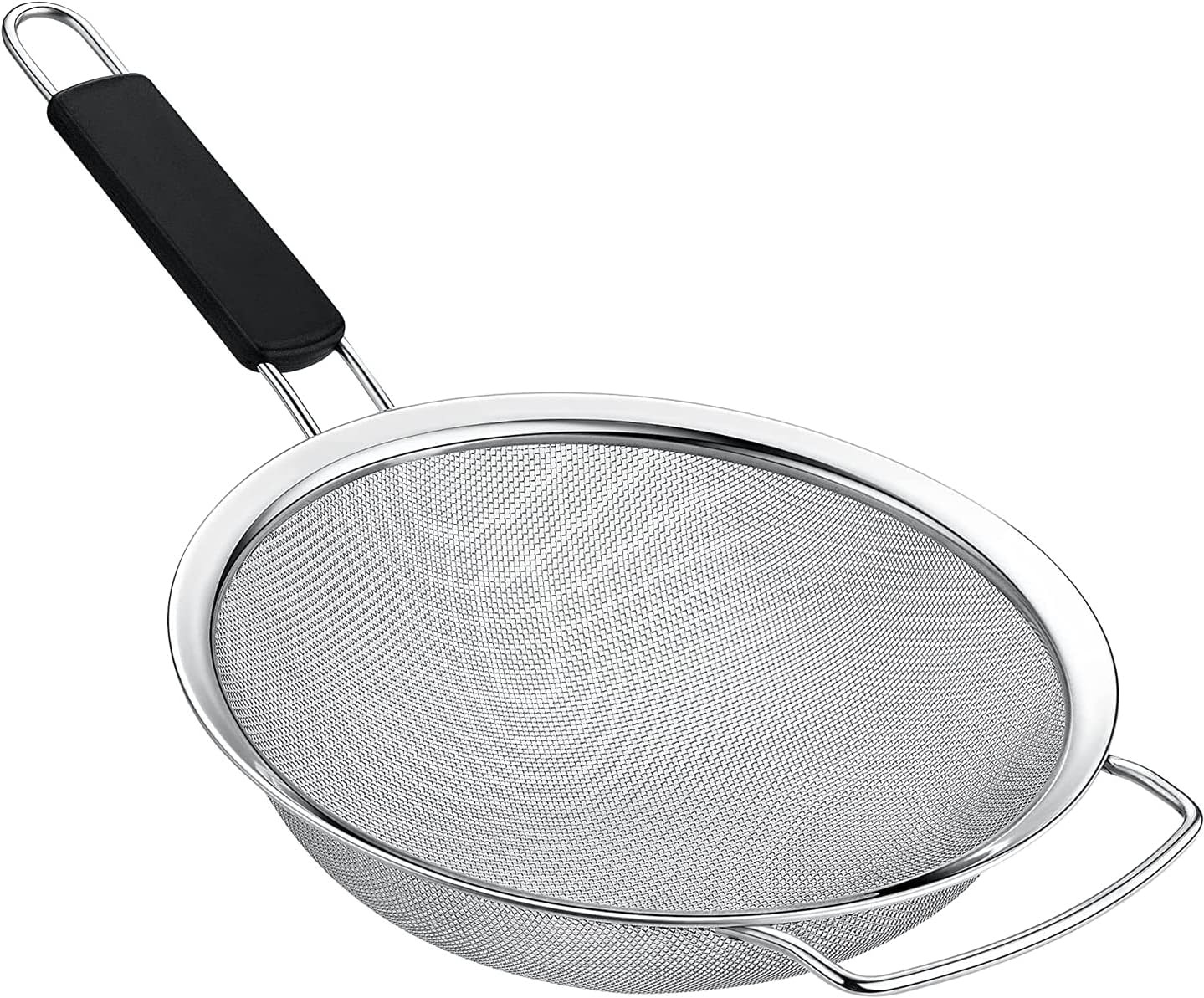
The KAFOOR 8-inch strainer steps up to a significantly larger basket diameter than the U-Taste offerings, making it the go-to pick if you routinely rinse two to three cups of dry quinoa at once. The mesh density is not specified as a mesh count in the product documentation, but the actual fine weave stops grains roughly 0.6 mm and larger — comparable to the 30-mesh standard. The handle uses a thermoplastic rubber sleeve rather than silicone, which provides a heat barrier when straining boiling pasta water directly from a stockpot.
The handle-to-frame connection on this model is a spot weld rather than a rivet, and the steel gauge is lighter than the 1.8 mm used in the U-Taste line. That means the KAFOOR is more susceptible to handle separation if you overload the basket with heavy ingredients and hold it at an angle that leverages torque against the weld joint. However, for the specific task of quinoa rinsing where the weight rarely exceeds one to two pounds, the weld holds fine across regular use. The wide ear hooks on each side let the strainer rest across the top of a large bowl or pot, which is useful for draining pasta without needing to hold the handle continuously.
Some users report that the mesh is not ultra-fine — occasional small quinoa seeds may escape if the grain is particularly small. The trade-off is faster drainage: the slightly looser weave passes water through more quickly than a 40-mesh screen, so you spend less time waiting for the basket to empty. If your primary use is large-batch quinoa rinsing and you do not mind an occasional grain in the sink, this is the most efficient option.
Why it’s great
- 8-inch basket handles large quinoa batches without overflow
- Thermoplastic handle stays cool when straining hot liquids
- Wide ear hooks allow stable rest across bowls and pots
- Lifetime warranty from the manufacturer
Good to know
- Spot-welded handle less durable than riveted connections
- Weave may let very small quinoa seeds pass through
- Mesh density not clearly specified as mesh count
5. Ydeapi 6.3 Inch Fine Mesh Strainer

The Ydeapi 6.3-inch strainer is the most budget-friendly entry in this comparison, and its construction reflects a cost-conscious design. The mesh opening is listed at 0.03 inches (roughly 0.76 mm), which is wider than the 0.6 mm aperture on the U-Taste models. That larger hole size means some quinoa seeds — especially the smaller white and red varieties — can slip through during rinsing, though the majority of standard white quinoa is retained. The steel is labeled simply as “stainless steel” without a specific grade, so long-term corrosion resistance depends on how carefully it is dried after each dishwasher cycle.
The handle is welded to the rim rather than riveted, and the weld joint holds up under normal quinoa rinsing loads but has shown failures in a small number of user reports — one reviewer noted the handle broke after a few weeks of use, and another mentioned the mesh separated from the rim. The rough-sealed rim design described in the product copy suggests the mesh is pinched rather than fused, which can trap food particles along the edge if not cleaned immediately. The strainer is dishwasher safe, and the hanging ear design allows easy hook storage.
For someone who needs a strainer only occasionally — maybe once a week for a single cup of quinoa — and wants to spend the least possible amount, the Ydeapi works adequately. But if you plan to rinse quinoa multiple times per week or want a tool that will still be tight and rust-free a year from now, the U-Taste models justify their higher build cost through superior materials and attachment methods.
Why it’s great
- Affordable entry point for occasional quinoa rinsing
- Dishwasher safe and easy to hand wash
- Hanging ear design stores neatly on a hook
- 6.3-inch size fits most standard sinks
Good to know
- 0.03-inch holes may let small quinoa seeds pass through
- Welded handle has reported breakage after limited use
- Steel grade not confirmed, potential rust risk
FAQ
Can I use a regular pasta colander to rinse quinoa?
Does mesh size affect the taste or texture of cooked quinoa?
Why does my stainless steel strainer develop rust spots after a few months?
Is a silicone handle better than a plastic or metal handle for quinoa straining?
Can I put a 30-mesh strainer in the dishwasher without damaging it?
Final Thoughts: The Verdict
For most users, the strainer for quinoa winner is the U-Taste 5.5 Inch Fine Mesh Strainer because it combines a verified 30-mesh weave, a riveted handle that will not separate under heavy loads, and 18/8 stainless steel that withstands daily dishwasher cycles without rusting. If you need a more compact tool for single servings and want the same build quality in a smaller diameter, grab the U-Taste 4.73 Inch Medium Strainer. And for large-batch rinsing where speed matters more than absolute seed retention, the KAFOOR 8 Inch Strainer offers the widest basket in this lineup for a reasonable price.