That nagging back pain from sitting all day, the stalled weight loss, the guilt of skipping another gym session—a quality stepper machine for home can break that cycle without a gym membership or a massive footprint in your living room. These compact cardio tools deliver a legitimate stair-climbing workout that torches calories, sculpts your legs and glutes, and gets your heart rate up in as little as 15 minutes. But not all steppers are built the same: some wobble under pressure, some are noisy enough to wake the neighbors, and others simply don’t provide enough resistance to challenge you.
I’m Mohammad Maruf — the founder and writer behind AirfryerBite. I spent weeks analyzing the mechanical specs, hydraulic systems, frame materials, and weight capacities of the most popular home steppers so you don’t have to wade through hundreds of conflicting Amazon reviews. My focus is on real-world durability, resistance quality, and joint-friendly design—not marketing fluff.
Whether you need a whisper-quiet mini stepper for under your desk or a full-size vertical climber with adjustable resistance, this guide to the best stepper machine for home breaks down seven models that deliver genuine results for different budgets and body types.
How To Choose The Best Stepper Machine For Home
A stepper machine’s job is simple—simulate climbing stairs—but the engineering behind that motion varies wildly. Your choice should hinge on the resistance system, the weight capacity, and the overall build quality, because a cheap frame that flexes under load will ruin your workout and your knees.
Resistance Type: Hydraulic vs. Magnetic vs. Bodyweight
Hydraulic cylinders are the most common in home steppers, using fluid compression to create resistance. They’re generally quiet and smooth, but can degrade over time if the seals leak. Magnetic resistance systems are quieter and more consistent, but are mostly found in higher-end machines. Many compact mini steppers offer no real resistance adjustment at all—they rely entirely on your body weight, which works for beginners but plateaus quickly. Look for a model with at least six levels of adjustable resistance if you intend to keep challenging yourself beyond the first month.
Weight Capacity and Stability
The most critical safety number is the maximum user weight. A stepper rated for 300 pounds is not merely a recommendation—it’s an indicator of the frame’s steel gauge, the quality of the welds, and the size of the base plate. Models with narrow pedals (under 12 inches wide) can cause instability for users with wider hips or larger thighs, leading to unnatural stepping angles that strain the knees. Also check the whole footprint and whether the stepper has anti-slip mats or rubber feet—a machine that slides on hardwood is dangerous at higher stepping rates.
Stride Length and Foot Pedal Design
Stride length determines how deep your step feels. Basic mini steppers offer a short 4-to-6-inch stride, which is fine for light movement while seated, but for a proper glute-burning climb, you want at least 10 inches. The pedals should be textured or ribbed to prevent slipping, and ideally wide enough for your entire foot to rest flat. Some vertical climbers use a rocking step motion rather than a straight up-down, which can be easier on the ankles but takes a few sessions to adjust your balance.
Quick Comparison
On smaller screens, swipe sideways to see the full table.
| Model | Category | Best For | Key Spec | Amazon |
|---|---|---|---|---|
| Sunny Health & Fitness Power Stepper | Vertical Climber | Full-body, app-connected training | 16.9-inch stride, hydraulic drive | Amazon |
| YOLEO Adjustable Resistance Stair Stepper | Folding Climber | Heavy-duty, high-weight capacity | 660 lb capacity, 3 workout modes | Amazon |
| JLL Smart Twist Stepper | Mini Twisting Stepper | Joint-friendly ankle protection | Dual hydraulic cylinders, V-Twist | Amazon |
| MERACH Stair Stepper | Vertical Climber | Space-saving, portable cardio | Folding, 300 lb capacity | Amazon |
| KINMAC Vertical Climber | Folding Climber | Quiet, low-impact hiking prep | Triangular steel frame, 265 lb | Amazon |
| HXD-ERGO Stair Stepper | Vertical Climber | Adjustable handlebar, knee-friendly | Triangular structure, 300 lb | Amazon |
| Sunny Health & Fitness Mini Stepper | Mini Stepper | Budget-friendly, desk-side use | Smart connectivity, 300 lb | Amazon |
In‑Depth Reviews
1. Sunny Health & Fitness Power Stepper (SF-S021001)

The Sunny Power Stepper is a premium vertical climber that delivers a 16.9-inch mountain climb stride—far deeper than the 4-to-6-inch range of typical mini steppers. That extended range puts your glutes and hamstrings through a legitimate climbing motion, not just a shallow bob. The hydraulic drive system operates near-silently, which matters if you’re stepping during early morning meetings or late at night.
Built-in heart rate sensors on the ergonomic handlebars are a rare feature at this tier, letting you monitor intensity without a separate chest strap. The Bluetooth connectivity to the SunnyFit app adds guided workout routes and trainer-led sessions, though the app’s free tier is generous enough that you won’t feel pressured to upgrade. The foldable frame with transport wheels makes it easy to roll under a couch or into a closet.
Some users report that the hardware bolts can loosen over time, potentially causing a clicking noise in the step counter—a maintenance issue that requires periodic tightening. The frame supports up to 300 pounds, but taller users at the ceiling limit should ensure the adjustable handlebar reaches a comfortable height before committing.
Why it’s great
- 16.9-inch stride provides deep glute-and-hamstring activation
- Built-in pulse sensors on handlebars for heart rate tracking
- Quiet hydraulic operation suitable for shared living spaces
Good to know
- Hardware bolts may loosen and cause clicking noises over time
- Takes up more floor space than mini steppers
2. YOLEO Adjustable Resistance Stair Stepper

The YOLEO stepper stands apart with its monstrous 660-pound weight capacity—more than double the average home stepper. The dual-triangle steel frame uses 0.8-inch by 2-inch thicker tubing that simply doesn’t flex under heavy load. It offers three distinct workout modes: standard climbing, incline hiking, and a ski simulation that shifts resistance from side to side for core engagement.
The oversized pedals are nearly double the length of standard models, which is a game-changer for larger feet or users who need stable foot placement. The unit arrives 90 percent pre-assembled; most users complete setup in about 15 minutes. The folding footprint is only 1.6 square feet, and the 360-degree swivel caster mat lets you slide it around without lifting.
That said, a small number of users report that the gear shift mechanism feels stiff and difficult to move, though it locks securely once set. A few negative reviews mention knee pain after extended sessions, which could indicate the motion path doesn’t suit all anatomies. Still, for the price-to-build ratio, this machine punches far above its cost tier.
Why it’s great
- 660-pound weight capacity—strongest frame in this comparison
- Oversized pedals provide stable footing for all foot sizes
- Three distinct workout modes prevent workout boredom
Good to know
- Gear shift mechanism can be stiff to operate initially
- Motion path may cause knee discomfort for some users
3. JLL Smart Twist Stepper
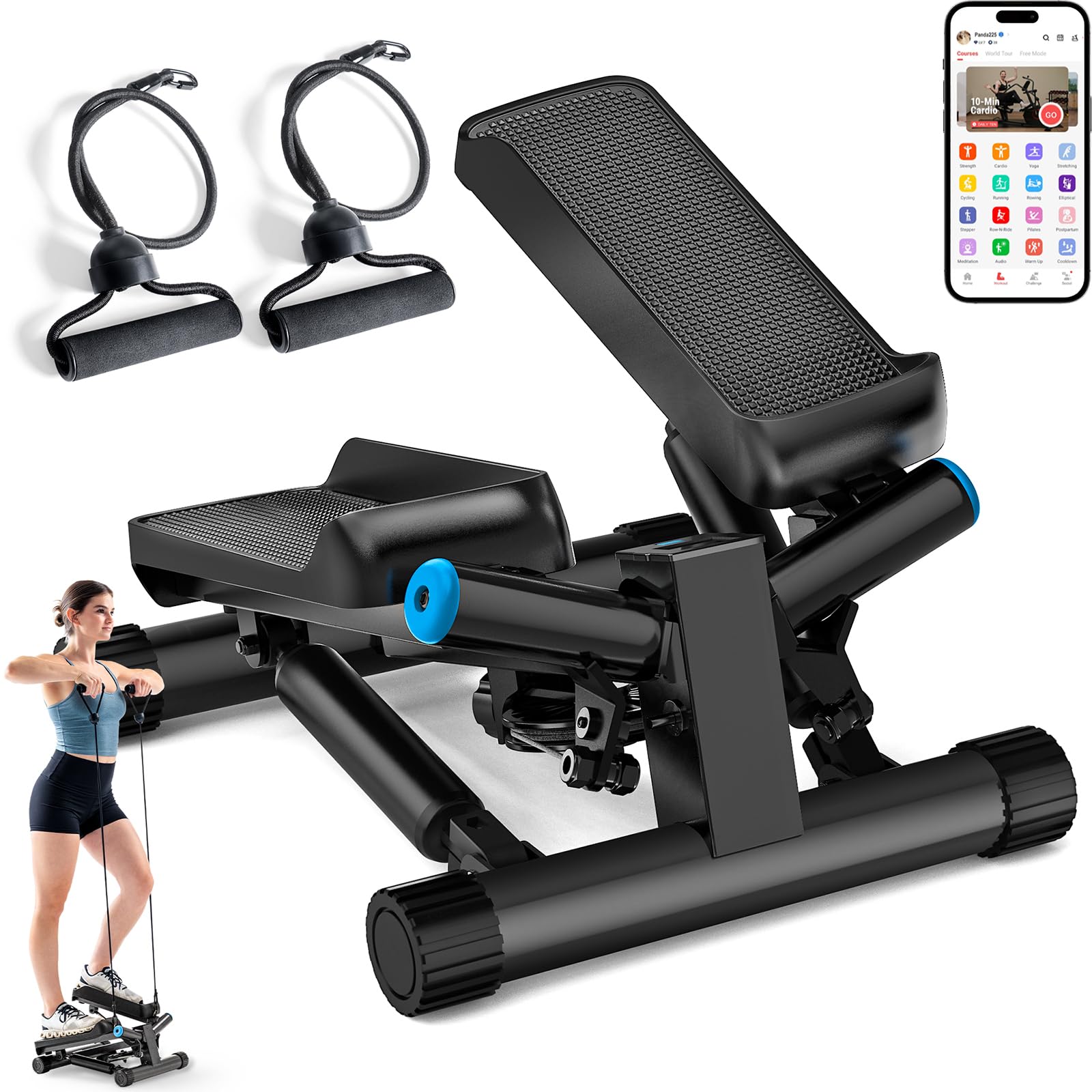
The JLL Smart Twist Stepper solves a problem that plagues traditional steppers: ankle strain. Its V-shaped twisting pattern makes the pedals follow a natural arc that protects ankle alignment while still engaging calves, glutes, and core. The dual hydraulic cylinders deliver whisper-quiet operation—you can hold a conversation or watch TV without distraction. For 16.9 pounds, it’s light enough to carry from room to room.
The adjustable step height knob ranges from 4.2 to 14.8 inches, effectively giving you continuous resistance control without swapping bands or weights. Two included resistance bands add upper-body pressing and rowing movements, transforming the machine into a full-body station. Bluetooth syncs with the free SunnyFit app for guided workouts and metric tracking, and the LCD display shows reps-per-minute, count, time, and calories.
Some users note the resistance bands are less effective than standalone bands, and a single review mentions knee pain after a week of use—though most find the twisting motion easier on joints than standard stepping. The 1-year warranty on the frame is standard, but the 180-day parts coverage feels short for the price. Overall, this is the most thoughtful stepper design for joint-conscious users.
Why it’s great
- V-twist motion protects ankle alignment while working the whole leg
- Adjustable step height from 4.2 to 14.8 inches
- Bluetooth sync with SunnyFit app for free guided workouts
Good to know
- Included resistance bands could be higher quality
- Rare reports of knee strain after extended use
4. MERACH Stair Stepper

MERACH’s stair stepper uses an engineered stride length and range of motion to mimic natural climbing while minimizing knee strain. The folding design collapses to a flat profile that can slide under a couch or into a closet corner. At 26.5 pounds, it’s portable enough to carry up stairs, yet the steel frame supports a full 300-pound user capacity. The assembly time is roughly 20 minutes thanks to pre-attached components.
The built-in LCD monitor tracks time, steps, and calories, and the handlebar adjusts to three height positions to accommodate different torso lengths. Users consistently highlight that 10 minutes on this machine produces a noticeable burn in the legs and glutes, which is the hallmark of an effective stepper. The resistance, however, is largely bodyweight-based—there’s no external resistance adjustment—so advanced users may outgrow it quickly.
A few customers note that the machine can be slightly louder than expected, describing it as a rhythmic thumping rather than a hydraulic hiss. The pedals are non-slip but some find them narrower than ideal for wide-footed users. For the price, it’s a solid entry into vertical climbing that won’t dominate your living space.
Why it’s great
- Folding design stores flat under furniture
- Quick 20-minute assembly process
- Effective 10-minute leg and glute burn
Good to know
- Resistance is bodyweight-only, no external adjustment
- Some noise during operation
5. KINMAC Vertical Climber

The KINMAC vertical climber uses a robust triangular frame design that feels solid underfoot without wobbling during intense sessions. The upright posture mimics rock climbing motion more than stair stepping, which shifts the emphasis to the quads and core. The digital monitor tracks time, count, and calories—basic but functional—and the handlebar is adjustable for different user heights.
Assembly takes about 15 to 20 minutes, and the folding design reduces the footprint considerably for storage. Multiple users report that this machine is particularly effective for hiking prep, as the continuous stepping motion builds the specific endurance needed for steep trails. The resistance comes from body weight plus the tension of the elastic band system, which provides a smooth, non-jarring motion.
The biggest drawback is that the foot rests are on the smaller side, forcing some users to step on their toes rather than planting their full foot. A single reviewer noted that the incline is not adjustable, limiting variety. The 265-pound weight capacity is lower than most competitors, so larger users should proceed with caution.
Why it’s great
- Triangular frame provides wobble-free stability
- Effective for building hiking-specific endurance
- Quiet operation with elastic band resistance
Good to know
- Foot rests may be too small for full-foot planting
- 265-pound weight capacity limits larger users
6. HXD-ERGO Stair Stepper
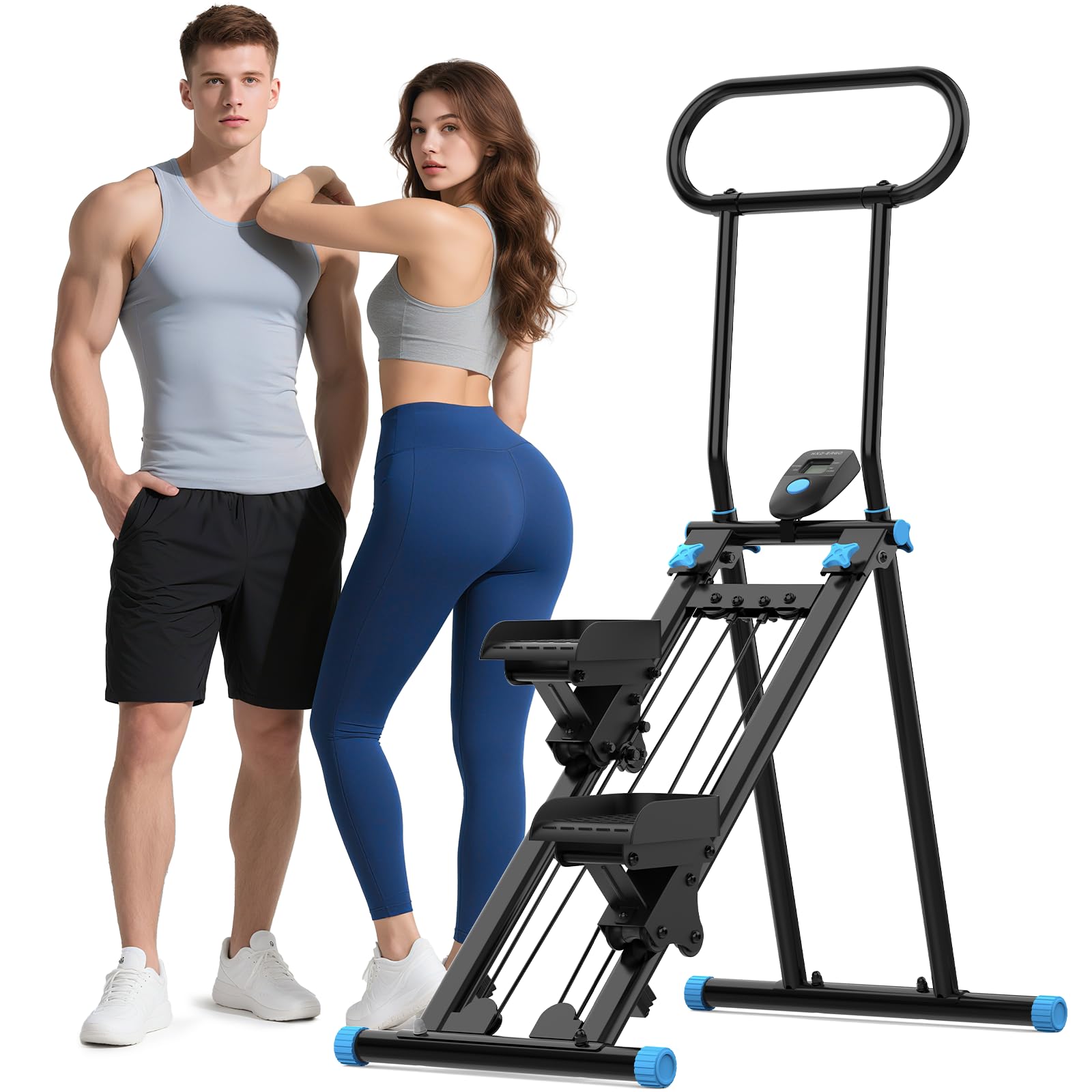
The HXD-ERGO stair stepper focuses on ergonomics with a reinforced triangular structure and an adjustable handlebar that offers three height settings. This makes it easy to maintain proper posture whether you’re 5 feet or 6 feet tall. The low-impact design is explicitly engineered to keep peak impact force on the knees between 1 and 1.5 times body weight, compared to 2–3 times for running—a meaningful feature for anyone with existing knee sensitivity.
The machine is built from corrosion-resistant steel and folds compactly for storage. Users consistently praise the smooth, noise-free motion, and the setup is simple enough that multiple household members can adjust it to their preferred height without tools. At 28 pounds, it’s heavy enough to stay planted during vigorous stepping but still manageable to relocate.
The main complaint is that the resistance isn’t adjustable; some users wish the stepping resistance could be tightened for a more challenging workout. The digital display is also minimal—steps and time only—without calorie tracking. For users prioritizing joint safety over high-intensity resistance, this is a well-engineered choice.
Why it’s great
- Three-height adjustable handlebar accommodates all user sizes
- Knee-friendly impact force (1–1.5x body weight)
- Sturdy corrosion-resistant steel frame
Good to know
- Resistance is not adjustable
- Display lacks calorie tracking
7. Sunny Health & Fitness Mini Stepper (NO. 012SMART)

Sunny Health & Fitness brings their reputation for affordable, functional fitness equipment to this compact mini stepper that weighs just 15 pounds and measures 15.9 by 12.2 inches. The upgraded smart model adds Bluetooth connectivity to the free SunnyFit app, unlocking over 1,000 trainer-led workouts and 10,000 virtual scenic tours. Despite the tiny footprint, the alloy steel frame supports up to 300 pounds, and the hydraulic cylinders provide smooth, quiet resistance.
The included resistance bands clip onto the base, allowing arm work alongside the stepping motion for a full-body effect. The LCD display tracks steps, time, and calories, and the unit comes pre-assembled out of the box. Users report that it’s perfect for short bursts of movement while watching TV or working at a standing desk—the portability means you can tuck it under a desk and pull it out whenever you need a break from sitting.
Where it falls short is the pedal width: at just over 11 inches long and relatively narrow, large users with thick thighs may find the pedals too close together, forcing an unnatural stepping angle. Some customers at higher weights (around 325 pounds) have reported cracking, though the manufacturer offers an upgraded wider version. For lighter users who want an entry-level smart stepper that won’t dominate a room, this is a capable option.
Why it’s great
- Ultra-compact and portable at 15 pounds
- Free SunnyFit app access with guided workouts
- Quiet hydraulic cylinders for shared spaces
Good to know
- Narrow pedals may not suit wider users
- Weight ratings near capacity may cause frame stress over time
FAQ
Will a stepper machine damage my hardwood or laminate floors?
Can you build visible muscle with a stepper machine, or is it just cardio?
How much electricity does a stepper machine consume?
Final Thoughts: The Verdict
For most users, the best stepper machine for home winner is the JLL Smart Twist Stepper because it combines a joint-friendly V-twist motion, whisper-quiet hydraulic cylinders, and adjustable step height in a compact 16.9-pound package that fits any room. If you want a machine that can handle heavy, intense training day after day, grab the YOLEO Adjustable Resistance Stair Stepper with its 660-pound capacity and three distinct workout modes. And for a premium full-body cardio experience with app connectivity and heart rate tracking, nothing beats the Sunny Health & Fitness Power Stepper.