Finding a stain that both deepens the grain of your butcher block and stays safe for direct food contact is a narrower spec sheet than most shoppers realize. The wrong finish can turn a chopping surface into a chemical concern, while the right oil-stain hybrid actually seals the wood against moisture and bacteria.
I’m Mohammad Maruf — the founder and writer behind AirfryerBite. I’ve spent years cross-referencing cutting board care guides, food-safety compliance documents (21 CFR 175.300), and accelerated wear tests to separate durable protective stains from temporary cosmetics.
Whether you are refreshing a countertop island or restoring a daily-use chopping board, choosing the stain for butcher block means balancing color depth, cure time, and food-grade certification against your specific wood species and usage frequency.
How To Choose The Best Stain For Butcher Block
Butcher block stain is different from a furniture stain. It must penetrate end-grain surfaces without leaving a surface film that can chip into food, and the color pigments must be stable enough not to leach under moisture. You are shopping for a protective finish first and a color additive second.
Food-Safe Certification vs. Marketing Claims
Look for language referencing FDA 21 CFR 175.300 — that is the regulation governing resinous and polymeric coatings for food contact surfaces. “Food safe” on a label is meaningless without the specific code. Oils that polymerize (linseed, tung) meet this standard after a full cure. Mineral-oil stains do not polymerize and require reapplication rather than a single cure cycle.
Viscosity and Wood Penetration
Thin-bodied oil stains soak deeper into the porous end-grain of a butcher block, producing richer color because the pigment travels below the surface. Thick gel stains tend to sit on the surface, which can flake or wear unevenly on a cutting surface. Tung oil and polymerized linseed oil offer medium viscosity that wicks into the wood without pooling.
Color Tone and Wood Species
Lighter stains like Hazelnut or clear Danish oil show the natural grain on walnut and cherry, while dark tung oil or deep walnut stains are better at unifying the appearance of mixed-wood blocks. Always test on a hidden section or scrap piece of the same wood species — end-grain absorbs color much more aggressively than face-grain.
Quick Comparison
On smaller screens, swipe sideways to see the full table.
| Model | Category | Best For | Key Spec | Amazon |
|---|---|---|---|---|
| Real Milk Paint Dark Tung Oil | Premium Oil | Deep waterproof color on walnut and birch | 100% pure tung oil, 16 oz | Amazon |
| Tried & True Danish Oil | Food-Safe Polymerized | Low-odor finish for interior use | Polymerized linseed oil, 8 oz | Amazon |
| Watco Butcher Block Oil + Stain | Stain Combo | Rich color in a single coat | Hazelnut, FDA-compliant, 16 oz | Amazon |
| Howard Products BBB012 Butcher Block Oil | Mineral Oil Pack | Colorless maintenance for light woods | 3-pack, 12 oz each, Vitamin E | Amazon |
| Epicurean Board Butter | Wax Blend | Quick restore and light conditioning | Mineral oil + beeswax, 4.5 oz | Amazon |
In‑Depth Reviews
1. Real Milk Paint Dark Tung Oil

This dark tung oil from Real Milk Paint delivers a waterproof, matte finish that actually bonds to the wood fibers rather than sitting on the surface. At 16 fluid ounces, you get enough volume for a large butcher block countertop or multiple cutting board applications. Buyers report using 4 to 8 coats — thinned 1:1 with citrus solvent or mineral spirits — to achieve a warm reddish-brown tone on birch, walnut, and oak surfaces.
The oil is ASTM quality tested and carries zero VOCs, heavy metals, or distillates. Because it polymerizes, the finish becomes flexible and water-resistant after a full cure, making it suitable for both indoor kitchen islands and outdoor furniture. Multiple reviewers note that the dark color requires careful mixing if you tackle a large project; pre-mixed half-and-half versions are available for consistent tinting across a whole countertop.
Plan for a labor-intensive application cycle — each coat needs several hours to dry before you can buff with steel wool and apply the next layer. The payoff is a non-slippery, wax-like surface that feels natural under a knife and resists water rings far better than standard mineral oil treatments.
Why it’s great
- 100% pure tung oil with zero VOCs for food-safe application
- Waterproof once cured; outperforms standard mineral oil on moisture resistance
- Rich dark brown tone that deepens the grain without blotchiness
Good to know
- Requires 4-8 thin coats for deep color on open-grain wood
- Must be thinned with solvent for even penetration on dense species
2. Tried & True Danish Oil

Tried & True Danish Oil uses polymerized linseed oil that penetrates deeply and cures into a soft satin sheen. The clear/transparent formula darkens the wood slightly without adding opaque pigment, which makes it ideal for showcasing the natural figure of cherry, teak, or walnut butcher blocks. At only 8 ounces, the volume is best suited for smaller projects — a single cutting board or a set of utensils.
What sets this apart from tung oil is the near-zero odor during application. Users consistently mention a mild, nutty scent instead of the strong chemical fumes associated with solvent-thinned finishes. Because it cures in 8 hours per coat, you can complete a 3-coat job within a weekend without worrying about lingering smells in your kitchen. The manufacturer confirms it is safe for wooden toys and pet items once fully cured.
Be aware that this oil is less durable than a polyurethane topcoat, so high-traffic butcher block surfaces may need a fresh coat every few months. Apply thin layers with a lint-free cloth, allow 5 minutes of penetration, then wipe off the excess before the 8-hour cure begins. Steel wool buffing between coats improves the final tactile feel.
Why it’s great
- Very low odor; safe to apply indoors without respirator or gloves
- Polymerizes into a satin sheen that reveals natural wood grain
- Food and skin contact safe after full cure (8 hours per coat)
Good to know
- Only 8 ounces — best for small projects, not full countertops
- Less abrasion-resistant than film-forming varnishes; needs periodic recoating
3. Watco Butcher Block Oil + Stain

Watco combines a protective oil with a built-in stain, so you get color and seal in a single application. The Hazelnut shade delivers a rich lustrous tone without needing a separate staining step. Formulated specifically for butcher blocks, cutting boards, and salad bowls, it complies with FDA 21 CFR 175.300 for food contact after a full 72-hour cure.
Users report that a single coat provides noticeable color depth, though 3-4 thin coats yield a more vibrant, glossy finish. Drying times are practical — the surface dries to the touch in 2 hours and is ready for a recoat in 6 hours. Some customers note that the oil has a moderate odor that requires open windows during application, and working the stain into the wood quickly is important to avoid lap marks.
The pint-size bottle (16 oz) is enough for a medium butcher block island or several large boards. Because it is an oil-based coating, it does not form a hard film — the protection comes from penetrating the wood pores. If you want a deep, warm brown on raw wood without multiple separate products, this all-in-one approach saves time.
Why it’s great
- Color and protective oil combined — no separate staining step needed
- Dries to the touch in 2 hours; recoat-ready in 6 hours
- FDA-compliant for food contact after full 72-hour cure
Good to know
- Moderate odor requires ventilation during application
- Must work quickly to avoid uneven color absorption on large surfaces
4. Howard Products BBB012 Butcher Block Oil
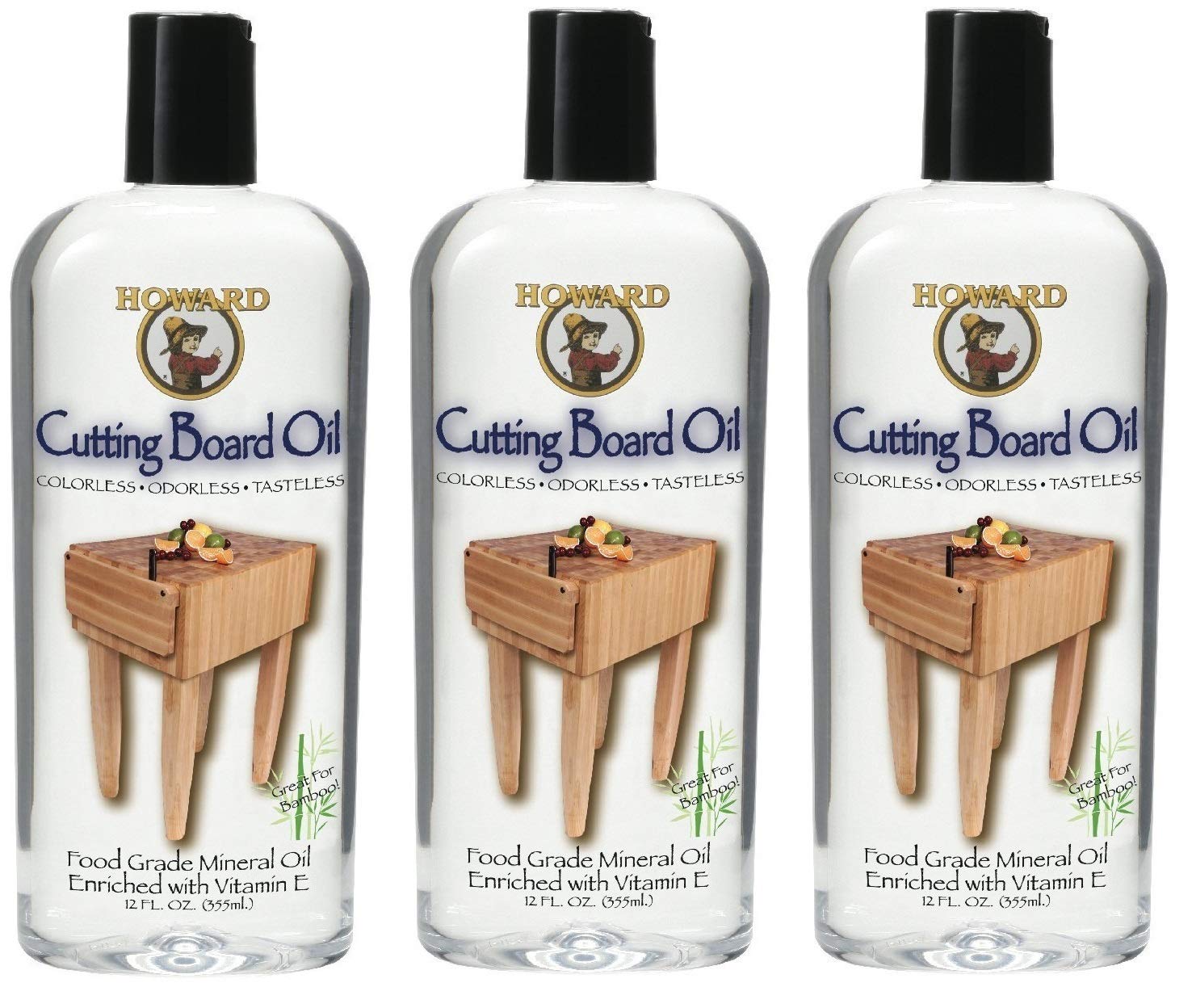
Howard Products BBB012 is a pure mineral oil enriched with Vitamin E, packaged as a 3-pack of 12-ounce bottles. This is not a stain in the traditional pigment sense — it is a colorless conditioner that hydrates the wood fibers, prevents drying and cracking, and resists rancidity. If you prefer the natural tone of your butcher block and want a simple maintenance routine, this is a straightforward, economical choice.
Mineral oil does not polymerize, so it never cures into a hard finish. Instead, it remains liquid in the wood pores, requiring periodic reapplication when the surface starts looking dry. Users report that a single bottle lasts for months on a daily-use cutting board because a little oil goes a long way when applied with a silicon brush. The 3-pack provides enough volume for multiple boards, utensils, and wooden bowls.
Because the oil is odorless and tasteless, it does not alter the sensory experience of food prep. The trade-off is minimal surface protection against water staining — you will need to dry the board immediately after washing. For users who want the lightest touch on their butcher block without any color shift, this kit delivers consistent results.
Why it’s great
- Colorless and odorless — maintains natural wood appearance
- Vitamin E enrichment helps prevent rancidity inside the bottle
- 3-pack offers excellent value for multi-board households
Good to know
- Does not polymerize; requires frequent reapplication as wood dries
- Offers minimal water resistance compared to tung or linseed oil
5. Epicurean Board Butter

Epicurean Board Butter is a proprietary blend of mineral oil and beeswax in a retro-style 4.5-ounce tin with a built-in sponge applicator. Unlike liquid oils, the butter-like consistency stays where you put it, making it ideal for vertical surfaces and detailed edges. The beeswax component adds a thin protective layer that helps maintain luster between deeper conditioning treatments.
Users report that it effectively hides minor scratches and scuffs on Epicurean brand boards and bamboo surfaces, though it does not fill deep bread-knife cuts. The included sponge is convenient for one-handed application, but some reviewers recommend wiping the top layer before each use to avoid bacteria transfer from the sponge back into the tin. It is 100% food-grade and leaves no odor or taste on prepared food.
The value proposition shifts depending on how many boards you maintain — a single tin lasts for years if you use it periodically. For owners of Epicurean composite boards or any sealed hardwood cutting surface, this is a quick-grab restore that works better than straight oil on surfaces that are not fully bare wood.
Why it’s great
- Butter-like consistency stays put on vertical surfaces
- Beeswax adds subtle luster and light surface protection
- Compact tin with sponge applicator is easy to store and use
Good to know
- Not a deep-penetrating stain; primarily a surface conditioner
- Sponge applicator may carry bacteria if not wiped before each use
FAQ
Can I use a standard furniture stain on a butcher block?
How often should I reapply a butcher block stain?
Will a dark stain hide existing scratches in my butcher block?
Final Thoughts: The Verdict
For most users, the stain for butcher block winner is the Real Milk Paint Dark Tung Oil because it delivers a genuine waterproof, food-safe finish with deep color that polymerizes into the wood. If you want a low-odor, clear satin sheen that maintains natural grain visibility, grab the Tried & True Danish Oil. And for a quick one-step color-and-protect solution on raw wood, nothing beats the Watco Butcher Block Oil + Stain.