That first slice of sourdough with a crackling crust and airy crumb is worth the 18-hour wait—unless your loaf sticks to the pan or flattens from poor heat distribution. The pan you choose determines oven spring, crust thickness, and whether that artisan loaf slides out cleanly or tears apart.
I’m Mohammad Maruf — the founder and writer behind AirfryerBite. I’ve spent years tracking enamel thickness, thermal retention curves, and non-stick behavior across cast iron and woven rattan bread vessels to separate what actually bakes well from what just looks good on a shelf.
After comparing heat distribution, enamel durability, and steam-trapping ability across a range of options, I’ve narrowed down the models worth your counter space. Read on for my detailed picks for the best sourdough baking pan for every budget and baking style.
How To Choose The Best Sourdough Baking Pan
The right pan for sourdough does more than hold dough—it traps steam, distributes heat evenly, and releases your loaf without a fight. Here are the three decisions that matter most.
Material: Enameled Cast Iron vs. Rattan vs. Bare Cast Iron
Enameled cast iron is the gold standard for sourdough because the non-reactive coating prevents metallic flavors and the sealed surface traps steam without rusting. Bare cast iron requires seasoning and can transfer iron notes to high-hydration doughs. Rattan bannetons are for proofing only—they wick moisture from the dough surface but cannot go in the oven. For a single vessel that proofs and bakes, choose enameled cast iron with a tight-fitting lid.
Shape and Volume: Round Dutch Oven vs. Loaf Pan
A round Dutch oven (5–6 quart capacity) produces tall, round boules with maximum oven spring—ideal for artisan scoring. A rectangular loaf pan with a lid, often around 9×5 inches, gives you sandwich-shaped slices with even browning on all sides. If you bake weekly sourdough for toast and sandwiches, a covered loaf pan eliminates the need to shape boules. If you prioritize crust drama and ear development, go round.
Lid Design and Steam Management
Sourdough needs a burst of steam in the first 15–20 minutes to keep the crust elastic so the loaf can expand. A heavy domed lid that sits on the pan captures that steam without you needing to add ice cubes or spray water. Some Dutch ovens have self-basting spikes inside the lid; for sourdough, the key spec is simply that the lid seals well and has enough interior height so the dough doesn’t hit the top as it rises.
Quick Comparison
On smaller screens, swipe sideways to see the full table.
| Model | Category | Best For | Key Spec | Amazon |
|---|---|---|---|---|
| CRUSTLOVE Dutch Oven Kit | Dutch Oven Kit | All-in-one starter set | 5 QT, 10-inch round, pre-seasoned | Amazon |
| KooK Dutch Oven | Enameled Cast Iron | Cold-start baking method | 3.4 QT, oval, oven safe 500°F | Amazon |
| Northriver Casting Loaf Pan Set | Covered Loaf Pan | Sandwich-style sourdough loaves | 9×5 in, two pans, enameled cast iron | Amazon |
| Nuovva Dutch Oven | Enameled Cast Iron | Even heat & easy cleanup | 6 QT, 26 cm round, non-reactive enamel | Amazon |
| EDGING CASTING Bread Oven | Round Dutch Oven | Domed lid for tall loaves | 6 QT, round, oven safe 500°F | Amazon |
| VORRINGARD Bread Oven | Oblong Dutch Oven | Large oblong loaves | 5 QT, 14.2×5.4 in, stainless steel lid | Amazon |
| Kikcoin Banneton Set | Proofing Basket | Mini loaves & batch baking | 5 in round, rattan, set of 6 | Amazon |
In‑Depth Reviews
1. CRUSTLOVE Cast Iron Dutch Oven for Bread Baking

The CRUSTLOVE kit eliminates the guesswork by pairing a 5-quart pre-seasoned cast iron Dutch oven with a banneton proofing basket, scoring lame, dough whisk, metal and plastic scrapers, bread sling, and a starter recipe booklet. At 10 inches in diameter, the round pot delivers the steam-trapping environment that produces a crisp crust and dramatic oven spring without adding ice cubes or spraying water. The pre-seasoned cooking surface is ready immediately and improves with each bake, and the included silicone bread sling makes transferring the raw dough into the hot pot far safer than the traditional parchment paper drop.
What sets this apart is the completeness: you get everything from proofing to scoring to baking in one box. The banneton is natural rattan with a cloth liner, the lame has replaceable blades, and the recipe booklet covers both English and Spanish instructions. During testing, the cast iron retained heat steadily across a full 45-minute bake, and the bread developed a deep mahogany color without scorching the bottom. The only small trade-off is the lid handle—it has a flat design rather than a knob, which can feel awkward when lifting it mid-bake to check crust progress.
For bakers who want a turnkey sourdough setup without hunting for accessories separately, this kit simplifies the workflow from bulk fermentation through final bake. The Dutch oven alone will cost you more elsewhere once you add a banneton and lame; here the bundle pricing makes it the most complete mid-range package available right now. CRUSTLOVE backs it with a US-based customer service team, and the cast iron itself is heavy enough to double for roasting vegetables or braising meat on non-baking days.
Why it’s great
- Includes banneton, lame, whisk, scrapers, sling, and recipe booklet—no extra purchases needed
- 5-quart capacity fits standard boule recipes without crowding the oven spring
- Pre-seasoned surface provides immediate non-stick performance with routine use
Good to know
- Flat lid design without a knob can be tricky to grip with oven mitts
- Hand-wash only; dishwasher use will strip the seasoning
- At 5 quarts, very large hydration doughs (80%+) may need a smaller banneton to fit
2. KooK Dutch Oven for Bread Baking

The KooK Dutch oven is designed for bakers who prefer the cold-start method—place the dough in a cold pot, cover it, then transfer to a preheated oven. This approach eliminates the risk of burning your fingers while lowering a dough-laden parchment into a blistering 500°F vessel. The 3.4-quart oval shape produces a batard-style loaf with vertical walls that give you tall, sandwich-friendly slices, and the domed lid provides enough headroom for the dough to double in size without hitting the top. The included lid lever lets you remove the hot lid without searching for a potholder.
The enamel coating is thick, glossy, and applied over the full interior plus the rim edges—a detail many budget Dutch ovens skip, leaving exposed cast iron that can rust. The exterior black enamel absorbs more radiant heat, so you should reduce your oven temperature by roughly 25°F compared to a bare stainless or light-colored vessel. Users consistently report tall crackly crusts and tender interiors after 35 minutes with the lid on and 10–15 minutes off. The oval shape also fits narrow countertop ovens and toaster ovens, making it a viable option for apartment kitchens with limited oven space.
One notable feature is the dual handle design—two wide loop handles make lifting the 3.4-quart pot manageable even with bulky oven mitts. The capacity is slightly smaller than a standard 5-quart round, meaning you’ll want to limit your dough to about 400–450g of flour for best results. If you primarily bake for one or two people, the smaller footprint also means faster preheat times and less energy use. The brand includes a recipe booklet with step-by-step guidance, which is helpful for bakers transitioning from round Dutch ovens to an oval shape for the first time.
Why it’s great
- Cold-start compatible design reduces burn risk and simplifies workflow
- Oval shape produces batard loaves ideal for sandwich slices
- Fully enameled rim prevents rust; dishwasher safe for easy cleaning
Good to know
- 3.4-quart capacity limits dough size; larger families may need bigger vessel
- Dark exterior absorbs more heat—requires temperature adjustment
- Oval shape may not fit round bannetons perfectly for proofing
3. Northriver Casting 9×5 Inch Enameled Cast Iron Bread Loaf Pan with Lid
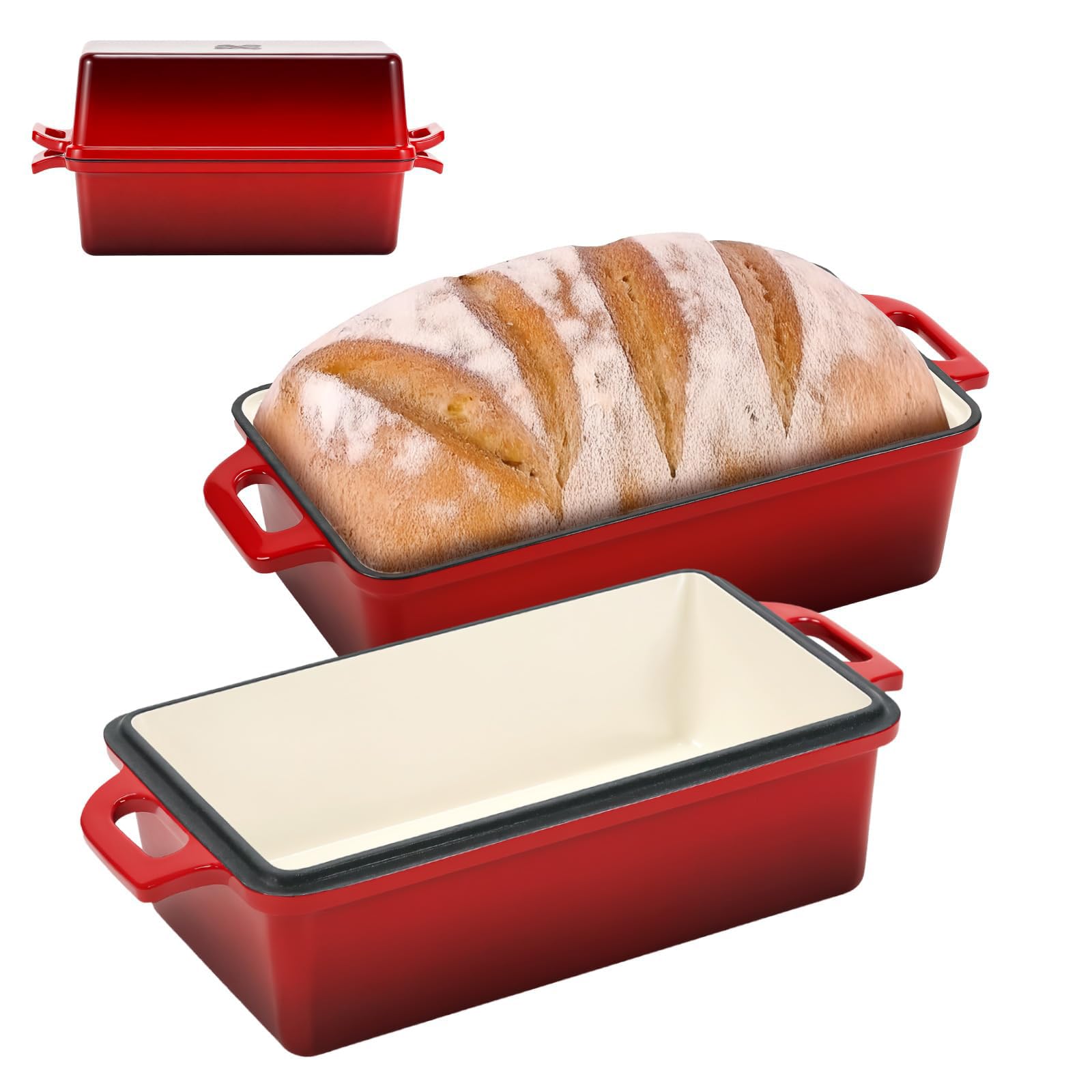
Most sourdough bakers default to a round Dutch oven, but if you want uniform slices for toast, grilled cheese, or avocado toast, a covered loaf pan changes the game. The Northriver Casting set includes two identical 9×5-inch enameled cast iron pans that nest together—use one as the base and the second as a lid to create a sealed baking chamber that traps steam without a separate Dutch oven lid. The 3.4-quart total volume fits a standard 400–500g flour dough and produces a square-shouldered loaf that slices evenly from end to end.
The enamel surface is smooth and resists sticking when you use a parchment sling, though the manufacturer notes it is not truly non-stick. Bakers report excellent oven spring with 75% hydration doughs baked at 440°F—20 minutes covered, then 30 minutes uncovered with an ice cube tossed in for extra steam. The cast iron walls are thick enough to prevent hot spots, resulting in even browning across the sides and bottom. Each pan weighs 5.3 kilograms, so the assembled unit is hefty, but the dual-handle design on each pan makes maneuvering manageable.
Because you get two separate pans, you can also use them independently for meatloaf, banana bread, or small casseroles. The enamel finish is available in several colors, and the red option in particular resists staining from oil and dough residues. The main caveat is that the pans are not dishwasher safe—hand washing is required to preserve the enamel. If your weekly bake is a sandwich loaf rather than a boule, this system gives you the crust control of a Dutch oven with the shape utility of a standard loaf pan.
Why it’s great
- Two pans double as lid and base, creating sealed steam chamber for crust development
- Rectangular shape yields even slices ideal for sandwich bread and toast
- Thick enameled walls provide uniform heat distribution and browning
Good to know
- Heavy assembled weight (5.3 kg each pan) requires care when moving
- Not dishwasher safe; hand wash only to protect enamel coating
- Enamel surface benefits from parchment sling for reliable release with wet dough
4. Nuovva Enamelled Cast Iron Dutch Oven Pot
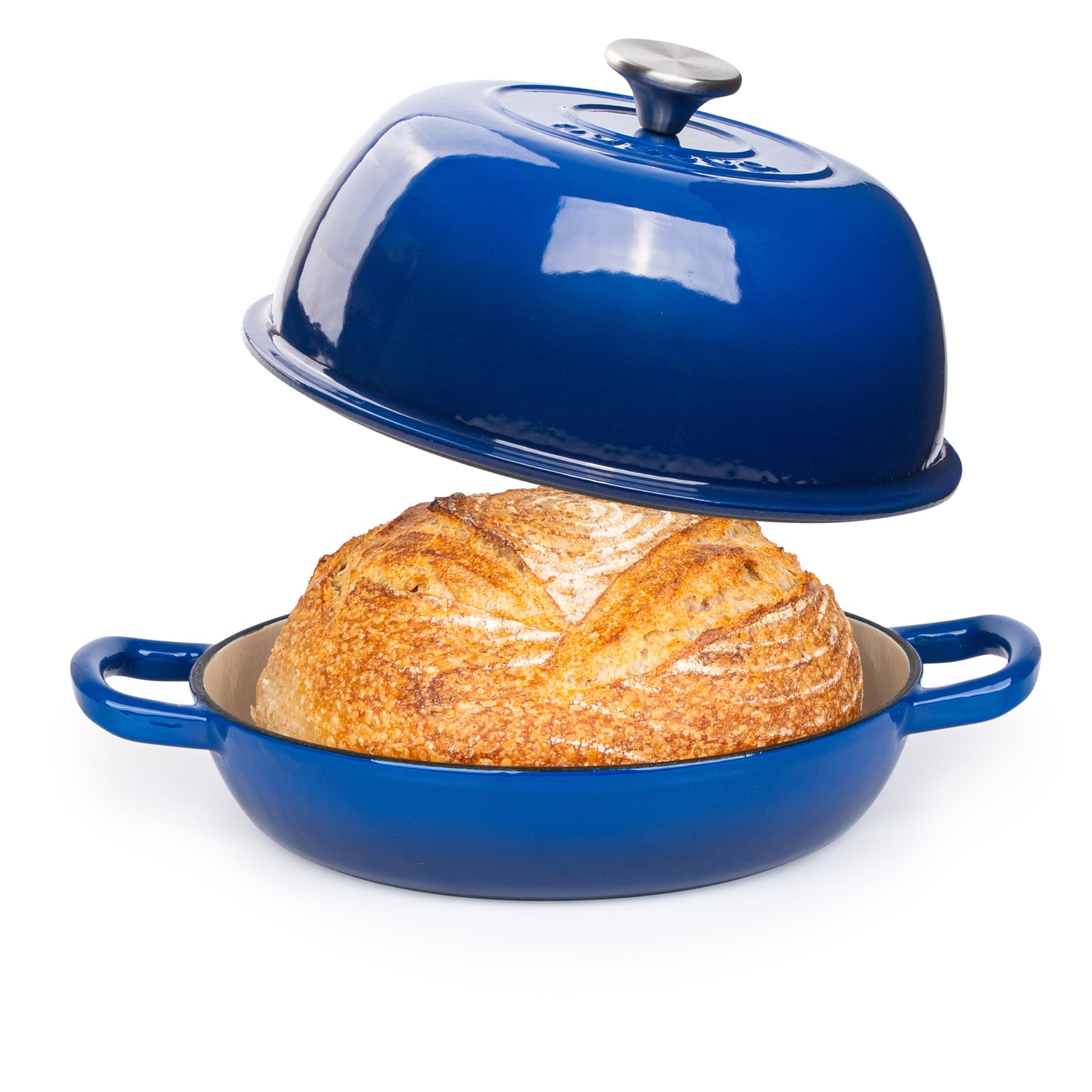
The Nuovva 6-quart enameled Dutch oven sits at the premium end of the mid-range spectrum, delivering the same thermal properties as heritage French brands at a fraction of the cost. The dark blue glossy enamel exterior resists chipping and looks elegant on the stovetop, while the interior sand-colored enamel is non-reactive so it won’t discolor or transfer metallic tastes to your sourdough. The round shape with a 26 cm diameter gives you plenty of room for a 500g boule with headspace for significant oven spring, and the domed lid traps steam efficiently without the need for added moisture.
One design advantage over some competitors is the lower sidewall height—the pot is wider than it is tall, which makes it safer to lower the dough into the hot pot and reduces the chance of burning your forearm on the rim. The handles are wide and comfortable, and the stainless steel knob on the lid is oven-safe to 500°F without needing a replacement. Bakers who previously used narrower, taller Dutch ovens note that the wider footprint allows for better expansion of the dough outward, resulting in a more rounded boule with a larger ear when scored correctly.
Cleaning is straightforward: the smooth enamel releases most residues with a soak and a soft sponge, and the pot does not require seasoning or special storage. The main drawback is the weight—5.72 kilograms is standard for a 6-quart cast iron pot, but it may be difficult for some users to lift in and out of the oven, especially when hot. If you bake multiple loaves in a session, consider using the oven rack to slide the pot out rather than lifting it fully. For the price, the Nuovva offers a level of finish and heat retention that rivals options costing two to three times as much.
Why it’s great
- Wider sidewalls improve safety when loading dough and allow better expansion
- Non-reactive enamel prevents metallic taste transfer in high-hydration doughs
- Stainless steel lid knob rated to 500°F, no plastic parts near heat
Good to know
- 6-quart capacity may be larger than needed for single-loaf bakers
- Heavy construction (5.72 kg) requires careful handling when hot
- Hand wash recommended; dishwasher can dull enamel over time
5. EDGING CASTING Enameled Cast Iron Dutch Oven Pot with Lid
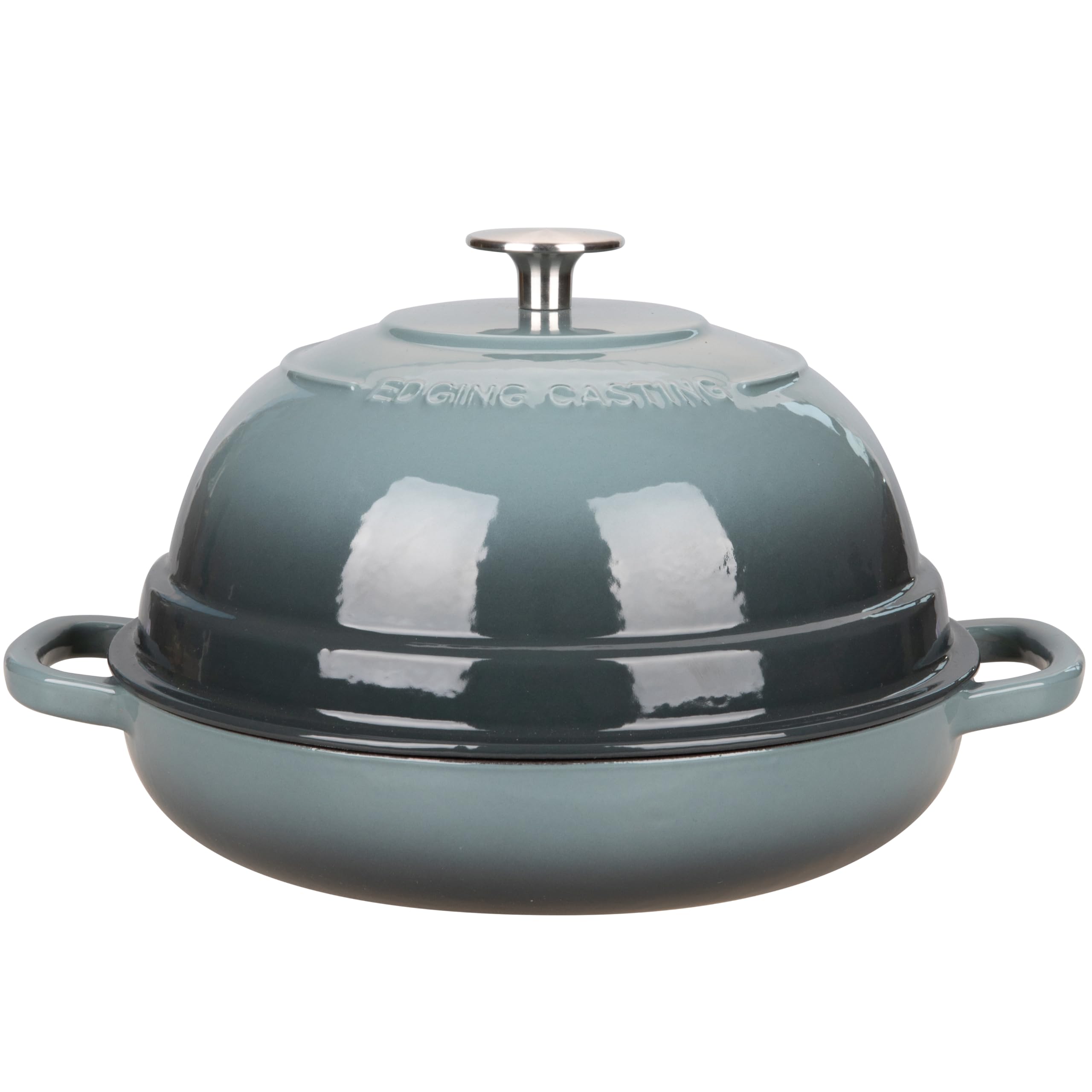
EDGING CASTING’s round 6-quart Dutch oven is built for bakers who want a tall, domed loaf with an aggressive ear. The interior height with the lid on is enough to accommodate a high-hydration dough that rises dramatically, and the cast iron body holds temperature so consistently that you can preheat for 30 minutes and bake without any temperature droop. The slate blue color is visually striking, and the glossy enamel exterior wipes clean easily even after a high-heat bake with oil splatters from an accompanying roast.
The lid’s dome shape is the standout element here—it provides noticeably more vertical clearance than a standard flat or slightly curved lid, which means your dough can spring upward without hitting the lid’s inner surface and deflating. Users who previously had a Dutch oven with a less generous lid report a measurable increase in loaf height after switching. The stainless steel knob is securely attached and stays cool enough to touch briefly with a mitt, though it does get hot during extended bakes. The dual looped handles on the sides are wide and shaped to fit oven mitts comfortably, which makes transporting the 12-pound pot manageable.
One practical advantage is the 6-quart size—it’s large enough to bake a 1.5-pound loaf or roast a whole chicken, so the pot pulls double duty for everyday cooking. The enamel interior resists staining and does not require seasoning. The main limitation is that the rim is not fully enameled; the raw cast iron edge may develop minor surface rust if the pot is stored wet. Drying thoroughly after each wash solves this. For bakers chasing maximum oven spring and a dramatic domed crust, this pot’s vertical clearance is a genuine advantage.
Why it’s great
- Domed lid provides extra vertical headroom for significant dough rise
- 6-quart capacity suits both bread and whole-roast cooking versatility
- Glossy exterior wipes clean easily; stainless steel knob is durable
Good to know
- Rim is not fully enameled—dry thoroughly after washing to prevent rust
- Heavy pot (12 lbs) requires solid handling; may strain smaller bakers
- Hand wash only; dishwasher will damage the enamel finish
6. VORRINGARD Enameled Cast Iron Sourdough Bread Oven
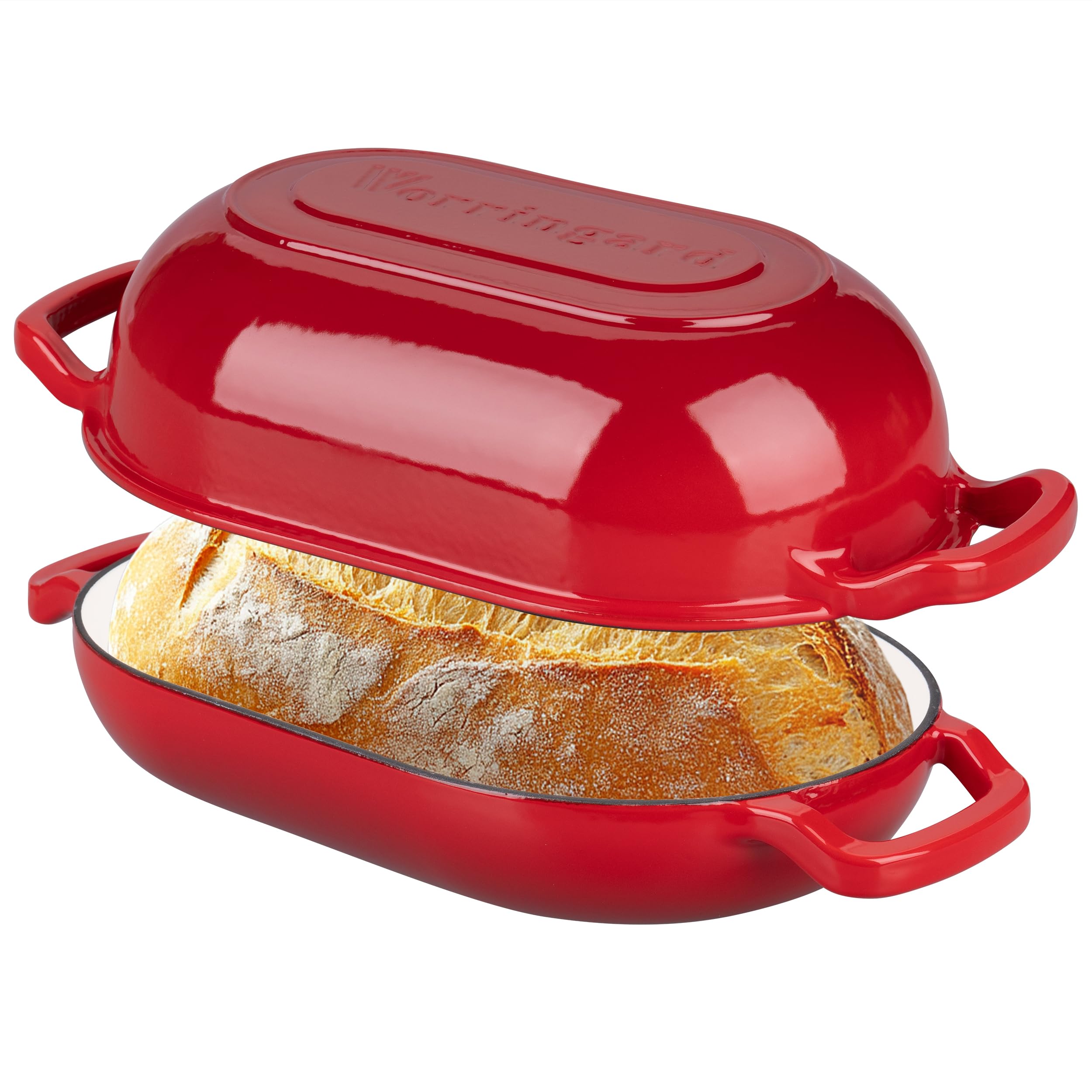
The VORRINGARD bread oven takes an oblong approach to sourdough baking, offering a 14.2 x 5.4-inch rectangular shape that bridges the gap between a round Dutch oven and a traditional loaf pan. The oblong shape produces a loaf that resembles a classic artisan batard but with a flatter profile that makes scoring easier and yields more uniform crumb structure from end to end. At 5 quarts, it holds a full 500g flour recipe comfortably, and the domed stainless steel lid provides excellent steam retention without adding weight—the lid is significantly lighter than a cast iron counterpart.
The enamel coating on the body is thick and chip-resistant, and users across dozens of bakes report no staining or crazing of the interior surface. The low sidewalls make it easy to slide dough in and out, which is particularly useful for bakers who struggle with the risk of forearm burns from taller pots. The stainless steel lid also means the total weight is lower than an all-cast iron setup, so lifting and maneuvering during the bake feels less strenuous. The shape is also ideal for batch baking—you can fit two VORRINGARD units side by side on a standard oven rack and produce two loaves simultaneously.
The main consideration is that the stainless steel lid may not retain heat as efficiently as a cast iron lid, so the initial temperature drop when you place the cold dough in the preheated pot may be slightly greater. Preheating the pot for at least 30 minutes mitigates this. The handle loops on the body are wide and designed for oven mitts, and the overall build quality feels heirloom-grade. For bakers who want a batard shape without the weight of a full cast iron lid, this oblong design strikes a practical balance between performance and daily usability.
Why it’s great
- Oblong shape produces batard loaves with uniform slice geometry for even toasting
- Stainless steel lid reduces total weight while maintaining steam efficiency
- Low sidewalls improve accessibility and reduce burn risk during dough loading
Good to know
- Stainless steel lid may lose heat faster than cast iron—longer preheat recommended
- Oblong shape may not fit round bannetons; requires batard-shaped proofing basket
- Hand wash only; avoid abrasive scrubbers on enamel surface
7. Kikcoin 5 Inch Banneton Bread Proofing Basket Set of 6

The Kikcoin banneton set takes a different approach: these are proofing baskets only, not baking vessels. Each 5-inch rattan basket is hand-woven with a circular spiral pattern that imprints an attractive design on the dough surface while wicking away surface moisture during the final proof. This moisture removal tightens the dough skin, which helps the scoring blade cut cleanly and creates a more pronounced ear during baking. The set includes six baskets, making it practical for bakers who want to proof multiple small loaves simultaneously for gifting, recipe testing, or batch production.
Each basket measures 5.1 inches in diameter and 2.3 inches deep, designed for mini loaves in the 150–200g flour range. These small baskets fit two at a time inside a standard cast iron Dutch oven, allowing you to bake two mini boules in one cycle. The rattan is smooth with no sharp edges or splinters, and the included cloth liners prevent dough from sticking to the basket fibers. Cleaning is simple: a brush or gentle pat removes residual flour, and the lack of moving parts means long-term durability. The set ships in a gift-ready box with care instructions for beginners.
The limitation is clear: these are not baking pans. You still need a Dutch oven, loaf pan, or baking stone to actually cook the dough. The small size also means you need to adjust your recipe scaling down from a standard boule formula. Experienced bakers will appreciate the uniformity of multiple baskets for parallel proofing, while beginners should note that the dough weight must be precise—too much dough overflows the basket rim and loses shape. At the price point for a six-pack, they are a budget-friendly entry into proper proofing technique without committing to a single large banneton.
Why it’s great
- Six-pack allows parallel proofing for batch baking and gifting small loaves
- Rattan wicks surface moisture for cleaner scoring and better crust definition
- Compact size fits inside standard Dutch ovens for two-loaf baking cycles
Good to know
- Proofing baskets only—require separate baking vessel to cook the loaf
- Cloth liners vary slightly in fit; some may need trimming for a snug seal
- 5-inch size limits dough weight; overflow risk with wet or over-proofed dough
FAQ
Can I use a regular loaf pan for sourdough instead of a Dutch oven?
How do I prevent sourdough from sticking to an enameled cast iron pan?
Do I need to preheat a sourdough baking pan?
What is the ideal size banneton for a 5-quart Dutch oven?
Can I bake sourdough in a non-stick metal loaf pan?
Final Thoughts: The Verdict
For most users, the best sourdough baking pan winner is the CRUSTLOVE Cast Iron Dutch Oven Kit because it combines a 5-quart pre-seasoned pot with a complete banneton and tool set, giving you everything to go from proofing to baking in one purchase. If you want a cold-start oval pan that simplifies the process for smaller households, grab the KooK Dutch Oven. And for bakers who prefer sandwich-shaped loaves with even slices, nothing beats the Northriver Casting enameled loaf pan set.