A bag of generic topsoil from the hardware store is the fastest way to watch your tomato seedlings turn yellow and your pepper plants refuse to fruit. Container vegetables live in a confined, artificial environment where drainage, aeration, and nutrient density matter more than they ever will in an open garden bed. The wrong mix compacts into a brick within weeks, suffocating roots and trapping water until rot sets in.
I’m Mohammad Maruf — the founder and writer behind AirfryerBite. I have spent hundreds of hours analyzing potting mix particle sizes, organic certifications, and moisture retention curves to help container gardeners avoid the most common soil failures.
After testing formulations ranging from sphagnum peat blends to coco coir bricks, I have narrowed the field to a handful of mixes that consistently deliver strong root development, balanced pH, and steady drainage. This guide is built to steer you toward the best soil for container vegetables that fits your pot volume, watering habits, and plant type without guesswork.
How To Choose The Best Soil For Container Vegetables
The wrong mix fails silently — roots drown, nutrients leach out, and growth stalls. Choose with the right criteria and your container garden becomes a self-sustaining system.
Look for Lightweight Aeration Ingredients
Container soil must contain perlite, vermiculite, or coarse sand to create air pockets. Without these, the mix settles into a dense sludge that blocks oxygen from reaching the root zone. A quick test: squeeze a handful of moistened mix — it should crumble, not form a hard clump.
Match the Base to Your Watering Habits
Peat moss holds water well but becomes hydrophobic when dry. Coco coir rehydrates faster and is more sustainable, but offers fewer nutrients on its own. Blended formulas combine both for balanced moisture control. If you tend to underwater, lean toward a peat-heavy blend; if you overwater, choose a coir-based mix with extra perlite.
Check for Added Fertilizer and Organic Certification
Container vegetables need a steady nutrient supply because frequent watering flushes out minerals. A mix with starter fertilizer or earthworm castings feeds plants for the first few weeks. OMRI-listed organic products avoid synthetic chemicals that can build up in pots and harm beneficial soil microbes.
Quick Comparison
On smaller screens, swipe sideways to see the full table.
| Model | Category | Best For | Key Spec | Amazon |
|---|---|---|---|---|
| Coast of Maine Organic Planting Soil | Organic Blend | Heirloom tomatoes & heavy feeders | 20 Qt volume with composted manure | Amazon |
| Espoma Organic Potting Mix | Indoor/Outdoor | Small containers & herbs | 8 Qt bag (pack of 2) with Myco-Tone | Amazon |
| Midwest Hearth Premium Potting Soil | Professional Grade | Seed starting & propagation | 8 Dry Quarts with pH control | Amazon |
| MODELLOR Coco Coir Brick | Expanding Brick | Large volume & custom mixes | 10 lb brick expands to 72–80 Qt | Amazon |
| Michigan Peat All Purpose Potting Soil | Budget Bulk | Large planters & raised beds | 50 lb bulk with slow-release fertilizer | Amazon |
In‑Depth Reviews
1. Coast of Maine Organic & Natural Planting Soil

The Coast of Maine Organic Planting Soil is the most effective ready-to-use mix I have seen for container vegetables that demand high nutrition and consistent drainage. Its composted manure base delivers a slow-release nitrogen kick that heirloom tomatoes and peppers respond to immediately — visible growth acceleration within the first week. The sphagnum peat moss provides enough water retention to reduce watering frequency in 12-inch pots without creating a soggy root zone.
OMRI certification confirms the absence of synthetic additives, which matters for edible crops where chemical buildup in confined containers can be absorbed by the plant. The 20-quart bag fills two 10-inch pots or one large planter box, making it a practical middle ground between small bags and bulk sacks. Customers consistently report strong stem development and deep green foliage even in pots that receive partial shade.
One recurring observation is the presence of small wood fragments in the mix. These are part of the compost process and help with aeration, but some users find them distracting. Additionally, the price per quart sits slightly above general purpose blends, though the nutrient density reduces the need for early-season fertilization. For a grower who wants a single-bag solution that works from transplant through harvest, this is the strongest candidate.
Why it’s great
- Composted manure provides rich, sustained nutrition for heavy-feeding vegetables
- Excellent moisture retention without waterlogging even in deep pots
- OMRI-listed organic — safe for edible container crops
Good to know
- Contains small wood bits that some users consider debris
- Premium cost per quart compared to standard potting mixes
2. Espoma Organic Potting Mix (Pack of 2)

Espoma’s Organic Potting Mix distinguishes itself through a dense inclusion of endo and ecto mycorrhizae — beneficial fungi that form a symbiotic relationship with plant roots, effectively increasing the root surface area for water and mineral absorption. In a container environment where root space is limited, this biological boost gives vegetables like basil, lettuce, and compact pepper varieties a measurable advantage in nutrient uptake. The blend of sphagnum peat moss, humus, perlite, earthworm castings, and kelp meal creates a biologically active medium right out of the bag.
This mix is sold as a two-pack of 8-quart bags, which is ideal for growers managing multiple 6-to-8-inch pots or a single medium planter. The texture is noticeably light and fluffy, promoting rapid root penetration during transplanting. Users report that herbs especially — basil, cilantro, and mint — show vigorous new growth within days of potting. The alfalfa and feather meal components provide a gentle nitrogen release that avoids the burn risk associated with synthetic fertilizers in confined containers.
The primary limitation is dry rehydration. Several users note that if the bag sits open or the mix dries out completely, it becomes hydrophobic and resists water absorption initially. Pre-moistening the soil before planting or using a wetting agent solves this. The per-bag volume is modest — for large containers exceeding 14 inches, you will need multiple packs. For small-space container gardening where root health and organic purity are the priority, this is a top-tier choice.
Why it’s great
- Myco-Tone mycorrhizae significantly boost root development in confined pots
- Rich organic ingredients — castings, kelp, and feather meal — feed plants naturally
- Light, fluffy texture allows easy root expansion and prevents compaction
Good to know
- Can become hydrophobic if allowed to dry out completely
- 8-quart bags are small; large containers require multiple units
3. Midwest Hearth Premium Potting Soil Mix

Midwest Hearth’s Premium Potting Soil Mix is a no-nonsense formulation built around an exact blend of sphagnum peat moss, perlite, and vermiculite — three ingredients that form the gold standard for aeration and moisture control in container environments. The peat moss holds water against gravity while the perlite and vermiculite create structural air pockets, preventing the anaerobic conditions that cause root rot in pots without drainage holes. The pH is pre-balanced to a neutral range suitable for nearly all common container vegetables.
This mix arrives ready to use with no additional wetting or screening required. The bag is resealable, which preserves moisture between uses — a small but meaningful feature for occasional planters who do not use the full 8-quart volume at once. Customers report excellent results when using it as a seed-starting medium for petunias, tomatoes, and peppers, with high germination rates and minimal damping-off disease. The absence of weed seeds and fungus gnats is a consistent positive note in user feedback.
The 8-quart size is best suited for small to medium containers and indoor gardening. For large outdoor planters or raised beds, you will need multiple bags. Some users find the price per quart higher than bulk alternatives, though the controlled ingredient quality justifies the premium for high-value crops. The resealable packaging and predictable texture make this a reliable everyday workhorse for the home container gardener who values consistency over volume.
Why it’s great
- Precise peat-perlite-vermiculite ratio ensures optimal aeration and drainage
- pH balanced for broad vegetable compatibility from seed to harvest
- Resealable bag keeps unused mix fresh and ready
Good to know
- 8-quart bag is small — large planters require multiple purchases
- Higher cost per quart than some bulk blends
4. MODELLOR Premium Coco Coir Brick
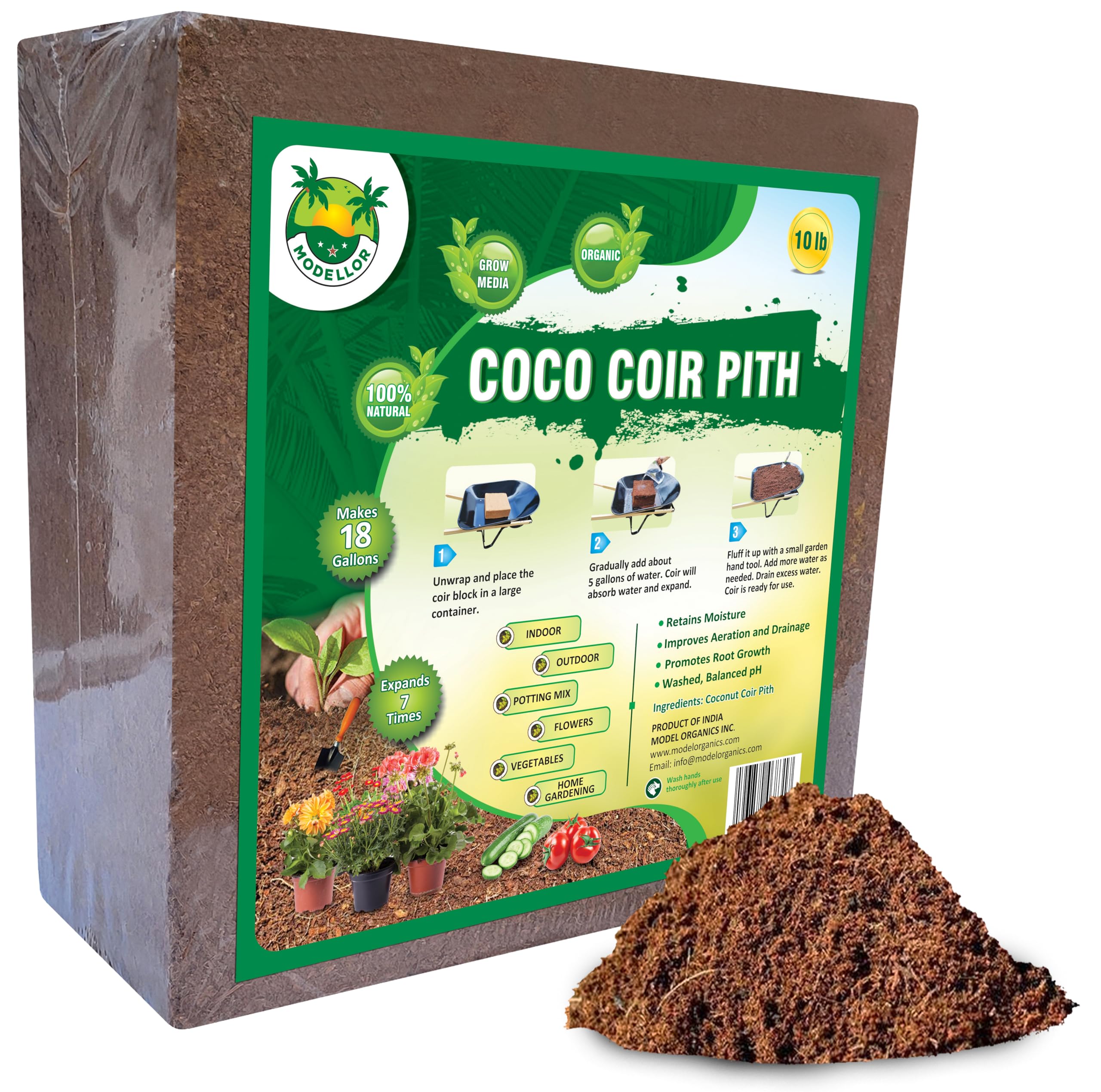
The MODELLOR Coco Coir Brick solves one of the biggest frustrations in container gardening: storage and cost efficiency of bulk soil. A single 10-pound brick expands to between 72 and 80 quarts of growing medium when hydrated, which is the volumetric equivalent of roughly four to five standard 20-quart bags of pre-mixed soil. For anyone managing a balcony full of 10-inch pots or a row of fabric grow bags, this dramatically reduces both shelf space and per-gallon cost.
The coir is triple-washed to reduce salt content — a critical detail because residual salts from unwashed coir can stunt vegetable growth, especially in seedlings. The fluffy, fibrous texture it expands into provides superior root aeration compared to peat alone, and it rehydrates instantly even after the brick has been stored for months. A half-brick fills a standard wheelbarrow with a light, airy medium that supports deep root penetration for crops like indeterminate tomatoes and climbing beans.
Because coco coir is inherently low in nutrients, it works best when mixed with compost, worm castings, or a slow-release organic fertilizer. Using it as a straight medium without amendments will lead to nutrient deficiency in fast-growing vegetables within three weeks. The expansion process requires a large bucket or tub and a bit of patience — but the volume yield is unmatched. For the serious container gardener who wants to control their own nutrient mix, this is the most versatile base available.
Why it’s great
- Massive volume yield — one brick equals 72–80 quarts of growing medium
- Triple-washed and low-salt — safe for sensitive seedlings and edible crops
- Superior rehydration and aeration compared to peat-only mixes
Good to know
- Coco coir is nutrient-free — must be amended with compost or fertilizer
- Hydration requires a large container and some manual mixing effort
5. Michigan Peat General All Purpose Premium Potting Soil

The Michigan Peat General All Purpose Potting Soil is a bulk workhorse designed for container gardeners who need volume without complexity. At 50 pounds, it fills multiple large planters or a sizable raised bed in one purchase, and it is pre-blended with perlite and sand so no additional mixing is required before use. The inclusion of both starter and slow-release fertilizers means the soil feeds transplants for several weeks, reducing the need for immediate liquid feeding.
The base material is rich reed sedge peat, which differs from the more common sphagnum peat. Reed sedge peat has a darker appearance and a finer texture, giving the mix a denser feel than lightweight professional blends. For deep-rooted vegetables like carrots, potatoes, or beets grown in tall containers, this density provides enough structural support to prevent toppling, though it requires careful watering to avoid compaction over time.
Several users report the presence of fungus gnats emerging from the bag after opening, which is a known risk with sedge peat-based products that have not been heat-treated. Pre-treating the soil by baking it at low heat or using a layer of sand on top of the pot can suppress gnat populations. For the budget-conscious gardener filling a large winter garden or bulk container setup, this delivers workable medium at a low per-pound cost, with the understanding that a little extra vigilance is needed for pest management.
Why it’s great
- 50-pound bag offers the best per-pound value for large-scale container gardening
- Pre-blended with perlite, sand, and fertilizers — ready straight from the bag
- Dense reed sedge peat provides good structural support for deep-rooted vegetables
Good to know
- Fungus gnats can emerge from the bag; pre-treatment recommended
- Denser texture requires careful watering to avoid compaction in long-season pots
FAQ
Can I use regular garden soil from my yard for container vegetables?
How often should I replace the soil in my vegetable containers?
What is the ideal pH for container vegetable soil?
Do I need to add fertilizer to pre-mixed potting soil?
Final Thoughts: The Verdict
For most users, the soil for container vegetables winner is the Coast of Maine Organic & Natural Planting Soil because it delivers a perfect balance of organic nutrients, excellent drainage, and OMRI certification in a 20-quart bag that suits typical home container setups. If you want a biologically active mix with mycorrhizae for stronger roots in small pots, grab the Espoma Organic Potting Mix. And for large-scale container gardening where volume and cost efficiency matter most, nothing beats the MODELLOR Coco Coir Brick as a base for custom blends.