Walking into your kitchen at 7 a.m. with a bag of frozen berries and a half-eaten banana shouldn’t feel like a negotiation with a hunk of plastic and metal. The difference between a smoothie that tastes like a chalky milkshake and one that genuinely feels like a 10-second vacation is almost never about the recipe — it’s about the blade geometry and motor torque hiding inside the base. Vague marketing copy won’t tell you whether the coupling will snap after three months of kale-and-ice abuse; knowing exactly how the 304 stainless steel stacked blade assembly interacts with a 1,000-watt motor will.
I’m Mohammad Maruf — the founder and writer behind AirfryerBite. I’ve spent years dissecting small-kitchen appliance spec sheets from the inside out, running side-by-side comparisons of wattage, blade design, container materials, and extraction ratios to separate genuine engineering from rebranded OEM shells.
This buying guide narrows a crowded field down to the seven most capable contenders on the market, each tested against the criteria that actually matter for daily use. Whether you are looking for a quick morning shake or a full-family pitcher, here is the definitive look at the best smoothie maker for your countertop and your routine.
How To Choose The Best Smoothie Maker
A smoothie maker is a simple machine — motor, blade, container — yet the choices around each component determine whether you get a creamy texture or a chunky mess. Focus on these four factors before you hit “add to cart.”
Motor Wattage and Torque Consistency
Wattage is the headline number, but the motor’s ability to maintain torque under load is what separates a machine that pulverizes frozen strawberries from one that stalls mid-cycle. Entry-level models hover around 600 watts and handle soft fruit and protein powder well, but ice and frozen bananas demand at least 800 watts for repeatable consistency. Premium models push past 1,100 watts, and the high-end units use all-copper windings that generate less heat during extended runs, preventing the thermal shutdown that cheaper motors trigger after 60 seconds of heavy blending.
Blade Design and Material Quality
Most budget smoothie makers rely on a four-leaf stainless steel blade; mid-range and premium units step up to a six-leaf or stacked assembly that creates multiple vortex zones inside the cup. The blade material matters too — 304 stainless steel resists corrosion from acidic fruit (pineapple, citrus, berries) far better than lower-grade alloys. A detachable blade assembly, found on several modern models, makes cleaning and eventual replacement significantly easier than a permanently sealed unit.
Container Capacity and Cup Versatility
Your household size dictates the ideal container setup. A single 24-ounce cup works for one daily shake but forces you to wash and reuse if you need a second serving later in the day. Multi-cup systems — common in mid-range kits — include a large pitcher (48 to 72 ounces) for batch prep plus two or three smaller to-go cups for mornings when you are running out the door. Pay attention to the cup material: BPA-free Tritan is shatter-resistant and doesn’t absorb odors, while standard polycarbonate can yellow over time.
Ease of Cleaning and Assembly
The best smoothie maker is the one you actually wash after every use. Models with removable blade assemblies let you rinse the blade hub and cup separately without food getting trapped in crevices. Dishwasher-safe parts (top rack) cut cleanup time to zero. Look for wide-mouth cups that accept a standard bottle brush — narrow cups with internal ridges, though visually appealing, can trap pulp and require a dedicated cleaning tool.
Quick Comparison
On smaller screens, swipe sideways to see the full table.
| Model | Category | Best For | Key Spec | Amazon |
|---|---|---|---|---|
| Ninja BL660 | Premium | Family batch prep & single-serve | 1,100W motor, 72-oz pitcher + two 16-oz cups | Amazon |
| Chefman Obliterator | Premium | Auto-blend convenience | 1,380W motor, 48-oz Tritan jar | Amazon |
| Ninja BL610 | Mid-Range | Large pitcher for families | 1,000W motor, 72-oz Total Crushing pitcher | Amazon |
| Beast Mini Plus | Premium | Compact countertop blending | 600W motor, 4.13″ footprint, 3 vessels | Amazon |
| Nutribullet 600W | Mid-Range | Reliable daily single servings | 600W motor, 24-oz cup, one-touch blend | Amazon |
| Sangcon 1000W | Budget-Friendly | Multi-cup versatility on a budget | 1,000W motor, 3 cups (24, 17, 10 oz) | Amazon |
| KOIOS 1000W | Budget-Friendly | All-in-one blending & grinding | 1,000W motor, 22-oz cups + 11-oz grinder | Amazon |
In‑Depth Reviews
1. Ninja BL660 Professional Compact Smoothie & Food Processing Blender

The Ninja BL660 is the Swiss Army knife of countertop blending — an 1,100-watt motor driving Total Crushing blades that reduce ice to snow in seconds, paired with a 72-ounce pitcher that handles weekend batch prep and two 16-ounce to-go cups for weekday mornings. The stacked blade design creates a vortex that pulls frozen fruit and greens downward, eliminating the jam-and-stall cycle that frustrates users of lower-wattage machines.
You get three manual speeds plus a pulse function, but the real differentiator is the dedicated single-serve function that runs the Pro Extractor Blades at optimal RPM for individual cups. The pitcher has a 64-ounce max liquid capacity, which means you can fill it with three pounds of frozen fruit plus liquid without stressing the motor.
The single real drawback is noise; at full power, the BL660 is loud enough that you will hear it across the house. That is the trade-off for a motor that doesn’t quit, and for most buyers the longevity and versatility more than compensate. It replaces both a full-size blender and a food processor, making it the most complete package in this comparison.
Why it’s great
- Three blending vessels (pitcher + two single-serve cups) cover all use cases
- Total Crushing Blades pulverize ice and frozen fruit without stalling
- Dishwasher-safe, BPA-free parts with a proven decade-plus lifespan
Good to know
- Loud enough at high speed to disturb early-morning household members
- Pitcher max liquid capacity is 64 oz, not the full 72-oz advertised volume
2. Chefman Obliterator 48 oz Countertop Blender
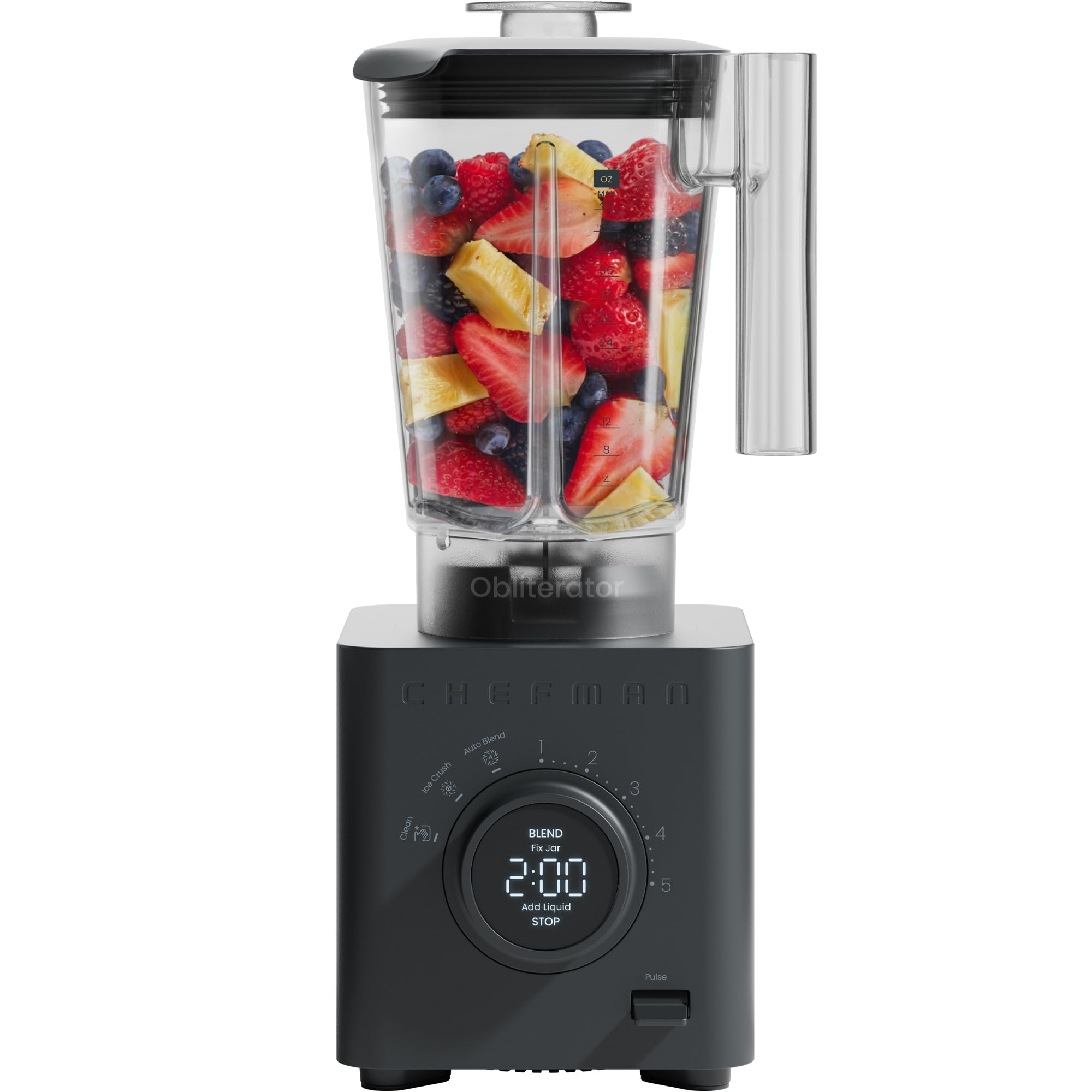
The Chefman Obliterator makes a strong case for automation-first design with a 1,380-watt motor and an Auto Blend function that analyzes ingredient load and adjusts speed and duration in real time. The 48-ounce Tritan jar is shatter-resistant, handles hot liquids when the lid is cracked, and sits on a weighted base that dampens vibration enough to make this one of the quieter high-power blenders in its class.
The dial control panel offers five blending speeds plus pulse, and the Auto Blend preset removes the guesswork from achieving a consistent texture. Countdown timer and LED alerts (“Fix Jar,” “Add Liquid”) reduce the chance of a watery or over-blended result. The blunt-blade design is a smart safety feature — it won’t cut skin during hand washing — yet still pulverizes frozen fruit at speed 2. A 2-in-1 tamper and scraper tucks into the lid, and the lid’s BPA-free cover doubles as a one-ounce measuring cup.
Noise output is lower than the Ninja BL660, settling into a low machine hum rather than a high-pitched whine. Owner reports highlight the solid feel of the base and the consistent results from the automatic cycle. The five-year warranty from Chefman adds long-term confidence, and the Red Dot Design Award signals that this blender looks as intentional on the counter as it performs in the glass.
Why it’s great
- Auto Blend adjusts speed based on ingredient load for foolproof consistency
- Quieter operation than most high-wattage blenders
- Includes tamper, scraper, and measuring lid — complete out of the box
Good to know
- 48-oz capacity is smaller than the 72-oz Ninja pitchers
- No single-serve to-go cups included
3. Ninja Professional Blender BL610
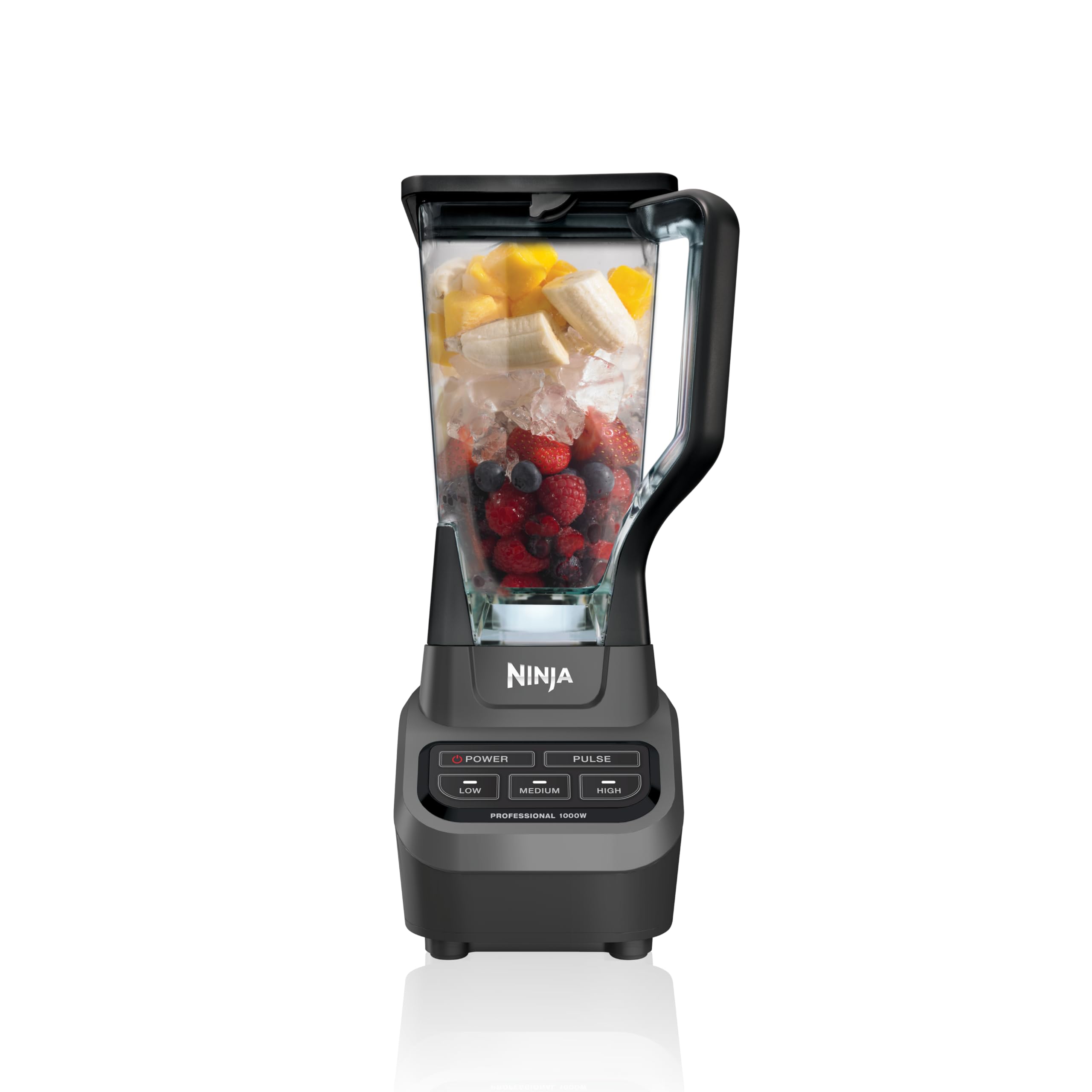
The Ninja BL610 is the stripped-down workhorse of the Ninja lineup — the same 1,000-watt motor and Total Crushing Technology as the more expensive Ninja models, but without the single-serve cups or food processor attachments. You get a single 72-ounce pitcher with a stacked blade assembly and a straightforward push-button interface. That simplicity makes it one of the most reliable large-format blenders for families who blend multiple servings every single day.
The four-blade design uses a staggered geometry that pulls ingredients downward into the blade path, eliminating the need for constant scraping or stirring. Frozen fruit, ice cubes, and whole vegetables surrender to the 1,000-watt motor without stalling, and the pitcher’s maximum liquid capacity of 64 ounces means you can pack in a pound of kale, three bananas, and a full tray of ice without overwhelming the system. Cleanup is a two-minute affair: rinse the pitcher, run the dishwasher cycle, and you are done.
The absence of variable speed controls and preset programs is a trade-off — you have a single high-speed blend setting and a pulse option. That works perfectly for smoothies and frozen drinks but limits fine control for sauces or emulsions. It is also loud, though no louder than any other 1,000-watt blender at full tilt. For buyers who want a permanent pitcher-based solution without paying for accessories they will never use, the BL610 is the most cost-effective route into the Ninja ecosystem.
Why it’s great
- Proven 1,000-watt motor with Total Crushing Technology that lasts for years
- Massive 72-oz pitcher handles family-sized batches
- Simple two-button operation with no learning curve
Good to know
- No to-go cups, no presets, no food processor attachment
- Loud at high speed; pitcher lid can pop off if overloaded with ice
4. Beast Mini Blender Plus
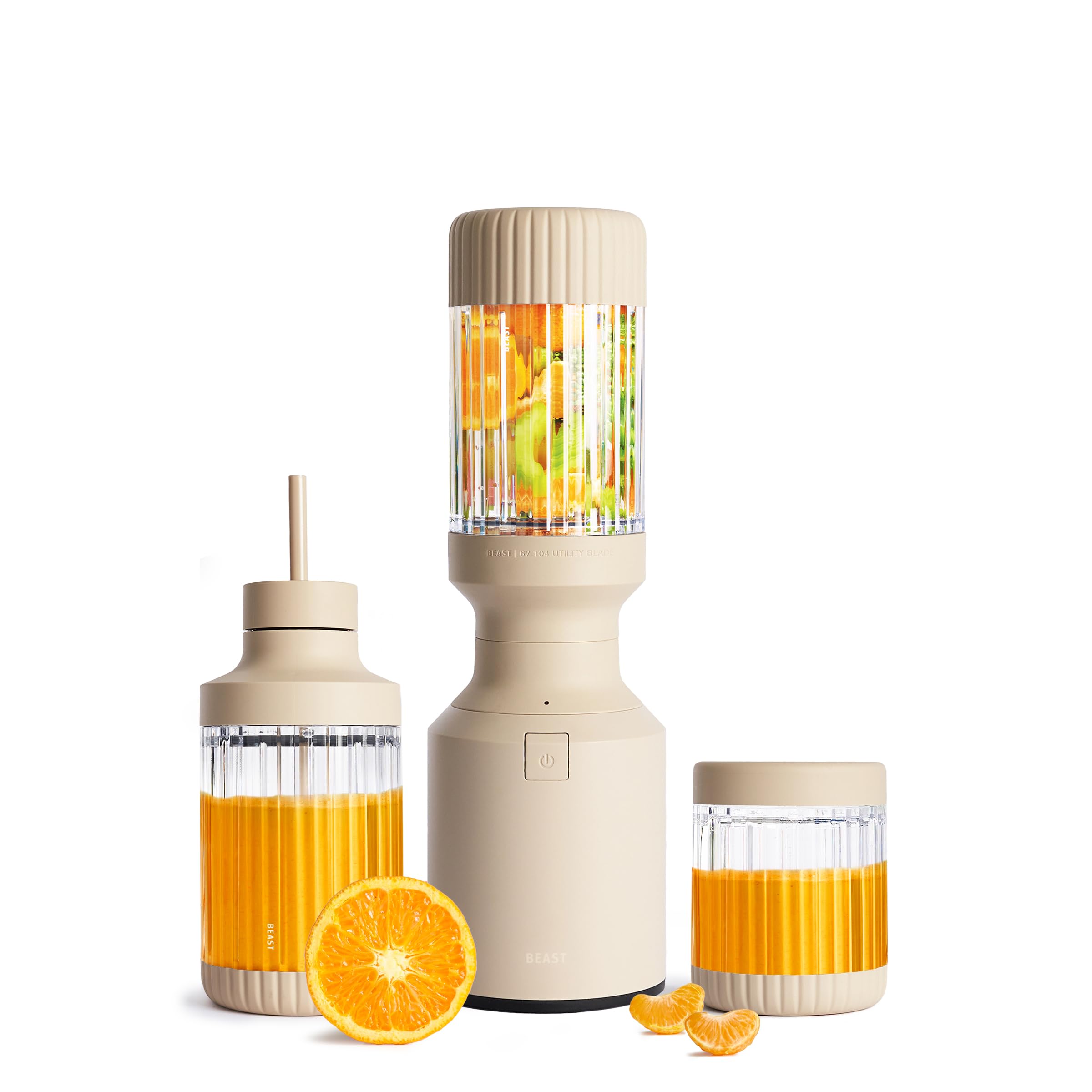
The Beast Mini Plus occupies a rare niche: a genuinely compact countertop blender that does not sacrifice blend quality. The 600-watt motor, housed in a base only 4.13 inches wide, drives a blade assembly that handles frozen fruit, greens, and ice without the labored stalling typical of sub-800-watt machines. The package includes three Blending Vessels — one for the base, two extra for grab-and-go — plus a Drinking Lid, a Straw Cap, and two reusable straws.
The vessel design narrows at the base and flares at the top, creating an aggressive vortex that pulls ingredients into the blade path faster than a straight-walled cup. Blending a full smoothie takes under a minute, and the auto-shutoff prevents over-processing. The matte finish and terra cotta color options make it a countertop-friendly appliance that you will leave out rather than store in a cabinet. Owners praise the quiet operation relative to the output; it runs louder than a handheld immersion blender but significantly quieter than the 1,000-watt Ninja models.
The trade-off is that the ridged interior of the vessels, while great for vortex formation, requires a dedicated bottle brush for thorough cleaning between uses. A small percentage of users reported blade dulling over several months, though the majority report consistent performance over a year of daily use. This is the strongest option for apartment dwellers, dorm students, or anyone with limited counter space who refuses to compromise on smoothie quality.
Why it’s great
- Ultra-compact footprint fits on crowded countertops
- Blends full smoothies in under a minute with auto-shutoff
- Includes multiple vessels and straws for portable use
Good to know
- Ridged vessel interiors require a brush to clean thoroughly
- 600W motor may not handle extremely dense nut butters or hard spices as well as higher-wattage units
5. Nutribullet Personal Blender 600W

The Nutribullet 600W is the benchmark that every single-serve smoothie maker is compared against, and for good reason: it has been doing the same job reliably for well over a decade. The 600-watt motor drives the signature Extractor Blade, which uses a cyclonic action to break down fibrous greens and frozen fruit into a drinkable consistency. The 24-ounce cup is the sweet spot — large enough for a substantial meal replacement, compact enough to fit under a standard cabinet.
Operation is as simple as it gets: fill the cup, screw on the blade, invert onto the motor base, and press down. No dials, no presets, no guesswork. The cup doubles as the drinking vessel, so you unscrew the blade, snap on the to-go lid, and walk out the door. Cleaning is equally friction-free — rinse the blade under running water or put the cup and lid on the top rack of the dishwasher. Owners consistently report a service life of eight to ten years before bearing wear becomes audible, which is exceptional for a sub-mid-range appliance.
The 600-watt motor is perfectly adequate for soft fruit, greens, protein powder, and yogurt, but it struggles with heavy ice loads or large volumes of frozen fruit without added liquid. If your daily smoothie is a dense, ice-heavy affair, you will need to thin it out or step up to a higher-wattage model. For the classic berry-spinach-yogurt formula, this remains the most proven and easiest-to-recommend entry-level smoothie maker on the market.
Why it’s great
- Decade-long track record with a huge base of loyal owners
- One-touch operation with a single blending cup that doubles as the drinking vessel
- Dishwasher-safe parts and simple rinse-clean blade
Good to know
- 600W motor requires liquid assists for heavy ice loads
- Audible noise is typical for the category; not ideal for early-morning quiet households
6. Sangcon 1000W Smoothie Blender

The Sangcon 1000W is a value play that refuses to feel cheap. The 1,000-watt motor drives a six-leaf stainless steel blade assembly — two more blades than the standard four-leaf design — which increases the number of cutting surfaces per revolution and produces a noticeably smoother texture in leafy green blends. The kit includes three BPA-free cups: a 24-ounce (700ml) juice cup, a 17-ounce (500ml) smoothie cup, and a 10-ounce (300ml) grinder cup for coffee beans or spices.
The twist-to-lock mechanism is a tactile improvement over the push-and-hold design found on many budget blenders; you lock the cup onto the base and walk away while it runs through the cycle. An upgraded cooling fan and T-shape sealing ring prevent leaks during extended use, and the reinforced gear base reduces wear at the coupling point — a common failure location in cheaper units. Owners report using it twice daily for five months without any degradation in performance, and several reviewers explicitly call it a quieter alternative to the Nutribullet at roughly half the cost.
The two main trade-offs are the absence of an auto-shutoff timer (you must twist to stop the motor) and the need to hold the cup in place during manual pulse mode if you want short bursts. The grinder cup works well for coffee and spices but is not large enough for bulk grinding. For the price-to-performance ratio, however, this is the strongest budget-friendly entry in the lineup.
Why it’s great
- Six-leaf blade assembly delivers smoother texture than standard four-leaf designs
- Twist-to-lock operation allows hands-free blending
- Three cup sizes with two different lid types cover nearly every use case
Good to know
- No auto-shutoff timer; requires manual twist to stop
- Must hold cup during manual pulse mode
7. KOIOS Smoothie Blender 1000W

The KOIOS 1000W takes the multi-functional approach further than any other product in this list by including a dedicated 11-ounce coffee grinder cup alongside the standard two 22-ounce blending cups. The all-copper turbocharged motor hits a maximum of 30,000 RPM at peak speed, and the two sets of 304 stainless steel blades (one for blending, one for grinding) are clearly differentiated by their geometry — the grinding blade is shorter and wider, optimized for even particle reduction rather than vortex creation.
The detachable blade design is a standout feature at this price tier: you unscrew the blade assembly from the cup, rinse it under the tap, and replace it if it ever dulls, rather than discarding the entire unit. Owners praise the grind quality for coffee beans and the smoothness of frozen-fruit blends, with several reviewers noting that it outperforms much more expensive single-purpose smoothie makers.
The push-to-blend mechanism requires constant downward pressure — you cannot lock the cup and walk away — and the noise level is high enough that you will hear it across a small apartment. The coffee grinder lid includes a sieve, which is useful for sifting coarse grounds but adds an extra part to keep track of. For buyers who want one motor base that handles both morning coffee grinding and post-workout smoothies, the KOIOS delivers surprising capability at a budget-friendly price.
Why it’s great
- Includes dedicated coffee/spice grinder cup with sieve lid
- Detachable 304 stainless steel blades for easy cleaning and replacement
- All-copper motor runs cooler and generates less odor
Good to know
- Requires constant downward pressure to operate; not hands-free
- Overheat protection can pause the motor after extended continuous blending
FAQ
Can a 600-watt blender handle frozen fruit and ice reliably?
What is the difference between a four-leaf and a six-leaf blade assembly?
Are detachable blade assemblies worth the extra cost?
How do I tell if a smoothie blender is BPA-free and food-safe?
What is the real-world difference between a push-to-blend and a twist-to-lock mechanism?
Final Thoughts: The Verdict
For most users, the best smoothie maker winner is the Ninja BL660 because it combines a powerful 1,100-watt motor, a full-size 72-ounce pitcher for batch prep, and two 16-ounce to-go cups for individual servings — a complete blender system that will outlast the countertops it sits on. If you want automated blending with fewer moving parts, grab the Chefman Obliterator and let the Auto Blend function dial in the perfect texture. And for the tightest budgets without cutting corners on durability, nothing beats the Sangcon 1000W — a six-leaf, three-cup kit that delivers surprising power at a fraction of the cost.