A compact meat slicer that actually stays put on the counter and delivers uniform deli-thin cuts without shredding the roast—that is the real test of a well-engineered small appliance. Most home units wobble, overheat after a single batch, or trap meat debris in crevices that defy cleaning. The right machine changes your weekly meal prep from a frustrating chore into a five-minute routine.
I’m Mohammad Maruf — the founder and writer behind AirfryerBite. I’ve spent years dissecting the hardware specs of countertop food slicers, evaluating blade metallurgy, motor duty cycles, and disassembly engineering to separate the genuinely useful designs from the frustrating ones.
This guide focuses exclusively on units that deliver repeatable, safe slicing without dominating your counter space. Whether you are portioning brisket for jerky, shaving rib eye for cheesesteaks, or slicing dense sourdough, these are the best options for a small meat slicer that balances footprint with real cutting capability.
How To Choose The Best Small Meat Slicer
Selecting the right countertop slicer means looking past marketing claims and focusing on four engineering variables that determine whether the machine will still perform after fifty pounds of meat. Beginners often overvalue blade size while ignoring the motor’s ability to maintain torque under load, or they assume all adjustable thickness dials deliver the same precision.
Motor Power and Duty Cycle
A 200-watt motor is the practical floor for home use. Lower-wattage units (around 150 watts) require frequent pauses—often a fifteen-minute rest after just five minutes of continuous slicing—which kills workflow when processing a whole brisket or a batch of pork belly. Look for DC motors, which run quieter and deliver more consistent torque at lower RPMs compared to universal AC motors. The duty cycle rating (for example, “10 minutes on / 20 minutes off”) is a hard spec that directly impacts whether the machine suits your batch size.
Blade Metallurgy and Diameter
Blade diameter determines the maximum height of food you can slice. A 6.7-inch blade handles standard deli logs and bread loaves; a 7.5-inch blade gives you extra clearance for larger roasts and taller blocks of cheese. Blade material matters just as much—high-carbon stainless steel holds an edge longer than standard stainless, and serrated blades grip crusty bread or tough meat skins better than smooth edges. Some mid-range and premium machines include both a serrated and a smooth blade, letting you separate raw-meat slicing from cooked-food slicing to avoid cross-contamination.
Build Material and Disassembly for Cleaning
Die-cast aluminum and stainless steel housings resist rust and stay rigid during use. Plastic housings are lighter but tend to flex, which can misalign the blade over time. The most important hygiene feature is how many parts detach without tools. The best designs let you remove the blade, carriage tray, slide rod, and food pusher in under sixty seconds for direct access to the blade housing and gear compartment. Machines with exposed grease channels or non-removable back plates trap meat residue and require tedious manual cleaning.
Safety Features
A child lock that forces a two-button start prevents accidental activation. Non-slip suction feet are non-negotiable—without them, the machine walks across the counter during slicing. The food pusher should double as a blade guard, and the blade housing should sit slightly above the blade edge to prevent accidental finger contact. Some units include an inner On/Off switch that adds an extra electrical disconnection point.
Quick Comparison
On smaller screens, swipe sideways to see the full table.
| Model | Category | Best For | Key Spec | Amazon |
|---|---|---|---|---|
| Borlebbi Quiet Slicer | Premium | Quiet operation & thin deli cuts | 200W DC motor / 7.5″ blade | Amazon |
| TOKASS 200W | Premium | High-carbon blade & jerky batches | German high-carbon steel blade | Amazon |
| FOHERE Dual-Blade | Mid-Range | Raw/cooked food separation | 2 blades (serrated + smooth) | Amazon |
| Pterying 200W | Mid-Range | Dual-blade versatility & cast-iron build | 200W motor / 2 blades / 11 lbs | Amazon |
| VEVOR 7.5″ | Mid-Range | Budget-conscious bulk slicing | ETL certified / 8.4 lbs | Amazon |
| Cogace Foldable | Budget | Space-saving storage | Folds flat / 6.7″ blade | Amazon |
| OSTBA 150W | Budget | Entry-level price & basic slicing | 150W motor / 6.7″ blade | Amazon |
In‑Depth Reviews
1. Borlebbi Quiet Slicer (200W DC Motor)

The Borlebbi stands apart from every other unit in this roundup because of its 200W DC motor. Where most home slicers use noisy universal motors, this DC-driven design delivers steady torque at lower RPMs—quiet enough that you can hold a conversation while slicing. The 7.5-inch blade handles whole brisket flats and large cheese blocks, and the adjustable dial covers the full 0-to-15mm range with noticeable precision. Reviewers consistently report that partially frozen meat (one to two hours in the freezer) produces shaved-thin slices for pho or hot pot without the machine bogging down.
Disassembly for cleaning is straightforward: the blade, carriage arm, and food pusher detach and wash easily with soapy water. The included stainless steel tray catches slices neatly, reducing counter mess. Some users mention that the suction cups do not hold perfectly on textured countertops—placing the unit on a flat cookie sheet solves the issue. The child lock and blade cover add a solid layer of safety, and the overall weight (around 11 pounds) keeps the machine planted during use.
For anyone slicing several pounds of meat weekly, the combination of quiet operation, consistent torque, and easy blade changes makes this the most enjoyable slicer to use over the long term. It is not the cheapest option, but the DC motor justifies the investment for regular users who value peace and smooth cuts.
Why it’s great
- 200W DC motor runs quieter than any AC unit tested
- Two 7.5-inch blades (serrated + smooth) for raw and cooked food separation
- Easy disassembly with removable blade, carriage, and pusher
- Consistent torque at low speed for thin deli cuts
Good to know
- Suction cups may slip on rough counter surfaces
- Some meat can accumulate behind the blade in the gear compartment
- Blade lock can be stubborn to release on first uses
2. TOKASS 200W Meat Slicer (2 Blades + Tray)

TOKASS differentiates itself by using German high-carbon stainless steel for both of its 7.5-inch blades. High-carbon steel retains a sharper edge significantly longer than standard stainless, which matters when you are slicing through sinewy roast beef or firm cheese blocks repeatedly. The 200W motor provides enough headroom for continuous slicing—users report processing whole eye-of-round roasts for jerky without needing a cooldown break mid-batch.
The two-button child lock requires pressing the safety lock and power button simultaneously, which prevents accidental startup effectively. The stepless adjustment knob covers ultra-thin to roughly 3/4-inch thick slices, and the included stainless steel tray catches slices cleanly. Reviewers consistently praise the machine’s ability to slice homemade bacon and tasso uniformly, and the lightweight build (under two pounds with packaging, though the unit itself is solid) means it is easy to move between storage and counter.
Cleaning requires some attention—the blade and carriage detach, but not every internal surface is exposed, so meat fat can dry in tighter corners if you do not wipe promptly. The 12-month warranty and free parts replacement service add peace of mind that budget brands rarely offer. For jerky makers or families who batch-slice roasts weekly, the TOKASS delivers repeatable results at a mid-premium price point.
Why it’s great
- German high-carbon steel blades hold edge longer than standard stainless
- 200W motor handles continuous jerky and roast slicing
- Two-button child lock prevents accidental activation
- 12-month warranty with free parts replacement
Good to know
- Not all internal surfaces are accessible for deep cleaning
- Some parts are non-removable, requiring careful hand washing
- Lightweight build may shift if suction cups are not on a clean surface
3. FOHERE 200W Dual-Blade Meat Slicer

The FOHERE is one of the few mid-range slicers that ships with both a serrated blade (for crusty bread and tough meat skins) and a smooth blade (for clean cheese and raw-meat cuts). The 200W motor is paired with a die-cast aluminum housing that resists rust and keeps the unit stable during operation. The 0-to-15mm thickness dial is stepless and provides fine control, though some users note that the sliding carriage has a slight gap between the slide and blade wall, which can cause narrower items like single sausages to tilt.
Blade changes are simple: a single locking mechanism lets you swap blades without tools. The non-slip suction feet hold well on smooth surfaces, and the food pusher doubles as a blade guard for safe handling. Reviewers highlight the unit’s performance on whole bread loaves and block cheese, and several mention that the motor runs at a slower RPM for better control—a trade-off that improves cut quality but extends slicing time slightly.
Cleaning is manageable because the blade, carriage, and pusher are removable, but the slide mechanism itself cannot be fully disassembled. Dried fat can accumulate in the slide track if not wiped immediately after use. For users who slice both raw meats and cooked breads or cheeses regularly, the dual-blade system alone justifies the mid-range investment.
Why it’s great
- Two 304 stainless steel blades (serrated + smooth) prevent cross-contamination
- Die-cast aluminum housing is rust-proof and stable
- Stepless 0-15mm thickness adjustment
- Non-slip feet and blade-guard pusher for safety
Good to know
- Slide mechanism has a gap that loses narrow items
- Cleaning tracks require immediate attention to avoid fat buildup
- Motor runs slower than some competing models
4. Pterying 200W Meat Slicer (2 Blades + Cast Iron)
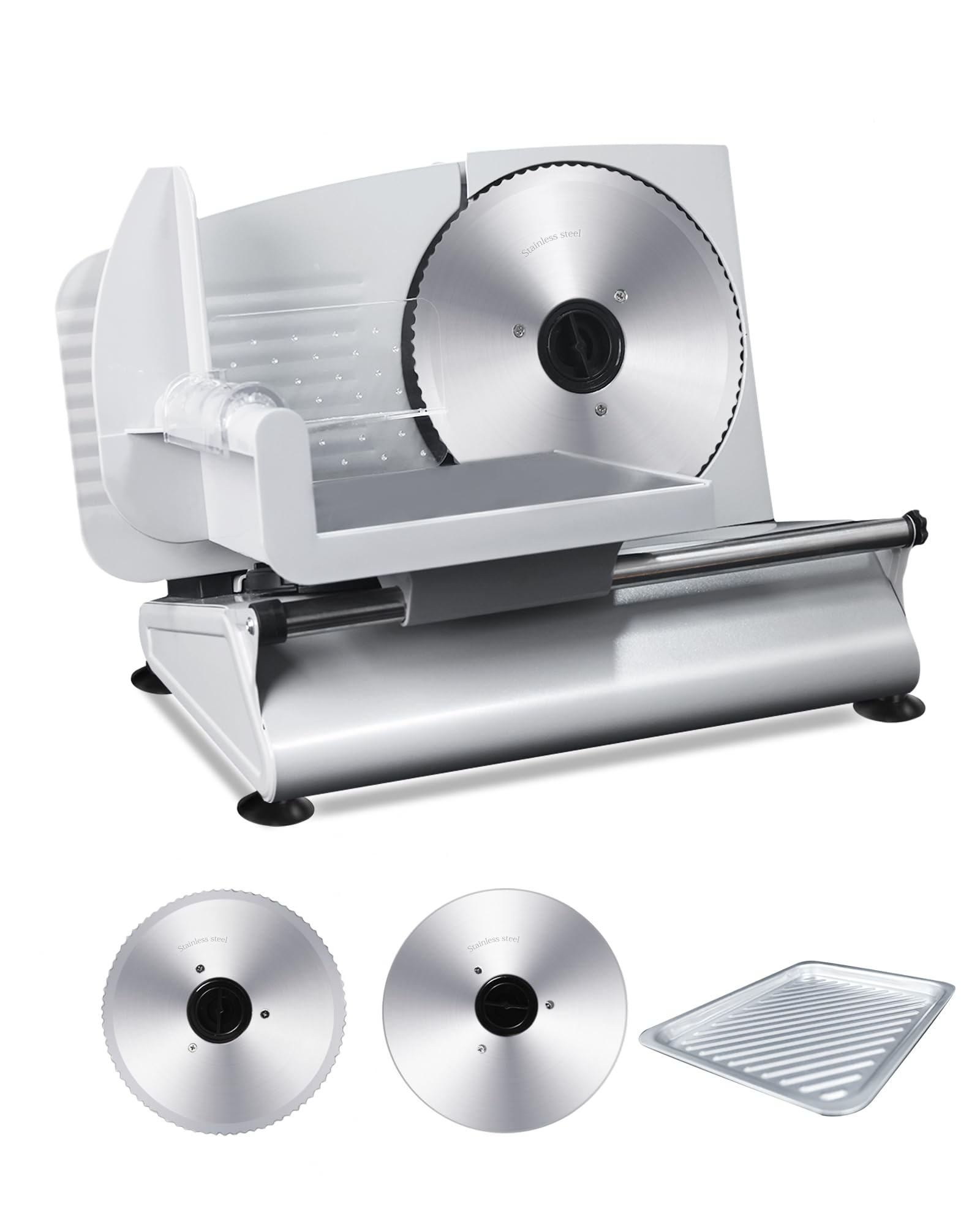
The Pterying stands out in the mid-range segment for its cast-iron construction, which gives it a hefty 11-pound mass that absorbs vibration and keeps the blade track stable. The included two 7.5-inch stainless steel blades (one serrated, one smooth) cover the same raw/cooked separation benefit as the FOHERE, but the cast-iron frame means the machine feels more solid during heavy use. The 200W motor provides enough power for frozen meats (as long as they are partially thawed) and handles dense bread without stalling.
The child lock requires a simultaneous two-button press, and the non-slip suction feet grip aggressively on smooth counters. The thickness knob adjusts from ultra-thin to roughly 3/4 inch, and the carriage slides smoothly with minimal lateral play. Customers mention that the machine slices homemade bacon and tasso uniformly, and the tilt of the blade helps keep food pressed against the carriage for consistent cuts.
Cleaning is the main compromise—while the blade, carriage, and pusher are removable, the base of the unit has exposed gearing that must be kept dry. You cannot fully disassemble the base for a thorough wash, so careful hand wiping is required. For users who prioritize build rigidity and dual-blade versatility over effortless cleaning, the Pterying is a strong mid-range contender.
Why it’s great
- Cast-iron frame at 11 lbs provides exceptional stability
- Two 7.5-inch stainless blades included (serrated + smooth)
- Child lock and strong suction feet for safe operation
- Sharp blades cut bacon, tasso, and bread uniformly
Good to know
- Base gearing cannot be fully disassembled for deep cleaning
- On/off switch is positioned at the rear, requiring reach over the blade area
- Limited capacity for very large roasts due to compact carriage
5. VEVOR 7.5″ 200W Electric Deli Slicer
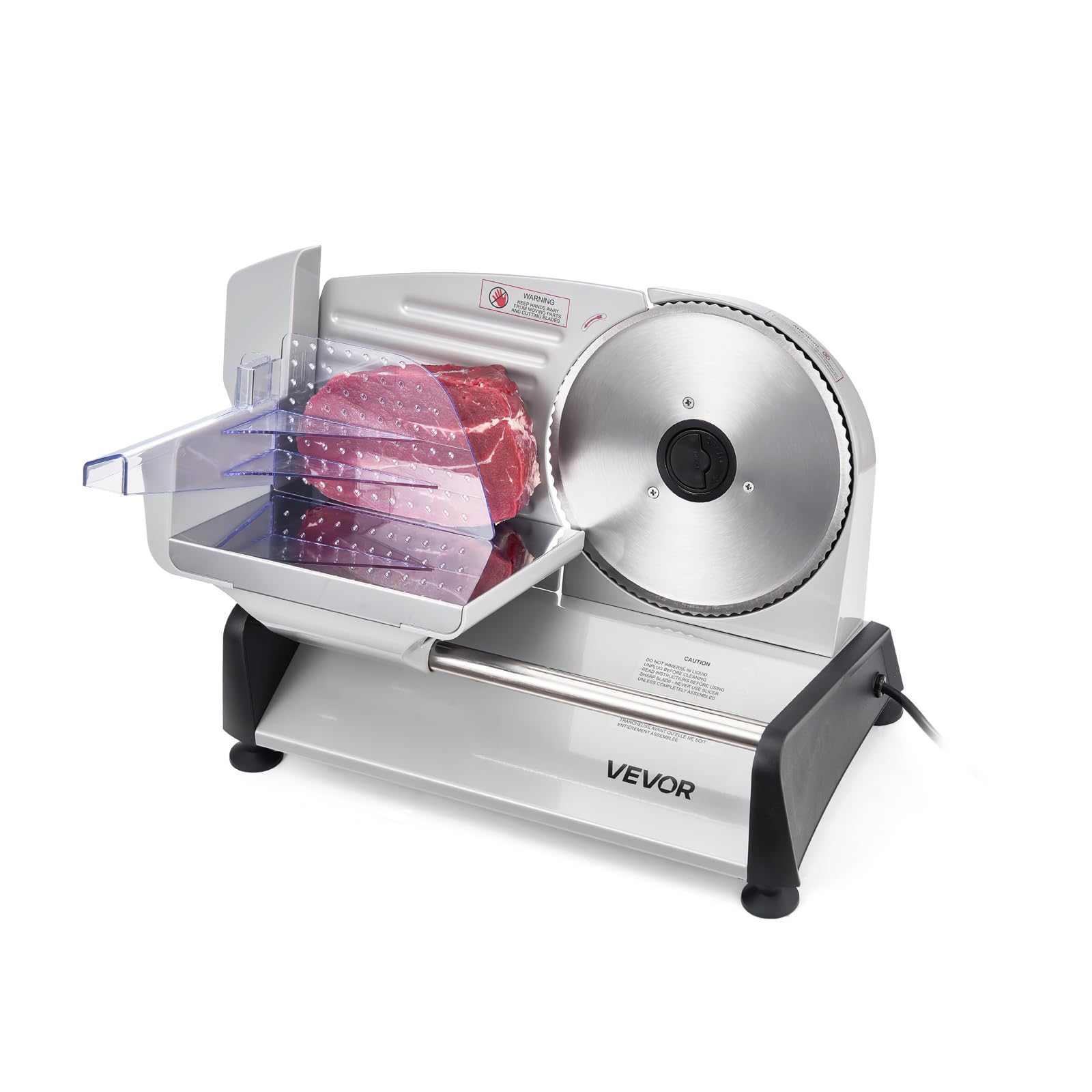
VEVOR’s entry into the small slicer space is a 7.5-inch machine with a 200W motor and ETL certification, an important safety validation that many budget units omit. The SUS420 stainless steel blade is corrosion-resistant and holds a practical edge for home use. The thickness adjustment ranges from 0 to 15mm (0 to 0.6 inches) via a precise knob, and the carriage, food pusher, and slider extension disassemble for cleaning—though some users note that initial alignment of the back plate and thickness knob is necessary for perfectly even slices.
The motor runs at 70-100 RPM and handles up to 10 pounds of meat in a single session without overheating, according to user reports. The blade housing sits 1 mm above the blade edge to reduce accidental contact, and the security lock plus rubber suction feet keep the unit stable. Reviewers consistently mention that the VEVOR provides professional-grade slice uniformity for the price, especially for jerky and deli meats.
Cleaning requires full disassembly of the removable parts, and dried fat must be addressed immediately—allowing it to set makes removal harder. Some users experienced a minor break-in period where the blade alignment needed adjustment, but after that, the machine performed reliably. For budget-conscious buyers who need ETL certification for peace of mind and do not mind a short calibration step, the VEVOR offers solid mid-range performance.
Why it’s great
- ETL certified for electrical safety compliance
- 200W motor processes up to 10 lbs without overheating
- SUS420 stainless steel blade resists corrosion
- 1mm blade housing overhang reduces finger contact risk
Good to know
- Initial alignment of back plate and knob needed for even slicing
- Cleaning requires immediate attention to prevent dried fat
- Slightly heavier at 8.4 lbs compared to some plastic alternatives
6. Cogace Foldable Meat Slicer (6.7″ Blade)

The Cogace addresses the most common complaint about countertop slicers—storage footprint—by folding flat when not in use. The 6.7-inch German RSG stainless steel blade is strong and wear-resistant, and the thickness knob offers a 0-to-20mm range, which is wider than most competitors. The machine includes CE and ETL certifications and a child safety lock, plus three suction feet that grip well on smooth surfaces.
In practice, the foldable mechanism works smoothly: you fold it out, lock it into place, slice, then fold it back in seconds. The blade cuts turkey, ham, and roast beef effectively, and the one-twist disassembly makes removing the blade and pusher straightforward. Reviewers note that the thickness setting is less precise than on die-cast machines—slice thickness varies depending on how hard you press the pusher—so it is better for uniform medium cuts than for exacting deli-thin work.
Some users report that the plastic construction feels less durable than aluminum or cast-iron units, and a small number had issues with exposed grease under the blade. The motor is adequate for home slicing but struggles with very dense bread or large roasts. For apartment dwellers or anyone who needs to stash the slicer in a drawer between uses, the Cogace’s folding capability is a genuine space-saving win, provided you accept the trade-offs in precision and material rigidity.
Why it’s great
- Folds flat for storage in drawers or cabinets
- German RSG stainless steel blade holds an edge well
- CE and ETL certified with child safety lock
- 0-20mm thickness range covers most home slicing needs
Good to know
- Slice thickness varies with pusher pressure due to plastic carriage flex
- Some units have exposed grease under the blade housing
- Motor struggles with very dense bread and large roasts
7. OSTBA 150W Electric Meat Slicer (6.7″ Blade)

The OSTBA is the most affordable slicer in this roundup and serves a clear purpose: occasional home slicing of cold cuts, bread, and cheese. Its 150W motor is less powerful than the 200W units, which translates to a five-minute continuous run limit followed by a fifteen-minute cooldown—a critical spec for anyone considering bulk jerky or roast slicing. The 6.7-inch serrated stainless steel blade is sharp and effective for standard deli portions, and the 0-to-15mm adjustable dial provides reasonable control for basic use.
Cleaning is genuinely easy because the blade, pusher, and carriage are dishwasher-safe—a genuine convenience at this price tier. The non-slip suction feet keep the unit stable, and the food pusher doubles as a blade guard. Customers report good results slicing beef brisket for pho and dense bread loaves, though the motor slows noticeably on thicker cuts.
The primary limitation is the duty cycle: you cannot run the OSTBA continuously for more than five minutes without risking motor damage. For someone who slices one or two pounds of meat at a time and does not need ultra-thin precision, this duty cycle is manageable. But for larger batches or regular heavy use, the motor limitation becomes frustrating quickly. The OSTBA is a functional entry-level tool for light, infrequent slicing tasks.
Why it’s great
- Lowest price entry point for home meat slicing
- Blade, pusher, and carriage are dishwasher-safe
- Non-slip suction feet keep the unit stable
- Sharp 6.7-inch serrated blade cuts bread and cold cuts well
Good to know
- 150W motor limits continuous run time to 5 minutes with 15-minute rest
- Struggles with ultra-thin slices; better for medium to thick cuts
- Meat debris can get into gear compartment, complicating cleaning
FAQ
How thick of a cut can a small electric meat slicer handle?
Can I slice partially frozen meat in a small meat slicer?
Why do some meat slicers need a rest period between uses?
Final Thoughts: The Verdict
For most users, the small meat slicer winner is the Borlebbi Quiet Slicer because its 200W DC motor delivers quiet, consistent torque for thin deli cuts and the two included blades handle raw and cooked foods separately. If you want a rock-solid build with dual blades and a cast-iron frame, grab the Pterying 200W. And for budget entry with dishwasher-safe parts, nothing beats the OSTBA 150W for light, occasional slicing.