A small knife sharpener that actually fits in your pocket is the difference between a clean slice through a ripe tomato and a crushed, mushy mess in the field. But most compact sharpeners cut corners on grit consistency, preset angle quality, or portability — leaving you with a tool that either wears out fast or fails to produce a functional edge after a few passes. The right unit balances robust abrasive material with a truly packable form factor that doesn’t feel like a downgrade from a bench stone.
I’m Mohammad Maruf — the founder and writer behind AirfryerBite. I analyze the internal geometry, abrasive composition, and build quality of serious sharpening tools to separate the ones built for consistent edge repair from the gimmicks that just scratch the blade.
The best small knife sharpener lets you maintain a functional edge anywhere without sacrificing the quality you get from a full-size setup — whether you are maintaining a daily carry blade or touching up a hunting knife at camp.
How To Choose The Best Small Knife Sharpener
A successful pocket sharpener must deliver consistent edge geometry without requiring a flat surface or hours of practice. Focus on the abrasive material, the preset angle design, and the overall portability profile — these three factors decide whether your field sharpener becomes a trusted companion or a drawer filler.
Abrasive Type and Grit Rating
The abrasive determines how aggressively metal is removed and what kind of finish you can expect. Monocrystalline diamond (typically 600 grit or finer) cuts fast and lasts for years without loading up — ideal for field repairs on tough steels like D2 or S30V. Tungsten carbide rods set a coarse edge quickly but remove more metal per pass, making them better for restoring a dulled blade than for daily maintenance. Ceramic V-notches deliver a finer finish and work well for honing an already sharp knife to a polished edge. For an all-around pocket sharpener, look for a fine 600 grit diamond rod paired with a ceramic slot — this combination covers both quick edge repair and refinement without over-sharpening.
Preset Angle Design and Rod Geometry
Most compact sharpeners use a fixed V-notch or a guided slot that sets the sharpening angle automatically. The ideal preset angle for general-purpose knives falls between 20 and 25 degrees per side — steep enough for edge retention, shallow enough for slicing aggression. Check whether the rods or slots are positioned at a consistent depth. A poorly aligned V-notch will round the apex instead of forming a clean burr. Tapered diamond rods are also essential for serrated blades and gut hooks — the rod should taper from roughly 3/8-inch diameter at the base to a fine point to reach into the scallops without grinding the edge geometry flat.
Portability and Storage
A small knife sharpener earns its living by being easy to carry. Look for an overall length under 9 inches when closed and a weight around 2 to 3 ounces — anything heavier becomes a burden in a day pack or tackle box. The rods should store securely inside the handle or the unit should fold flat without rattling. A lanyard hole or a zippered pouch improves accessibility during field use. Avoid designs where the sharpening surface is exposed when stored — unprotected diamond rods or carbide rods will dull against gear fabric or abrade other items in a pocket.
Quick Comparison
On smaller screens, swipe sideways to see the full table.
| Model | Category | Best For | Key Spec | Amazon |
|---|---|---|---|---|
| SHARPAL 178N | Diamond Rod Set | Serrated & straight edges | 600 grit monocrystalline diamond | Amazon |
| DMT Dia-Fold FWEF | Folding Stone | Finish & polishing | Fine/Extra-Fine diamond stone | Amazon |
| Smith’s Pocket Pal X2 | Multi-Tool | EDC & survival | Coarse/fine slots + diamond rod | Amazon |
| Camillus GLIDE | V-Notch Multi | Shears & multitools | Multi-angle carbide & ceramic | Amazon |
| Gatco Edgemate | Pocket Carbide | Quick field edge | Tungsten carbide surface | Amazon |
In‑Depth Reviews
1. SHARPAL 178N 3-In-1 Pocket Knife Sharpener

The SHARPAL 178N is a 3-in-1 sharpening system built around a 4-inch monocrystalline diamond rod coated with a consistent 600 grit (25 micron) abrasive. The round rod sharpens straight edges while the 3.5-inch tapered rod reaches into serrations and gut hooks — both store inside the aluminum handle, keeping the diamond surfaces protected when not in use. A dedicated fishhook groove on the handle body adds utility for anglers without adding bulk.
Real-world testing shows the 600 grit diamond cuts aggressively enough to reform a damaged edge on S30V blade steel within 10 to 15 strokes, yet the consistent grain size leaves a clean burr that polishes out quickly. The tapered rod outperforms most competition at the same price tier because its diameter narrows smoothly from 3/8-inch to a fine point — this geometry lets it clean out scalloped serrations without grinding the unsharpened valley floor. The aluminum handle feels dense and rigid, unlike the plastic handles on cheaper foldable rods, and the lanyard hole paired with the included storage pouch makes it easy to clip into a day pack or glove box.
No water or oil is needed to use the diamond surface — the open bond design prevents metal swarf from clogging the grit even after prolonged dry use. The three-year warranty covers material and workmanship defects, which is rare at this price point. The 600 grit is fine enough for a finish edge on kitchen knives but still coarse enough to reprofile a hunting blade in the field, giving it a versatility that few pocket sharpeners can claim.
Why it’s great
- Monocrystalline diamond cuts everything from serrations to fish hooks without wearing down quickly
- Aluminum handle stores both rods securely — no loose components rattling in a pouch
- 600 grit hits the sweet spot between aggressive material removal and a refined edge finish
Good to know
- The round diamond rod removes metal fast — light pressure is required to avoid over-sharpening thin blades
- No coarse grit option for heavy reprofiling of completely dull blades
2. DMT Dia-Fold Double Sided Pocket Sharpener (FWEF)

The DMT Dia-Fold FWEF is a folding diamond sharpening stone with a Fine (600 grit) side and an Extra-Fine (1200 grit) side, designed for finishing and polishing rather than aggressive edge repair. The micronized monocrystalline diamonds are bonded in a dot pattern across the surface — this raised diamond topography prevents metal particles from clogging the abrasive, so the stone cuts consistently without needing oil or water. The unit folds flat to a 5×3.25-inch profile and weighs 2.4 ounces, making it thin enough to slip into a jacket pocket or the back pocket of a field pack.
This sharpener excels at daily maintenance for knives that already have a functional edge — five strokes on the Fine side followed by three on the Extra-Fine side restores push-cut sharpness on high-carbon steel in under two minutes. For steels like D2 or CM154, the Fine side deburrs effectively while the Extra-Fine side produces a polished apex that glides through paper towel. The folding plastic handle is the only potential weak link — reviewers note it feels slightly flimsy compared to the stone itself, but the hinge mechanism holds the stone rigid during use and the handle does not flex under moderate pressure. The stone is made in the USA while the handle components are sourced from China, but the overall construction holds up to regular use without the hinge loosening over time.
The FWEF combination (Fine/Extra-Fine) is ideal for the user who wants a razor finish on an already sharp blade, not for someone trying to repair a chipped or completely neglected edge — a Coarse/Extra-Coarse Dia-Fold covers that scenario. The Fine side at 600 grit is on par with the SHARPAL 178N for refinement, but the Extra-Fine side at 1200 grit adds a polishing step that the 178N cannot replicate. If your focus is edge polish and daily touch-ups on quality kitchen or hunting steel, the DMT Dia-Fold delivers the finest portable finishing surface available at this size.
Why it’s great
- 1200 grit Extra-Fine side produces a mirror-polished apex that competitors cannot match in a foldable format
- Dot-pattern diamond bond prevents clogging — no water or oil required during extended use
- Folds flat to pocket-friendly dimensions without exposing the abrasive surface
Good to know
- Not effective for reshaping a dull or chipped blade — requires a coarse stone for initial work
- Plastic handle feels less premium than the diamond stone itself, though it remains functionally reliable
3. Smith’s Pocket Pal X2 (50364)

The Smith’s Pocket Pal X2 is a multi-function tool that combines two sharpening slots (coarse carbide for setting an edge, fine ceramic for honing) with a tapered diamond rod, a fire starter, a compass, an LED light, and a signal whistle — all in a 3.4-inch long, 1.76-ounce package. The coarse carbide slot uses preset 25-degree angles to quickly restore a dull blade, while the fine ceramic slot refines the edge and removes the burr left by the carbide. The tapered diamond rod is stored in the bottom of the unit and handles serrations, gut hooks, and single-bevel blades without needing an additional tool.
The fire starter uses a ferrocerium rod that produces a strong spark when struck with the carbide sharpener or a knife spine — the rod is thin and can snap if too much pressure is applied, but it works reliably for emergency fire lighting. The compass is small and functional for basic directional travel, though it is fragile and not meant to replace a dedicated navigation tool. The LED light provides enough visibility to sharpen or light a stove in low light conditions, and the whistle carries a loud high-pitched tone that is useful for group signaling. The preset angle slots force a consistent edge geometry even if the user has no sharpening experience — this makes the Pocket Pal an excellent backup for beginners who want a no-guesswork sharpening solution while hiking, fishing, or camping.
The carbide slot removes metal aggressively — three or four passes can set a new edge, but too much pressure will carve a deep groove into the blade. The ceramic slot cannot fully correct a poorly set carbide edge, so the user must be deliberate about alternating between the two slots. The diamond rod is tapered from a wide base to a point, reaching deep into scalloped serrations that V-notch sharpeners cannot touch. The bright yellow body is easy to spot in a pack or tackle box, and the overall weight is low enough to attach to a keychain or zipper pull. This is not a precision sharpening system — it is a field-ready multi-tool that keeps your blade functional while offering survival backup features in one compact unit.
Why it’s great
- Coarse/fine slots and a diamond rod cover everything from dull blades to serrated edges in one tool
- Integrated fire starter, compass, whistle, and LED make it a true survival multi-tool for the outdoors
- Preset angle slots eliminate guesswork for beginners learning to sharpen in the field
Good to know
- Carbide slot is aggressive — too much pressure removes excessive metal and changes the blade profile
- Ferro rod is thin and prone to snapping if struck too hard, and the compass is fragile
4. Camillus GLIDE Compact V-Notch Sharpener

The Camillus GLIDE is a V-notch sharpener that accommodates knives, shears, axes, and fish hooks through multiple preset channels: a multi-angle carbide slot, a V-notch ceramic slot, and dedicated shear sharpeners at 20, 30, and 45 degrees. The body is constructed from glass-filled nylon, giving it impact resistance that survives drops onto rocks or concrete without cracking. Integrated T6, T8, T9, and T10 drivers plus a flathead screwdriver turn the sharpener into a tool for adjusting optics, tightening pack hardware, or maintaining outdoor gear in the same session.
The carbide slot is aggressive and sets a coarse edge quickly — useful for restoring a neglected blade on a folding knife or hatchet. The ceramic V-notch refines that edge into a finer finish, though the transition from carbide to ceramic requires careful stroke counting to avoid leaving a rough burr. The preset angle is steeper than the SHARPAL 178N or DMT Dia-Fold, which means the resulting edge favors durability over slicing aggression — a good trade-off for field knives that see hard use on wood and cordage. The shear sharpeners at 30 and 45 degrees work well for scissors and pruners, and the fish hook groove accommodates hooks up to roughly size 4/0 without flattening the barb.
The integrated bit drivers are a practical addition for outdoorsmen who carry multi-tools with Torx or flathead fasteners — no need to dig for a separate screwdriver. The lifetime warranty adds peace of mind for a tool that will be thrown into gear bags and truck consoles. At 3.25 by 0.75 by 7.5 inches and 68 grams, the GLIDE is pocketable but slightly longer than the Smith’s Pocket Pal, so it is better suited for a pack or tackle box than for keychain carry. The coarse grit nature of the carbide means this sharpener works best for users who prioritize quick edge restoration over polished finishes.
Why it’s great
- Multiple preset angles (20, 30, 45 degrees) cover knives, shears, and axes with no guesswork
- Integrated Torx and flathead drivers reduce the number of tools needed in a repair kit
- Glass-filled nylon body withstands heavy impacts and rough field conditions
Good to know
- Carbide slot removes metal aggressively — not suitable for daily touch-ups on high-end kitchen steel
- Lacks a diamond rod for serrated edges, limiting its utility on scalloped blades
5. Gatco Edgemate Pocket Knife Sharpener
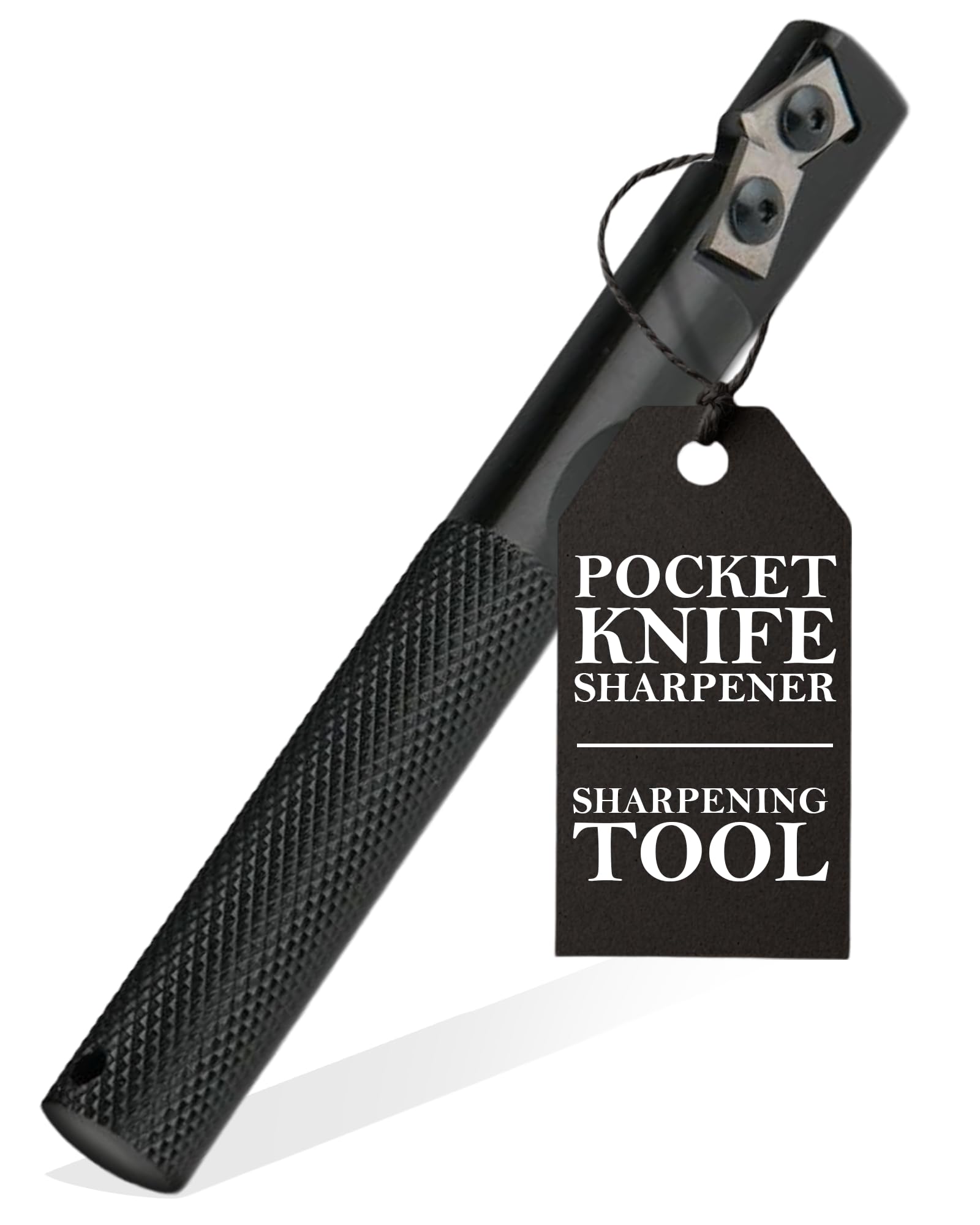
The Gatco Edgemate is a tungsten carbide sharpener designed for quick field restoration of pocket knives, kitchen knives, hunting tools, and garden shears. The carbide surface is mounted on a 8.25-by-3.75-inch body with an ergonomic handle that provides a secure grip even in wet or greasy conditions. No setup or angle calculation is required — the user simply presses the blade into the carbide V-slot and pulls it through for three to five passes on each side.
The tungsten carbide rod is extremely aggressive — it restores a functional edge on a heavily dulled kitchen knife in under 30 seconds, but it also removes visible amounts of blade steel with each pass. Reviewers caution that moderate pressure produces the best results; pressing too hard creates a deep gouge that requires excessive ceramic honing to smooth out. The Edgemate works well for pocket knives and medium-grind kitchen blades, but thicker tools like axes or heavy garden shears may require more passes than the tool is designed to handle efficiently. The initial edge sharpness is good for utility slicing (opening boxes, cutting cordage, field dressing) but lacks the refinement needed for precision kitchen work like slicing raw fish or paper-thin vegetables.
Portability is straightforward — the body weighs virtually nothing and slides into a gear bag pocket or kitchen drawer without taking up noticeable space. The lack of a ceramic finishing slot means the edge will feel rougher than what a diamond or ceramic system produces, and users who want a polished edge should follow up with a fine-grit stone or ceramic honing rod. The Edgemate is a pure restoration tool for people who need a fast, straight edge in the field and are not concerned with mirror finishes. For the buyer on a strict budget who needs a one-tool solution for multiple blade types, the Gatco Edgemate delivers the most aggressive metal removal per dollar in the pocket sharpener category.
Why it’s great
- Tungsten carbide restores a dull blade to functional sharpness in under 30 seconds with minimal effort
- Ergonomic handle provides a stable grip in wet field conditions or greasy kitchen environments
- Extremely lightweight and compact — disappears into a drawer or pack pocket
Good to know
- Carbide removes metal aggressively — heavy pressure will damage blade geometry and shorten blade life
- No ceramic or diamond finishing slot — the resulting edge is coarse and lacks polish
FAQ
Can a small knife sharpener handle serrated blades effectively?
How many passes should I make with a carbide pocket sharpener?
What is the difference between monocrystalline diamond and tungsten carbide in a pocket sharpener?
Is a 600 grit diamond rod fine enough for kitchen knives?
Final Thoughts: The Verdict
For most users, the best small knife sharpener winner is the SHARPAL 178N because its monocrystalline diamond rods cut through serrated blades, straight edges, and fish hooks without wearing down, and the aluminum handle stores everything securely for pocket carry. If you want a polished edge finish that rivals a bench stone, grab the DMT Dia-Fold FWEF. And for an all-in-one survival tool that sharpens, starts fires, and lights your way in the dark, nothing beats the Smith’s Pocket Pal X2.