The standard “juicer” you grab at the big-box store spins at thousands of RPMs, shredding your produce with heat and noise, which oxidizes the juice and shortens its shelf life to mere hours. A slow juicer—also called a masticating or cold press juicer—replaces that centrifugal chaos with a gentle, single-auger crush that spins at roughly 60 to 85 RPM. This low-speed squeeze yields significantly more juice, preserves vitamins and enzymes, and leaves bone-dry pulp behind. The result is a glass of juice that stays vibrant and fresh in the fridge for up to 72 hours instead of just 24.
I’m Mohammad Maruf — the founder and writer behind AirfryerBite. I’ve spent years analyzing the hardware behind countertop appliances, studying motor torque curves, auger geometries, and feed-chute diameters to understand exactly what separates a frustrating juicer from one that makes daily wellness effortless.
This guide breaks down nine of the current most compelling slow juicer models, from entry-level machines built for budget-conscious beginners to premium units designed for dedicated juicing enthusiasts. Whether your priority is a wide chute that swallows whole apples, a powerful motor that handles tough greens without jamming, or a simple cleaning routine that takes under three minutes, the right best slow juicer for your kitchen comes down to a handful of critical specs that are easy to compare once you know what to look for.
How To Choose The Best Slow Juicer
Not all slow juicers are built the same. Some prioritize a massive feed chute to eliminate prep work; others focus on high torque for crushing tough leafy greens and wheatgrass. Understanding the four critical specs below will keep you from making a purchase you will regret after a month of daily use.
Feed Chute Width and Prep Time
A narrow 1.5-inch feed chute forces you to chop carrots, apples, and cucumbers into small sticks before each juicing session. A wide chute — 4.3 inches or larger — lets you drop in whole fruits, reducing prep time by at least five minutes per session. This single spec is often the difference between a juicer you use daily and one that collects dust in the back of a cabinet.
Motor Torque and RPM Range
Low RPM (55–85) minimizes heat buildup and oxidation, but torque is what actually drives the auger through dense vegetables like beets and sweet potatoes. A motor rated at 150W to 240W with high torque (measured in newton-meters) will not stall or overheat under heavy use. Models that advertise torque figures — such as 180nm — are generally better equipped for continuous juicing of hard produce.
Build Materials and BPA-Free Certification
The auger and strainer basket should be stainless steel — cheaper plastic augers wear down and can leach microplastics into the juice. The feed chute and juice collection cups should be made from Tritan or other BPA-free materials, especially if you plan to juice citrus or acidic fruits regularly. Premium models often use the same baby-grade Tritan found in high-end water bottles.
Cleaning Design and Dishwasher Compatibility
A slow juicer with fewer than seven parts cleans up faster. The most user-friendly designs use a one-piece stainless steel filter that rinses clean under running water without needing a scrub brush. Some models are fully dishwasher-safe (top rack), while others require hand-washing the motor base only. Avoid any model where the manual warns about a “complicated cleaning brush” as the primary cleaning method.
Quick Comparison
On smaller screens, swipe sideways to see the full table.
| Model | Category | Best For | Key Spec | Amazon |
|---|---|---|---|---|
| TUUMIIST 3-in-1 Smart Touch | Premium | Smart touchscreen & auto-reverse | 6.5″ chute, 150W motor | Amazon |
| Kuvings Whole Slow Juicer B6000S | Premium | 10-year warranty & high yield | 3″ chute, 240W motor | Amazon |
| Omega Cold Press Juicer | Premium | Hands-free batch juicing | 68 oz hopper, 150W motor | Amazon |
| Cuisinart CSJ-300 Easy Clean | Mid-Range | Mesh-free easy-clean filter | 200W motor, 1.5L capacity | Amazon |
| Anybear Cold Press Juicer | Mid-Range | High torque 180nm motor | 4.3″ chute, 200W, 65 RPM | Amazon |
| Greater Goods Cold Press Juicer | Mid-Range | Quiet 85-115 RPM operation | 3″ chute, 150W, <60dB | Amazon |
| 3-in-1 SMALLHOO Cold Press | Value | Ultra-wide 7″ chute & sorbet | 7″ chute, 350W, 120oz hopper | Amazon |
| Godspeeds Cold Press Juicer | Value | Entry-level ease of use | 5.8″ chute, 300W motor | Amazon |
| Breville BCP600SIL Citrus Press | Specialty | Dedicated citrus juicing | Motorized cone, 110W | Amazon |
In‑Depth Reviews
1. TUUMIIST 3-in-1 Cold Press Juicer Machine
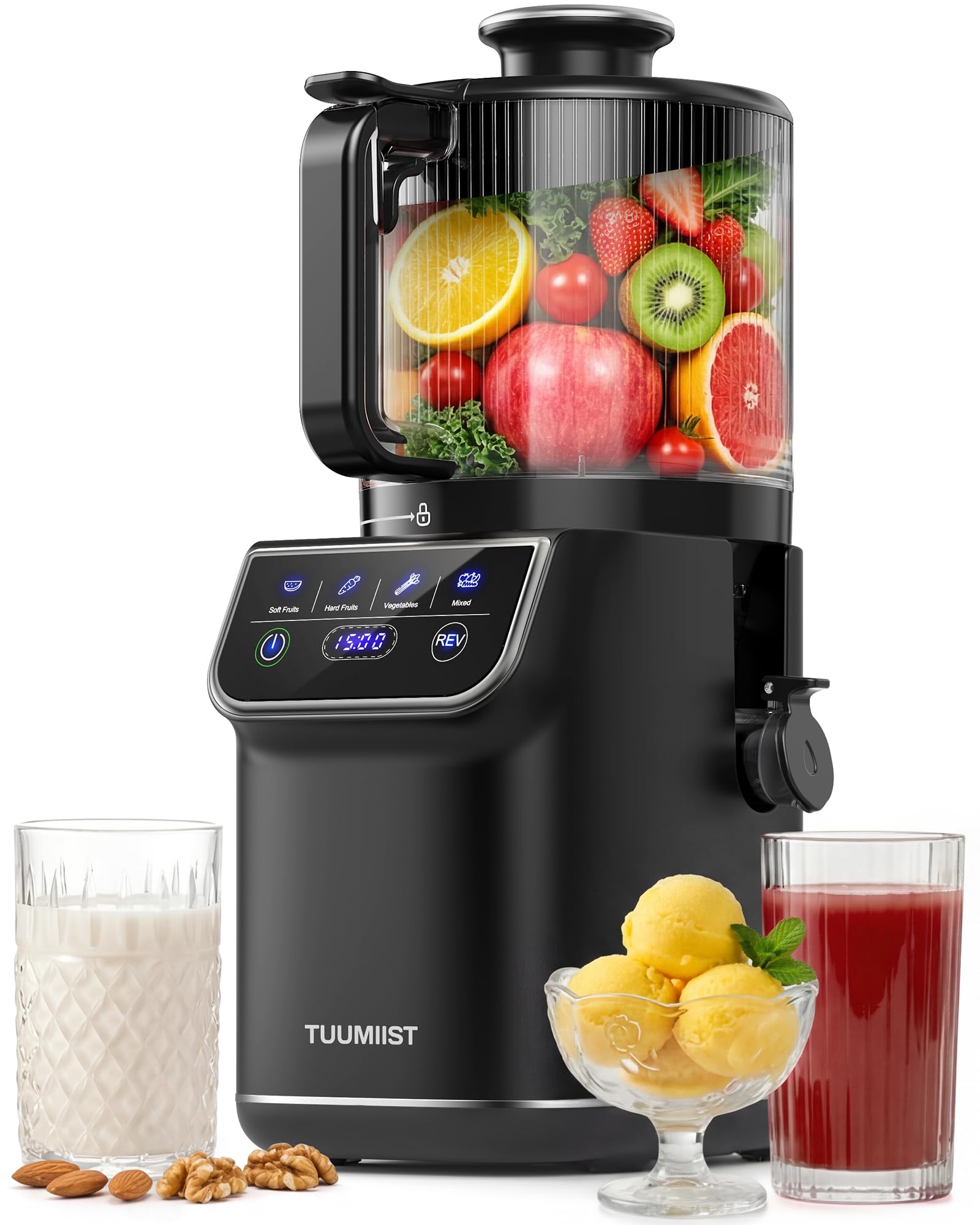
The TUUMIIST 3-in-1 stands out because it combines the two things most buyers want: a 6.5-inch extra-wide self-feeding chute that swallows whole fruits without pre-cutting, and a smart touchscreen interface that makes switching between juice, nut milk, and sorbet modes genuinely intuitive. The 150W motor runs at whisper-quiet levels below 60 dB, so morning juicing sessions won’t wake anyone else in the house. The auto-reverse function automatically clears jams when you push tougher ingredients like ginger or celery, which removes the need to manually hit a reverse button mid-session.
What really earns the “Best Overall” tag is the balance between raw performance and everyday convenience. The 100-ounce batch pitcher lets you juice once and store enough for three days, while the simplified three-part assembly means cleanup is a three-minute rinse rather than a ten-minute disassembly puzzle. The high juice yield — users consistently report bone-dry pulp — validates the cold press design philosophy without requiring an exorbitant price tag. It also includes four preset modes, giving you fine-grained control over how the auger handles delicate berries versus dense root vegetables.
There are a couple of trade-offs. The touchscreen is responsive, but one review mentioned a cracked screen during shipping (the company replaced the unit quickly). Also, the motor is 150W rather than the 240W found on some similarly priced competitors, which means it can slow down slightly when you feed very hard produce like whole beets in rapid succession. For most home kitchens juicing apples, carrots, celery, oranges, and leafy greens daily, this machine delivers the best mix of speed, yield, and cleaning ease in its class.
Why it’s great
- 6.5-inch chute eliminates nearly all pre-chopping
- Smart auto-reverse clears jams without manual button presses
- Three-minute rinse cleanup with only three main parts
- Four touchscreen modes for juice, milk, sorbet, and manual
Good to know
- 150W motor may bog down slightly with very hard produce like whole beets
- Touchscreen is not sealed; avoid running water over the control panel during cleaning
2. Kuvings Whole Slow Juicer B6000S

Kuvings has been a pillar in the slow juicer market for four decades, and the B6000S is the model that solidified the brand’s reputation. A 240W motor driving the auger at a consistent 60 RPM delivers some of the highest juice yields in the industry — users consistently report bone-dry pulp and minimal froth, even when juicing large batches of leafy greens. The 3-inch wide feed chute is notably smaller than many competitors’ offerings, but it still fits whole cucumbers, lemons, and small apples without pre-cutting. The included blank strainer lets you make sorbets and nut milks, giving the B6000S true three-in-one versatility.
The real value here lies in the warranty and material quality. Kuvings backs this unit with a 10-year warranty, which is nearly unheard of in this price tier, and the feed chute is made from certified BPA-free Tritan — the same material used in premium baby bottles. The smart cap on the juice spout prevents dripping between glasses, and the pulp duct is sized to prevent clogging even with stringy celery or wheatgrass. Owners consistently report that the machine feels solid and well-balanced on the counter, with no wobble or vibration during operation.
There are a few points to consider. The 3-inch chute means you will still need to quarter larger apples, which adds roughly 30 seconds per apple compared to the 6.5-inch models. Cleanup involves six parts rather than three, and the pulp chute requires a thin brush for thorough cleaning. One long-term owner noted that the silicone plug on the smart cap tore after two years, but Kuvings replaced the entire bowl assembly under warranty. If you prioritize a proven track record and the security of a decade-long warranty over the absolute widest feed chute, the Kuvings B6000S is a compelling choice.
Why it’s great
- 240W motor with consistent 60 RPM for high juice yield with bone-dry pulp
- 10-year warranty — outstanding long-term value
- BPA-free Tritan construction; smart cap prevents drips between glasses
- Blank strainer included for sorbets and nut milks
Good to know
- 3-inch chute requires quartering large apples and halving oranges
- Cleanup involves six parts and a thin brush for the pulp chute
3. Omega Cold Press Juicer

Omega is a name that carries serious weight in the masticating juicer world, and the new horizontal model with the 68-ounce hopper aims to solve the biggest pain point of slow juicing: constant feeding. The extra-large hopper holds roughly two liters of produce at once, so you can load up carrots, celery stalks, or chunks of apple and let the machine self-feed while you handle other breakfast prep. The auto-detection mode senses pressure inside the juicing drum and automatically shifts between forward and reverse to prevent jams — no button pressing required.
The all-in-one auger design reduces the total parts count significantly. Most traditional slow juicers have seven to nine parts; the Omega drops to roughly four major components, which makes both assembly and cleanup noticeably faster. The 60-second memory feature is a thoughtful touch: if you step away from the machine mid-batch, you have a full minute to add more ingredients before the machine powers down and you have to restart the sequence. At 150W, the motor is not the most powerful on this list, but the horizontal auger design leverages gravity and geometry rather than sheer torque to process produce efficiently.
On the downside, a few users have reported that the pulp exit hole can clog when juicing large volumes of stringy greens in quick succession — the motor also runs hot after about 30 minutes of continuous use. The unit is not dishwasher-safe, which means every component must be hand-washed. Additionally, the 13.67-pound weight and horizontal footprint take up more counter real estate than the vertical models. If you juice in large weekly batches and value a self-feeding hopper over compact storage, the Omega is a top contender.
Why it’s great
- 68-ounce hopper enables hands-free batch juicing for the whole week
- Auto-detection mode switches between forward and reverse to clear jams automatically
- Very low parts count simplifies cleaning compared to traditional designs
- 60-second memory feature prevents restarting the sequence after a brief pause
Good to know
- Not dishwasher-safe — every part requires hand-washing
- Heavy horizontal footprint; takes up significant counter space
4. Cuisinart CSJ-300 Easy Clean Slow Juicer

Cuisinart engineered the CSJ-300 with a mesh-free filter that removes the most tedious part of slow juicer cleanup: scrubbing a fine strainer basket. Instead of a perforated screen that traps pulp, this juicer uses a solid auger sleeve and a juice collection bowl with a large opening, so rinsing under running water clears the residue in seconds. The 200W motor is surprisingly capable for this tier, extracting dry pulp from carrots, apples, and celery with minimal effort, and the reverse function handles occasional clogs without needing to disassemble the machine mid-session.
The build is straightforward and user-friendly. The plastic construction keeps the unit lightweight at roughly 7 pounds, and the vertical design occupies a relatively small footprint on the counter. Most removable parts are top-rack dishwasher safe, which reinforces the “easy clean” marketing promise. Real users consistently praise the high juice yield and the noticeably quiet operation compared to centrifugal juicers they previously owned. The price sits comfortably in the mid-range zone, making it a strong option for someone who wants the health benefits of cold press juicing without committing to a premium-tier investment.
There are durability concerns that surface in longer-term reviews. Several owners report that the juicing bowl can develop hairline cracks after a couple of months of daily use, leading to juice leakage. Celery stalks with tough strings can wrap around the auger and strain the plastic components. Replacement parts are difficult to find, and Cuisinart support has been described as unhelpful by some users. If you plan to juice a few times per week with softer produce, the CSJ-300 will serve you well; for daily heavy-duty use, consider stepping up to a model with stainless steel internals.
Why it’s great
- Mesh-free filter design makes cleanup genuinely faster than traditional strainers
- 200W motor produces high juice yield with dry pulp
- Lightweight vertical design with top-rack dishwasher-safe parts
- Quiet operation; produces smooth, flavorful juice
Good to know
- Plastic bowl may crack under frequent heavy use
- Difficult to find replacement parts if components wear out
5. Anybear Cold Press Juicer 200W
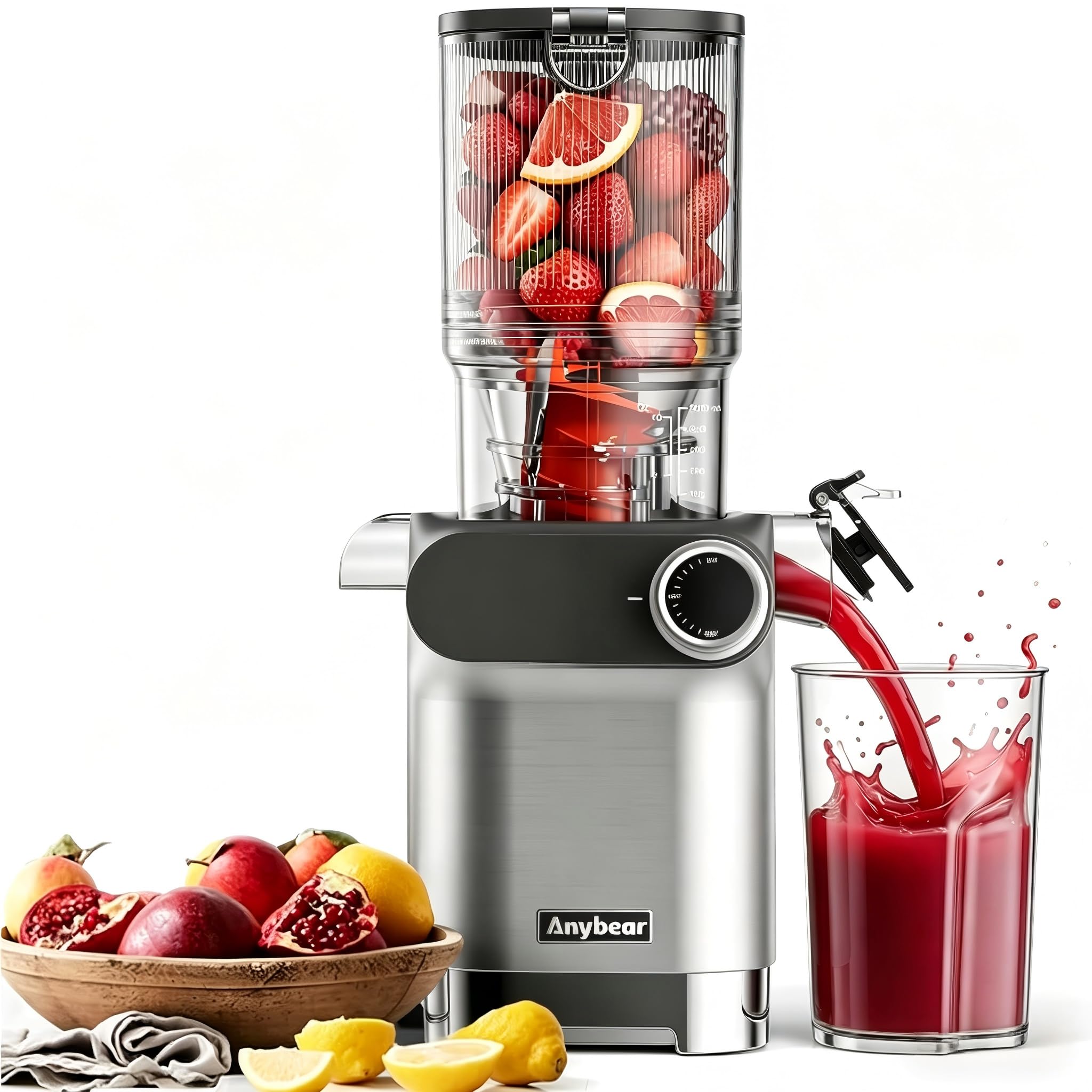
Anybear takes a torque-first approach with a 200W motor that delivers a massive 180 newton-meters of torque — one of the highest figures in this guide. This matters when you push through whole beets, sweet potatoes, or frozen chunks of pineapple without the motor bogging down or overheating. The auger spins at a steady 65 RPM, which is right in the sweet spot for minimizing oxidation while still processing produce quickly. The 4.3-inch feed chute is wide enough to fit whole apples and halved oranges without pre-cutting, saving noticeable prep time on busy mornings.
Material quality is a focus here. The feed chute is made from imported USA Tritan, a premium BPA-free plastic commonly used in baby bottles and high-end water bottles. The one-piece stainless steel filter is designed to rinse clean with a single pass under water. A rotary control with clearly marked ON, OFF, and REVERSE positions is intuitive enough for elderly users or children to operate safely. The package includes a recipe book and an extended 5-year warranty with free replacement — a strong indicator of confidence in the build.
The major concern reported by a minority of buyers is quality control at delivery. At least one user received a unit that appeared to be used or refurbished rather than brand new, and the return process, while ultimately handled by Amazon, was inconvenient. The 200W motor, while high-torque, draws more power than the average 150W slow juicer, but that trade-off is acceptable for anyone who regularly juices dense root vegetables. Overall, the Anybear offers genuine value if you get a fresh unit, and the five-year warranty provides a safety net.
Why it’s great
- 180nm torque handles dense produce like beets and sweet potatoes with ease
- Tritan feed chute — baby-grade BPA-free material
- 5-year extended warranty with free replacement
- 4.3-inch chute fits whole apples; one-piece filter rinses clean instantly
Good to know
- Occasional quality control issues — some units arrive appearing previously used
- Higher power draw; motor is 200W instead of the more common 150W
6. Greater Goods Cold Press Juicer

Greater Goods positions this juicer as the quiet alternative to pricier models, and it delivers on that promise. The 150W motor operates at less than 60 decibels — roughly the volume of a quiet conversation — which makes it a strong candidate for early-morning juicing in shared apartments or homes with sleeping children. The motor speed varies between 85 and 115 RPM depending on the load, which is slightly faster than the 60 RPM of premium machines, but the trade-off is faster throughput without significant heat generation. The 3-inch feed chute is adequate for small apples, carrots, celery, and cucumbers but will require quartering of larger fruit.
The build quality punches above its price point. The machine has a sturdy, stable base with a non-skid footing, and the sage green finish is genuinely attractive enough to leave on the counter. Assembly and disassembly are straightforward: the one-piece auger housing clicks into place without alignment frustration, and most parts are top-rack dishwasher safe. The included cleaning brush tackles the strainer basket effectively. Users consistently report that the juice comes out smooth with minimal froth and that the pulp is notably dry — a sign of efficient extraction.
There are a couple of ergonomic compromises. The 400ml juice cup is small compared to the 1000ml+ capacity found on premium models, meaning you will empty it at least once per batch if you are juicing for more than one person. The plunger can be tricky to use because the chute walls are relatively snug, requiring some care when pushing produce down. A few users questioned the long-term durability of the plastic auger housing, though no widespread failure pattern has emerged. For a mid-range buy that prioritizes quiet operation and a refined countertop presence, the Greater Goods is a well-considered choice.
Why it’s great
- Sub-60 dB operation — among the quietest vertical slow juicers tested
- Sturdy build with attractive sage green finish; stable on the counter
- Top-rack dishwasher safe; easy one-piece auger housing assembly
- Smooth juice with minimal froth and dry pulp
Good to know
- 400ml juice cup is small for multi-serving batches
- Plunger fits snugly in the chute, requiring careful insertion
7. SMALLHOO 3-in-1 Cold Press Juicer
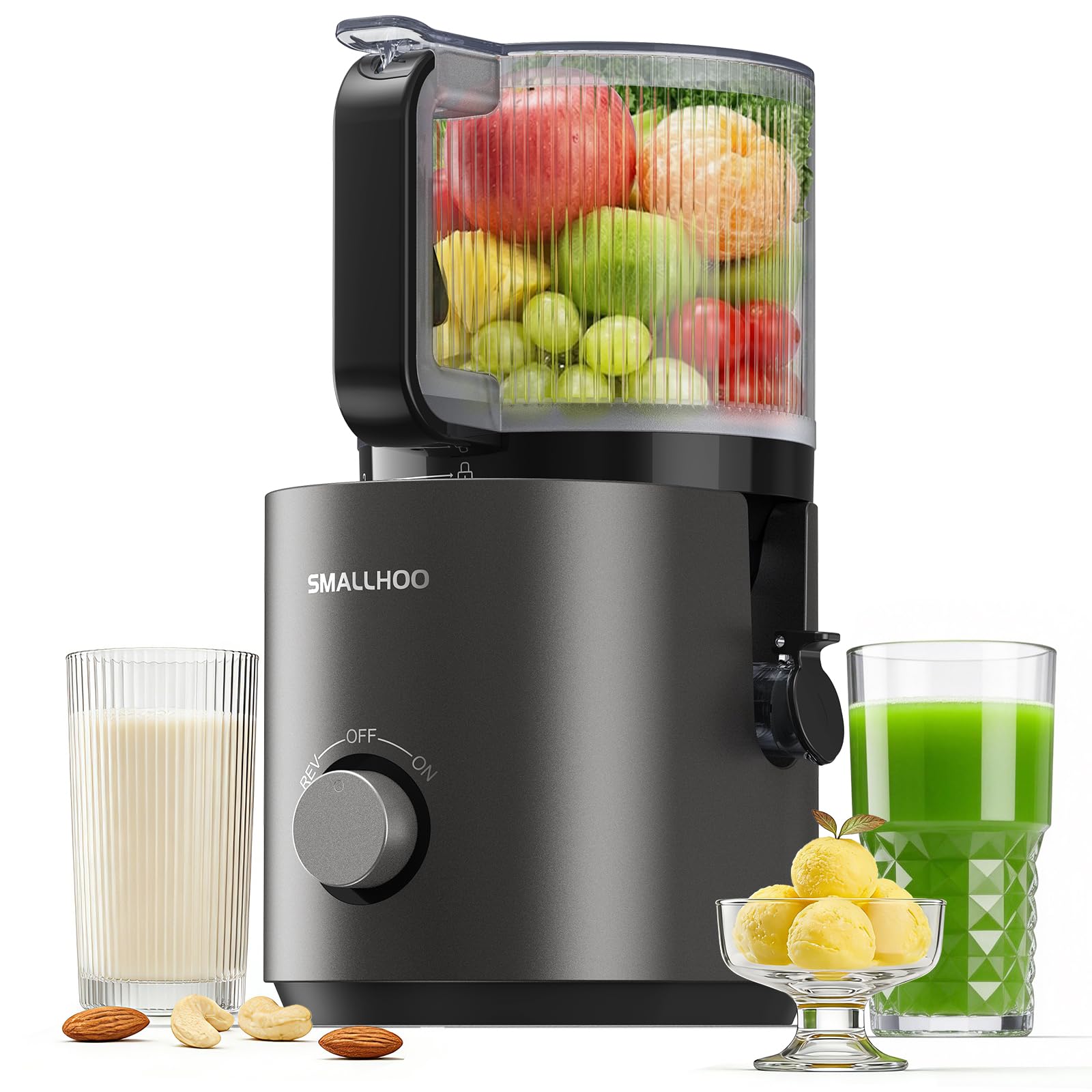
If reducing prep time to absolute zero is your top priority, the SMALLHOO 3-in-1 is the standout model in this guide thanks to its 7-inch ultra-wide feed chute. That is wide enough to drop in a whole pineapple core-first or an entire head of romaine without any chopping. The motor is rated at 350W — higher than any other model in this lineup — and the 60 RPM slow-squeeze technology maintains the cold press principles despite the larger power draw. The 120-ounce extra-large hopper holds enough produce for a week’s worth of juice in a single loading session, which is ideal for families or serious meal preppers.
Versatility is a major selling point. The machine comes with three interchangeable strainers that let you switch between pure juice, creamy nut milk, and natural sorbet. The stainless steel construction on the main body gives it a more durable feel than the all-plastic budget models, and the mirror satin finish is easy to wipe down. The reverse function works well for clearing clogs, and the automatic safety lock prevents operation when the lid is open — a genuinely important feature if children are in the home. Users consistently report the juice yield is excellent and that the unit is quieter than expected for a 350W motor.
There are some drawbacks. The motor runs warm after extended use, and the wide chute means you need significant vertical clearance above the counter — about 17 inches — to feed produce. Some users noted that the machine can be slightly noisy on the sorbet setting compared to juice mode. The 3-in-1 versatility, while impressive, requires swapping the strainer basket, which adds a few minutes to cleanup. For anyone who hates chopping produce and wants the widest possible feed chute, the SMALLHOO delivers an experience that no narrow-chute juicer can match.
Why it’s great
- 7-inch chute fits whole pineapples and romaine heads without prep
- 120-ounce hopper enables true batch juicing for families
- Three interchangeable strainers for juice, nut milk, and sorbet
- Stainless steel body with mirror finish; automatic safety lock
Good to know
- Motor runs warm during extended continuous use
- Requires 17 inches of overhead clearance for feeding tall produce
8. Godspeeds Juicer Machines with 5.8″ Chute
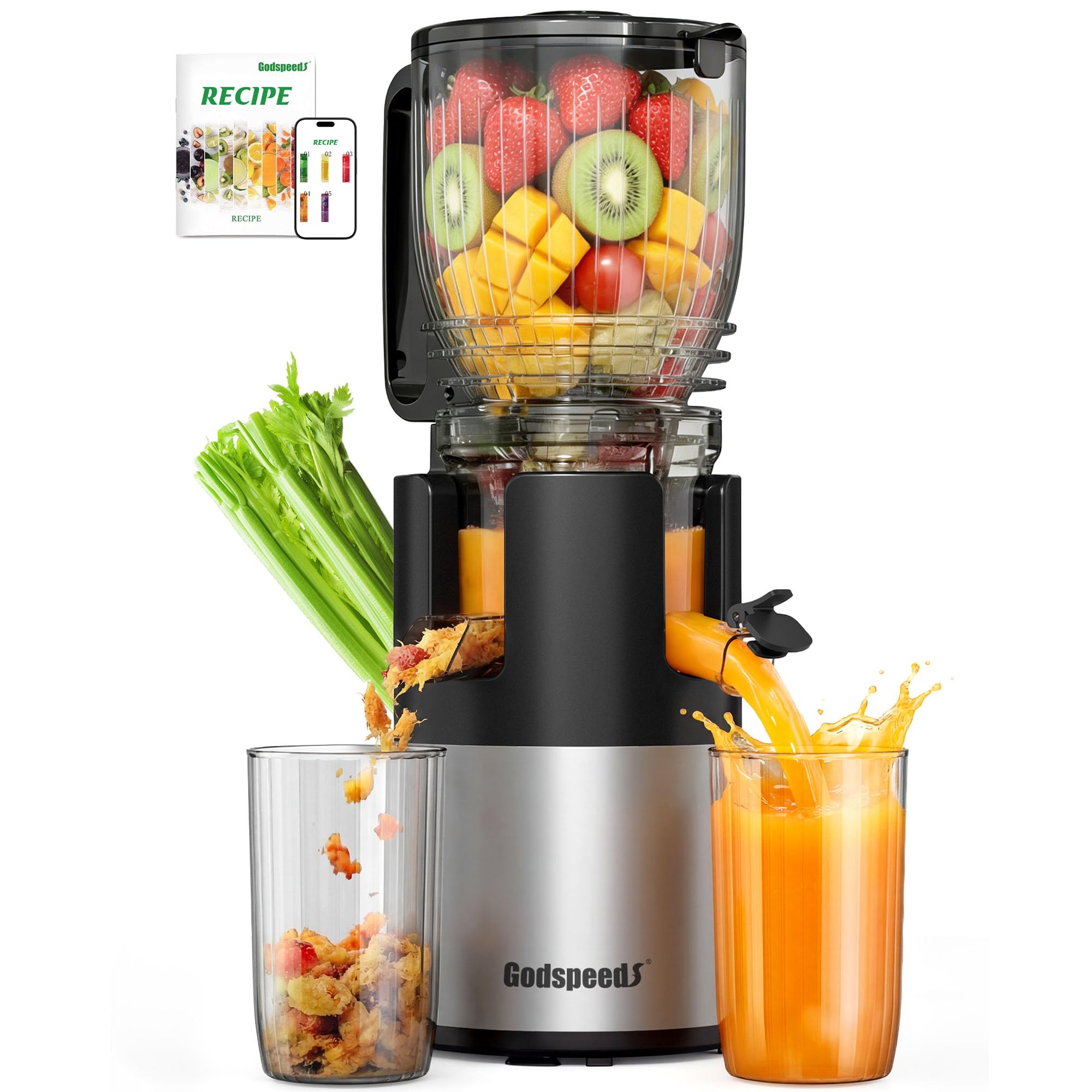
The Godspeeds Slow Juicer enters the budget tier with a surprisingly generous 5.8-inch wide feed chute that fits whole apples and cucumbers, something many budget juicers cannot claim. The 300W motor is powerful on paper, and when combined with the masticating auger, it produces high juice yields with very dry pulp. User reviews consistently praise the easy assembly — a simple three-step process — and the quiet operation, both of which are uncommon at this price level. The machine includes a recipe book, a safety lock feature, and overheat protection for peace of mind.
The standout feature is the removable filter that resists pulp buildup and rinses clean in seconds under running water. No soaking or scrubbing is required, which directly addresses the number-one complaint among first-time juicer buyers: difficult cleanup. The metal-free filter is also gentler on the juice, preserving natural flavors without metallic aftertaste. Users regularly report that the machine handles a wide range of produce — apples, oranges, celery, carrots, leafy greens — with consistent results and that the resulting juice stays vibrant for 48 hours in the refrigerator.
There is one functional limitation that emerges from real-world use: the machine has a tendency to clog when processing fibrous ingredients like ginger, especially when inserted in large chunks. One user noted that the clog almost always happens at the pulp discharge point, requiring a brief disassembly to clear. Additionally, the bulk of the reviews are short-term impressions based on the first week of ownership, so long-term durability data is thin. For a first-time slow juicer buyer on a strict budget who values a wide chute and easy cleaning, the Godspeeds is the safest entry-level bet on this list.
Why it’s great
- 5.8-inch wide chute at a budget price point — a rarity in this tier
- Removable filter rinses clean in seconds; no soaking required
- Quiet 300W motor produces high juice yield with dry pulp
- Three-step assembly is beginner-friendly
Good to know
- Prone to clogging at the pulp discharge when juicing fibrous ginger or large ginger chunks
- Limited long-term durability data from sustained daily use
9. Breville BCP600SIL Citrus Press Motorized Juicer

The Breville BCP600SIL is not a traditional slow masticating juicer; it is a purpose-built citrus press that uses a motorized cone to extract juice from oranges, grapefruits, lemons, and limes. If your primary juicing goal is fresh-squeezed orange juice every morning, this machine outperforms any masticating juicer on citrus by a wide margin. The finned juicing cone and fruit dome work together to apply even downward pressure, extracting every drop of juice from two orange halves in roughly five to seven seconds. The dual switch safety mechanism ensures the cone only spins when the arm is lowered, making it genuinely safe for family kitchens.
The drip-stop juice spout is a clever piece of engineering: it holds the juice in the collector until you push a glass against the spout, which prevents countertop messes. Cleanup is straightforward — the juice cone, collector, and filter are all dishwasher safe. Users consistently cite the build quality as excellent for a plastic unit, with a heavy base that prevents tipping during operation. A real-world example: one user reported extracting 2.75 cups of juice from 18 limes in a single session, with minimal pulp and no spillage.
The limitation is obvious: this machine does nothing besides citrus. It cannot juice carrots, celery, apples, ginger, or leafy greens. The juice collector holds only 16 ounces, so you will need to stop and empty it during large batches. There is no reverse function because clogs are not an issue with citrus, but the single-purpose nature means you will still need a second appliance for vegetable juicing. If your household consumes fresh orange juice daily and you rarely juice vegetables, the Breville is the fastest and most satisfying tool for the task.
Why it’s great
- Extracts juice from two orange halves in 5–7 seconds with minimal effort
- Drip-stop spout prevents countertop messes between cups
- Dishwasher-safe cone, collector, and filter for easy cleanup
- Dual safety switch prevents operation without the arm lowered
Good to know
- Dedicated citrus press — cannot juice vegetables, apples, or greens
- 16-ounce juice collector requires emptying during large batches
FAQ
How long does fresh slow-pressed juice last in the refrigerator?
Can a slow juicer handle wheatgrass and leafy greens without clogging?
What does the reverse function actually do on a slow juicer?
Is a 350W motor better than a 150W motor for a slow juicer?
How many parts do most slow juicers have for cleaning?
Final Thoughts: The Verdict
For most users, the best slow juicer winner is the TUUMIIST 3-in-1 Cold Press Juicer because it delivers the ideal balance of wide feed chute, smart touchscreen controls, quiet operation, and three-minute cleanup at a realistic mid-premium price. If you want bulletproof long-term reliability and the highest juice yield from leafy greens, grab the Kuvings Whole Slow Juicer B6000S with its 10-year warranty. And for hands-free batch juicing that lets you walk away while the machine processes a full hopper, nothing beats the Omega Cold Press Juicer.