A single boiler espresso machine forces a deliberate trade-off: steam first, then brew, or brew first, then steam. That workflow constraint defines every machine on this list, separating enthusiasts who value shot quality from those who prioritize speed. The real challenge isn’t the temperature swing between modes—it’s finding a machine whose brew boiler holds temperature stability long enough to pull a balanced shot before the element kicks back on.
I’m Mohammad Maruf — the founder and writer behind AirfryerBite. I’ve spent years analyzing thermal dynamics, pressure profiling, and build quality across dozens of espresso machine categories, focusing specifically on how single boiler designs manage the thermodynamic gap between brewing and steaming.
This guide breaks down the strongest contenders in the category, from lever-driven classics to PID-stabilized semi-automatics. Whether you value manual control, rapid heat-up, or commercial-grade components, the right single boiler espresso machine balances temperature precision with your daily workflow.
How To Choose The Best Single Boiler Espresso Machine
A single boiler design means the same heating element and chamber serve both brewing and steaming. The transition between modes takes time—usually 30 to 90 seconds—depending on boiler material, wattage, and thermal mass. The best machines in this category minimize that wait without sacrificing shot quality.
Boiler Material and Thermal Mass
Aluminum heats fast but cools fast too, which creates temperature instability during the brew cycle. Brass and copper boilers hold heat longer, giving you a more forgiving window for extraction. Uncoated aluminum, like the Gaggia Classic Evo Pro’s boiler, requires careful temperature management to avoid bitter or sour shots. Stainless steel-lined aluminum thermoblocks, like those in the Ascaso Steel DUO, offer faster heat-up than brass but still maintain consistency through PID feedback.
PID vs. Thermostat Control
A PID (Proportional-Integral-Derivative) controller maintains the boiler temperature within a narrow range, typically ±1°F, by adjusting power output in real time. Standard thermostats let the temperature swing 10–15°F before kicking the element back on, which leads to sour first shots and bitter follow-ups. For a single boiler machine, PID control is the single most impactful upgrade you can prioritize—it makes the thermal recovery gap between steam and brew modes predictable.
Steam Wand Design
Single boiler machines often use a single-hole or two-hole steam tip because the boiler can’t generate the sustained steam pressure of a heat exchanger or dual boiler. A commercial-style, ball-jointed wand with a single-hole tip produces the best microfoam for latte art, but it requires the boiler to be fully heated to steam temperature first. Some designs, like the De’Longhi Dedica’s automatic wand, trade manual control for convenience by managing the steam-to-brew transition automatically.
Portafilter Size and Basket Compatibility
A 58mm portafilter gives you access to commercial-grade baskets, bottomless portafilters, and precision tampers. Smaller sizes like the 49mm on the Flair Pro or the 54mm on some Philips models limit aftermarket upgrades and change the dose-to-yield ratio. For dialing in specific beans, 58mm is the standard; for forgiving extraction with larger grind sizes, smaller diameter baskets can be more beginner-friendly.
Quick Comparison
On smaller screens, swipe sideways to see the full table.
| Model | Category | Best For | Key Spec | Amazon |
|---|---|---|---|---|
| Ascaso Steel DUO | Dual Thermoblock | Precision PID & Fast Heat-Up | PID ±1°F control | Amazon |
| Rocket R58 Cinquantotto | Dual Boiler | Commercial-Grade Build | 58mm E61 group | Amazon |
| Diletta Bello+ | E61 Single Boiler | Manual Craft with PID | E61 group & shot timer | Amazon |
| Gaggia Classic Evo Pro | Classic Single Boiler | Mod-Friendly Reliability | 58mm commercial portafilter | Amazon |
| Gaggia Classic Pro | Classic Single Boiler | Proven Workhorse | 9 bar extraction | Amazon |
| La Pavoni PC-16 | Lever Manual | Hands-On Pressure Control | 38oz solid brass boiler | Amazon |
| Ninja Luxe Café Pro ES701 | Multi-Function | Automated All-in-One | Built-in grinder & tamper | Amazon |
| Ninja Luxe Café Premier ES601 | Multi-Function | Guided Espresso & Drip | 25 grind settings | Amazon |
| De’Longhi Dedica Maestro Plus | Compact Semi-Auto | Quick Heat-Up & Compact | 54oz water tank | Amazon |
| Philips Barista Brew | Integrated Grinder | Beginner-Friendly Semi-Auto | 280g dual bean container | Amazon |
| Flair 49 PRO | Manual Lever | Pure Manual Control | 49mm no-plastic brew path | Amazon |
In‑Depth Reviews
1. Ascaso Steel DUO Espresso Machine

The Ascaso Steel DUO uses two independent thermoblocks — one for brewing at 200°F and one for steaming at 275°F+ — which effectively sidesteps the single boiler temperature swing problem. The PID controller adjusts in 1-degree increments, and the 58mm walnut-handled portafilter accepts standard commercial baskets. Heat-up takes under two minutes, and the brew thermoblock maintains stability within ±1°F during a 25–30 second extraction.
The steam thermoblock produces dry, consistent pressure for microfoam without waiting for a boiler to recover. Volumetric programming lets you save preinfusion duration, single dose volume, and double dose volume. The carbon steel and polished stainless steel body adds 35 pounds of heft, which dampens vibration from the vibe pump during extraction.
One caveat: the 120V version requires a 15A circuit, and some users report the steam power drops slightly on shared kitchen circuits. The interface, while precise, has a learning curve for programming preinfusion times. For home baristas who want PID accuracy without the thermal recovery wait, this is the most capable single boiler alternative on the market.
Why it’s great
- Independent brew and steam thermoblocks eliminate mode-switching delay.
- PID control at 1°F increments gives exceptional shot repeatability.
- 58mm commercial portafilter with walnut handle accepts all standard accessories.
Good to know
- Requires a dedicated 15A circuit for full steam performance.
- Volumetric programming interface is not intuitive out of the box.
2. Rocket Espresso R58 Cinquantotto

The Rocket R58 Cinquantotto uses separate boilers for brew and steam, which means you can steam and pull shots simultaneously without temperature interference. The brew boiler operates at 200°F while the steam boiler holds 270°F, and the detachable PID touchscreen gives real-time access to both temperatures. Heat-up from cold takes about 10 minutes, and the commercial-grade rotary pump supports optional direct plumbing.
The E61 group head provides passive preinfusion through its thermosiphon design, and the mirrored shot timer sits flush against the stainless steel body. The steam wand uses a two-hole tip that produces very dry, high-pressure steam for latte art. The 2.5-liter boiler capacity supports multiple back-to-back milk drinks without significant temperature drop.
Build quality is exceptional — hand-assembled in Milan with non-proprietary parts — but the brew head clearance is tight. A scale under a bottomless portafilter may not fit without raising the cup tray. The 58mm portafilter accepts standard baskets, and the rotary pump runs far quieter than vibe pumps found on budget single boilers.
Why it’s great
- Dual boilers allow simultaneous brewing and steaming without temperature swing.
- Rotary pump supports direct plumbing and runs quietly.
- E61 group head provides thermal stability and passive preinfusion.
Good to know
- Brew head clearance is tight; scales may not fit under bottomless portafilter.
- Preinfusion is passive only — no programmable duration control.
3. Diletta Bello+ Espresso Machine

The Diletta Bello+ couples a classic E61 group head with PID temperature control on the steam boiler, giving you thermal stability for both brew and steam modes. The 3-liter boiler heats up in roughly 15 minutes, and the PID screen doubles as a shot timer during extraction. Programmable preinfusion up to 10 seconds adds flexibility for lighter roasts that benefit from a low-pressure soak.
The stainless steel body and frame are hand-made in Milan, and the E61 group uses a thermosiphon design for passive temperature stabilization. The cool-touch steam wand rotates 360 degrees and produces enough pressure for microfoam on 2–3 milk drinks before needing recovery. The low-power eco-mode reduces boiler temperature during idle periods, cutting energy consumption without losing thermal momentum.
This is not a beginner machine — the 58mm portafilter and bottomless basket demand good puck prep and WDT technique. The drip tray is small relative to the footprint, and the eco-mode recovery from idle to brew temperature takes about 30 seconds longer than full power operation. For experienced users upgrading from a Breville or Gaggia, the Bello+ offers genuine E61 thermal inertia at a lower entry point than dual boiler alternatives.
Why it’s great
- E61 group head delivers commercial-grade thermal stability for single boiler design.
- PID control with shot timer and programmable preinfusion up to 10 seconds.
- Eco-mode saves energy while maintaining faster recovery than thermostats.
Good to know
- Long 15-minute heat-up time compared to thermoblock machines.
- Drip tray is small and requires frequent emptying during multiple shots.
4. Gaggia RI9380/49 Classic Evo Pro

The Gaggia Classic Evo Pro uses an uncoated aluminum boiler with a 9-bar OPV and a commercial three-way solenoid valve. The 58mm portafilter accepts standard commercial baskets, and the steel housing is built in Italy. Heat-up takes about 5 minutes, and the brew temperature is controlled by a standard thermostat with a roughly 15°F swing band — meaning you’ll need to temperature surf for consistent shots without modification.
The steam wand is a commercial-style articulating tube, and the machine ships with both pressurized and non-pressurized baskets. The modding community around this machine is extensive: you can swap the OPV spring to adjust brew pressure, add a PID controller for stable temperatures, install a single-hole steam tip for better microfoam, and add a dimmer switch for flow control. The uncoated aluminum boiler requires regular descaling and careful water quality management to prevent corrosion.
For its price tier, the Classic Evo Pro offers the most repairable and upgradable platform. The brass boiler version (E24) addresses the corrosion concern, but the standard Evo Pro remains the cheapest entry point into commercial-format 58mm espresso with a three-way solenoid. If you’re willing to invest in a PID kit and a proper grinder, this machine can produce espresso that rivals machines costing three times as much.
Why it’s great
- 58mm commercial portafilter accepts all standard accessories and baskets.
- Extensive modding community supports PID, OPV spring swap, and flow control upgrades.
- Three-way solenoid valve keeps dry pucks and simplifies cleanup.
Good to know
- Uncoated aluminum boiler is prone to scaling and requires diligent maintenance.
- Standard thermostat creates 15°F temperature swing; PID upgrade is recommended for consistency.
5. Gaggia RI9380/47 Classic Pro

The Gaggia Classic Pro uses a brass boiler with a 9-bar OPV and a three-way solenoid valve, offering better thermal stability than the aluminum-boiler Evo Pro. The 58mm commercial portafilter and steel housing match the Evo Pro’s footprint, but the brass boiler retains heat longer and recovers faster between shots. The steam wand is a commercial-style articulating tube with a two-hole tip, though many users swap it for a single-hole tip for finer microfoam control.
The thermostat on this model still has a roughly 10–15°F swing band, so temperature surfing or PID modification is recommended for precise extraction. The machine ships with pressurized baskets for beginners and non-pressurized baskets for experienced users. The three-way solenoid valve relieves pressure after brewing, producing dry pucks that knock out cleanly.
Long-term owners report that the brass boiler lasts for years with standard descaling and routine gasket replacements. The parts availability is excellent, and the modding community is mature. This machine is not for users who want push-button convenience — it rewards those willing to dial in grind, dose, and temperature technique. For its price tier, the brass boiler Classic Pro is the most durable single boiler option before stepping up to E61 machines.
Why it’s great
- Brass boiler provides better thermal retention and recovery than aluminum equivalents.
- 58mm commercial portafilter and three-way solenoid for clean pucks.
- Simple, repairable design with excellent parts availability.
Good to know
- Thermostat temperature swing requires surfing or PID upgrade for consistency.
- Steam wand tip works better for beginners after swapping to single-hole version.
6. La Pavoni PC-16 Professional Espresso Machine

The La Pavoni PC-16 uses a 38-ounce solid brass boiler with a vertical lever group that gives you direct pressure profiling through arm force. There is no thermostat-controller temperature swing because you control the pressure manually — a skilled user can hold 9 bars for the entire extraction or ramp pressure for blooming light roasts. The chrome-plated brass body is made in Italy and has a footprint smaller than most semi-automatic machines.
The steam wand uses a proprietary design that produces less powerful steam than modern commercial wands, which limits microfoam quality for latte art. The boiler capacity of 38 ounces is enough for about two double shots before refilling. The machine comes with a pressurized basket system, but the real performance comes from using non-pressurized baskets with a fine grind and proper tamp.
Learning curve is steep: group head temperature varies with boiler pressure, and pulling consistent shots requires tracking preinfusion time and lever speed. The machine lacks a pressure gauge on the group, so users rely on a group head temperature sticker or a dedicated thermometer to dial in. For users who want complete manual control and are willing to practice, the Pavoni produces body-heavy shots with thick crema that semi-automatics struggle to match.
Why it’s great
- Manual lever gives full pressure profiling control for customized extractions.
- Solid brass boiler offers excellent thermal mass in a compact footprint.
- No electronics means long-term repairability and simple maintenance.
Good to know
- Steam wand produces lower pressure than commercial wands; microfoam requires practice.
- No pressure gauge on group head; temperature tracking requires external thermometer.
7. Ninja Luxe Café Pro Series ES701

The Ninja Luxe Café Pro ES701 integrates a conical burr grinder with 25 settings, a built-in scale for weight-based dosing, and an assisted tamper that uses a lever mechanism to apply consistent pressure. The Dual Froth System Pro combines steaming and whisking simultaneously for hands-free microfoam, and the independent hot water system lets you brew Americanos, tea, or hot chocolate without affecting the steam function. The machine also brews drip coffee and cold press espresso, making it a four-in-one countertop appliance.
The Barista Assist Technology monitors each brew and adjusts grind size recommendations based on previous extraction data. You can select from single, double, quad, ristretto, and lungo espresso styles, and the machine automatically adjusts dose, tamp pressure, and water temperature. The 68-ounce water tank is large enough for multiple drinks without frequent refilling.
Some users report that the milk frother adds water during automatic steaming, diluting the microfoam texture slightly. The quad shot function produces a thinner, less concentrated result compared to pulling a double from a dedicated espresso machine. The machine cannot steam and brew simultaneously, and the drip tray fills quickly when brewing hot water through the frother system. For users who want a countertop appliance that handles espresso, drip, and cold brew with minimal manual technique, the Pro ES701 delivers convenience at the cost of espresso purity.
Why it’s great
- Built-in grinder with weight-based dosing and assisted tamper for consistent puck prep.
- Dual Froth System creates hands-free microfoam suitable for dairy and plant-based milks.
- Four-in-one functionality covers espresso, drip, cold brew, and hot water.
Good to know
- Automatic milk frother can add water and dilute microfoam texture.
- Quad shot function produces thinner, less concentrated espresso than dedicated machines.
8. Ninja Luxe Café Premier ES601
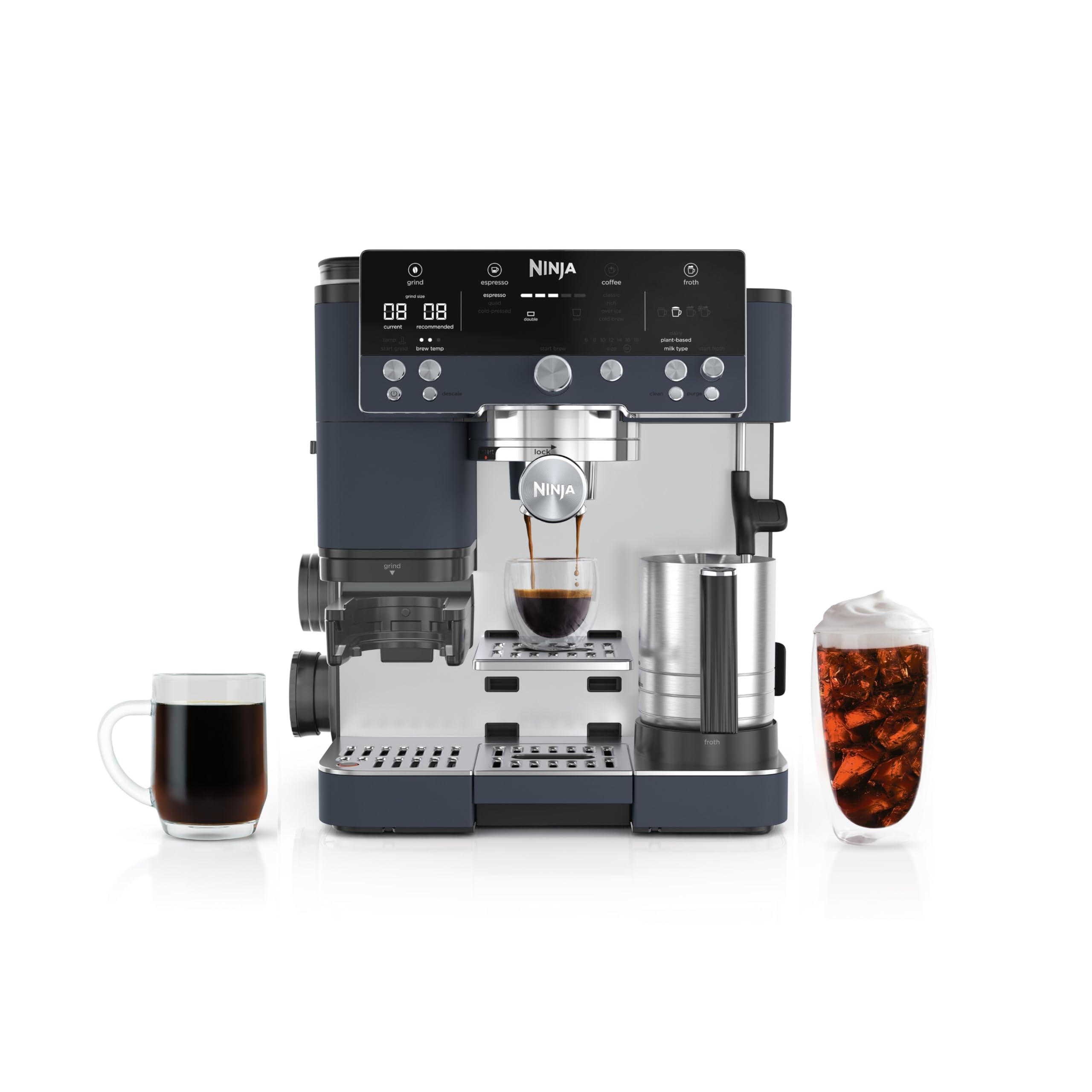
The Ninja Luxe Café Premier ES601 uses Barista Assist Technology to guide you through grind size and dose adjustments based on live extraction feedback. The built-in conical burr grinder has 25 settings, and the built-in scale measures coffee weight before grinding. The assisted tamper uses a spring-loaded lever to apply consistent tamp pressure, removing one variable from the dial-in process. The machine brews espresso, drip coffee, and rapid cold brew from a single portafilter system.
The hands-free milk frother uses a magnetic whisking mechanism that works with both dairy and non-dairy milk. You can select thin froth, thick froth, or cold foam from the control panel, and the machine automatically heats and textures the milk. The 4.4-pound capacity refers to the machine’s weight, not the water tank; the actual removable tank holds 54 ounces for espresso and up to 68 ounces combined for drip and cold brew modes.
Users report that the espresso quality is consistent and repeatable for the target audience — casual enthusiasts who want good results without measuring and timing every shot. The drip coffee function is adequate but not exceptional compared to dedicated drip brewers. The regular drip coffee mode produces a slightly thin body compared to the espresso output. The steam wand dribbles slightly after use, requiring a quick wipe to prevent dripping on the counter.
Why it’s great
- Barista Assist Technology provides live grind size and dose recommendations.
- Hands-free milk frother works with dairy and plant-based milks with preset froth levels.
- Three-in-one design covers espresso, drip coffee, and cold brew in one footprint.
Good to know
- Drip coffee function produces thinner body than dedicated drip brewers.
- Steam wand may dribble after use; requires quick cleanup to prevent counter mess.
9. De’Longhi Dedica Maestro Plus

The De’Longhi Dedica Maestro Plus uses a 15-bar Italian pump that preinfuses at low pressure before ramping to 9 bars during extraction. The advanced thermoblock heats up in roughly 30 seconds, and three infusion temperature settings let you match the water temperature to your bean roast level. The automatic steam wand offers three temperature and three milk texture settings, managing the steam-to-brew transition without manual input. The 54-ounce removable tank is generous for a machine with a footprint of just 8.15 inches wide.
The machine uses a proprietary 53mm portafilter, which limits aftermarket basket compatibility compared to 58mm standards. The auto steam wand purges after each use to prevent milk residue buildup, and the drip tray, water tank, and portafilter are dishwasher-safe. The compact stainless steel design fits under standard cabinets with the drip tray removed, making it one of the most counter-friendly single boiler options available.
Reviewers note that the automatic steam wand produces acceptable microfoam but lacks the dry power of a commercial articulating wand for advanced latte art. The 53mm portafilter means you cannot use standard VST or IMS baskets for finer control. For users who want quick heat-up, automatic milk texturing, and a small footprint, the Dedica Maestro Plus delivers consistent espresso with minimal workflow friction.
Why it’s great
- 30-second heat-up from cold with advanced thermoblock technology.
- Automatic steam wand with three temperature and texture settings manages transition.
- Compact 8.15-inch wide footprint fits small countertops easily.
Good to know
- 53mm portafilter limits aftermarket basket and accessory compatibility.
- Automatic steam wand produces good microfoam but less dry than commercial articulating wands.
10. Philips Barista Brew PSA3228/41
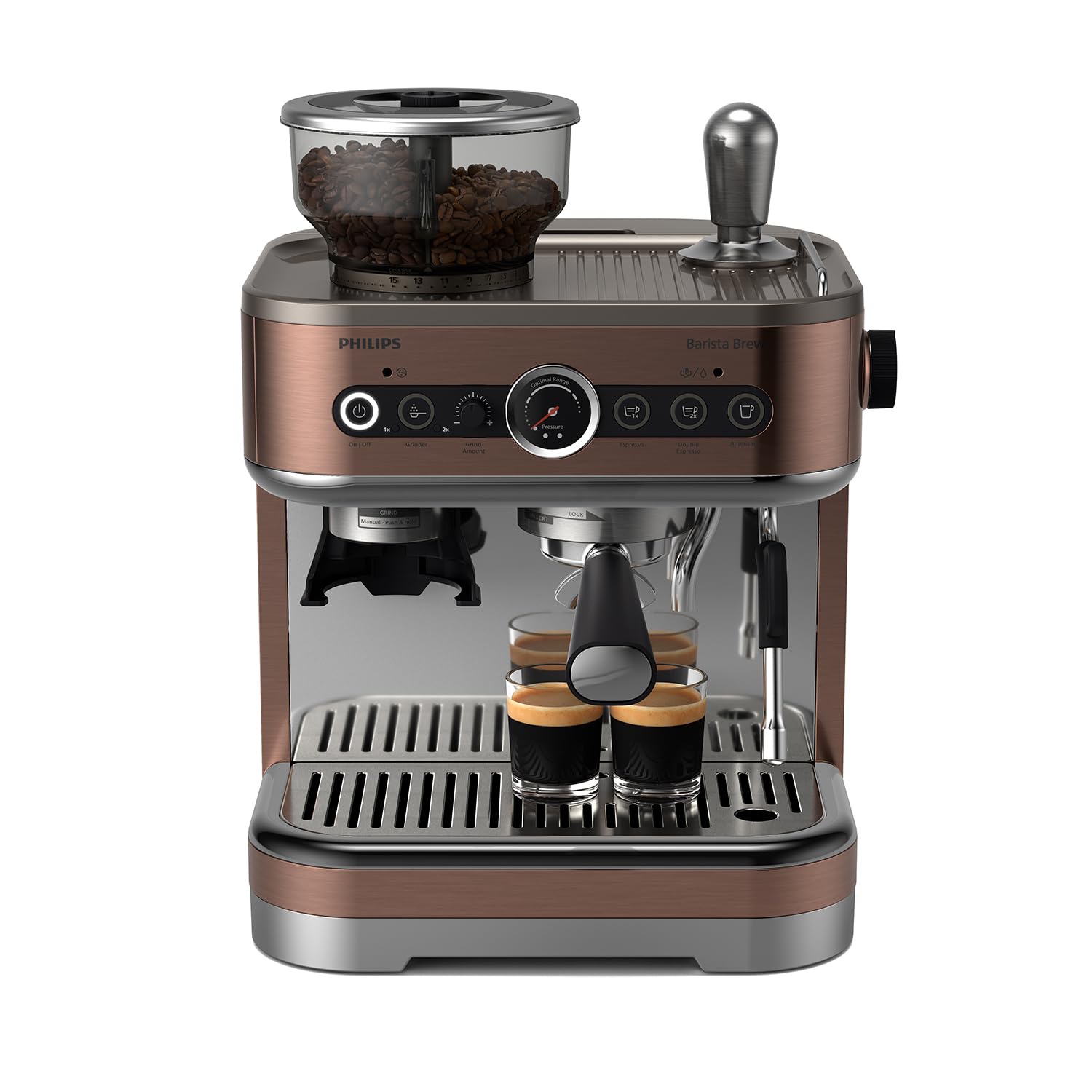
The Philips Barista Brew uses a 58mm portafilter with single and dual wall filter baskets, giving users the option to use pre-ground coffee or fresh beans from the dual 280-gram bean container. The integrated conical burr grinder dispenses directly into the portafilter, and the calibrated tamper uses a countertop-safe tamping system to ensure consistent pressure. The machine features separate buttons for single, double, and Americano, with a hot water outlet for tea or lungo-style drinks.
The steam wand is a manual articulating design paired with a 450ml stainless steel milk jug for frothing. The anti-fingerprint metal housing keeps the exterior clean during daily use, and the compact footprint fits most countertops. The machine also includes a powder ring for leveling and an espresso stand for cup placement during extraction.
Some users report that the double basket is too shallow for a 20-gram dose, causing coffee to overflow when removing the funnel. The grind adjustment range is not marked in grams, making repeatability slightly inconsistent between batches. The steam wand produces acceptable microfoam but requires practice for latte art consistency. For beginners who want a complete setup with a 58mm portafilter and integrated grinder, the Barista Brew offers a guided experience without the complexity of external equipment.
Why it’s great
- 58mm portafilter with single and dual wall baskets for flexibility with grind quality.
- Integrated grinder with dual bean container and calibrated tamper simplifies workflow.
- Compact metal housing with anti-fingerprint coating stays clean during daily use.
Good to know
- Double basket is too shallow for 20-gram doses; aftermarket basket recommended.
- Grind adjustment lacks gram markings, making repeatability less precise.
11. Flair 49 PRO Manual Espresso Maker
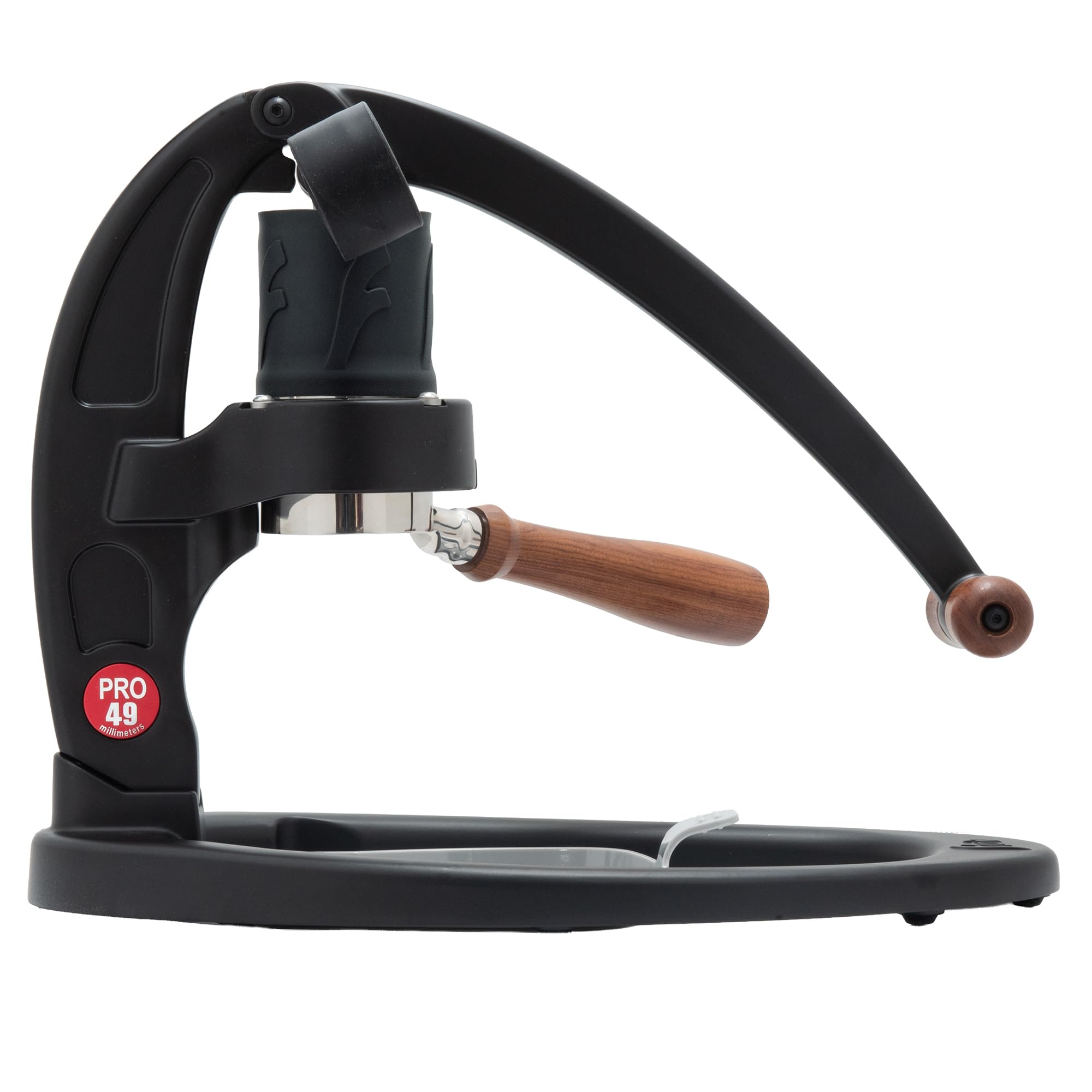
The Flair 49 PRO is a fully manual lever machine that uses a 49mm portafilter with a stainless steel brew cylinder, valve plunger, and stem. There are no plastics in the brew path, and the integrated pressure gauge shows the custom espresso zone between 5 and 9 bars. The machine requires a kettle for heating water, a burr grinder, and a scale — it does not include a heating element or pump. The footprint measures 13.5 by 7.5 inches, making it one of the most portable single boiler alternatives available.
The 49mm portafilter is deeper and more narrow than 58mm standard, which allows for larger grind sizes and longer contact time. This design produces espresso with fuller body and mouthfeel compared to wider baskets. The machine includes both a pressurized basket for beginners without a quality grinder and a bottomless basket for full control. The carrying case makes it suitable for travel or camping.
Workflow requires boiling water separately, preheating the brew chamber, grinding and dosing, then assembling and pulling the shot. The temperature management is manual — you control water temperature and preheat duration. The learning curve is significant: consistent shots require practice with grind, dose, tamp, and lever pressure. For users who want complete control over every variable and are willing to invest in separate equipment, the Flair 49 PRO produces espresso that competes with commercial lever machines at a fraction of the counter space.
Why it’s great
- Fully stainless steel brew path with no plastic contact for pure flavor.
- 49mm narrow, deep basket allows forgiving grind size and full-bodied shots.
- Integrated pressure gauge for profiling between 5 and 9 bars.
Good to know
- Requires separate kettle, grinder, and scale — not an all-in-one setup.
- Manual workflow with preheating and assembly time is slower than semi-automatics.
FAQ
Can I steam milk and brew espresso simultaneously with a single boiler machine?
Do I need a PID upgrade on a Gaggia Classic Pro to make good espresso?
How does a 49mm portafilter change espresso extraction compared to 58mm?
What water quality is best for single boiler espresso machines to prevent scaling?
Final Thoughts: The Verdict
For most users looking for a single boiler espresso machine, the winner is the Gaggia Classic Evo Pro because it offers the best balance of commercial-format 58mm portafilter, repairable design, and modding potential at its price tier. If you want PID precision without the wait time, grab the Ascaso Steel DUO for its dual thermoblock system and 1-degree temperature control. And for pure manual control with zero electronics and the ability to dial in pressure profiling, nothing beats the Flair 49 PRO — just budget for a quality grinder and a gooseneck kettle.