A dull knife is not just frustrating—it’s dangerous, forcing you to apply extra pressure that leads to slips and cuts. The remedy is a proper sharpening stone, but the market is flooded with confusing grit numbers, materials, and claims that paralyze new buyers. This guide cuts through the noise to pinpoint the specific stones that actually work for a first-time user.
I’m Mohammad Maruf — the founder and writer behind AirfryerBite. I’ve spent years analyzing kitchen hardware specifications, from blade geometries to abrasive particle density, to separate marketing fluff from functional gear.
Whether you own a single chef’s knife or a full block of neglected blades, learning to use a sharpening stone for beginners is the single skill that transforms your entire cooking experience by restoring a factory-sharp edge every time.
How To Choose The Best Sharpening Stone For Beginners
A beginner’s sharpening stone needs to be forgiving, consistent, and paired with tools that eliminate guesswork. Here are the critical factors to evaluate before buying.
Grit Range: The Repair-to-Polish Spectrum
A single grit stone will only get you partway. Look for a dual-sided or multi-grit system that covers at least a medium grit around 1000 for daily touch-ups and a finer grit above 3000 for refining the edge. If your knives are very dull or have visible nicks, a coarse side around 400 grit is essential for reshaping the blade before you move to finer stones.
Stone Material: Diamond vs. Corundum vs. Ceramic
Diamond stones cut aggressively, stay flat longer, and require no soaking—ideal for a beginner who wants immediate results without prep. Corundum (aluminum oxide) stones, often called water stones, offer a more controlled, smoother finish but need a 5–10 minute soak before use and may need flattening over time. Ceramic stones sit in between, offering a very fine polish without the maintenance of water stones.
Accessories That Matter: Angle Guide, Non-Slip Base, and Strop
Holding a consistent angle (typically 15–20 degrees) is the hardest part for a new user. A kit that includes an angle guide removes this pain point immediately. A non-slip bamboo or rubber base prevents the stone from sliding across the counter, which can ruin an edge or damage the blade. A leather strop with polishing compound removes the micro-burr left after sharpening and gives you that razor-sharp, shaving-ready finish.
Quick Comparison
On smaller screens, swipe sideways to see the full table.
| Model | Category | Best For | Key Spec | Amazon |
|---|---|---|---|---|
| Sharp Pebble Whetstone Kit | Water Stone | First-time sharpening with angle guide | 1000/6000 grit bamboo base | Amazon |
| HJYC 4-Side Whetstone Set | Water Stone | Complete kit with flattening stone | 400/1000/3000/8000 grit | Amazon |
| DOWOX Diamond Whetstone | Diamond/Ceramic | No-soak fast sharpening | 400/1000/8000 3-sided | Amazon |
| MITSUMOTO SAKARI Whetstone | Water Stone | Traditional Japanese feel | 1000/3000 grit wood base | Amazon |
| YCAMMIN Diamond Plate | Diamond Plate | Budget no-soak entry | 400/1000 grit honeycomb | Amazon |
In‑Depth Reviews
1. Sharp Pebble Premium Whetstone Knife Sharpening System

The Sharp Pebble kit is the gold standard for a first-time buyer because it bundles a mid-range 1000 grit side for everyday edge restoration with a 6000 grit side for a polished, razor-like finish. The included angle guide takes the most common beginner mistake—inconsistent blade angle—off the table, locking you into the correct 15–20 degree range on every pass.
The non-slip bamboo base holds the stone securely, and the rubber feet prevent sliding even on a wet counter. The 2.1-pound weight adds stability, and the stone’s aluminum oxide composition (corundum) delivers a smooth, controlled cut without the aggressive material removal that can scare a new user.
Setup is straightforward: soak the stone for 5–10 minutes, place the angle guide on the blade, and stroke. Users report transforming a completely dull, unusable knife into a functional slicing tool in about 45 minutes. The kit also includes a downloadable ebook with tips, though some buyers opt for YouTube tutorials for visual guidance. A flattening stone is recommended for long-term maintenance to keep the surface true.
Why it’s great
- Angle guide included removes the steepest learning curve for beginners
- Bamboo base with rubber feet provides rock-solid stability during sharpening
- 1000/6000 grit progression handles both dull knives and fine polishing in one stone
Good to know
- Requires a 5–10 minute water soak before each use
- Angle guide may not fit thicker blades like cleavers or axes perfectly
2. HJYC 4-Side Grit 400/1000 3000/8000 Water Stone Kit

The HJYC kit offers the widest grit range in this lineup, spanning a coarse 400 grit for reshaping heavily damaged edges all the way up to an 8000 grit for a mirror-polish finish. This is a true four-stage system, and the inclusion of a flattening stone is a major plus—it prevents the water stones from developing a dished surface over time, which is the primary failure point of budget corundum stones.
Users report that the 1000 grit stone feels more like a 600 grit in terms of aggression, which actually works in favor of a beginner who needs to remove metal quickly before moving to the finer stones. The kit also includes a leather strop with polishing compound for burr removal, a bamboo base with non-slip pads, and a honing guide for chisels. At 5.5 pounds, the stones themselves have a substantial mass that helps maintain consistent pressure.
Preparation requires a 10-minute water soak, and the coarse 400 grit side wears faster by design to avoid clogging—a smart engineering choice. One reviewer sharpened 15 knives before noticing any perceptible wear on the 1000/3000 grit stones. The kit is especially suited for someone who owns both kitchen knives and woodworking tools and wants a single solution that covers both.
Why it’s great
- Four grit stages (400 to 8000) cover repair, sharpening, honing, and polishing
- Includes a flattening stone to maintain surface flatness over months of use
- Leather strop and polishing compound deliver a professional burr-free finish
Good to know
- Coarse 400 grit is aggressive and may remove more metal than necessary on slightly dull knives
- Grit numbers feel slightly coarser than labeled—expect the 1000 to cut like a 600
3. DOWOX 3-Sided Diamond & Ceramic Sharpening Stone Kit
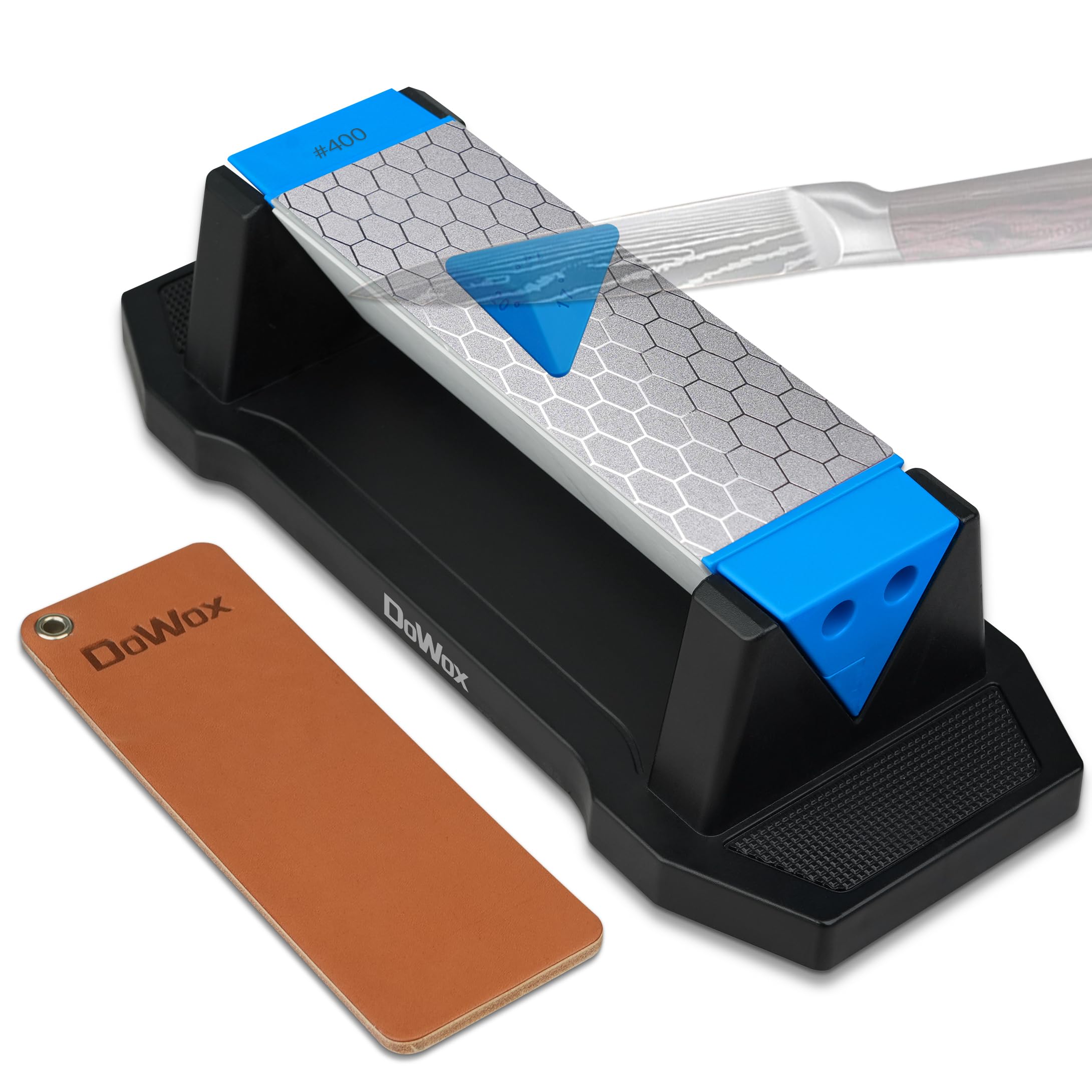
The DOWOX kit stands out with its hybrid material approach: two diamond-coated sides (400 and 1000 grit) for fast, aggressive material removal, and a ceramic side (8000 grit) for the final fine polish. Diamond requires no soaking or oil—you can pull the stone out, wet it with a splash of water or a damp towel, and start sharpening immediately. This is a major convenience advantage for beginners who want instant gratification without prep time.
The 3-sided design is compact (4.33 inches long by 2.95 inches wide), making it easy to store in a drawer, yet the plastic base is waterproof and includes a non-slip pad. The kit also comes with an angle guide and a leather strop for burr removal. Users consistently report achieving a razor-sharp edge faster than with traditional water stones, and the diamond surface stays flat without the dishing issue common to corundum stones.
One caveat: diamond plates are aggressive, and the 400 grit side removes metal very quickly. A beginner should use light pressure and fewer strokes on the coarse side to avoid over-grinding. The included angle guide helps with consistency, but some users have reported missing the angle guide in their package—check the box upon arrival. Overall, this is the best choice for someone who values speed and low maintenance.
Why it’s great
- Diamond and ceramic construction requires no soaking—ready to use in seconds
- 3 grit sides (400/1000/8000) cover the full sharpening-to-polish spectrum
- Compact, waterproof design stores easily and rinses clean under running water
Good to know
- Diamond cuts aggressively—beginners must use light pressure to avoid removing too much metal
- Some units have shipped without the angle guide; verify contents immediately
4. MITSUMOTO SAKARI Japanese Whetstone 1000/3000 Grit

The MITSUMOTO SAKARI offers a traditional Japanese sharpening experience with a white corundum stone bonded to a solid wooden base. The 1000 grit side is the sweet spot for most kitchen knife maintenance, and the 3000 grit side refines the edge to a smooth, polished finish that slices through paper effortlessly. The wooden base is fitted with TPR rubber strips on the bottom, providing excellent grip on countertops without sliding.
At 772 grams (about 1.7 pounds), the stone has a pleasant heft that feels premium in hand. The stone requires a 5-minute water soak before use, and the white corundum material wears evenly with a smooth, consistent cut—less aggressive than diamond, which is actually an advantage for a beginner learning pressure control. The 15–20 degree angle is easy to maintain because the wooden base offers a natural hand reference point.
The main trade-off is the narrower grit range. Without a coarse 400 grit side, this stone is best for regular maintenance of knives that are already reasonably sharp, rather than restoring heavily damaged edges. The included instructions are minimal, so a beginner should watch a few sharpening tutorials online before starting. That said, users who take the time to learn report edges sharper than they thought possible from their kitchen knives.
Why it’s great
- Authentic Japanese white corundum stone delivers a consistently smooth, controlled cut
- Solid wooden base with TPR rubber provides exceptional non-slip stability
- 1000/3000 grit progression is perfect for maintaining already functional kitchen knives
Good to know
- No coarse grit side—not suitable for restoring very dull or chipped blades
- Instructions are sparse; beginners will need to learn technique from external resources
5. YCAMMIN Double-sided Diamond Sharpening Stone

The YCAMMIN diamond plate offers the most budget-friendly entry point into sharpening without sacrificing the core function. The honeycomb diamond surface on the 400 grit side aggressively removes material to repair nicks and re-establish a burr, while the 1000 grit side refines the edge to a functional sharpness. The unique honeycomb pattern allows swarf (metal dust) to fall into the gaps, preventing the surface from glazing over during use.
This stone is remarkably portable at just 0.74 pounds and 7 inches long, fitting easily into a camping kit or a small kitchen drawer. The plastic base has a non-slip design that works on most surfaces, though some users note it can slide on very smooth countertops—placing it on a damp cloth solves the issue. Diamond means zero soaking is required; just spray with water or use a damp cloth and start sharpening.
The 400 grit side is aggressive, and one reviewer warns that it “takes off material like nobody’s business,” so beginners should apply very light pressure and count strokes. The kit includes only the stone and base—no angle guide, no strop, no flattening stone. For the price, this is an excellent trial stone to see if manual sharpening suits you before investing in a more complete system.
Why it’s great
- Honeycomb diamond surface prevents swarf buildup for consistent cutting action
- Lightweight and compact (0.74 lbs, 7 inches) for easy storage and portability
- No soaking or oil needed—just wet and sharpen immediately
Good to know
- 400 grit side is very aggressive and can over-grind a blade if too much pressure is applied
- Lacks an angle guide, a strop, and a flattening stone—only the bare essentials are included
FAQ
Do I need to soak a diamond sharpening stone before using it?
What grit stone should a beginner start with for kitchen knives?
Can I ruin my knife with a sharpening stone as a beginner?
Final Thoughts: The Verdict
For most users, the sharpening stone for beginners winner is the Sharp Pebble Premium Whetstone System because it bundles the essential accessories—angle guide, non-slip bamboo base, and leather strop—that eliminate the steepest learning curve while delivering a true professional-grade 1000/6000 grit edge. If you want the widest grit range and a flattening stone for long-term maintenance, grab the HJYC 4-Side Whetstone Kit. And for a no-soak, instant-use diamond plate that proves manual sharpening works, nothing beats the compact YCAMMIN Diamond Plate.