A dull kitchen knife is one of the most dangerous things in your drawer — it slips, it binds, and it forces you to apply more pressure than any blade should take. The difference between a frustrating prep session and a smooth, controlled cut comes down to having a reliable sharpener for kitchen knives that removes steel predictably without destroying your edge geometry.
I’m Mohammad Maruf — the founder and writer behind AirfryerBite. I’ve spent years analyzing small-kitchen hardware specs, separating the magnetic-angle gadgets from the actual diamond-abrasive systems, and tracking which pull-through and electric designs preserve blade life versus which ones chip the edge.
This guide compares seven top-rated sharpeners across pull-through, electric, and rolling formats so you can find the best sharpener for kitchen knives that matches your blade collection and sharpening skill level.
How To Choose The Best Sharpener For Kitchen Knives
Selecting a sharpener for kitchen knives comes down to three variables: the abrasive material, the angle control system, and the format — pull-through versus electric versus rolling. Each variable directly affects how much metal is removed, how consistent the edge is, and how much skill you need to get a shaving-sharp result.
Abrasive Type: Diamond vs. Ceramic vs. Tungsten Carbide
Diamond abrasives, either electroplated or resin-bonded, cut the fastest and handle high-hardness steels like VG-10 or SG2 without glazing. Ceramic discs and rods are best for fine honing and polishing — they refine the edge without aggressive material removal. Tungsten carbide slots, common on budget pull-through sharpeners, work quickly but can chip thin edges if the blade is not aligned properly. For a single sharpener that handles both dull restoration and daily touch-ups, look for a diamond coarse stage paired with a ceramic fine stage.
Adjustable Sharpening Angles
Most Western-style German knives (Wusthof, Zwilling) ship with a 20-degree edge per side, while many Japanese knives prefer a 15-degree or even 14-degree angle for a sharper slicing geometry. A sharpener that locks to only one angle forces you to commit to a specific blade type. Models with a dial or swappable guides that span 14 to 24 degrees give you the flexibility to sharpen Asian, Western, and specialty blades without buying a second unit.
Format: Pull-Through, Electric, or Rolling
Pull-through sharpeners are the fastest and most foolproof — you slide the blade through fixed abrasive slots a few times and the edge is restored. Electric models use motor-driven diamond wheels or abrasive belts for consistent results across multiple knives, but they take up more counter space and cost more. Rolling sharpeners, like the Bogoni style, use a handheld roller with magnetic guides that let you set the angle manually while moving the abrasive disc along the edge. Rolling units offer a middle ground: more precision than pull-through, less aggression than electric, and no cord.
Quick Comparison
On smaller screens, swipe sideways to see the full table.
| Model | Category | Best For | Key Spec | Amazon |
|---|---|---|---|---|
| Work Sharp Ken Onion Mk.2 | Electric Belt | Pro-level adjustable angles | Variable speed, 15-30° angle range | Amazon |
| Chef’sChoice 15XV | Electric Diamond | Japanese knives, 15° edge | 3-stage, 100% diamond abrasives | Amazon |
| Chef’sChoice UltraHone | Electric Diamond | German steel & serrated blades | 2-stage, 20° precision guides | Amazon |
| Bogoni Rolling Sharpener | Rolling Manual | Ergonomic, no-slip rolling | 400/3000 grit diamond & ceramic | Amazon |
| Chef Pro Electric | Electric Motor | Quick countertop sharpening | 2-stage, coarse/fine guides | Amazon |
| MAD SHARK Pull-Through | Manual Pull | Multiple angle settings | 6 adjustable angles, 14-24° | Amazon |
| Work Sharp Pull-Through | Manual Pull | Drawer-storable convenience | Diamond & ceramic wheels | Amazon |
In‑Depth Reviews
1. Work Sharp Ken Onion Mk.2 Knife Sharpener

The Work Sharp Ken Onion Mk.2 uses flexible abrasive belts driven by a variable-speed motor, which gives you control over both grit progression and edge aggressiveness. The angle guide adjusts from 15 to 30 degrees in half-degree increments, so you can match the edge geometry to any blade — from a thin Japanese petty knife to a thick German chef’s knife. The Mk.2 attachment expands the tool to handle scissors, serrated blades, and even axe edges.
Rated at roughly 2 pounds with a stainless steel build, this unit sits solidly on the counter during use. The electronic speed control lets you dial down the belt speed for delicate blades or crank it up for reprofiling a heavily chipped edge. Owners report that the 800 and 1000-grit belts are the sweet spot for kitchen maintenance, and the 3-year warranty covers the motor and drive components.
The learning curve is real — you need to practice on a cheap knife before touching expensive steel. The belt system removes metal faster than any pull-through design, so a few seconds of over-grinding can change the blade profile. For serious home cooks and knife enthusiasts who want professional-level results without sending blades out, this is the most versatile electric sharpener in the category.
Why it’s great
- Variable motor speed matches belt to blade hardness
- Full 15-30° angle range covers any kitchen steel
- Flexible belts follow curved blades without flat spots
Good to know
- Requires practice to avoid over-grinding on thin edges
- Belt costs add up with frequent use
- Larger footprint than pull-through models
2. Chef’sChoice 15XV Professional Electric Sharpener

The Chef’sChoice 15XV is a 3-stage electric sharpener with 100-percent diamond abrasives plated onto the first two stages and a flexible stropping stage for the final polish. It converts standard 20-degree factory edges into a Trizor XV 15-degree edge, which is significantly sharper than most Western knives ship with. The brushed metal housing weighs 5 pounds, which keeps the unit planted during rapid passes.
Stage 1 uses coarse diamonds to reshape the bevel and remove nicks. Stage 2 uses finer diamonds to hone the edge, and Stage 3 uses a patented flexible abrasive disk to polish and micro-smooth the blade. The flexible spring guides automatically adjust to the blade thickness, so you do not need to manually align each knife. Owners report that first-time sharpening takes roughly one minute, and subsequent touch-ups take about 10 seconds per knife.
The unit is designed specifically for straight-edge and serrated blades, and it is particularly effective on Japanese steel at 15 degrees. The noise level sits between 65 and 75 dB — comparable to a quiet conversation. The trade-off is that the 15-degree edge is thinner and may feel less durable on heavy chopping tasks, but for slicing and push-cutting, the difference is immediate.
Why it’s great
- 100% diamond abrasives sharpen high-hardness steel efficiently
- 3-stage system refines edge from coarse to polished in seconds
- Metal housing and 5-pound build prevent counter slip
Good to know
- Fixed 15-degree angle not ideal for 20-degree German knives
- Stage 3 flexible disk wears over time and needs replacement
- No variable speed control — single motor speed
3. Chef’sChoice UltraHone 2-Stage Electric Sharpener

The Chef’sChoice UltraHone uses 100-percent diamond abrasives in both stages with precision angle guides locked to a 20-degree edge — the standard for most Western kitchen knives. Stage 1 sharpens with coarse diamonds to reshape the edge, and Stage 2 uses advanced micron-size diamonds to hone and refine the finish. The unit handles both straight-edge and serrated blades, including bread knives and steak knives, without needing separate attachments.
Weighing just over 1 pound with a compact plastic housing, this sharpener fits easily in a drawer or on a small counter corner. The spring-loaded guides automatically center the blade, so you simply pull the knife through each slot 2-3 times and the edge is restored. Users report that Wusthof, Henckels, and Chicago Cutlery blades come back to factory-level sharpness, and serrated knives clean up well on the Stage 1 slot alone.
The limitation is the single 20-degree angle. If you own Japanese knives with 15-degree edges, this sharpener will not match that geometry and may actually blunt the thin edge by grinding it to a wider angle. It is also not designed for single-bevel or chisel-ground blades. For a home cook using primarily German-style steel, this is a fast, foolproof electric option at a reasonable cost.
Why it’s great
- 100% diamond abrasives for fast, consistent edge restoration
- Sharpens serrated blades without special adapter
- Compact enough for drawer storage
Good to know
- Fixed 20-degree angle unsuitable for Japanese 15-degree knives
- Plastic housing less durable than metal-bodied units
- No fine-grit stropping stage for mirror polish
4. Bogoni Rolling Knife Sharpener
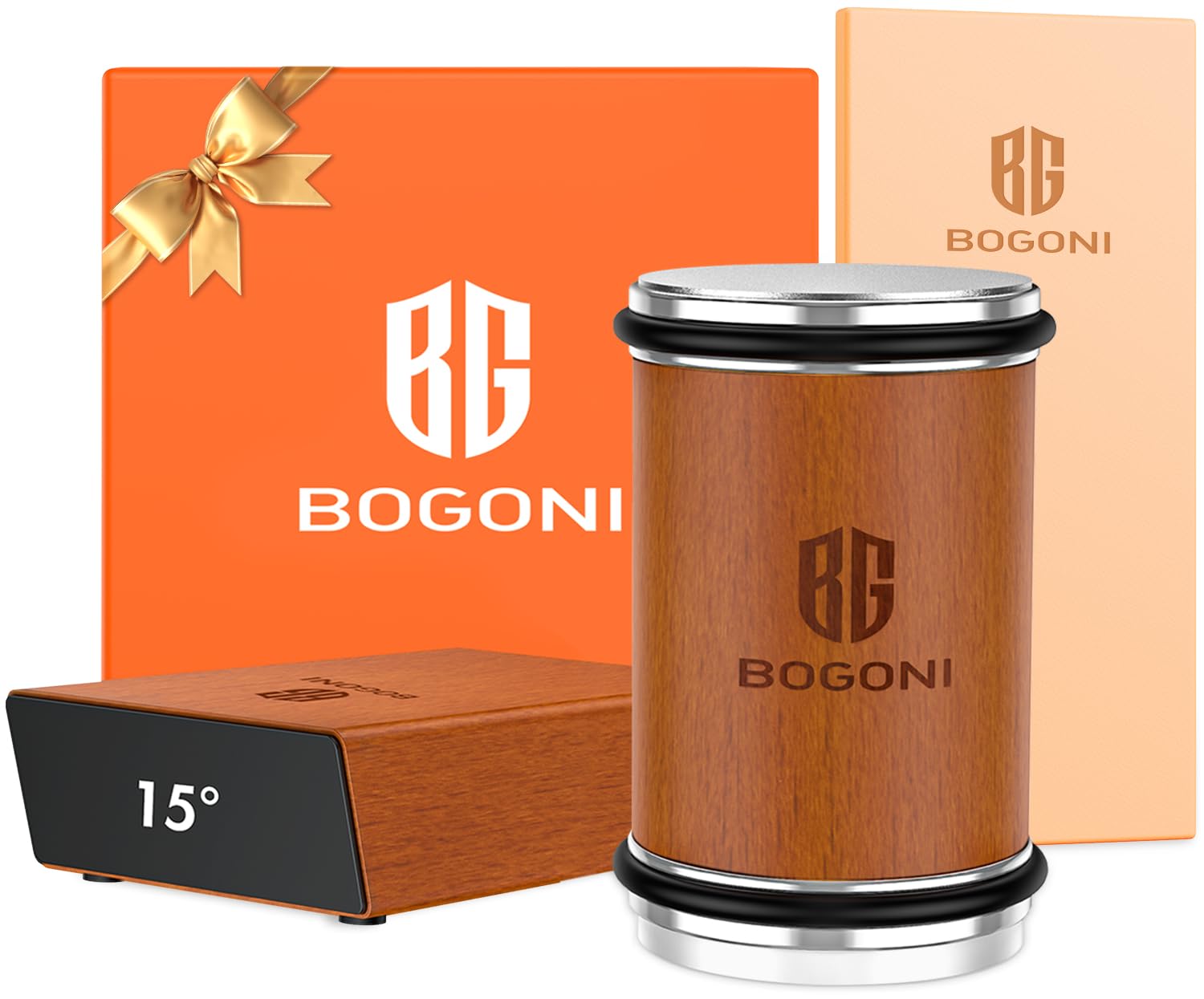
The Bogoni Rolling Sharpener takes a different approach from pull-through and electric units: a handheld roller fitted with a 400-grit diamond disc for reshaping and a 3000-grit ceramic disc for polishing. The knife sits on a magnetic holder with six N52 neodymium magnets that lock it firmly in place, and the roller glides along the edge at a preset angle. Two magnetic angle guides — 15 degrees for thin Japanese blades and 20 degrees for standard Western edges — snap onto the base to ensure consistent geometry.
The natural wood construction and compact dimensions make this a countertop-friendly tool that does not need an outlet. Professional chefs with tendonitis or wrist strain find the rolling motion much less taxing than using a manual pull-through or a whetstone. The included leather strop adds a final polishing step for a razor edge, and the discs are replaceable, extending the tool’s lifespan indefinitely.
The rolling action requires both hands — one to hold the magnetic base steady and one to move the roller — which is slower than a pull-through but offers more control. Some users note that the roller axle can loosen during shipping and needs a quick tightening before first use. For cooks who want manual precision without the learning curve of a whetstone, this is a smart middle-ground system.
Why it’s great
- 400/3000 grit combo handles both reshaping and fine polishing
- Strong N52 magnets hold blade securely during roll
- Ergonomic rolling motion reduces hand strain
Good to know
- Slower than pull-through for multiple knives
- Roller axle may arrive slightly loose
- Included leather strop lacks detailed usage instructions
5. Chef Pro Electric 2-Stage Knife Sharpener

The Chef Pro Electric Sharpener is a 2-stage motor-driven system with built-in guides for kitchen knives, sports knives, and scissors. Stage 1 uses a coarse grinding wheel to reshape the edge and remove dull metal, while Stage 2 uses a fine wheel to hone and polish the blade. The compact body measures 8 inches long and sits on three suction cups that grip the counter to prevent movement during use.
The motor runs quietly and does not vibrate excessively, even during extended sharpening sessions. Removable metal-shard receptacles with easy-to-clean plugs catch the filings, so debris does not scatter across the counter. Owners report that 6-8 passes per slot restores severely dull blades, and routine maintenance requires only 2-3 passes. The unit also handles serrated blades and straight-edge scissors on the right-side slot.
The angle is fixed — there is no adjustment dial or swappable guide. This means the Chef Pro is best suited for standard 20-degree Western knives. The suction cups work well on smooth countertops but may lose grip on textured or porous surfaces. For a budget-friendly electric option that does not require manual effort, this sharpener delivers reliable results without taking up significant counter space.
Why it’s great
- Suction-cup base prevents sliding during sharpening
- Removable debris trays simplify cleanup
- Sharpens scissors and serrated blades on one slot
Good to know
- Fixed angle not compatible with Japanese 15-degree edges
- Suction cups may not grip textured countertops
- Requires multiple passes for very dull blades
6. MAD SHARK Adjustable Pull-Through Sharpener

The MAD SHARK pull-through sharpener stands out because of its adjustable angle dial, which lets you choose from six settings: 14, 16, 18, 20, 22, and 24 degrees. This wide range means you can sharpen Japanese knives at 14 or 15 degrees, Western knives at 20 degrees, and even heavy-duty outdoor blades at 22 or 24 degrees. The pull-through slots include a tungsten steel slot for coarse sharpening, a ceramic slot for fine honing, and a separate scissor slot.
The ergonomic handle keeps your fingers away from the blade path, and two silicone pads on the bottom anchor the tool to the counter. The compact design weighs only 0.4 pounds, making it portable enough for camping or travel. A guide printed on the body suggests the best angle for each knife type, which helps beginners avoid guesswork. Users with both Japanese and American knives report that switching between 15 and 20 degrees works smoothly with a simple twist of the dial.
The tungsten carbide slot removes metal aggressively — this is good for reviving very dull blades but can leave a slightly rougher edge that the ceramic slot then refines. The right-handed bias noted by some left-handed users means the tool is most comfortable when pulled with the right hand. For the price point, the adjustable angle feature is rare and makes this a versatile choice for mixed-blade households.
Why it’s great
- 6 adjustable angles from 14° to 24° cover any kitchen blade
- Tungsten slot restores dull blades quickly
- Integrated scissor slot adds versatility
Good to know
- Tungsten carbide is aggressive and requires care on thin edges
- Right-handed design less natural for left-handed users
- Plastic body may not withstand heavy daily commercial use
7. Work Sharp Pull-Through Kitchen Knife Sharpener

The Work Sharp Pull-Through Sharpener uses diamond and ceramic sharpening wheels mounted inside a compact plastic body that measures just 8.25 inches long. The large rubber handle and rubber base provide a stable grip during use, and the unit is light enough at 0.5 pounds to store in a utility drawer or a BBQ kit. It sharpens chef knives, paring knives, serrated blades, and scissors.
The diamond wheel cuts quickly through dull steel, while the ceramic wheel refines the edge for a clean slicing finish. Users report that knives that previously could not cut through tomato skin become smooth cutters after just a few passes. The design removes minimal metal compared to aggressive tungsten carbide slots, which helps prolong blade life for high-end knives. A 3-year warranty from Work Sharp covers the manufacturing quality.
The fixed angle means this sharpener is optimized for standard Western knife geometry, so it is not ideal for 15-degree Japanese blades. The diamond disks darken over time with use, though this does not noticeably affect performance. For a no-fuss, drawer-storable sharpener that delivers consistent results without any setup, this is a solid entry-level pick.
Why it’s great
- Diamond wheels cut fast without removing excessive metal
- Compact size fits in standard kitchen drawers
- 3-year warranty adds peace of mind
Good to know
- Fixed angle not suited for Japanese 15-degree knives
- Diamond disks darken with use
- No coarse slot for heavily nicked blades
FAQ
Can I use a pull-through sharpener on my Japanese VG-10 knives?
How often should I sharpen my kitchen knives with an electric sharpener?
What is the difference between a honing rod and a sharpener for kitchen knives?
Will an electric knife sharpener ruin my expensive Wusthof or Zwilling knives?
Final Thoughts: The Verdict
For most users, the best sharpener for kitchen knives is the Work Sharp Ken Onion Mk.2 because its variable-speed belt system and full 15-30 degree angle adjustment handle any kitchen steel with professional consistency. If you want a dedicated 3-stage diamond system for fast, foolproof results on Japanese 15-degree blades, grab the Chef’sChoice 15XV. And for a compact, drawer-storable pull-through that never misses, nothing beats the Work Sharp Pull-Through.