A serrated knife lives or dies on its ability to saw through a hard, crackling crust without turning the soft interior into a pile of crumbs. Too many home bakers settle for a dull blade that squashes their sourdough before it even breaks the surface. Finding a blade that grips the crust, glides through, and leaves a clean slice is the difference between a disappointing breakfast and a perfect piece of toast.
I’m Mohammad Maruf — the founder and writer behind AirfryerBite. I’ve spent years analyzing blade geometry, edge retention, and handle ergonomics across hundreds of kitchen knife models to separate marketing claims from real cutting performance.
Whether you bake artisan loaves every weekend or just need a reliable tool for bagels, tomatoes, and melons, choosing the right best serrated knife means understanding steel composition, scallop versus wavy edge design, and whether a full-tang construction actually matters for a bread knife.
How To Choose The Best Serrated Knife
A serrated knife is not a straight-edge chef’s knife with teeth glued on. The cutting action relies on the serrations grabbing the hard surface while the gullets (the spaces between teeth) clear debris. Understanding the interplay of blade material, edge geometry, handle ergonomics, and overall construction prevents the common mistake of buying a knife that looks aggressive but fails on crusty rye.
Blade Steel and Hardness
High-carbon stainless steel is the standard for serrated blades because it resists corrosion while maintaining enough hardness (typically 56–60 HRC) to hold the teeth sharp over dozens of loaves. Japanese super steels like 10Cr15CoMoV offer higher carbon content and vanadium for improved edge retention, but they require hand-washing and careful storage. Entry-level blades stamped from softer steel will dull faster, forcing you to replace the entire knife rather than sharpen it.
Edge Geometry: Scalloped vs. Wavy Serrations
Scalloped edges (curved, rounded gullets) excel at cutting through hard crusts and are easier to sharpen with a ceramic rod. Wavy serrations (sharp, pointed teeth) grip aggressively and work well on soft breads and cakes without tearing. A hybrid design, like the flat wavy edge on some German-steel blades, attempts to combine the best of both — aggressive initial bite with smooth glide through the center crumb.
Blade Length and Kitchen Versatility
An 8-inch blade is the standard for bread knives, offering enough reach to slice a full boule while maintaining maneuverability. A 10.6-inch blade extends your reach for large watermelons, whole turkeys, or massive sourdough batards, but the extra length requires more clearance on your cutting board and a slightly different sawing motion. For most home bakers, 8 inches provides the best balance of control and versatility.
Handle Construction and Tang
Full-tang construction (the steel extends the entire length of the handle) provides balanced weight distribution and prevents the blade from loosening over time. Handles made from Pakkawood or textured polypropylene offer secure grip even with wet or oily hands. Ergonomic curvature and a rounded spine reduce fatigue during repetitive slicing, a detail often overlooked in budget models that prioritize low cost over comfort.
Quick Comparison
On smaller screens, swipe sideways to see the full table.
| Model | Category | Best For | Key Spec | Amazon |
|---|---|---|---|---|
| HOSHANHO 8-inch | Premium | Japanese steel edge retention | 10Cr15CoMoV steel, 15° edge | Amazon |
| CoquusAid 10.6-inch | Mid-Range | Extra length for large items | 10.6 in blade, German steel | Amazon |
| Dexter 8-inch Scalloped | Mid-Range | Commercial-grade durability | Hollow scalloped edge, PP handle | Amazon |
| MAD SHARK 8-inch | Budget | Value with full-tang build | High-carbon steel, full tang | Amazon |
| Chicago Cutlery 8-inch | Budget | Classic entry-level bread knife | 25° taper grind, stainless steel | Amazon |
In‑Depth Reviews
1. HOSHANHO 8-Inch Japanese Steel Bread Knife

The HOSHANHO is the only knife in this roundup built from Japanese 10Cr15CoMoV super steel, a high-carbon alloy that includes cobalt, molybdenum, and vanadium for exceptional wear resistance. The edge is sharpened to a 15-degree angle — noticeably more acute than the 18 to 25-degree edges found on most serrated blades — which allows the teeth to bite into hard crusts with less downward pressure. In practice, this means your sourdough boule stays perfectly round while the knife saws through the crust without collapsing the crumb structure.
The Pakkawood handle is a clear step up from molded polymer: it warms to the hand quickly, offers a secure grip even with slightly greasy fingers, and the full-tang construction gives the knife a balanced feel that reduces wrist fatigue during extended slicing sessions. At half a pound, it carries enough heft to feel substantial without being heavy. The included blade guard and presentation box make it a strong gift option for the baker who already owns basic knives and wants a performance upgrade.
One trade-off: the manufacturer explicitly advises against dishwasher cleaning because the Pakkawood can crack or discolor with repeated heat cycles, and the high-carbon edge may develop micro-pitting if left wet. Users who prefer throw-in-the-dishwasher convenience should look at the Dexter scalloped model instead. For everyone else who is willing to hand-wash and dry immediately, the HOSHANHO delivers the sharpest out-of-box performance and the best long-term edge retention in this price tier.
Why it’s great
- Japanese super steel with excellent edge retention
- Ergonomic Pakkawood handle with full-tang balance
- 15-degree acute edge cuts crust without crushing
Good to know
- Hand-wash only; Pakkawood discolors in dishwasher
- Premium price reflects higher material cost
2. CoquusAid 10.6-Inch Serrated Knife
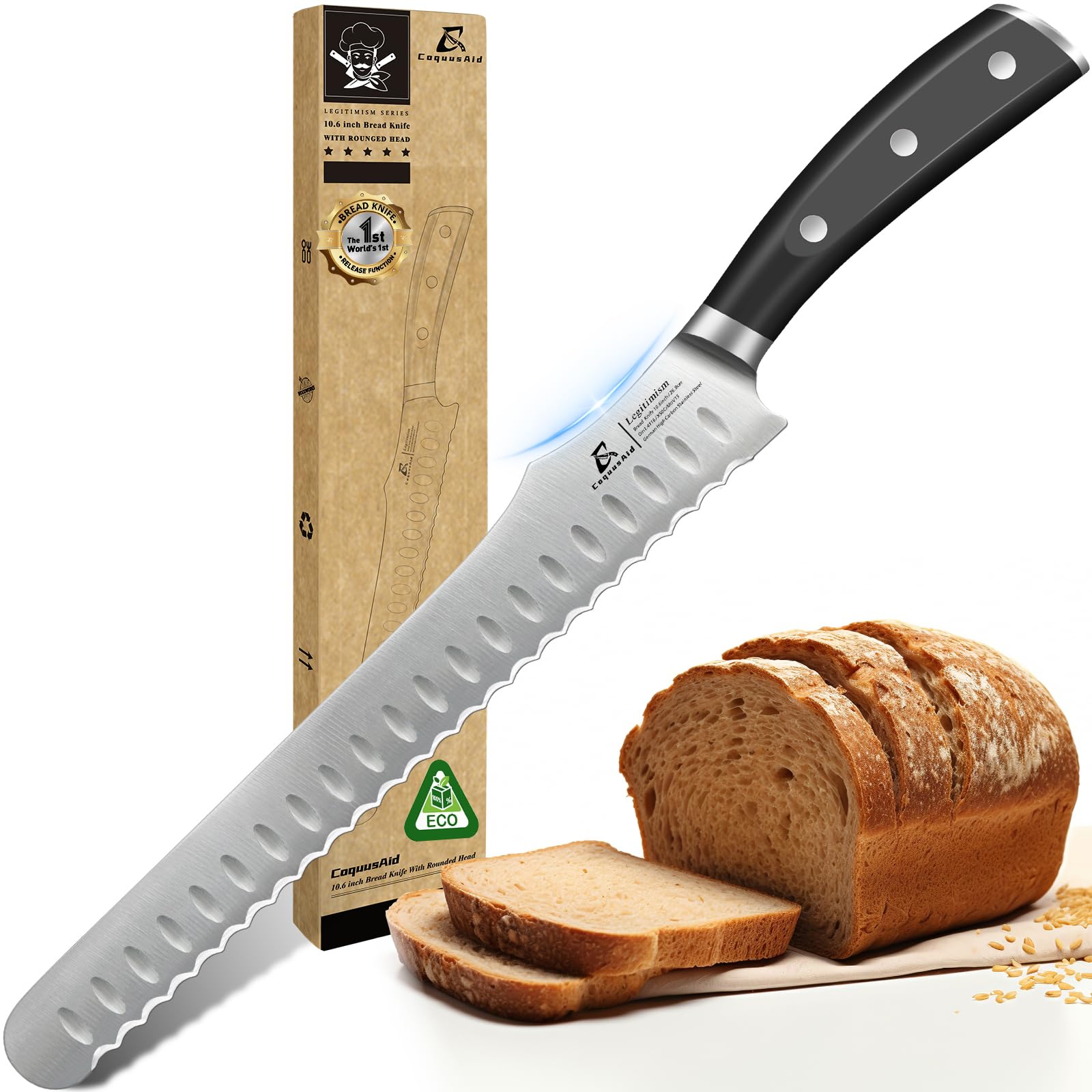
The CoquusAid immediately stands out for its 10.6-inch blade, which is roughly 33 percent longer than the standard 8-inch bread knife. This extra length is a genuine advantage when you need to slice an extra-wide sourdough batard, carve a Thanksgiving turkey breast, or cut through a whole watermelon without dragging the handle across the rind. The flat wavy-edge design, sharpened to 18 degrees, combines aggressive scallop-style serrations with a smooth edge section that reduces tearing on soft interiors.
German high-carbon stainless steel forms the core of the blade, and the manufacturer uses a single-edged construction with rock-hollow dimples — a feature more common on santoku knives — to reduce food sticking during slicing. The dimples create tiny air pockets between the blade and the food, so crusty bread crumbs and sticky cake layers release cleanly instead of gumming up the serrations. Users who bake sticky enriched doughs like brioche or challah will notice the difference immediately.
The handle is molded from ABS (acrylonitrile butadiene styrene), a durable thermoplastic that resists impact and won’t absorb moisture. A few early buyers reported that the spine near the handle had a sharp edge that required light grinding for comfort, though later production runs appear to have addressed this. At roughly 0.4 pounds, the knife feels nimble despite the extended blade length, making it a versatile choice for bakers who want one knife that handles both oversized loaves and delicate layer cakes.
Why it’s great
- Extra-long blade handles large loaves and meats
- Dimple design reduces food sticking
- German steel holds a reliable 18-degree edge
Good to know
- Some units had a sharp spine near handle
- ABS handle lacks the warmth of wood
3. Dexter 8-Inch Scalloped Bread Knife
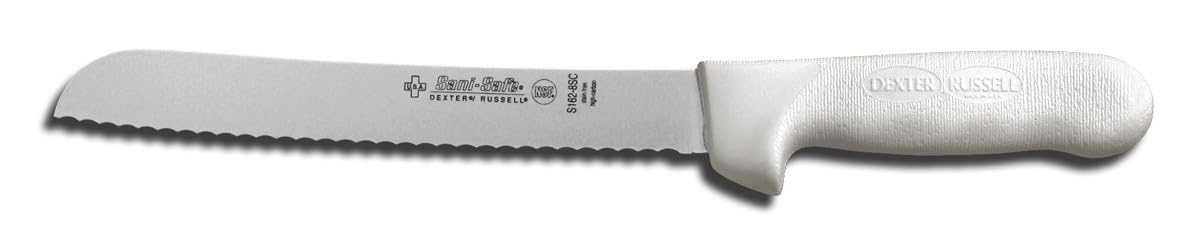
Dexter-Russell is a name more commonly found in commercial kitchens than home pantries, and this 8-inch scalloped bread knife reflects that heritage. The blade uses a hollow scalloped edge — each scallop is a curved, polished divot rather than a pointed tooth — which produces a clean sawing action that is especially effective on crusty artisan breads. Users consistently report that fresh sourdough slices without tearing or excessive crumb buildup, a direct result of the scallop geometry clearing crust debris on each stroke.
The handle is molded from white polypropylene with a contoured rubber overmold that provides a non-slip grip even when your hands are dusted with flour. At just 0.3 pounds, it is the lightest knife in this group, which makes it easy to maneuver but may feel insubstantial to users accustomed to heavier forged blades. The lightweight construction also translates to less fatigue during long slicing sessions, a real advantage in a busy bakery or when preparing multiple loaves for a gathering.
A standout feature is the dishwasher-safe designation — the polypropylene handle and high-carbon steel blade can survive commercial dishwashing cycles without warping or discoloration, though hand-washing is still recommended to preserve the edge. The scalloped design is also easier to touch up with a ceramic honing rod than a pointed wavy edge, extending the usable life of the knife before professional sharpening is needed. For home bakers who prioritize low maintenance and commercial reliability, the Dexter is a smart, no-nonsense choice.
Why it’s great
- Scalloped edge creates clean crust cuts
- Dishwasher-safe polypropylene handle
- Lightweight and comfortable for extended use
Good to know
- Lightweight feel may not suit everyone
- Scalloped edge less aggressive on soft breads
4. MAD SHARK 8-Inch Serrated Knife

The MAD SHARK competes in the budget-friendly tier but brings construction details more common on mid-range knives, including a full-tang, one-piece steel design with triple rivets securing the handle scales. The blade is made from high-carbon stainless steel with a wide wavy serration pattern that provides aggressive bite on crusty breads while still cutting through soft bagels and ripe tomatoes without squashing them. The cutting edge measures 8.25 inches, giving it a slight reach advantage over standard 8-inch models.
What stands out at this price point is the included presentation box, blade protector, and polishing cloth — a package usually reserved for more expensive knives. The handle is ergonomically contoured with a slight curve that fits the palm naturally, and the full-tang construction gives the knife a balanced feel that belies its budget price. Users who have owned the knife for over two years report that the serrations remain functional without resharpening, which speaks to the heat treatment and steel quality.
The wavy serration pattern is more aggressive than a scalloped edge, meaning it grabs crust aggressively but can leave slight surface marks on very soft breads like angel food cake. It is not the best choice for delicate pastries. Hand-washing is recommended to maintain the edge and prevent rust spots from food acids, though the stainless steel formulation resists corrosion reasonably well. For bakers who want a full-tang knife with solid edge retention without spending premium dollars, the MAD SHARK delivers excellent value.
Why it’s great
- Full-tang construction with triple rivets
- Aggressive wavy serrations for crusty bread
- Includes blade guard and polishing cloth
Good to know
- Wavy pattern can mark soft cakes
- Hand-wash preferred for edge longevity
5. Chicago Cutlery Essentials 8-Inch Bread Knife

The Chicago Cutlery Essentials bread knife is the classic entry-level option, built around a stamped stainless steel blade with an exclusive 25-degree taper grind that delivers a sharp edge right out of the box. The serrations are traditional pointed teeth, effective on standard sandwich breads and moderately crusty loaves, though they struggle more with extra-hard artisan crusts compared to the scalloped or Japanese steel options above. For the occasional baker who makes a weekly loaf, this knife gets the job done without fuss.
The handle is a simple black polymer design with a metal end cap. It is not a full-tang construction — the steel extends only partway into the handle — which shifts the balance slightly toward the blade. Some users find this tip-heavy feel helps with the sawing motion, while others prefer a more neutral balance. The blade resists rust and staining adequately, and the full lifetime warranty from Chicago Cutlery provides peace of mind for the price-conscious buyer.
Several customer reviews note that the knife is effective on sourdough and tomatoes but mention that serrated knives are inherently difficult to sharpen and recommend yearly replacement rather than resharpening. This advice applies more to budget stamped blades than to premium forged knives, but it is a fair assessment at this price point. If you bake bread daily or want a knife that can be resharpened professionally, stepping up to the HOSHANHO or Dexter will save money over time. For a reliable backup or a starter knife, the Chicago Cutlery is a solid pick.
Why it’s great
- Classic design with reliable stainless steel blade
- Sharp 25-degree taper grind out of the box
- Full lifetime warranty included
Good to know
- Not full-tang; balance leans forward
- Difficult to resharpen at home
FAQ
Can a serrated knife be sharpened at home?
What blade length is best for slicing homemade sourdough?
Why does my bread knife crush soft bread instead of slicing it?
Is a full-tang construction important for a bread knife?
Final Thoughts: The Verdict
For most users, the best serrated knife winner is the HOSHANHO 8-Inch because its Japanese 10Cr15CoMoV steel delivers the sharpest out-of-box edge and the longest retention for daily sourdough bakers. If you want an extra-long blade that handles large loaves and carving duty, grab the CoquusAid 10.6-Inch. And for dishwasher-safe, commercial-grade reliability that requires no fuss, nothing beats the Dexter 8-Inch Scalloped.