Getting a rich, balanced espresso shot at home without dropping four figures on a commercial monster is a tricky line to walk. Most machines in this bracket either skimp on temperature stability, use undersized portafilters, or come with steam wands that can barely tickle milk, leaving you with sour underextractions and flat foam. The sweet spot is finding a semi-automatic that delivers a genuine 9-bar extraction, a 58mm commercial group head, and a capable steam circuit without the unnecessary frills that drive up the cost.
I’m Mohammad Maruf — the founder and writer behind AirfryerBite. I’ve spent the better part of a decade analyzing espresso hardware, comparing thermoblock vs. boiler designs, PID controller accuracy, and real-world puck prep across hundreds of models, so I know exactly which sub-$1000 machines actually hold their own against cafe gear.
This guide breaks down the nine most competitive models for anyone serious about dialing in at home, covering everything from true dual-boiler setups to integrated grinders and commercial-grade steam wands. Whether you are upgrading from a pod machine or building your first home barista station, the semi automatic espresso machine under $1000 category has never offered more genuine pro-level hardware within reach.
How To Choose The Best Semi Automatic Espresso Machine Under $1000
The sub-$1000 espresso machine market has matured dramatically, but the difference between a frustrating morning and a perfect shot comes down to a handful of non-negotiable specs. Beginners often get drawn to high pump pressure numbers (15 or 19 bar) without realizing that what really matters is stable 9-bar extraction pressure at the group head, a capable steam system, and a portafilter that accepts standard 58mm baskets and accessories. Here are the key factors to weigh before you buy.
Boiler Type: Single, Dual, or Heat Exchanger
A single boiler machine forces you to choose between brewing and steaming — you pull your shot, then wait for the boiler to heat up to steam temperature. This works fine for straight espresso but gets tedious if you make multiple milk drinks in a row. A dual boiler machine gives you independent heating circuits for brew and steam, allowing simultaneous pulling and frothing. Heat exchangers sit between these options, but they are rare in this price bracket and often require a cooling flush. For home baristas who mainly drink lattes or cappuccinos, a dual boiler offers the fastest workflow without temperature compromise.
Portafilter Size and Standardization
54mm portafilters are common on machines like the Breville Barista Express, and they produce fine espresso, but they lock you into a non-standard accessory ecosystem. A 58mm commercial portafilter matches the size used in almost every professional espresso machine, meaning you can use any 58mm basket, bottomless portafilter, or distribution tool on the market. This is a critical long-term advantage if you plan to upgrade your puck prep game with a WDT tool, leveler, or precision tamper. Machines like the Gaggia Classic E24 and the Gevi Dual Boiler feature true 58mm groups, giving you the widest path to consistent extraction.
Temperature Control: PID vs. Thermostat
Thermostat-controlled machines allow water temperature to swing by 10-15 degrees Fahrenheit during a shot, which leads to sour or bitter results depending on where the temperature lands. Proportional-Integral-Derivative (PID) control locks water temperature to within a single degree, giving you repeatable extractions across consecutive shots and the ability to tune for light versus dark roasts. Any machine in this price range that lacks a PID should be considered a compromise unless you plan to mod it — modern sub-$1000 espresso hardware should absolutely include electronic temperature management for consistent results.
Steam Power and Wand Design
A weak steam wand turns milk texturing into a frustrating chore. Look for a machine with a commercial-style steam tip (single or dual hole) and a wand that articulates freely for positioning your pitcher. Panarello-style frothing sleeves inject air automatically but produce coarser, less creamy foam compared to a manual wand. For latte art or dense microfoam, you want a bare stainless steel wand with good steam pressure — the Ninja Luxe Cafe’s hands-free frother and the De’Longhi La Specialista’s automatic wand offer convenience, while the Gaggia E24’s wand gives you full manual control for perfect texture.
Quick Comparison
On smaller screens, swipe sideways to see the full table.
| Model | Category | Best For | Key Spec | Amazon |
|---|---|---|---|---|
| Breville Barista Express | Integrated Grinder | All-in-one bean-to-cup workflow | 54mm portafilter, PID, 1600W | Amazon |
| De’Longhi La Specialista Touch | Touchscreen | Guided recipes & auto-frothing | 15 grind settings, 10 presets | Amazon |
| Ninja Luxe Cafe Pro | Multi-Brew | Espresso, drip & cold brew versatility | 25 grind settings, weight-based dosing | Amazon |
| Café Bellissimo | Smart WiFi | App-controlled customization | 95 oz tank, 15 bar pump | Amazon |
| Gaggia RI9380/46 E24 | Commercial Grade | Reliable 9-bar standard extraction | 58mm portafilter, 1200W | Amazon |
| De’Longhi La Specialista Arte Evo | Cold Brew | Cold extraction technology in 5 minutes | 8 grind settings, 15 bar pump | Amazon |
| Gevi Dual Boiler | Dual Boiler | Simultaneous brew & steam on a budget | 58mm portafilter, 31 grind settings | Amazon |
| KitchenAid KES6403 | Compact | Small footprint with dual temp sensors | 58mm portafilter, 15 bar pump | Amazon |
| Owl G3006 by Gemilai | Dual Display | Real-time pressure & temp monitoring | PID, 58mm group, pre-infusion | Amazon |
In‑Depth Reviews
1. Breville Barista Express BES870XL
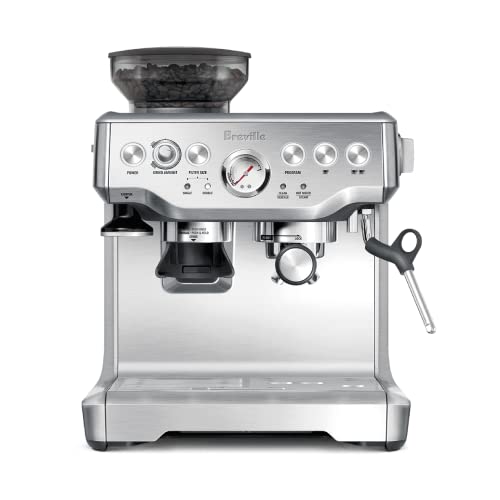
The Breville Barista Express has been a benchmark in the sub-$1000 category for years, and for good reason — it combines an integrated conical burr grinder, PID-controlled water temperature, and a powerful 1600W thermocoil heating system in one compact chassis. The dose-control grinding mechanism delivers grounds directly into the 54mm portafilter, and the Razor dose trimming tool helps level the puck for even extraction. With low-pressure pre-infusion that ramps up gradually, the BES870XL consistently pulls shots with good crema and balanced flavor across a wide range of beans.
The manual steam wand provides real control for microfoam texturing, though it takes practice to dial in the right technique for latte art. The 67 oz water tank is large enough for multiple drinks without constant refilling, and the integrated tamper and storage for accessories keep the countertop clean. Long-term users report the machine lasting 5-6 years with regular maintenance, including O-ring replacements and solenoid valve cleaning around the 12-month mark, but the sheer volume of community support and replacement parts makes it one of the most repairable machines at this price point.
Where the Barista Express falls short is the 54mm portafilter size — it locks you into Breville-specific baskets and accessories, limiting your upgrade path to third-party 58mm gear. The built-in grinder, while convenient, produces more fines than a dedicated high-end grinder, so you may outgrow it if you develop a serious espresso hobby. Still, for anyone wanting a complete bean-to-cup solution with no separate grinder investment, this remains the gold standard for consistent daily espresso.
Why it’s great
- Integrated PID temperature control delivers repeatable shot quality shot after shot
- Conical burr grinder grinds on demand directly into the portafilter for zero mess
- Manual steam wand produces real microfoam for latte art with practice
Good to know
- 54mm portafilter limits accessory compatibility compared to 58mm commercial standard
- Built-in grinder creates more fines than a premium separate grinder
- Solenoid valve can fail around 6-12 months without proper descaling routine
2. Gaggia RI9380/46 E24 Classic Pro

The Gaggia Classic Pro E24 is the purist’s choice in this bracket — a made-in-Italy machine with a solid steel housing, a true 58mm commercial portafilter, and a three-way solenoid valve that relieves pressure after extraction for cleaner, drier pucks. The 9-bar extraction pressure is mechanically regulated (no OPV mod needed on this model), and the commercial steam wand gives you full manual control for texturing milk exactly how you want it. This is not a set-and-forget machine; it rewards technique and punishes sloppy puck prep, but the espresso quality when dialed in rivals machines costing twice as much.
Longevity is the hallmark here — owners report daily use for 4+ years with only basic maintenance like group head gasket replacements and quarterly descaling. The simple internal layout (no proprietary PCBs or complex thermoblocks) means you can self-service almost any component, and replacement parts are widely available. The 1200W heating element is adequate for pulling shots back-to-back, though you will need to wait between brew and steam since it runs a single boiler. Bottled or filtered water is strongly recommended to minimize scale buildup in the boiler.
The biggest trade-off is the lack of a PID — the Classic Pro uses a traditional thermostat, so temperature surfing is essential for consistent results. Many owners add a PID controller as an aftermarket mod, but that adds cost and installation effort. The stock steam wand is positioned at the rear and requires a bit of a reach, and the drip tray is smaller than average. If you value repairability, commercial-standard components, and a machine that will outlast multiple cheaper models, the Gaggia E24 is the most durable platform under $1000.
Why it’s great
- True 58mm commercial portafilter accepts any standard basket and accessory
- 9 bar extraction with three-way solenoid for dry pucks and easy cleanup
- Fully repairable design with abundant replacement parts and aftermarket support
Good to know
- No PID temperature control requires manual temperature surfing for consistency
- Single boiler forces wait between brewing and steaming
- Small drip tray and rear steam wand position require counter space management
3. Ninja Luxe Café Pro Series ES701

The Ninja Luxe Café Pro is a Swiss Army knife of coffee brewing — it does espresso, drip coffee, cold brew, and hot water all in one machine, and it does each mode with surprisingly competent engineering. The Barista Assist Technology uses weight-based dosing through a built-in scale, grinding by mass rather than time, and then adjusts grind size recommendations based on your previous brew results. The integrated tamper lever eliminates the messy step of manual tamping, and the Dual Froth System Pro uses a spinning whisk alongside steam to create hands-free microfoam for dairy and plant-based milks alike.
Beyond espresso, the cold press mode extracts at lower temperature and pressure for a smooth, less acidic cold brew concentrate in about five minutes. The drip coffee mode offers three strength profiles and carafe sizes from 6 to 18 oz. Build quality is robust — the 27-pound chassis feels solid, and the auto-purge steam wand self-cleans after each use. The storage compartment for baskets and cleaning tools keeps the counter tidy, and the included XL milk jug (with froth markings) makes two-drink batches easy.
Some users report that the weight-based dosing can overfill the basket if not calibrated properly, leading to wet pucks and watery quad shots. The machine also has a learning curve for those switching from a traditional semi-auto, since the guided interface removes some hands-on control. The price is near the top of the sub-$1000 bracket, but the versatility — espresso, drip, cold brew, and hot water from one footprint — makes it a strong contender for households that want a multi-brew solution without a separate kettle, French press, or cold brew maker.
Why it’s great
- Weight-based dosing with built-in scale eliminates guesswork for consistent doses
- Hands-free Dual Froth System Pro creates microfoam without manual technique
- Four brewing modes (espresso, drip, cold brew, hot water) replace multiple appliances
Good to know
- Weight-based dosing can overfill the basket if calibration drifts
- Guided interface reduces manual control for experienced home baristas
- Bottom water tray needs careful handling to avoid spills when emptying
4. De’Longhi La Specialista Touch
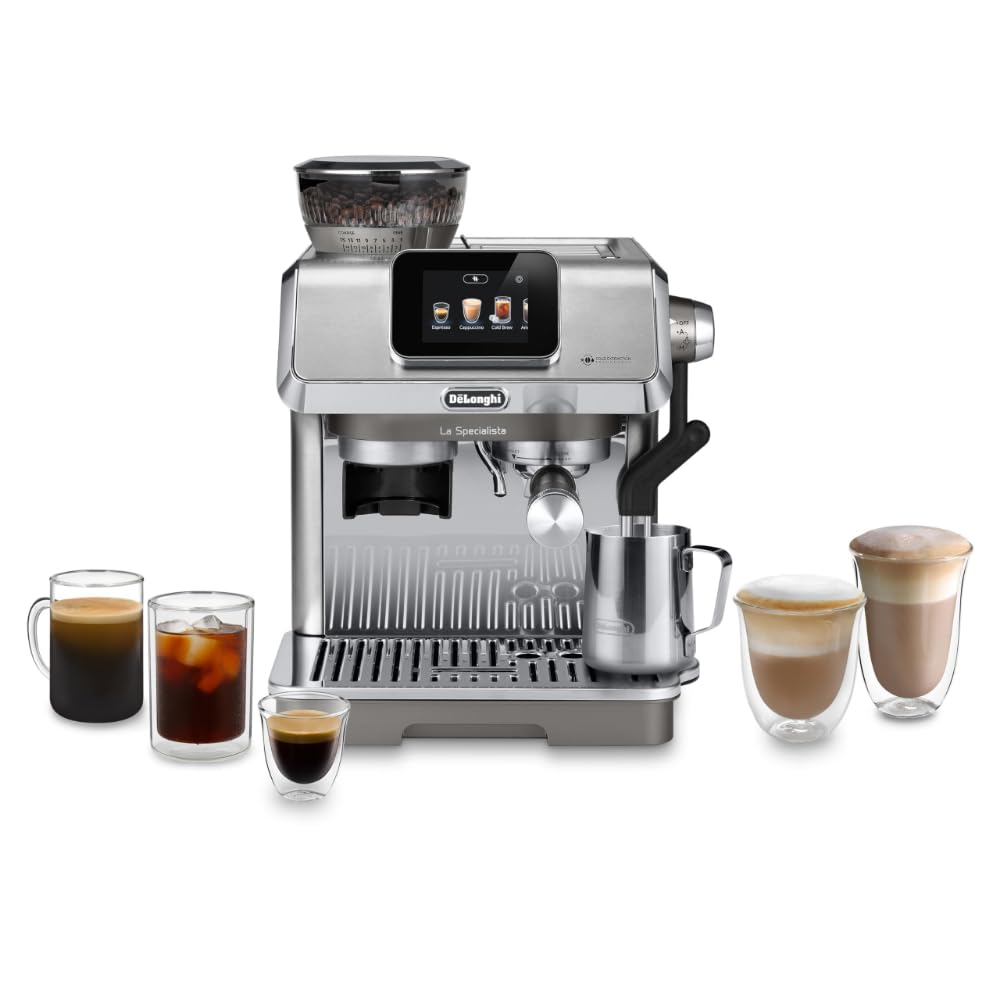
The La Specialista Touch is De’Longhi’s most advanced semi-automatic under the $1000 ceiling, featuring a 3.5-inch color touchscreen that guides you through 10 preset drink recipes including espresso, latte, flat white, cold brew, and cappuccino. The Bean Adapt technology walks you through dialing in grind size, dose, pre-infusion time, and temperature for each new bean variety, making it the most beginner-friendly machine in this list without sacrificing extraction quality. The Italian-made conical burr grinder has 15 settings, and the built-in scale ensures the correct dose weight before tamping.
Milk frothing is handled by an automatic steam wand that adjusts between five froth levels and four temperature settings, with a manual override option for experienced users who want to texture milk by hand. The Cold Extraction Technology creates cold brew in under five minutes, and the Advanced Thermoblock heats up in seconds so you are not waiting for a boiler. The design earned 2025 Red Dot and iF Design Awards, and the stainless steel body feels substantial without dominating counter space — dimensions are 14.37 x 11.22 x 15.87 inches.
The main concern with this machine is the grinder consistency at the finest settings, as some users report needing to stay above grind setting 8 to avoid clogging. The removable brew group and cleaning cycle are straightforward, but the machine relies on proprietary components, so long-term repairability is not on par with the Gaggia Classic Pro. If you want a guided espresso experience with automatic frothing and don’t mind a closed ecosystem, the La Specialista Touch delivers exceptional convenience and drink variety for the top end of the budget.
Why it’s great
- Interactive touchscreen and Bean Adapt guide make dialing in approachable for beginners
- Automatic steam wand with 5 froth levels and 4 temperature settings for consistent milk texture
- Cold brew in under 5 minutes via Cold Extraction Technology
Good to know
- Grinder can struggle at the finest settings; stay above grind setting 8 for smooth operation
- Proprietary parts limit long-term repairability versus traditional boiler machines
- Price sits at the very top of the sub-$1000 bracket
5. Gevi Dual Boiler Espresso Machine

The Gevi Dual Boiler is one of the most surprising value propositions in this category, offering a true dual boiler system — one stainless steel boiler for brewing and a separate one for steam — at a price point where most competitors still use single boilers or thermoblocks. This means you can pull a shot and steam milk simultaneously without any temperature drop, dramatically speeding up the workflow for multiple milk drinks. The machine also features a 58mm commercial portafilter, NTC and PID temperature control, and a built-in conical burr grinder with 31 grind settings.
Build quality is impressive for the price, with a stainless steel body and a solid 15-pound weight. The steam wand is positioned for easy pitcher access and produces powerful, dry steam that can texture milk in under 20 seconds once you get the hang of it. The 2.8L water tank is the largest in this review, and the detachable drip tray simplifies cleanup. Users report that the optimal grind setting falls around 5-8 depending on bean freshness, and the learning curve is minimal compared to manual-only machines — most owners are pulling drinkable shots within their first 15 attempts.
The built-in grinder is adequate for entry-level work but does produce some clumping, especially with darker roasts, and the plastic tamper feels light compared to a precision aftermarket option. The Gevi does not have the same community or parts availability as the Gaggia or Breville, so long-term support is less documented. For the price, however, the dual boiler capability alone makes this a compelling choice for anyone who regularly makes lattes or cappuccinos for two or more people and wants to avoid the brew-wait-steam dance.
Why it’s great
- True dual boiler allows simultaneous brewing and steaming for faster multi-drink workflows
- 58mm commercial portafilter accepts standard accessories and baskets
- 2.8L water tank reduces refill frequency compared to most competitors
Good to know
- Built-in grinder can produce clumping with darker roasts
- Included tamper is lightweight; upgrading to a precision tamper improves puck prep
- Limited long-term parts and community support compared to established brands
6. De’Longhi La Specialista Arte Evo

The Arte Evo sits one step below the Touch in De’Longhi’s lineup, but it retains the core features that matter most: a built-in conical burr grinder with 8 settings, a commercial-style steam wand, and the proprietary Cold Extraction Technology that produces cold brew in under five minutes. The 15-bar Italian pump delivers pre-infusion at low pressure before ramping to full pressure, and the Active Temperature Control system with three infusion settings lets you match temperature to bean roast level. The pressure gauge on the front panel gives real-time feedback during extraction, helping you dial in without a separate scale or flow meter.
The barista kit includes a dosing and tamping guide that slides onto the portafilter to prevent mess, along with a tamping mat and a storage drawer for accessories. The steam wand creates smooth microfoam capable of latte art, though it is not automatic like the Touch’s system — you control the depth and angle manually. The compact footprint (14.37 x 11.22 x 15.87 inches) fits under standard cabinets, and the removable 67 oz water tank is easy to refill and clean. Long-term owners report consistent coffee quality over two years of daily use, with the main gripe being that the grinder jams occasionally with very dark roasts if left at too fine a setting.
The big difference between the Arte Evo and the Touch is the interface — the Arte Evo uses buttons and a pressure gauge rather than a full touchscreen, and it lacks the Bean Adapt guided dial-in. For users who are comfortable experimenting with grind and dose, the Arte Evo delivers 90% of the Touch’s espresso quality for about half the price. The cold brew feature is genuinely useful and not a gimmick, producing a smooth concentrate that works well for iced lattes or espresso martinis without bitterness.
Why it’s great
- Cold Extraction Technology creates smooth cold brew concentrate in under 5 minutes
- Pressure gauge gives real-time feedback for dialing in extraction quality
- Included dosing and tamping guide reduces mess during puck prep
Good to know
- Grinder can jam with very dark roasts at fine settings; grind more coarsely for dark beans
- Manual steam wand requires practice to achieve latte-art-quality microfoam
- No touchscreen or guided dial-in like the more expensive Touch model
7. Owl G3006 by Gemilai

The Owl G3006 is a feature-packed semi-automatic that punches above its weight class, offering a dual display that simultaneously shows brewing pressure and temperature, a PID controller with adjustable pre-infusion (0-30 seconds), and a full 58mm group head — all at a surprisingly accessible price point. The PTC heating element integrated into the brew head maintains stable temperature during extraction, compensating for the thermal losses that plague cheaper machines. The dual-hole steam wand swivels 360 degrees and produces enough power to texture milk for two lattes in a single session.
The 1500W heating element and 2-meter heating pipe create strong, consistent steam pressure, and the side-mounted steam lever offers smooth, ergonomic control. Users report that the machine heats up quickly and maintains temperature stability within a couple of degrees, which is excellent for this price tier. The 57 oz water tank is removable and transparent, and the drip tray lifts out for easy cleaning. The Ivory White finish with chrome accents looks more expensive than it is, and the dual display adds a modern tech aesthetic to the countertop.
The biggest concern is quality control — a small but notable number of buyers have reported defective pumps or touchscreens out of the box, and support is handled primarily through email, which can be slow for troubleshooting. The G3006 also requires careful preheating to avoid underextraction on the first shot, and users must use fresh, properly ground coffee to get good results because the machine is unforgiving with stale or pre-ground coffee. For the price, the PID, 58mm group, and dual display combo is unmatched, but you should be prepared for a potential learning curve and some QC variability.
Why it’s great
- Dual display shows real-time pressure and temperature for precise dialing in
- Full PID controller with adjustable pre-infusion time for extraction customization
- 58mm group head accepts standard commercial accessories and baskets
Good to know
- Some units arrive with defective pumps or touchscreens; quality control is inconsistent
- Requires proper preheating and fresh coffee to avoid underextraction
- Customer support is email-only, which can delay issue resolution
8. Café Bellissimo Semi Automatic

The Café Bellissimo brings smart home integration to the semi-automatic category, connecting to the SmartHQ app for drink customization — you can adjust shot volume and strength, save profiles for different beans, and receive software updates over WiFi. The Italian-made 15-bar pump provides a gradual pressure ramp for balanced extraction, and the built-in conical burr grinder offers 15 grind size settings. The standout spec here is the massive 95 oz water reservoir, which cuts refills down to once a week for a heavy-use household, and the removable tank has a built-in handle for easy carrying.
Aesthetically, the Bellissimo is one of the best-looking machines in this bracket, with a matte white finish and copper accents that blend into modern kitchen designs. The steam wand rotates 180 degrees and produces sufficient pressure for microfoam, though it cannot steam and brew simultaneously. The four included portafilter baskets (single, double, and dual-wall options) give you flexibility for different bean freshness levels. Former baristas who have tested this machine consistently praise the shot quality when properly dialed in, noting that the extraction is clean and the crema is thick.
The major weak point is the built-in grinder, which multiple owners describe as unreliable — it clogs frequently with compacted grounds, and the grounds distribution can be messy. Some units have also exhibited water leaks from the base and button labels that wear off quickly. Many owners recommend using a separate, high-quality grinder and bypassing the internal one entirely, which obviously defeats the purpose of an all-in-one machine. If the grinder issues are fixed in a future revision, the Bellissimo could be a top contender, but as it stands, the extraction quality is held back by its weakest component.
Why it’s great
- 95 oz water tank requires refilling far less often than any competitor in this price range
- WiFi connectivity and SmartHQ app allow customized drink profiles and software updates
- Italian 15-bar pump with pressure ramp produces clean, balanced extractions
Good to know
- Built-in grinder clogs frequently and distributes grounds messily
- Cannot steam milk and pull a shot simultaneously due to single boiler design
- Some units have water leaks and button label wear; quality control varies
9. KitchenAid KES6403 Semi-Automatic

The KitchenAid KES6403 proves that you do not need a massive footprint for quality espresso — it measures just 6.38 inches deep and 13.15 inches wide, making it the most counter-friendly option in this roundup. Despite the compact size, it features a 58mm commercial-grade portafilter and dual smart temperature sensors that monitor brew and steam temperature simultaneously for consistent thermal stability. The 15-bar pump provides adequate pressure, and the slim design fits neatly under cabinets without sacrificing drip clearance for taller cups.
The steam wand is functional but has limited articulation, so positioning your milk pitcher takes some adjustment. The machine includes four filter baskets (single and double, with pressurized and non-pressurized options), a solid metal tamper, and a milk pitcher. The removable water tank holds 1.4 liters, and the auto-clean cycle runs for about 15 minutes to flush the system. Users describe the learning curve as gentle — it is a good starter machine for someone moving from a pod system to ground coffee without wanting to study thermodynamics in their kitchen.
The main limitations are the plastic build components and the single boiler design, which means you cannot steam and brew simultaneously. Some units have arrived with gasket leaks or portafilter seal issues, and the water tank lid is difficult to grip. The machine is also loud during extraction, which may be noticeable in an open-plan kitchen. For the price, the 58mm portafilter and dual temperature sensors are impressive, but the overall construction feels less premium than similarly priced competitors like the De’Longhi Arte Evo or the Owl G3006.
Why it’s great
- Ultra-compact footprint fits tight counter spaces without sacrificing a 58mm portafilter
- Dual smart temperature sensors improve thermal consistency during brew and steam
- Includes four filter baskets for pressurized and non-pressurized brewing
Good to know
- Plastic body components feel less durable than stainless steel alternatives
- Single boiler design prevents simultaneous brewing and steaming
- Some units have gasket or portafilter seal issues out of the box; quality control varies
FAQ
Is a 15 bar pump necessary for good espresso extraction?
What is the benefit of a bottomless portafilter on a semi-automatic machine?
How important is a PID controller for temperature stability in this price range?
Final Thoughts: The Verdict
For most users, the semi automatic espresso machine under $1000 winner is the Breville Barista Express because its integrated grinder, PID temperature control, and proven durability provide the best balance of convenience and shot quality for daily home use without a separate grinder investment. If you want a true 58mm commercial portafilter and a fully repairable machine that will last a decade, grab the Gaggia Classic Pro E24. And for the most versatile coffee maker that also does drip and cold brew without extra appliances, nothing beats the Ninja Luxe Café Pro.