The difference between a good rack of ribs and an unforgettable one usually comes down to what you put on them before they hit the heat. A dry rub is the foundation of bark, crust, and deep flavor penetration, yet most store-bought options are either too salty, too sweet, or loaded with fillers that scorch before the meat renders.
I’m Mohammad Maruf — the founder and writer behind AirfryerBite. I’ve spent years analyzing the ingredient profiles, sugar-to-salt ratios, and particle sizes of dozens of BBQ rubs to separate the blends that build a proper bark from those that just add sodium.
This guide breaks down the five most reliable options for backyard pitmasters who want competition-grade results without mixing their own. Whether you’re smoking low-and-slow or grilling hot-and-fast, the best rub for ribs store bought balances sweetness, heat, and spice structure for a crust that sticks through the cook.
How To Choose The Best Rub For Ribs Store Bought
Selecting a dry rub off the shelf is not just about picking a brand you recognize. The chemistry of sugar caramelization, salt penetration, and spice particle size determines whether you end up with a glossy bark or a bitter, burnt crust. Here are the three factors that matter most.
Sugar-to-Salt Ratio
The balance between sweet and savory dictates how the rub behaves during a long cook. A rub with too much brown sugar will char before the collagen breaks down, especially on a smoker running at 225°F for six-plus hours. Look for blends where sugar appears after salt in the ingredient list, or where the ratio hovers near 2:1 sugar-to-salt. This gives you caramelization without a carbonized exterior.
Particle Size and Texture
Coarse-ground rubs stick better to the meat surface and release flavor gradually over the cook. Powdery blends, often containing anti-caking agents like silicon dioxide or calcium silicate, dissolve into a paste that burns quickly and clogs your shaker. A good rib rub should have visible granules of garlic, pepper, and sugar — not a uniform dust.
Presence of Fillers and Phosphates
Many mass-market rubs add tricalcium phosphate or modified corn starch to keep the blend free-flowing. These fillers dilute the spice concentration and can leave a chalky mouthfeel on the finished bark. Premium blends skip these additives entirely, relying on the natural dryness of the spices to prevent clumping. For injection blends, phosphates help moisture retention, but a dry rub should not contain them.
Quick Comparison
On smaller screens, swipe sideways to see the full table.
| Model | Category | Best For | Key Spec | Amazon |
|---|---|---|---|---|
| Kosmos Q Dirty Bird | Dry Rub | Sweet heat on ribs & chicken | 16 oz bag, brown sugar & red pepper | Amazon |
| Meat Church Honey Hog Combo | Dry Rub Set | Pork ribs and pulled pork | 14 oz + 13 oz bottles | Amazon |
| Famous Dave’s Variety 3-Pack | Variety Pack | Sampling multiple rub styles | Rib Rub 5.5 oz + 2 other blends | Amazon |
| Snider’s Prime Rib & Roast | Dry Rub | Budget-friendly large volume | 32 oz shaker, garlic & pepper base | Amazon |
| Kosmos Q Reserve Brisket Injection | Injection Marinade | Moisture enhancement for smoking | 16 oz jar, phosphate-enhanced | Amazon |
In‑Depth Reviews
1. Kosmos Q Dirty Bird BBQ Dry Rub
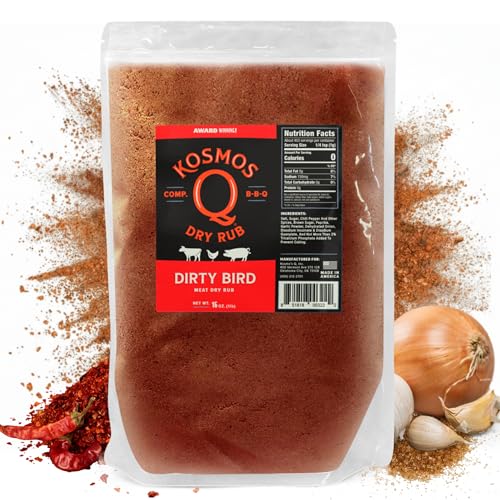
This is the rub that put Kosmos Q on the competitive BBQ map, and it earns its reputation through a precise sweet-heat balance. Brown sugar provides the caramelization base, while red pepper and paprika build a mild, lingering heat that does not overwhelm the pork. The particle size is noticeably coarse — visible granules of garlic and pepper ensure the rub adheres to the meat surface without dissolving into a paste.
On a full rack of spare ribs smoked at 250°F for five hours, Dirty Bird produced a glossy, deeply colored bark with zero scorching. The salt level is restrained enough that you can apply a generous layer without ending up with a sodium bomb. It also works well on chicken thighs and turkey legs, making it a versatile single-blend solution for backyard cooks who do not want to maintain a dozen different shakers.
One thing to note: the resealable bag is convenient but the spout can clog if the rub settles during shipping. Give it a good shake before each use to redistribute the larger spice particles. Compared to the Honey Hog blend below, this rub skews slightly more savory, which makes it a better choice for beef ribs or brisket as well.
Why it’s great
- Award-winning sweet heat profile that builds a deep bark without burning
- Coarse particle texture adheres well and releases flavor slowly
- Lower sodium content allows heavy application without over-salting
Good to know
- Bag spout can clog with larger spice granules — shake before use
- Not ideal for anyone seeking a pure vinegar-based or mustard-forward flavor
2. Meat Church Honey Hog BBQ Rub Combo

Meat Church has become a cult favorite in the competitive BBQ circuit, and the Honey Hog blend is the primary reason. This combo includes one bottle of the original Honey Hog and one bottle of Honey Hog Hot, giving you both a sweet baseline and a spiced-up alternative. The original leans heavily on honey powder and brown sugar for a sticky, candy-like crust that works exceptionally well on pork ribs and pork shoulder.
On baby back ribs cooked at 275°F for three hours using the 3-2-1 method, the Honey Hog original created a dark mahogany bark with a tacky surface that held up through the wrap phase. The Hot version adds cayenne and extra black pepper, raising the heat index noticeably but not enough to qualify as truly spicy — it is more of a warm tingle that builds over multiple bites. Both versions are gluten-free and contain no MSG.
The main drawback is shipping reliability. Some customers report delivery delays that can stretch beyond a month, so ordering ahead of a planned cook is essential. Additionally, the honey-forward sweetness can be too cloying for beef ribs or brisket; this blend is optimized for pork and poultry. If you want a one-rub solution for multiple proteins, the Kosmos Q Dirty Bird is more versatile.
Why it’s great
- Dual-bottle combo offers both original and hot versions for flexibility
- Honey powder creates a sticky, glossy bark that holds through the wrap phase
- Gluten-free with no MSG or artificial fillers
Good to know
- Shipping delays are common — order well before your planned cook
- Sweetness level can be overpowering for beef cuts
3. Famous Dave’s Seasoning Variety 3-Pack
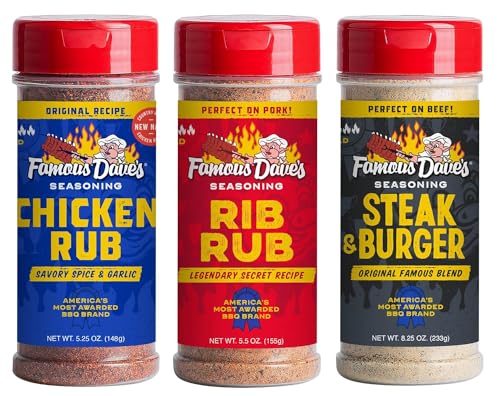
Famous Dave’s built a restaurant empire on their rib recipes, and this variety pack gives you three of their signature blends in one purchase. You get the Steak & Burger Seasoning (8.25 oz), the Rib Rub (5.5 oz), and the Chicken Rub (5.25 oz). The Rib Rub is the standout here — a sweet, smoky, garlicky blend that has been refined over 25 years of competition cooking.
The Rib Rub hits all the right notes for pork ribs: brown sugar for caramelization, paprika for color, and a balanced salt level that does not require a water glass after every bite. On a rack of St. Louis-style ribs smoked at 225°F for six hours, it produced a clean, reddish-brown bark with no bitter spots. The Chicken Rub, which includes tomato powder and paprika, is equally effective on wings and thighs, adding a subtle tang that complements the smoke.
This pack is ideal for someone who wants to experiment with different rub styles without committing to a single large bottle. The downside is that the individual bottles are relatively small — the Rib Rub is only 5.5 ounces, so if you cook ribs frequently, you will burn through it quickly. Also, the Steak & Burger seasoning is heavy on black pepper, which may overpower more delicate cuts like pork chops.
Why it’s great
- Three distinct rubs offer versatility for ribs, chicken, and beef
- Rib Rub has a proven competition pedigree with 25 years of refinement
- Generous total weight for the price point
Good to know
- Individual bottle sizes are small for frequent cooks
- Steak & Burger seasoning can be too peppery for some palates
4. Snider’s Prime Rib & Roast Seasoning

Snider’s is a straightforward, no-nonsense seasoning that prioritizes volume and consistency over flashy marketing. The 32-ounce shaker is effectively two pounds of dry rub, making it the most economical option per ounce on this list. The flavor profile is built around garlic, black pepper, salt, and a restrained amount of sugar — it is more savory than sweet, which sets it apart from most rib rubs.
On a prime rib roast cooked at 450°F for searing then lowered to 325°F, this rub formed a salty, peppery crust that complemented the beef fat without competing with it. For pork ribs, the lower sugar content means you lose some of the caramelized bark that sweet rubs provide, but it also means the rub will not scorch even on a hot grill. The ingredient list is clean — no MSG, no artificial flavors, and no anti-caking agents.
The trade-off is that this is not a dedicated rib rub. The flavor is generic enough to work on almost any meat — steak, brisket, lamb, even vegetables — but it lacks the complexity of a blended rib rub like the Kosmos Q or Meat Church offerings. If you cook a wide variety of proteins and want one seasoning that covers all bases at a low cost per pound, this is your pick.
Why it’s great
- Massive 32 oz container provides exceptional value for frequent cooks
- Savory garlic-pepper profile works on beef, pork, lamb, and vegetables
- No MSG, artificial flavors, or fillers
Good to know
- Low sugar content limits caramelization and bark formation on ribs
- Flavor profile is basic compared to competition-grade blends
5. Kosmos Q Reserve Blend Brisket Injection
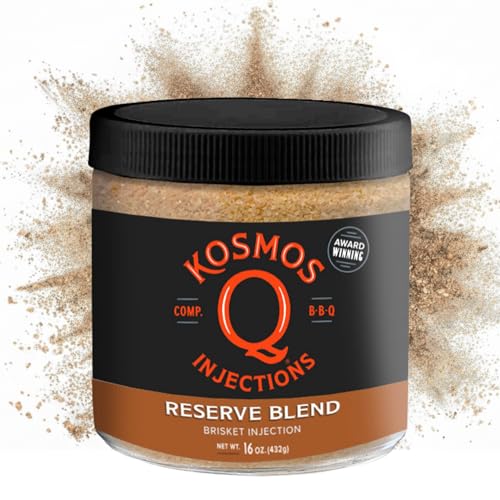
Strictly speaking, this is not a dry rub — it is a meat injection marinade designed to be mixed with water and injected deep into the muscle tissue. However, for serious pitmasters who want the most tender and flavorful brisket or pork shoulder, injection is an essential step that dry rubs alone cannot achieve. The Kosmos Q Reserve Blend uses food-grade phosphates to lock in moisture during long cooks, preventing the dreaded dry-out that ruins expensive cuts.
When used on a full packer brisket smoked at 225°F for 12 hours, this injection produced noticeably juicier meat compared to a non-injected control. The flavor is beefy with a mild, well-balanced kick that does not taste artificial. It mixed easily with distilled water and the injection process was smooth — no clogs in the needle. The 16-ounce jar yields roughly 4 gallons of injection solution, making it a cost-effective choice for competition cooks who need to treat multiple briskets.
Note that this is not a substitute for a dry rub; you should still apply a surface rub before smoking. The injection works from the inside out, while the rub builds bark on the outside. If you are cooking ribs specifically, injection is optional — ribs have enough intramuscular fat that they rarely need added moisture — but this product shines on brisket, pork shoulder, and thick steaks.
Why it’s great
- Phosphate formula retains moisture effectively during long low-and-slow cooks
- Competition-grade flavor that wins approval from serious pitmasters
- High yield — 16 oz jar makes up to 4 gallons of injection solution
Good to know
- Not a dry rub; must be used as a liquid injection marinade
- Unnecessary for ribs due to their natural fat content
FAQ
Can I use a beef rub on pork ribs without ruining the flavor?
How far in advance should I apply the rub before smoking?
Final Thoughts: The Verdict
For most users, the best rub for ribs store bought winner is the Kosmos Q Dirty Bird BBQ Dry Rub because it balances sweet heat with a coarse particle texture that builds a deep, non-scorching bark on pork ribs and chicken alike. If you want a honey-forward sweetness that turns pork ribs into candy-like perfection, grab the Meat Church Honey Hog Combo. And for a budget-friendly, large-volume seasoning that works across all proteins without breaking the bank, nothing beats the Snider’s Prime Rib & Roast Seasoning.