A room fan sitting on a nightstand that barely stirs the air is a waste of plastic and counter space. The difference between a fan that merely spins and one that genuinely cools your room comes down to blade pitch, motor type, and oscillation range — factors most buyers overlook until the heat becomes unbearable. This guide breaks down exactly which specifications separate the effective circulators from the ornamental desk decorations.
I’m Mohammad Maruf — the founder and writer behind AirfryerBite. My research focuses on comparing the measurable airflow metrics, decibel ratings, and motor efficiency data that define real-world performance in the home cooling category.
We examined over a dozen models across multiple tiers to find the ones that deliver on their airflow claims without sounding like a jet engine. The result is a focused, data-backed analysis of the best room fans available right now, organized by how well they actually perform in real rooms.
How To Choose The Best Room Fans
Choosing a fan for a bedroom, living room, or office is more nuanced than just picking the tallest or cheapest model. Airflow reach, noise output at each speed, and the ability to direct that air where you need it are the three pillars of a smart purchase. Here is what separates a fan that works from one that just exists on your floor.
Airflow Metrics: CFM, ft/s, and Coverage Area
Cubic Feet per Minute (CFM) tells you how much air the fan moves, but feet per second (ft/s) tells you how far that air travels. A high CFM with low ft/s means the fan moves a lot of air in its immediate vicinity but fails to stir the far corner of a twelve-by-fourteen-foot room. Look for a model that couples high CFM — above 800 for tower fans — with a ft/s rating of at least 23 to ensure air reaches across a standard bedroom.
Noise Output: dB Ratings and Speed Creep
The decibel rating printed on the box is almost always the lowest speed measurement. A fan rated at 20 dB on low can easily jump to 45 dB on high, which is the difference between a whisper and a humming conversation. Pay attention to reviews that mention the noise at mid and high settings. DC motor fans generally produce less noise across the speed range compared to the older AC motors found in budget models.
Oscillation Type: Degrees Matter
Standard oscillation is side-to-side, covering 60 to 90 degrees. Some premium models now offer up to 150 degrees, which spreads the air across a much wider area — critical for open-concept rooms. A handful of air circulators also tilt vertically, allowing you to direct airflow up to break a hot ceiling layer or down to cool a seated user. A fan that can oscillate both horizontally and vertically is far more versatile than one limited to a single plane.
Motor Type: DC vs. AC Efficiency
A DC motor consumes up to 70 percent less electricity than an AC equivalent and runs quieter at every speed level. The trade-off is purchase price: DC fans typically cost more upfront. However, the long-term energy savings and reduced noise make the premium worth it for anyone running a fan eight or more hours daily. AC motors are durable and cheap but louder and less efficient — fine for occasional use in a garage or workshop.
Quick Comparison
On smaller screens, swipe sideways to see the full table.
| Model | Category | Best For | Key Spec | Amazon |
|---|---|---|---|---|
| GoveeLife 42″ | Smart Tower | App & voice control | 150° oscillation / 26 ft/s | Amazon |
| DREO Bladeless Tower | Bladeless Tower | Safety & easy cleaning | 25 ft/s / 4 modes | Amazon |
| IRIS WOOZOO Circulator | Desk Circulator | Targeted 3D airflow | 82 ft max distance | Amazon |
| LEVOIT Tower Fan | Compact Tower | Ultra-quiet bedroom use | 20 dB low / 23 ft/s | Amazon |
| PELONIS 30″ Tower | Budget Tower | Entry-level tower cooling | 847 CFM | Amazon |
| OmniBreeze Tower | Mid-Range Tower | Auto temperature adjustment | 540 m³/h airflow | Amazon |
| IRIS WOOZOO Desk Fan | Compact Desk | Small desk / dorm cooling | 29 dB / 65° oscillation | Amazon |
In‑Depth Reviews
1. GoveeLife 42″ Tower Fan for Bedroom

The GoveeLife 42-inch tower fan is the most feature-dense option in this roundup, packing 12 wind speeds, 5 distinct modes, and a 150-degree oscillation arc into a 42-inch frame that reaches up to 26 ft/s. That oscillation range is the widest of any model here — nearly double the standard 90-degree swing — which makes it the best choice for open-concept living spaces or large master bedrooms where air needs to be pushed across a wide area. The built-in DC motor keeps noise at 27 dB on the lower settings, so it won’t interfere with sleep or conversation.
Smart home integration is the standout feature. The fan works with Alexa, Google Assistant, and Siri via Matter protocol, and the GoveeLife app allows you to set schedules, adjust oscillation arcs symmetrically, and pair with a compatible thermo-hygrometer for automatic speed adjustments based on room temperature. The unit also includes a removable grille and impeller wheel for easy cleaning, plus an aromatherapy box that accepts essential oils — a detail no other fan in this list offers.
On the highest speed, the fan is noticeably powerful but also the loudest in the group, and the 5 GHz Wi-Fi incompatibility is a limitation for users with dual-band routers. The price is the highest here, but for buyers who want app control, voice integration, and the widest possible room coverage, the GoveeLife justifies every penny.
Why it’s great
- Widest 150° oscillation covers the most room area
- 12 speeds plus 5 modes offer fine-grained airflow control
- Smart app, voice control, and temperature sensor pairing
- Removable grille and aromatherapy box add unique value
Good to know
- Premium price point reflects the smart features
- Does not support 5 GHz Wi-Fi networks
- Highest speed setting produces noticeable fan noise
2. DREO Bladeless Tower Fan

The DREO Bladeless Tower Fan 307 delivers a strong 25 ft/s airflow using an algorithmic impeller design and the Conada effect, which forces air through a precisely shaped aperture for a smooth, uninterrupted stream. The 36-inch profile is tall enough to circulate air across a room without dominating the visual space, and the 90-degree oscillation ensures even coverage. The bladeless construction eliminates the safety concern of spinning blades — a meaningful advantage for households with small children or curious pets.
Four modes (Normal, Natural, Sleep, and Auto) paired with four speed levels give you enough flexibility to handle different scenarios, from a quiet nighttime breeze in Sleep mode to a high-velocity push on a humid afternoon. The removable rear grille and impeller wheel make this one of the easiest models to clean, which matters for anyone who runs a fan year-round. The built-in remote storage compartment in the back prevents the controller from disappearing.
The Auto mode adjusts fan speed based on room temperature, though the sensor is integrated into the fan itself and less effective than the paired sensor approach used by the GoveeLife. On the highest setting, the white noise is noticeable but not objectionable — similar to the sound of a window AC unit from across the room. For buyers prioritizing safety, easy maintenance, and consistent performance, this is a strong mid-premium contender.
Why it’s great
- Bladeless design ensures safety and easy cleaning
- 25 ft/s airflow reaches across large rooms
- Quiet operation, especially in Sleep and Natural modes
- Remote compartment prevents losing the controller
Good to know
- Auto mode temperature sensor is less precise than paired sensors
- Highest setting still generates audible white noise
- Not as compact as smaller desk circulator options
3. IRIS USA WOOZOO Air Circulator Fan with Remote

The IRIS USA WOOZOO Air Circulator is a desk-sized powerhouse that throws air an impressive 82 feet, which is remarkable for an 11-inch-tall unit. This model stands out for its 3D oscillation capability — it can swing side-to-side and tilt up and down simultaneously, allowing you to direct airflow in any combination of angles. That vertical tilt is critical for breaking up stratified hot air near the ceiling or pushing cool air from an AC vent across the floor.
Five speed settings plus a natural breeze mode give you plenty of range, from a gentle whisper at the lowest setting to a firm gale at the highest. The auto-off timer options of 1, 2, or 4 hours make it a practical choice for bedside use, and the remote control includes a dedicated storage slot on the back of the unit. The matte white finish and compact footprint mean it fits on crowded nightstands or desks without looking out of place.
At speed five, the fan produces a noticeable motor hum, though it is still quieter than many comparably sized desk fans. The plastic construction feels solid but lightweight — the unit weighs under 5 pounds — so it can slide on a smooth surface if the oscillation is set to wide. For anyone who needs targeted airflow that reaches across a room from a small desktop footprint, this is the most effective compact circulator available.
Why it’s great
- 82-foot max air distance from a compact 11-inch frame
- 3D oscillation (horizontal and vertical tilt) for directed airflow
- Five speeds plus natural breeze mode
- Remote with onboard storage and auto-off timer
Good to know
- Highest speed produces noticeable motor noise
- Lightweight build may shift during wide oscillation
- Premium price for a desk-sized fan
4. LEVOIT Tower Fan for Bedroom
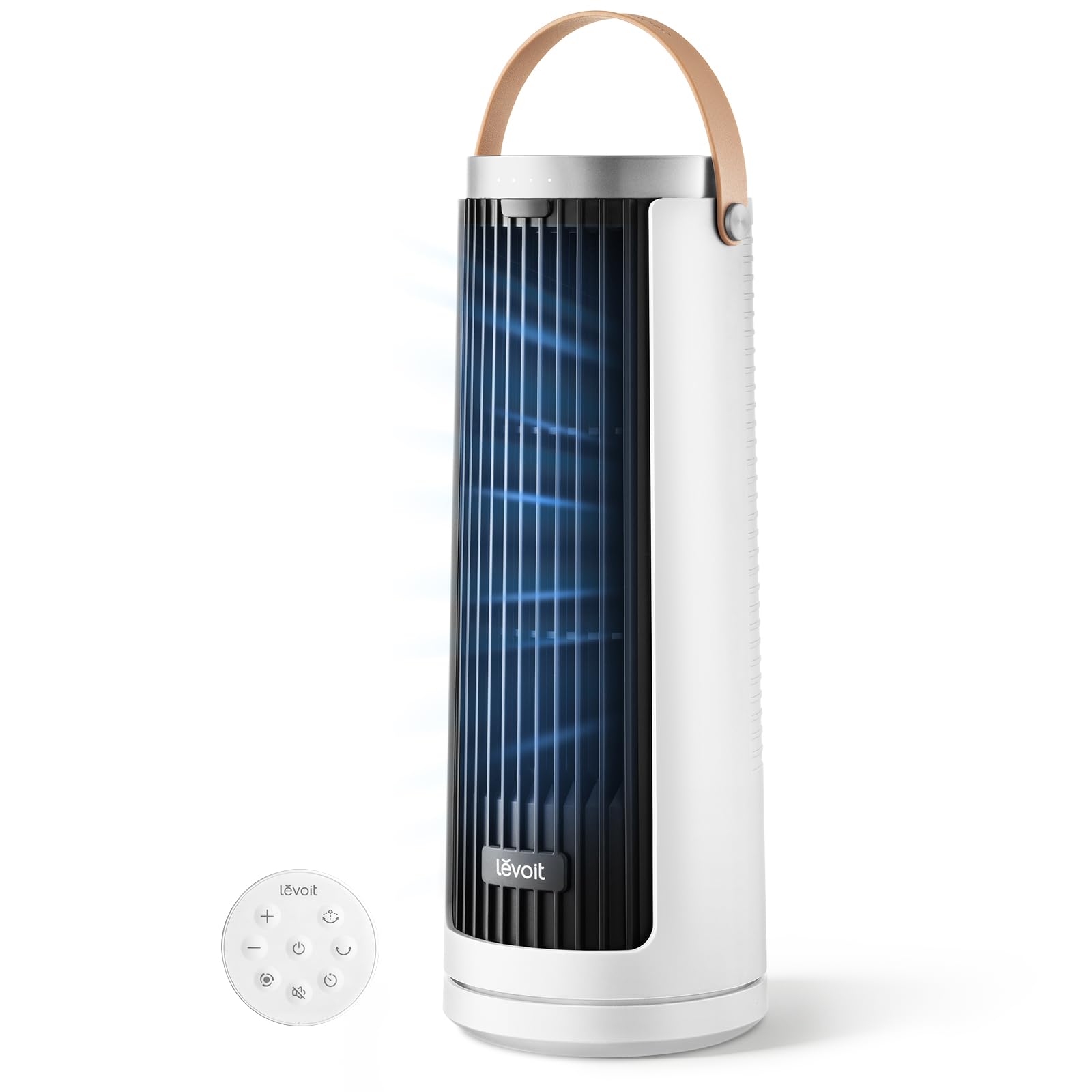
The LEVOIT Tower Fan uses a high-efficiency DC motor and VortexAir Technology to produce a focused stream of air at up to 23 ft/s while consuming a maximum of 7.5 watts. That energy efficiency is exceptional — running this fan for 24 hours costs pennies. The noise floor at the lowest speed is rated at 20 dB, which is quieter than a library. For light sleepers or anyone working in a quiet office, this is the most acoustically considerate fan in the lineup.
Five fan speeds plus a Turbo mode give you granular control, and the multi-angle oscillation offers three preset arcs: 30, 60, or 90 degrees. The ability to narrow the oscillation to 30 degrees is useful when you want to direct airflow at a single spot — like a bed or desk — without circulating air across the entire room. The 12-hour timer, optional sound-off, and display-off functions further tailor the experience for overnight use.
The carrying handle is a soft fabric loop integrated into the top, which makes it genuinely portable between rooms. The glossy plastic finish shows dust and fingerprints more readily than matte models, and the unit is limited to a tabletop or floor placement with no wall-mounting option. For buyers who prioritize whisper-quiet operation and minimal energy draw above all else, the LEVOIT delivers exactly that.
Why it’s great
- 20 dB low-speed operation — the quietest fan reviewed
- DC motor draws only 7.5 watts at max speed
- Adjustable 30°, 60°, or 90° oscillation arcs
- 12-hour timer with display-off and sound-off modes
Good to know
- Glossy finish collects visible smudges and dust
- No wall-mounting option included
- Lacks vertical tilt found on air circulator models
5. PELONIS 30-Inch Oscillating Tower Fan

The PELONIS 30-inch tower fan brings CycleBoost technology to a budget-friendly frame, moving 847 CFM of air with a 90-degree oscillation range. The 30-inch height is shorter than most tower fans, which makes it a good fit for apartments or rooms with low furniture where a taller model might look disproportionate. Assembly is genuinely tool-free — two base halves snap together, and the body twists onto the base nut in under a minute.
Three speeds and a 7-hour timer represent a simpler control scheme compared to the multi-mode competitors, but the trade-off is ease of use. The top-mounted control panel, with buttons for power, speed, timer, and oscillation, is intuitive enough to operate without the remote. The built-in handle on the back makes it easy to relocate between rooms. At 37 dB on low, it is quiet enough for background white noise during sleep.
The cylindrical grille design restricts airflow to a narrow band about 24 inches off the ground. Several users noted that the air stream bypasses a seated person and only cools the lower legs or the side of a mattress. The base is also relatively narrow, making the fan prone to tipping if bumped, especially on carpeted floors. For a budget-friendly tower fan that fits small spaces, the PELONIS works well as a supplement to an existing air conditioner but should not be relied on as a primary cooling source for a seated workspace.
Why it’s great
- Tool-free assembly takes under a minute
- Compact 30-inch height fits low furniture spaces
- Three speeds and a 7-hour timer are simple to use
- Low noise level suitable for bedroom background sound
Good to know
- Airflow band sits low and may miss seated users
- Narrow base makes the fan prone to tipping
- No vertical tilt or multi-mode settings
6. OmniBreeze Digital Electric Tower Fan

The OmniBreeze Tower Fan integrates a digital temperature display into the body, which shows the current room temperature and feeds data into the Auto mode algorithm. In Auto mode, the fan adjusts its speed up or down based on the ambient temperature, which is a useful feature for maintaining consistent comfort through the night without manually cycling speeds. Four modes (Normal, Natural, Sleep, and Auto) cover most use cases, and the remote control works up to 20 feet away.
The 36-inch tower design includes a 90-degree oscillation that distributes air across the room, and the 540 m³/h airflow rating is adequate for medium-sized bedrooms and living rooms. The two-piece base and lock nut assembly takes about 30 seconds, making it one of the quickest setups among the tower fans reviewed. The mute function silences all button tones, and the display can be turned off entirely for pitch-dark bedrooms.
Some users noted that the oscillation is limited to approximately 60 degrees of actual coverage rather than the advertised 90, which reduces the spread compared to the DREO or GoveeLife models. The painted plastic finish is prone to scratching, and the base does not include rubberized feet for hard floors — it can slide on tile or wood during oscillation. For buyers who want a digital temperature readout and auto-adjusting speed without spending for premium smart features, the OmniBreeze strikes a functional middle ground.
Why it’s great
- Digital temperature display with auto speed adjustment
- Four modes and four speed levels provide good variety
- 30-second tool-free assembly
- Mute function and display-off mode for dark rooms
Good to know
- Actual oscillation coverage may be less than advertised
- Painted finish scratches more easily than matte plastic
- Base lacks anti-slip pads for hard flooring
7. IRIS USA WOOZOO Desk Fan, Oscillating Air Circulator
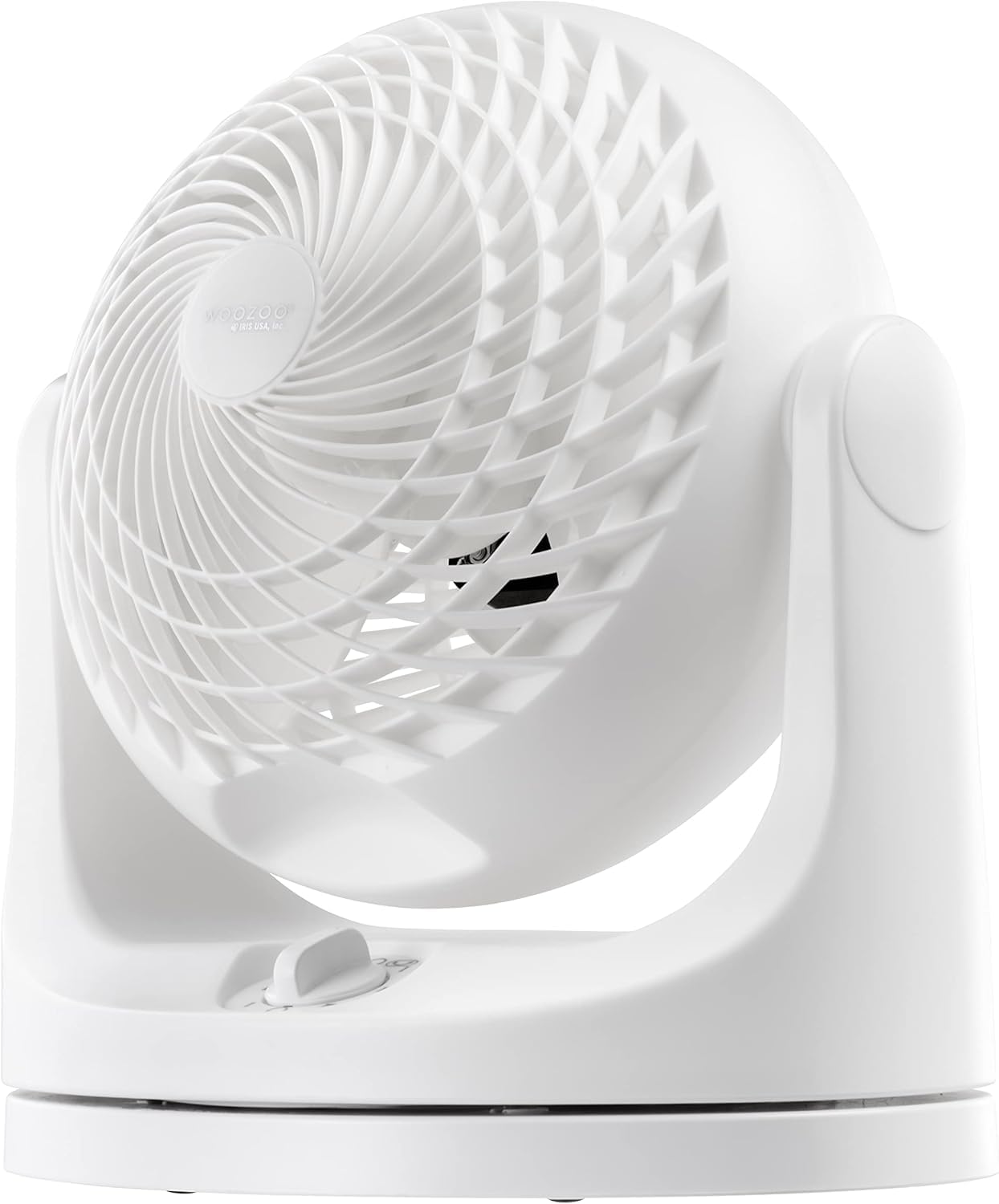
The IRIS USA WOOZOO Desk Fan is the budget-oriented sibling of the premium WOOZOO Circulator, designed for smaller spaces like dorm rooms, office cubicles, or compact bedrooms. It covers a rated 244 square feet with a 36-foot maximum air distance, which is sufficient for a standard 12×12 room. The deep-pitch fan blades and spiral grille design focus the airflow into a tight stream rather than a diffused breeze, which makes the air feel more directed and effective even at lower speeds.
Three speed settings are controlled by a simple front-mounted touch button, and the 65-degree oscillation spreads the air across a desktop or small room without overshooting. The vertical tilt offers six preset angles, so you can point the airflow up toward the ceiling or down toward a seated torso. At 29 dB on the lowest setting, it is quiet enough for use during video calls or light sleep — not as silent as the LEVOIT but well within comfortable range.
The build quality is good for the price tier, with a 4.63-pound weight and a built-in carry handle on the back that makes it genuinely portable. Some users reported that the fan developed a rattle after extended use at the highest speed, though the majority of reviews note stable performance over multiple years. For anyone seeking a no-frills, effective desk fan that covers a small room without breaking the budget, this is the most practical entry point in the list.
Why it’s great
- Covers 244 sq. ft. with a 36 ft air distance from a compact body
- Deep-pitch blades and spiral grille deliver focused airflow
- Six vertical tilt positions and 65° oscillation
- Lightweight with a built-in carry handle for portability
Good to know
- Only three speeds with no timer or remote control
- Plastic construction may develop noise at highest speed over time
- Limited to tabletop use with no floor stand option
FAQ
What is the ideal CFM rating for a bedroom fan?
How loud is too loud for a tower fan in a bedroom?
Do bladeless tower fans cool better than bladed fans?
Is oscillation worth paying extra for in a room fan?
Can I use a tower fan with my air conditioner to save money?
Final Thoughts: The Verdict
For most users, the best room fans winner is the GoveeLife 42″ Tower Fan because it combines the widest 150-degree oscillation, 12 speeds, smart home compatibility, and a built-in aroma diffuser into a single package that covers large rooms without compromise. If you want ultra-quiet operation for a nursery or home office, grab the LEVOIT Tower Fan — its 20 dB low-speed whisper and 7.5-watt power draw are unmatched. And for targeted 3D airflow from a compact desktop footprint, nothing beats the IRIS USA WOOZOO Air Circulator, which throws air 82 feet from an eleven-inch frame and oscillates in every direction.