Unlike a campfire that wastes heat sideways, a rocket stove channels the flame vertically through a insulated chamber, forcing complete combustion that delivers intense, concentrated heat directly under your pot. The result is a boil time measured in minutes, far less smoke, and a fraction of the fuel consumption you’d expect from open-fire cooking.
I’m Mohammad Maruf — the founder and writer behind AirfryerBite. I’ve spent years analyzing outdoor cooking hardware, from portable backpacking stoves to heavy-duty cast iron cook stations, and I evaluate each rocket stove on its burn efficiency, material thickness, and real-world portability.
This guide cuts through the marketing noise to bring you the most capable, durable, and genuinely useful best rocket stove options available for camping, emergency preparedness, and backyard cooking, so you can pick the one that matches your exact needs.
How To Choose The Best Rocket Stove
Rocket stoves are deceptively simple, but the wrong choice will leave you fighting unstable pots, rusted-out bodies, or poor airflow that kills the burn. Here are the three factors that separate a great stove from a frustrating one.
Material: Cast Iron vs. Stainless Steel vs. Carbon Steel
Cast iron stoves retain heat far longer and radiate it back toward the pot after the flame dies, which helps maintain a steady simmer. The trade-off is weight — a cast iron rocket stove typically weighs 12 to 21 pounds, making it a base-camp or emergency-prep tool rather than a backpacking companion. Stainless steel models resist rust better and shed weight dramatically, landing around 1 to 10 pounds depending on gauge, but they cool faster and the thinner walls of budget versions can warp under sustained high heat. Carbon steel sits in the middle — durable, relatively lightweight, but vulnerable to rust if the paint or coating chips.
Burn Chamber Design and Airflow Control
The defining feature of any rocket stove is the L-shaped or J-shaped tube that forces intake air to mix with fuel gases before ignition. Look for a vertical chamber that is fully insulated with refractory metal or ceramic lining — that lining protects the outer walls from warping and keeps the internal temperature high enough for a secondary burn that consumes smoke. Adjustable doors on the combustion chamber and damper give you the ability to throttle the air supply, which directly controls heat output. Without those doors, you rely entirely on how fast you feed sticks into the tube, which is less precise for simmering.
Stovetop Stability and Cookware Compatibility
A three-prong or six-prong cast iron trivet should sit flat and hold a 12-inch cast iron skillet or Dutch oven without wobbling. Some stoves use welded flanges or bent prongs that flatten under the weight of a full pot, causing dangerous tipping. The trivet height also matters — if the pot sits too far above the exhaust port, you lose heat energy before it reaches the cookware. Ideally, the top of the combustion tube should sit within an inch of the trivet surface. For backpacking stoves like the MSR PocketRocket 2, the pot support arms must lock securely into place; loose pot support is a common failure point on ultralight canister stoves.
Quick Comparison
On smaller screens, swipe sideways to see the full table.
| Model | Category | Best For | Key Spec | Amazon |
|---|---|---|---|---|
| IronClad Supply Rocket Stove | Premium Cast Iron | Emergency prep & off-grid living | 23,000 BTU peak output | Amazon |
| Onlyfire Cast Iron Rocket Stove | Premium Cast Iron | Heavy-duty backyard cooking | 0.5″ thick cold-rolled steel body | Amazon |
| TAFEIDA Rocket Stove | Mid-Range Stainless | Car camping & deck use | 17″ x 13″ x 5″ flat-pack footprint | Amazon |
| StarBlue Collapsible Rocket Stove | Mid-Range Carbon Steel | Vehicle camping & group cooking | Collapsible flat-pack design | Amazon |
| Lineslife Double Doors 12.6″ | Mid-Range Cast Iron | RV trips & base camps | 18 lbs all-cast-iron build | Amazon |
| Lineslife Stainless Steel 12.6″ | Mid-Range Stainless | Rust resistance & lighter carry | Stainless steel with refractory lining | Amazon |
| MSR PocketRocket 2 | Ultralight Canister | Solo backpacking & day hikes | 9.9 oz total kit weight | Amazon |
In‑Depth Reviews
1. IronClad Supply Rocket Stove

The IronClad Supply Rocket Stove delivers the highest BTU output in this roundup at 23,000 BTUs, but what sets it apart is the ceramic-lined combustion chamber that sustains those temperatures without warping the outer body. Weighing 21 pounds, this is a heavy-duty unit built for stationary use at a cabin, in the backyard, or as part of a go-bag for emergency preparedness. The six-prong cast iron stovetop accepts a full-size Dutch oven or a 12-inch skillet without any wobble, and the included canvas bag doubles as a firewood carrier.
Users consistently report that it boils water in minutes using only small sticks and a few lumps of charcoal, with jet-like flames that burn nearly smoke-free once the chamber reaches operating temperature. The fuel support system — a built-in grate inside the loading tube — keeps smaller twigs from falling through and starving the flame. Heat-resistant silicone handles make moving the unit safe after cooking, though the 21-pound weight means it’s strictly a car-camp or off-grid cabin tool.
Reviewers note that the ceramic liners hold up well over repeated use, and the build quality is described as “solidly built, will outlive user.” There are no reported defects in the casting or door alignment, and the firebox door seals tightly for precise airflow control. It is a premium investment for anyone who prioritizes durability and raw heat output over portability.
Why it’s great
- Ceramic-lined combustion chamber prevents warping and sustains secondary burn
- Authentic 23,000 BTU peak output with twigs or charcoal
- Six-prong cast iron trivet stable for heavy Dutch ovens
Good to know
- At 21 pounds, it is the heaviest model tested — not for backpacking
- Canvas bag is weather-resistant but not waterproof for long-term storage
2. Onlyfire Cast Iron Rocket Stove

The Onlyfire Cast Iron Rocket Stove is built with a 0.5-inch thick cold-rolled steel body and a refractory metal lining that survives hours of high-heat burning without cracking. At 12 pounds, it is significantly lighter than the IronClad unit while still offering that same 23,000+ BTU output from a handful of twigs. The cast iron trivet supports all standard cookware sizes, and the stable base prevents tipping even with a full 12-inch cast iron skillet and several pounds of chili inside.
Users report boiling a liter of water in under six minutes, and the rocket-burn design produces a clean flame with noticeably less smoke than an open fire. The stainless steel side handles with heat-resistant silicone grips make it easy to reposition the stove once it cools down, and the compact 12.72-inch footprint fits on a picnic table or on the ground next to a camp chair. A small number of early units experienced cracking on the first use, but the manufacturer appears to have addressed this in later production runs — the majority of recent reviews highlight excellent longevity.
The lockable fuel door and tight-fitting design keep sparks contained, which is a genuine safety advantage for use during moderate burn bans or on dry campgrounds. Ash collects cleanly at the bottom for easy disposal. For the price, this stove offers the most balanced combination of heat output, build quality, and weight in the premium cast iron category.
Why it’s great
- 0.5-inch cold-rolled steel body with refractory metal lining resists warping
- 12-pound weight makes it the lightest heavy-duty cast iron option
- Lockable fuel door and enclosed design reduce spark hazard
Good to know
- Some early units cracked on first use; newer batches are reportedly more consistent
- Handles and door hardware feel less durable than the main body
3. TAFEIDA Rocket Stove

The TAFEIDA Rocket Stove is a generously sized flat-pack stainless steel unit measuring 17 inches long by 13 inches wide, offering a large cooking surface that fits multiple burgers, a full cast iron griddle, or a large pot of soup simultaneously. The design uses a horizontal feed tube with a vertical chimney, and the large opening accepts twigs, split firewood, and even small branches without needing to break them down into tiny pieces. The 6-kilogram weight (roughly 13 pounds) is reasonable for car camping and deck use.
Users highlight the sturdy welded construction, noting that the welds feel solid and the stove holds up well to repeated use. The included fire poker helps manage the burn and clear ash, and the large fuel chamber allows for longer burn times between refueling compared to smaller backpacking stoves. A few reviewers recommend hammering the pot support flanges for a more stable fit before first use, as the factory bends can be slightly uneven.
The main downsides reported are some interior rusting inside the burn tube after several uses — this is cosmetic and does not affect performance, but it means the stove benefits from being dried out after use. The tongs included in the package are a weak point; several units arrived with damaged tongs, and the manufacturer does not offer a straightforward replacement process. For the cooking area alone, this is a strong mid-range choice for family-sized camp meals.
Why it’s great
- 17 x 13-inch flat-pack footprint provides the largest cooking surface in this roundup
- Welded stainless steel construction with reinforced joints feels durable
- Accepts larger branches without needing to split or break fuel into tiny pieces
Good to know
- Interior of the burn tube can develop surface rust if not dried after use
- Included tongs are low quality and may arrive damaged
4. StarBlue Collapsible Rocket Stove

The StarBlue Collapsible Rocket Stove solves the storage problem that plagues rigid rocket stoves — it breaks down into flat panels that pack into a compact 5.8 x 5.2 x 12-inch bundle, making it the most car-trunk-friendly option in the mid-range category. The rust-resistant low-carbon steel body assembles with sliding leg pins in about 30 seconds, and the wide cross-stand provides a stable platform for cast iron skillets or a cookie sheet underneath to catch ash. The large fuel chamber accommodates sticks up to about 1 inch in diameter.
Users report extremely fast ignition — a fire started with small twigs cooks chicken cutlets in about 40 minutes with minimal babysitting. The collapsible design means the chimney section slides out, but it can be difficult to separate from the body while hot, so you must wait for cooldown before packing up. The included carrying bag is roomy, but the chimney soot will transfer to the bag and your hands during handling.
A few experienced users note that the feeding chute is not steep enough to auto-feed sticks like a traditional rocket stove design — you need to manually push fuel into the burn chamber periodically. The lack of a damper door means you have less control over airflow for low-temperature simmering. Despite these limitations, the build quality and customer service are praised, with one review noting that the company replaced a unit with a paint defect without hassle.
Why it’s great
- Fully collapsible flat-pack design fits in tight trunk or gear storage spaces
- 20-second assembly with sliding leg pins — no tools required
- Rust-resistant low-carbon steel body with good customer support
Good to know
- Chimney section is difficult to remove while hot; must wait for full cooldown
- Feeding chute is not steep enough for gravity-fed auto-feed operation
5. Lineslife Double Doors 12.6″ Cast Iron
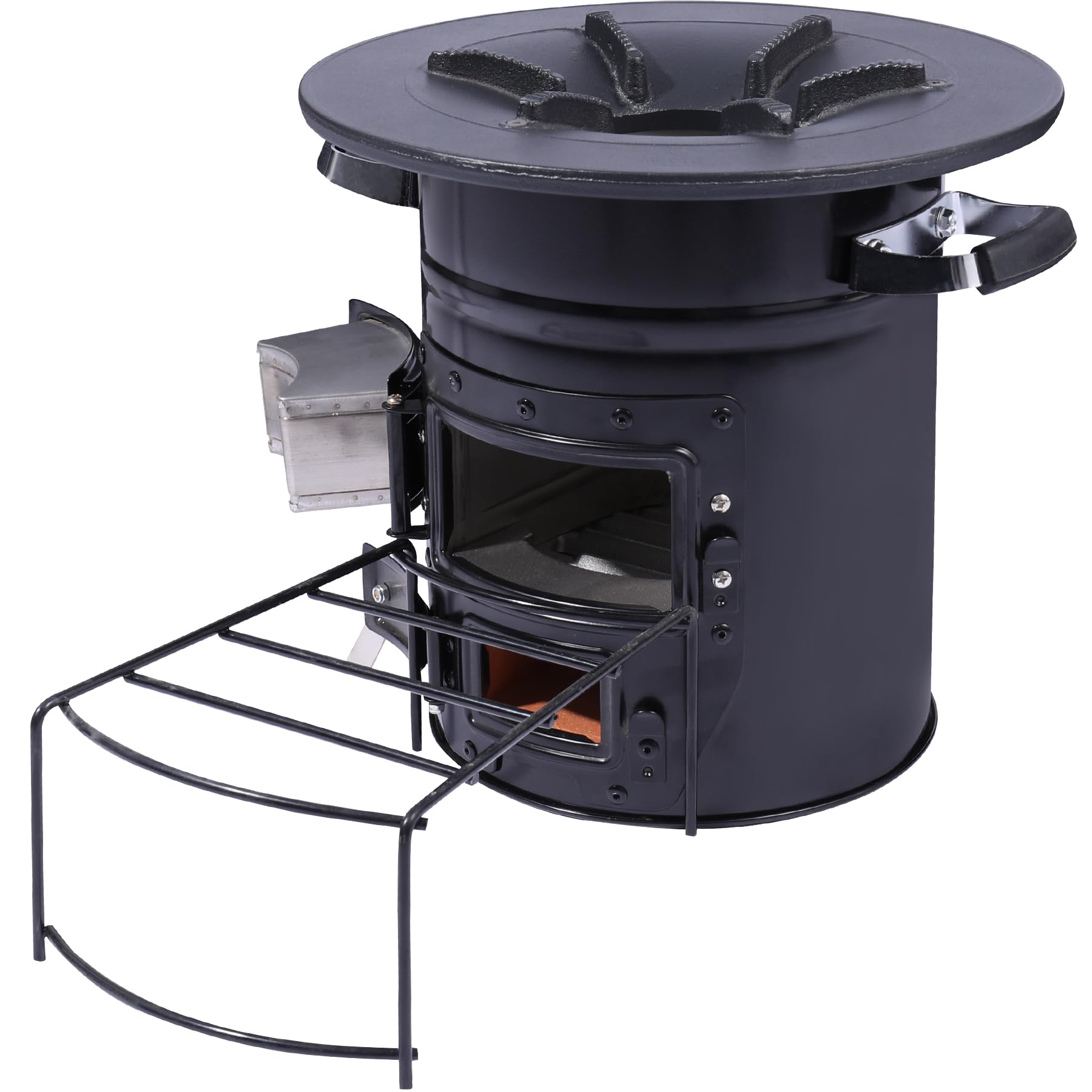
The Lineslife Double Doors 12.6″ Cast Iron Rocket Stove is built like a miniature forge — it weighs 18 pounds, uses 0.5-inch cold-rolled sheet for the body, and features a double-door design with both a main combustion chamber door and a separate damper door for precise airflow regulation. The cast iron six-prong stovetop supports a 12-inch cast iron skillet or a full Dutch oven without flexing. The included removable fire rack in the combustion chamber creates the air circulation needed for a secondary burn that drastically reduces smoke.
Owners praise the well-sealed doors and the refractory metal lining inside the top door and combustion chamber, which protects the outer cast iron from direct flame impingement. The stainless steel handles with silicone grips make moving the unit manageable despite the weight, and the oxford storage bag includes a utensil pouch for fire starters and gloves. Users note that it works well with twigs, charcoal, and solid biomass fuel, and that the cast iron retains heat long after the flame is gone, allowing for low-heat simmering.
The primary caveat is that this stove is heavy enough that it is not practical for frequent relocation — it is best set up at a campsite or in an RV and left there for the duration. The surface gets extremely hot, and the stove must be used in a well-ventilated outdoor area. Reviewers consistently report that it is durable enough to outlast most alternative cooking gear, and the cast iron construction ensures it will survive years of regular use if properly stored.
Why it’s great
- Double-door design allows independent control of combustion air and damper airflow
- Full cast iron construction with refractory metal lining for extreme durability
- Excellent heat retention enables long, steady simmering after flame dies
Good to know
- At 18 pounds, it is best suited for stationary car-camp or RV deployment
- Surface temperatures are extreme; requires a designated heat-safe area
6. Lineslife Stainless Steel 12.6″
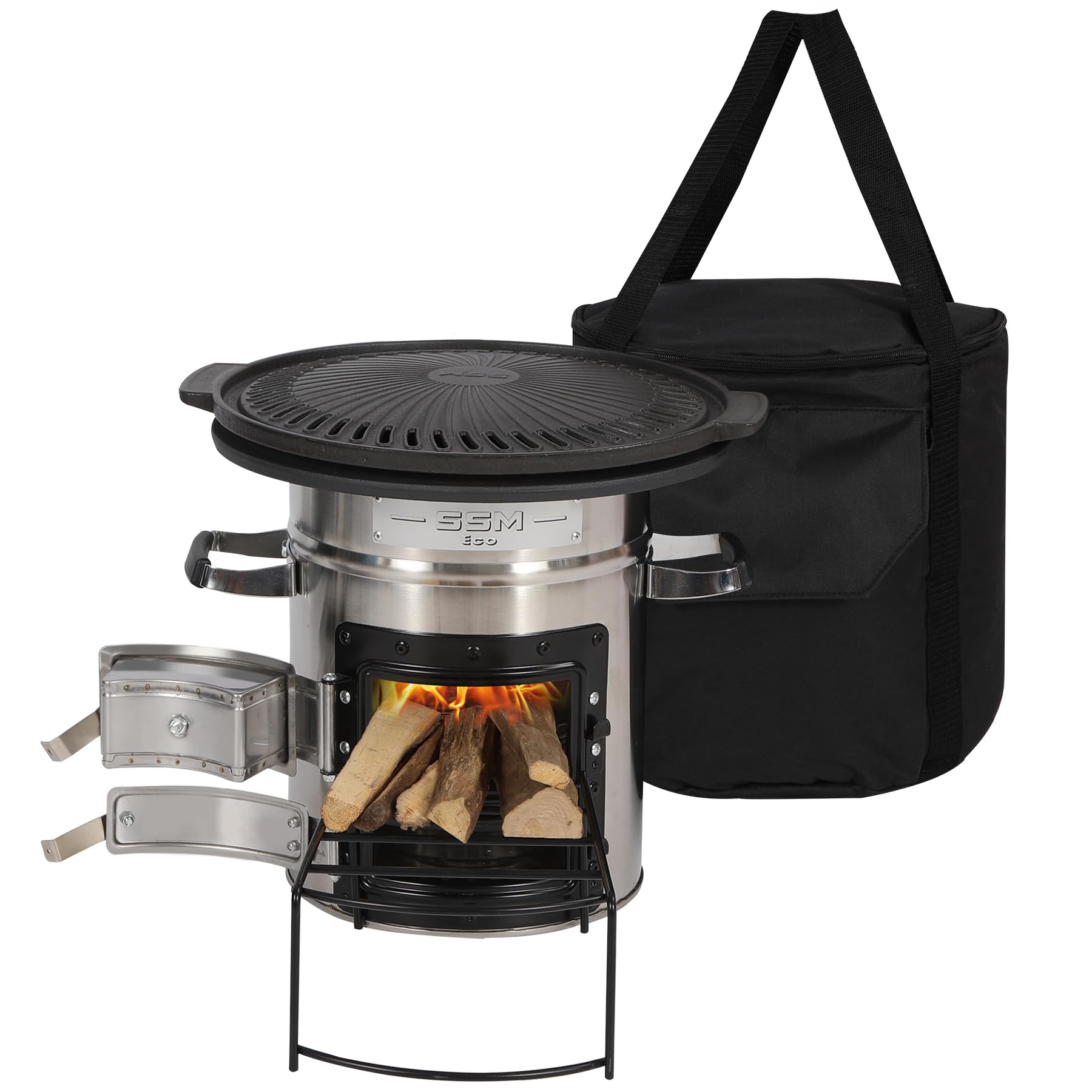
The stainless steel version of the Lineslife 12.6-inch rocket stove shares the same double-door design and six-prong cast iron trivet as its cast iron sibling, but swaps the heavy body for a stainless steel shell that weighs dramatically less. The included griddle pan and baking tray expand cooking options beyond simple boiling — you can fry eggs, sear meat, or even bake small items over the contained flame. The refractory metal lining in the top door and combustion chamber is retained, so the stainless steel body is protected from direct heat exposure.
Users find this stove significantly easier to transport than a cast iron equivalent, describing it as lightweight while still being “sturdy and well-engineered.” The windproof design is a standout feature — the enclosed combustion chamber means the burn is largely unaffected by gusts, which is a genuine problem with open campfires and many gas stoves. The cast iron trivet remains stable under a variety of pot sizes, and the included oxford storage bag fits everything neatly.
A few reviewers note that the unit is still heavy and bulky compared to true backpacking stoves, so it remains in the car-camp and RV category. The stainless steel body does not hold heat as well as cast iron, so the stove cools quickly once the fuel is exhausted. For someone who wants the double-door airflow control and rust resistance of stainless steel, this is a solid mid-range choice that avoids the weight penalty of full cast iron.
Why it’s great
- Stainless steel body resists rust and weighs less than cast iron equivalent
- Windproof enclosed combustion design maintains burn in gusty conditions
- Includes griddle pan and baking tray for expanded cooking versatility
Good to know
- Stainless steel body does not retain heat as well as cast iron for post-flame simmering
- Still too heavy and bulky for backpacking use
7. MSR PocketRocket 2
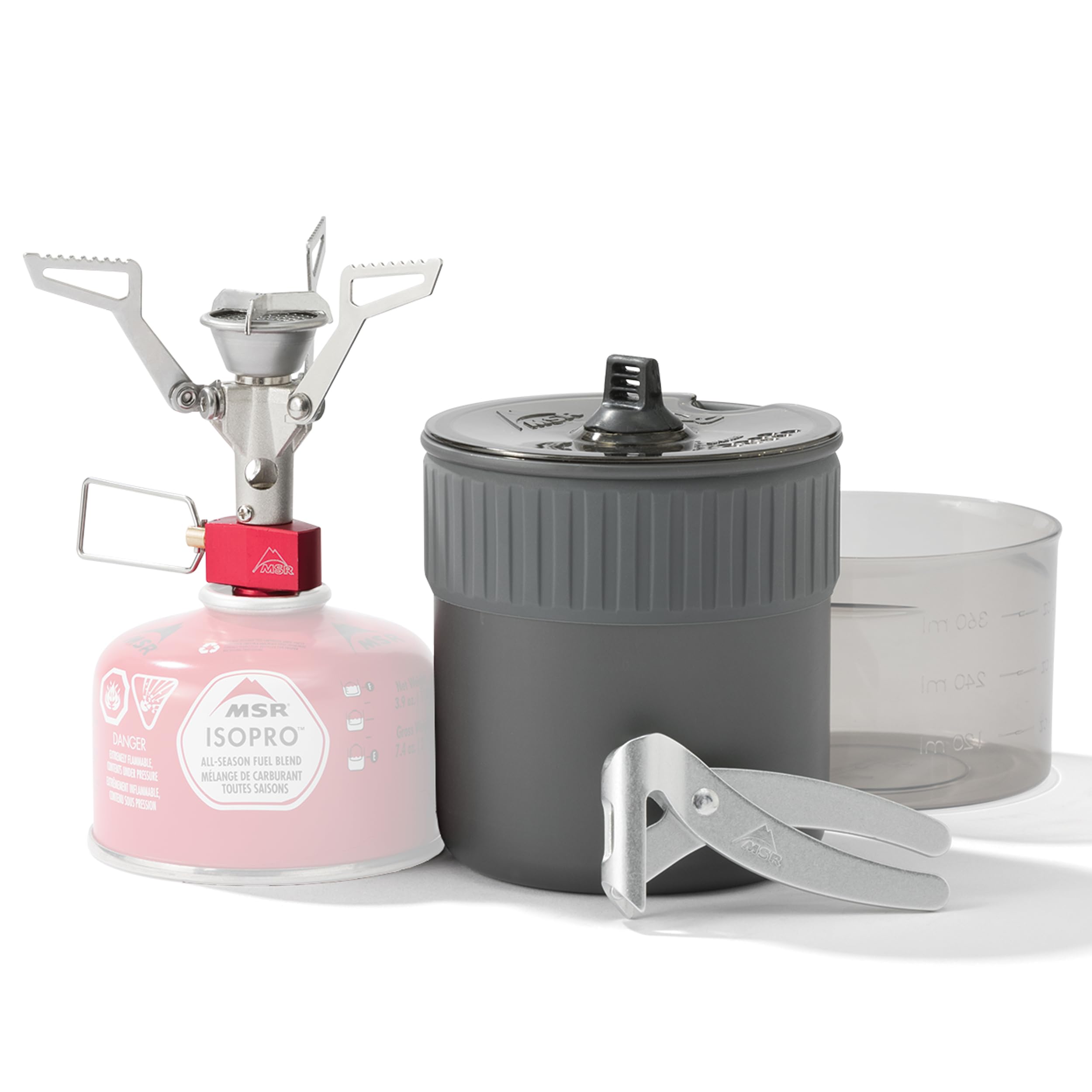
The MSR PocketRocket 2 is an entirely different class of stove from the wood-burning rocket stoves above — it is a high-pressure isobutane canister stove designed for ultralight backpacking where every gram counts. This kit includes the PocketRocket 2 stove head, a 0.75-liter aluminum pot, an insulated bowl that doubles as a drinking vessel, a clear lid with straining ports, and a mini pot lifter — all packing into a 4 x 4 x 5-inch stuff sack that weighs just 9.9 ounces. It boils one liter of water in 3.5 minutes, making it ideal for dehydrated meals and coffee.
Users consistently praise the compact size and weight, noting that the entire pot, stove, and fuel canister fit inside the included sack and take up minimal backpack space. The simmer control is surprisingly functional for a canister stove, allowing more than just boil-only meals. The pot’s insulated grip and the hot-and-cold-safe bowl add convenience for solo hikers who want to eat directly out of the cookware.
The key limitation for rocket stove shoppers: this requires proprietary isobutane canisters, not twigs and branches. If your goal is off-grid cooking without manufactured fuel, this is not the right tool. The pot sits somewhat precariously on the small burner head — vigorous boiling can nearly dislodge the pot if you are not careful. The plastic bowl at the bottom of the pot will melt if left in place during cooking. For the ultralight backpacking niche, however, this is a category-leading performer.
Why it’s great
- Ultralight 9.9-ounce total kit weight with pot, stove, and cup included
- 3.5-minute boil time for 1 liter using isobutane canisters
- Simmer control allows more than just boil-only cooking
Good to know
- Requires manufactured isobutane canisters — no wood-burning capability
- Pot sits precariously on small burner; vigorous boiling can risk tipping
FAQ
Can I use a rocket stove indoors or inside a tent?
What is the difference between a rocket stove and a regular campfire?
How do I prevent my rocket stove from rusting?
Can I use charcoal in a rocket stove instead of wood?
Final Thoughts: The Verdict
For most users, the best rocket stove winner is the IronClad Supply Rocket Stove because its ceramic-lined combustion chamber and 23,000 BTU output deliver the highest heat efficiency and durability for emergency prep and off-grid cooking. If you want a lighter cast iron option that still provides heavy-duty performance for backyard cooking, grab the Onlyfire Cast Iron Rocket Stove. And for ultralight backpackers who need a stove that fits in a 4-inch stuff sack and boils water in 3.5 minutes, nothing beats the MSR PocketRocket 2.