That glass of tap water might look clear, but if your local supply reads above 200 ppm on a TDS meter, you are drinking dissolved solids, heavy metals, chlorine byproducts, and trace pharmaceuticals every single day. A proper reverse osmosis system is the only residential solution that pushes water through a semi-permeable membrane with pores as small as 0.0001 microns, physically blocking particles that activated carbon alone cannot touch.
I’m Mohammad Maruf — the founder and writer behind AirfryerBite. I’ve spent years digging through NSF certification databases, analyzing membrane rejection rates, stage configurations, and pure-to-drain ratios to separate the systems that actually deliver sub-20 ppm water from the ones that just sound good on the box.
Whether you are dealing with hard well water, municipal chloramine, or simply want drinking water that rivals spring quality, understanding the difference between a 5-stage budget system and a tankless smart unit with UV sterilization is what leads you to the true best ro filters for your specific household chemistry and budget.
How To Choose The Best RO Filters
Every RO system follows the same core principle — push water through a semi-permeable membrane — but the real-world results vary wildly based on pre-filtration stages, membrane quality, added features like UV light or remineralization, and whether you choose a tankless or tank-based design. Here are the specific specs and trade-offs you need to evaluate before buying.
Stage Count vs Real Filtration Power
A 5-stage system typically includes sediment, carbon block, RO membrane, another carbon polish, and a final post-filter. A 6-stage system adds an alkaline remineralization cartridge to raise pH and add calcium/magnesium back into the water. More stages do not automatically mean better water — the RO membrane itself does 90% of the work. What matters is the quality of the pre-filters (to protect the membrane from clogging) and whether the final stage introduces beneficial minerals or simply adds unnecessary cost.
Feed Water Pressure and TDS Rejection Rate
RO membranes require a minimum driving pressure — usually 40-60 psi — to push water through the membrane pores effectively. If your home water pressure is on the low side, a built-in booster pump (found in most tankless systems) becomes critical for maintaining flow rate and achieving the advertised TDS rejection rate of 90-98%. Systems without pumps often produce much slower output and higher wastewater ratios, especially when incoming water temperature drops below 50°F.
Tankless vs Traditional Tank Design
Tankless RO systems (like the Waterdrop D6 or iSpring RO500AK) use a high-pressure pump to push water through the membrane on demand, delivering purified water instantly without a storage tank. This eliminates the risk of secondary bacterial growth inside a stagnant tank and saves significant under-sink space. Traditional tank-based systems store 2-4 gallons of pre-purified water and release it when you open the faucet. The trade-off: tankless systems require a dedicated electrical outlet and tend to be louder during operation, while tank systems work passively with no power draw.
Pure-to-Drain Ratio and Water Waste
Older RO systems wasted 3-4 gallons of water for every gallon they produced. Modern systems achieve ratios of 2:1, 3:1, or even 5:1 — meaning you get two to five cups of purified water for every one cup sent to the drain. A higher ratio reduces your water bill and environmental footprint but often requires a permeate pump or more advanced membrane technology. If you live in an area with water restrictions or high utility rates, prioritize models with a ratio of at least 2:1.
NSF/ANSI 58 Certification
NSF/ANSI 58 is the only standard specifically designed for residential RO systems. It verifies that the system reduces a defined list of contaminants (including arsenic, lead, fluoride, nitrates, and total dissolved solids) to the levels claimed on the packaging. Systems without this certification may use the same membrane technology, but they have not been independently tested for performance verification. Always check for the NSF seal on the system itself — not just individual filter components.
Quick Comparison
On smaller screens, swipe sideways to see the full table.
| Model | Category | Best For | Key Spec | Amazon |
|---|---|---|---|---|
| Waterdrop D6 | Tankless Under Sink | High flow with smart display | 600 GPD, 2:1 ratio | Amazon |
| iSpring RCC7AK | Tank-Based Under Sink | Remineralized alkaline water | 75 GPD, NSF 58 certified | Amazon |
| APEC ROES-50X | Tank-Based Under Sink | Budget-friendly reliability | 50 GPD, 5-stage | Amazon |
| SimPure T1-400UV | Tankless Under Sink | Near-zero TDS with UV | 400 GPD, UV sterilization | Amazon |
| iSpring RO500AK-BN | Tankless Under Sink | Fast alkaline flow | 500 GPD, 2:1 ratio | Amazon |
| DREO Countertop RO | Countertop | No-install convenience | 3:1 ratio, auto-fill pitcher | Amazon |
| Aigerri Countertop RO | Countertop | High water efficiency | 5:1 ratio, UV + RO | Amazon |
| Home Master TMHP | Tank-Based Under Sink | 9-stage premium purity | UV + dual remineralization | Amazon |
| Waterdrop KJ600 | Tankless Under Sink | Instant hot + cold water | 600 GPD, heating function | Amazon |
In‑Depth Reviews
1. Waterdrop D6 Reverse Osmosis System
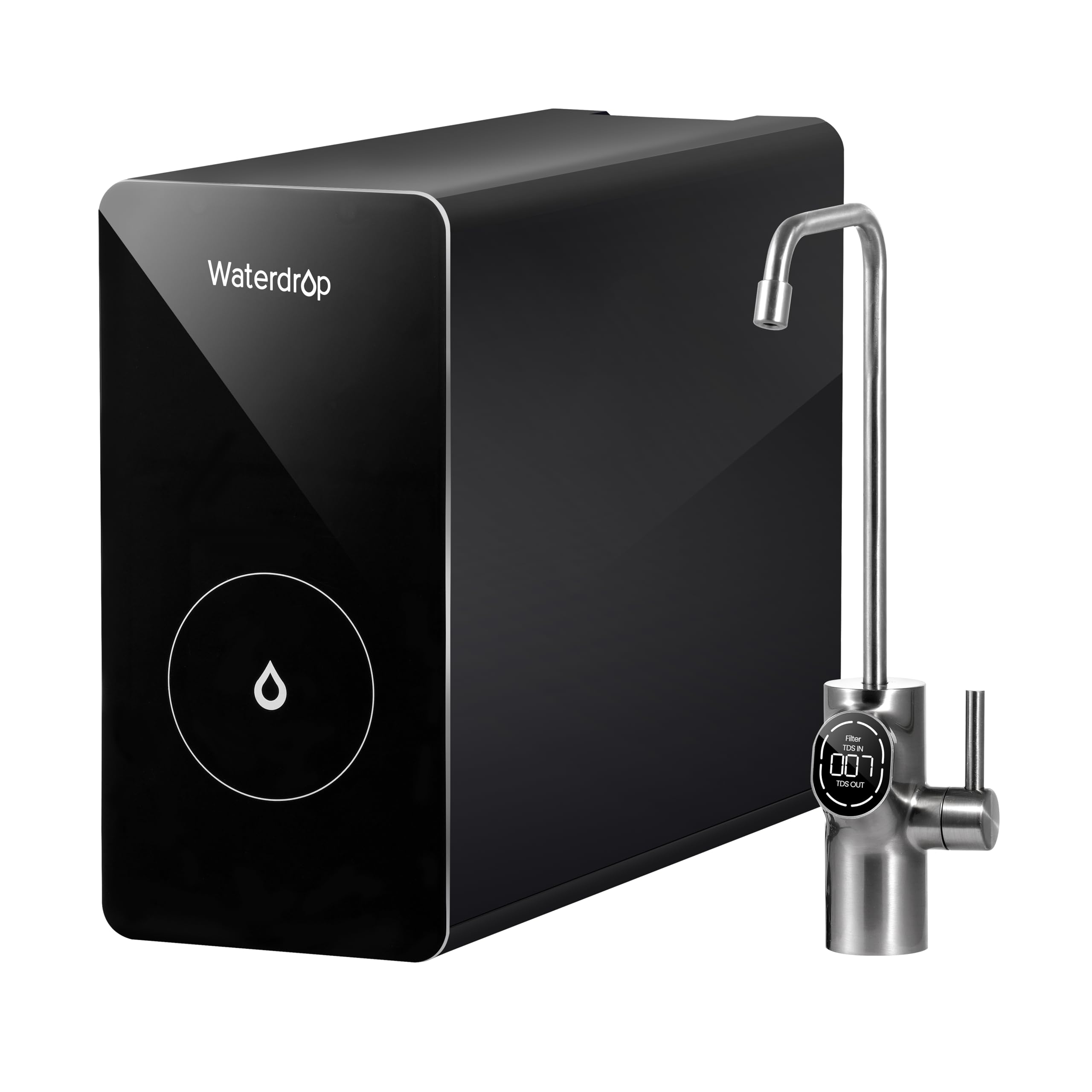
The Waterdrop D6 strikes the hardest balance between flow rate, filtration quality, and under-sink footprint. Its 600 GPD output means you fill an 8-ounce cup in about 8 seconds — fast enough that you never feel like you are waiting on the system. The 6-stage composite filter combines PP cotton, carbon block, and RO membrane into a single cartridge that twists out for replacement in under a minute.
The smart faucet display shows real-time TDS and remaining filter life, which removes the guesswork from maintenance. At a 2:1 pure-to-drain ratio, the D6 wastes only one gallon for every two it produces — a significant efficiency gain over older tank-based systems that dumped three gallons down the drain. You do need a standard electrical outlet under the sink for the built-in pump to operate.
The tankless design saves roughly 70% of under-sink space compared to a traditional system with a storage tank. A few users note the system produces a faint humming noise during operation, and the initial flush takes about five minutes before the water reads clean on a TDS meter. For a mid-premium system that delivers laboratory-grade water without the cabinet clutter, this is the one to beat.
Why it’s great
- Fast 600 GPD flow fills a large bottle in seconds
- Smart faucet displays live TDS and filter life
- 2:1 pure-to-drain ratio reduces water waste
- Compact tankless design frees under-sink space
Good to know
- Requires a dedicated 110V outlet under sink
- Produces a low hum during active water production
2. iSpring RCC7AK 6-Stage RO System

The iSpring RCC7AK is the most popular alkaline RO system on the market for good reason. It adds a natural mineral stage after the standard 5-stage filtration, which raises the pH level and reintroduces calcium and magnesium. The result is water that tastes noticeably smoother and less flat than what comes out of a standard RO-only system — closer to bottled spring water than distilled water.
The patented top-mounted faucet design lets you tighten the faucet nut from above the countertop, which eliminates the contortionist act of reaching under the sink. The transparent first-stage filter housing lets you visually inspect sediment buildup so you know exactly when to swap the pre-filter. Rated at 75 GPD, the flow is adequate for a small family, though the 2.6-gallon storage tank means you have a reserve ready at all times.
NSF/ANSI 58 certification covers the entire system — not just individual components — so the claimed 93-98% TDS reduction and contaminant removal for lead, arsenic, fluoride, and PFAS is independently verified. The alkaline stage adds a slight increase in TDS (typically 15-30 ppm), which is intentional for taste balance. If you want the purity of RO water without the acidic or “dead” taste, this system delivers it consistently.
Why it’s great
- Full system NSF 58 certified for verified performance
- Alkaline filter restores minerals for better taste
- Top-mounted faucet simplifies DIY installation
- Transparent first-stage housing shows filter condition
Good to know
- 75 GPD flow is slower than tankless alternatives
- Tank takes up significant under-sink storage space
3. APEC Water ROES-50X 5-Stage System
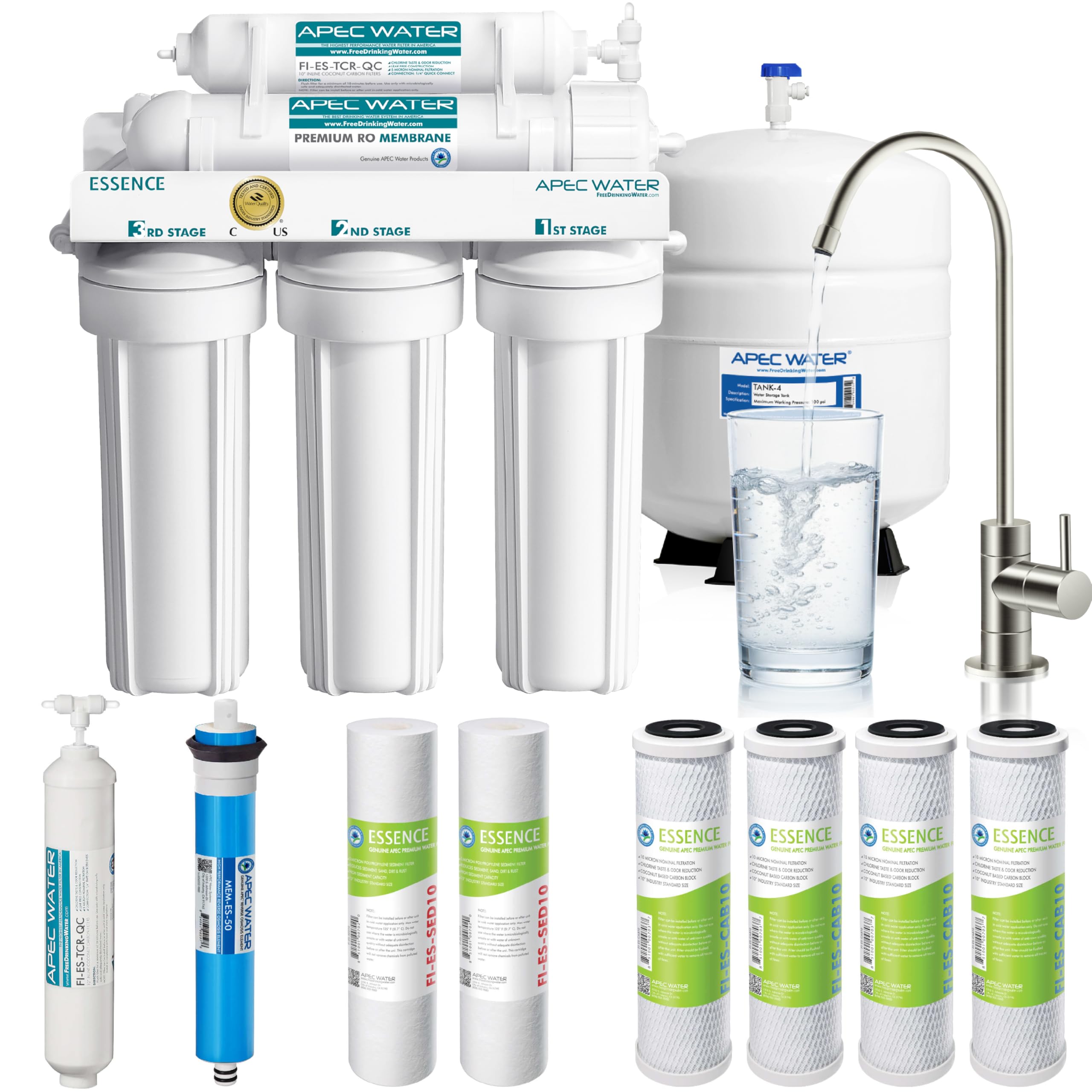
The APEC ROES-50X is the gold standard for budget-friendly under-sink RO filtration. It uses a straightforward 5-stage process — sediment, carbon, RO membrane, carbon polish, and final post-filter — with no gimmicks. The system comes with an extra pre-filter set (stages 1-3) included in the box, effectively doubling the life of your initial filter setup before you need to buy replacements.
The 50 GPD membrane is not fast compared to modern tankless units, but the 3.2-gallon storage tank provides up to 6 gallons of pressurized water per day, so you never wait for a glass to fill. The color-coded tubing and quick-connect fittings make the installation process straightforward for a first-time buyer — most users report completing the setup in 90 minutes with the included manual. APEC is one of the few brands that designs, engineers, and tests every system in-house.
Customers consistently report TDS drops from the 400-500 ppm range down to 10-40 ppm, representing a 90-95% reduction even on heavily mineralized municipal water. The system is NSF certified for material safety (NSF 372) and performance (NSF 58), so the contaminant reduction claims are independently backed. For someone on a tight budget who still wants genuinely purified water and not just taste improvement, this is the most reliable entry point.
Why it’s great
- Includes extra pre-filter set for extended service life
- Color-coded tubing and quick-connect fittings simplify install
- Veteran brand with 20+ years of in-house engineering
- Durable storage tank provides consistent water pressure
Good to know
- 50 GPD production rate requires patience for large quantities
- Tank-based design occupies more under-sink space
4. SimPure T1-400UV Tankless RO System

The SimPure T1-400UV is one of the few tankless RO systems that integrates UV sterilization directly into the filtration path. The UV lamp activates automatically whenever water flows through the system, providing an additional layer of microbial protection that standard RO membranes cannot guarantee against certain bacteria and viruses. For households on well water or concerned about microbial contamination, this is a meaningful upgrade.
The system delivers 400 GPD through an 8-stage filtration process (sediment, carbon, RO membrane, post-carbon, and UV). The built-in booster pump maintains consistent pressure even if your home supply dips below 40 psi. The tankless design keeps the unit to just 5.3 inches wide, which fits even the tightest under-sink cabinets. The included smart faucet displays TDS levels in real time so you can verify water quality at a glance.
SGS testing against NSF/ANSI 58 standards confirms the system can reduce TDS from 200-500 ppm down to near-zero — typically under 25 ppm, and often below 10 ppm on average city water. The 1.5:1 pure-to-drain ratio is slightly less efficient than some competitors, but the addition of UV sterilization justifies that trade-off for many buyers. The system requires a standard electrical outlet and takes about 30 minutes to install with the included push-fit connectors.
Why it’s great
- Integrated UV sterilization kills bacteria and viruses
- Near-zero TDS output with SGS/NSF 58 verification
- Ultra-compact 5.3-inch width fits tight cabinets
- Booster pump maintains flow on low-pressure supply
Good to know
- 1.5:1 pure-to-drain ratio is less efficient than some rivals
- UV lamp adds ongoing electricity cost
5. iSpring RO500AK-BN Tankless RO System

The iSpring RO500AK-BN combines a 500 GPD high-output pump with a natural pH alkaline remineralization stage in a tankless form factor. It produces 0.4 gallons per minute — enough to fill an 8-ounce cup in roughly 10 seconds — while adding calcium, magnesium, and potassium back into the water for a smooth, slightly sweet taste profile. The brushed nickel faucet complements modern kitchen aesthetics without feeling cheap.
NSF 58 certification covers the TDS reduction performance, and the system’s 2:1 pure-to-drain ratio is among the best in the tankless alkaline category, reducing wastewater by up to 400% compared to older RO designs. The 3-stage filtration setup (composite sediment/carbon, RO membrane, carbon-alkaline) uses a twist-and-lock filter replacement that requires no tools and no water shutoff. An automatic self-cleaning function flushes the RO membrane after 24 hours of standby, extending filter life.
The system does require a dedicated electrical outlet and needs at least 17.5 inches of vertical clearance in your under-sink cabinet. Customer feedback consistently highlights the excellent support from iSpring’s US-based team, with multiple reports of free replacement parts shipped even for units past the standard warranty period. If you want tankless convenience with the taste benefits of remineralized water and do not want to sacrifice flow rate, this is the premium choice.
Why it’s great
- 500 GPD tankless flow with alkaline remineralization
- 2:1 pure-to-drain ratio minimizes water waste
- NSF 58 certified for verified TDS reduction
- Automatic self-cleaning extends membrane lifespan
Good to know
- Requires 17.5-inch vertical clearance under sink
- Faucet hole size may need a reducer plate for larger openings
6. DREO Countertop RO Water Filter
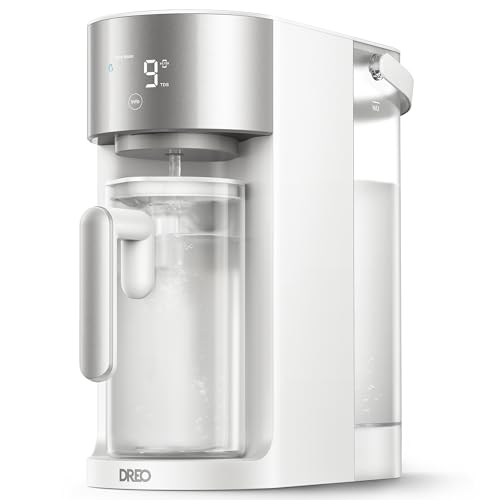
The DREO Countertop RO system is tailor-made for renters, dorm residents, or anyone who cannot permanently modify their kitchen plumbing. It requires zero installation — just plug the unit into a wall outlet, fill the 3-liter raw water reservoir, and let the system produce purified water into the included 1.1-liter auto-fill pitcher. The auto-fill sensor stops dispensing when the pitcher is full, so you never overflow the container.
The 7-in-1 filtration process is SGS tested against NSF/ANSI 58 standards, removing up to 99.99% of over 1,000 contaminants including PFOA, PFOS, chlorine, and fluoride. The real-time TDS display shows both incoming and outgoing water quality side by side, so you can watch the system pull TDS from 400+ ppm down to the 10-50 ppm range. The 3:1 pure-to-drain ratio is excellent for a countertop unit and keeps wastewater to a minimum.
Each filter lasts between 6 and 12 months depending on incoming water quality, and the push-to-install filter swap takes about two seconds. The unit fits into a footprint of 14.5 inches long by 6.7 inches wide, making it compact enough for most kitchen counters. The main limitation is batch size — you must refill the raw tank after producing about 1.1 liters of purified water, which makes it better suited for 1-2 person households than large families.
Why it’s great
- Plug-and-play with zero plumbing required
- SGS tested to NSF/ANSI 58 for verified contaminant removal
- 3:1 pure-to-drain ratio minimizes water waste
- Auto-fill pitcher prevents overflow
Good to know
- Small batch size requires frequent refills for larger households
- Countertop footprint takes up kitchen work surface
7. Aigerri UV Countertop RO System

The Aigerri Countertop RO System achieves a 5:1 pure-to-drain ratio — one of the highest water-efficiency ratings in the countertop RO category. For every five cups of purified water you get, only one cup goes to the drain. This makes it an exceptional choice for environmentally conscious households or anyone on a water meter who wants to minimize waste from their filtration system.
The 5-stage filtration process includes a UV sterilization chamber that provides additional microbial reduction on top of the RO membrane. The 5-liter raw water reservoir and 2-liter purified tank combine for enough capacity to serve a small family without constant refilling. The unit is BPA-free and NSF/ANSI 372 certified for material safety, ensuring no harmful chemicals leach from the plastic housing into your water.
The countertop design requires a minimum vertical clearance of 22 inches for the lid to open fully — a factor to measure before purchase if you plan to place it under low cabinets. The included two replacement cartridges extend the total filtered output to approximately 529 gallons, matching roughly 6,000 single-use plastic water bottles. The touch control panel is sensitive, and some users report the filter lifespan is slightly shorter than advertised if incoming water is particularly hard, but overall filtration quality is consistent and reliable.
Why it’s great
- Industry-leading 5:1 pure-to-drain ratio saves water
- UV sterilization adds microbial protection
- Large 5L raw tank reduces refill frequency
- NSF/ANSI 372 certified for BPA-free materials
Good to know
- Needs 22-inch vertical clearance for lid opening
- Filter lifespan may be shorter on very hard water
8. Home Master TMHP HydroPerfection RO System
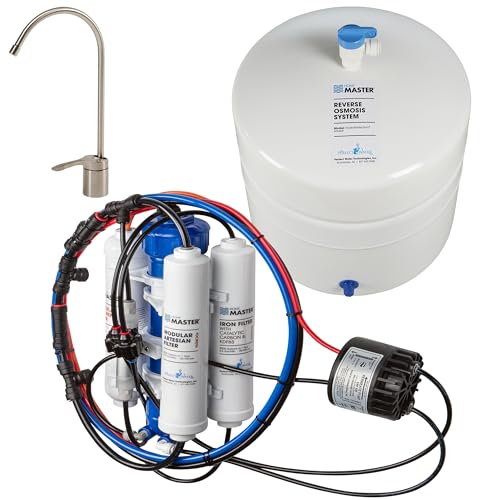
The Home Master TMHP HydroPerfection is a 9-stage under-sink RO system that uses a patented dual-pass alkaline remineralization process and an EPA-registered UV sterilizer. Instead of passing water through a single remineralization cartridge, the system adds calcium and magnesium twice — once before the final carbon stage and once after — resulting in water that tastes closer to mineral spring water than any other RO system on this list.
The UV sterilizer carries EPA registration number 97952AZ1, which is a formal certification that the lamp effectively inactivates microorganisms, setting it apart from unverified UV claims on other products. The system includes a booster pump that maintains a 1:1 pure-to-drain ratio — meaning for every gallon of purified water produced, only one gallon is wasted. This efficiency is exceptional for a tank-based system that also includes a permeate pump for pressure regulation.
The 9-stage process sounds complex, but the system ships fully assembled with color-coded tubing and push-to-connect fittings. Annual filter changes are straightforward, and the membrane itself typically lasts 2-3 years before replacement. A 2000-gallon capacity rating means it can handle a family of four with ease. The only meaningful trade-off is the physical size of the system — the tank, filter housings, and UV module require generous under-sink space and access to an electrical outlet.
Why it’s great
- EPA-registered UV sterilizer for verified microbial inactivation
- Dual-pass remineralization delivers superior taste
- 1:1 pure-to-drain ratio with booster pump
- Fully assembled with color-coded push-fit tubing
Good to know
- Large physical footprint requires generous cabinet space
- Higher upfront cost than standard 5-stage systems
9. Waterdrop KJ600 Instant Hot Water RO System
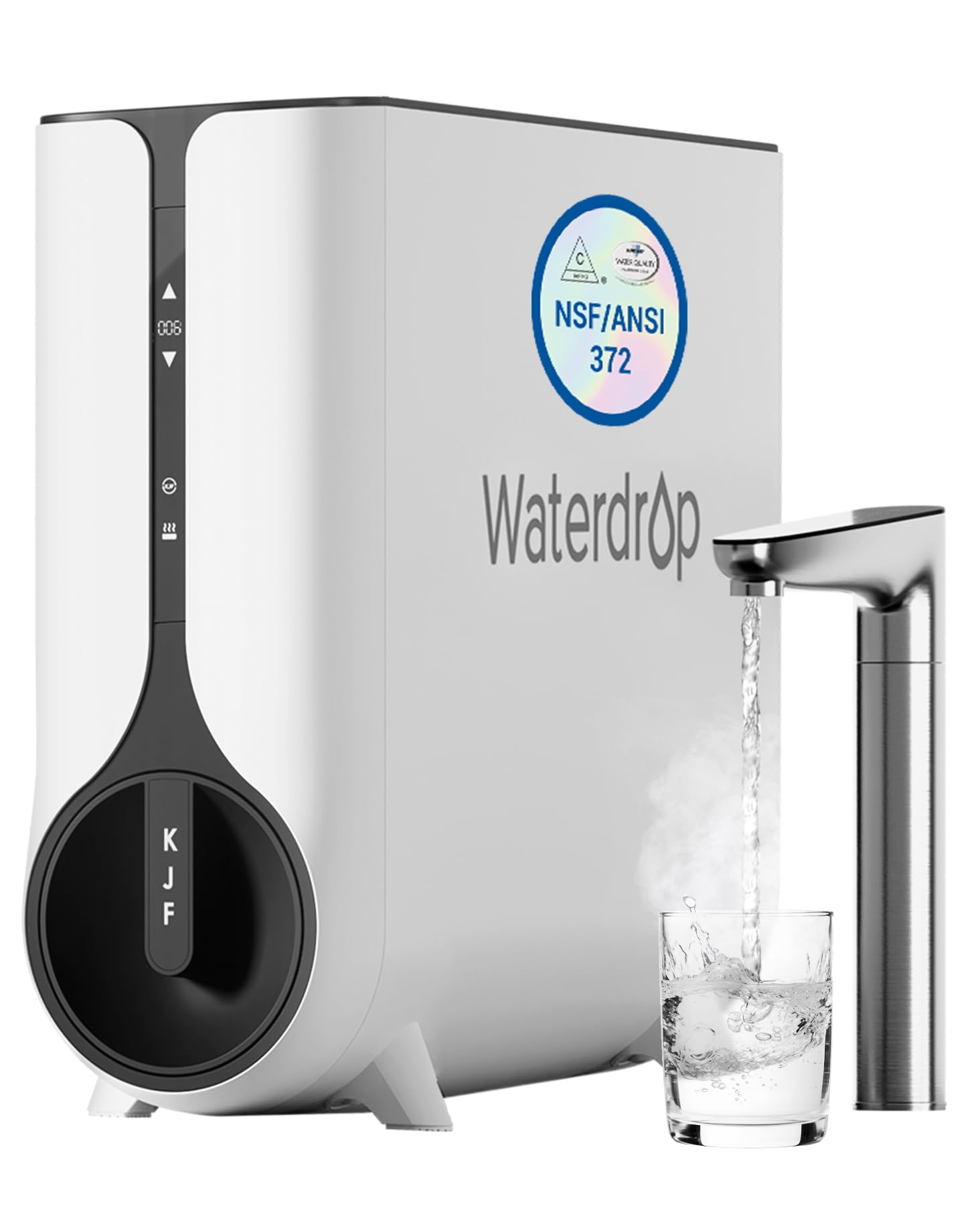
The Waterdrop KJ600 is the first tankless RO system that integrates an instant hot water dispenser directly into the under-sink unit. It delivers both chilled (ambient) and hot water up to 203°F, eliminating the need for a separate kettle or instant hot faucet. The adjustable temperature range from 104°F to 203°F makes it ideal for everything from baby formula to pour-over coffee to instant oatmeal.
The 5-stage deep filtration uses a single 5-in-1 composite filter that reduces TDS, PFOA, PFOS, fluoride, arsenic, lead, and mercury. The 600 GPD flow rate fills a standard cup in a few seconds, and the smart faucet display shows live TDS levels, filter life, and set temperature with a child lock feature to prevent scalding. The unit uses high-temperature-resistant Teflon tubing rated to 500°F for the hot water line, so there is no risk of melting or chemical leaching.
The main consideration is physical size — the base unit takes up roughly 25% of a standard under-sink cabinet, and the tall faucet requires a 1.5-inch counter hole (most homes have a 1.25-inch or 1.375-inch hole that needs enlarging). The system produces a periodic humming sound as it reheats the internal tank, which some users find noticeable in quiet kitchens. If you want a single appliance that provides both purified drinking water and instant hot water, this is the most integrated solution available.
Why it’s great
- Built-in instant hot water up to 203°F
- 600 GPD flow with high-efficiency 2:1 drain ratio
- Smart faucet with child lock and TDS display
- High-temp-rated Teflon tubing ensures safety
Good to know
- Large base unit requires significant cabinet space
- Periodic reheating noise may be audible
- Faucet hole enlargement needed for most countertops
FAQ
What is the difference between NSF 58 and NSF 372 certification for RO systems?
How often should I replace the filters in my RO system?
Can an RO system be installed without drilling into the countertop?
Final Thoughts: The Verdict
For most users, the best ro filters winner is the Waterdrop D6 because it delivers the perfect combination of 600 GPD tankless speed, a smart TDS faucet, and a compact footprint that fits any under-sink cabinet without sacrificing filtration quality. If you want the crisp taste of remineralized alkaline water on demand, grab the iSpring RO500AK-BN for its fast 500 GPD flow and 2:1 efficiency ratio. And for renters or anyone who refuses to touch their plumbing, nothing beats the DREO Countertop RO for zero-install convenience backed by SGS-verified NSF/ANSI 58 performance.