Ditching bottled water for a permanent under-sink upgrade means confronting a market flooded with membrane ratings, stage counts, and certification acronyms. The best systems remove up to 99% of total dissolved solids, fluoride, lead, and emerging contaminants like PFAS, but the wrong choice can mean slow flow, excessive wastewater, or a filter replacement schedule that feels like a second mortgage.
I’m Mohammad Maruf — the founder and writer behind AirfryerBite. I’ve spent thousands of hours analyzing water filtration hardware, cross-referencing NSF certification databases, and mapping contaminant reduction claims against real-world TDS performance to separate genuine engineering from marketing gloss.
After evaluating tanked and tankless designs across every meaningful spec — membrane pore size, pure-to-drain ratio, gallon-per-day capacity, and filter longevity — this guide delivers a clear verdict on the best reverse osmosis water filtration system for your home, your budget, and your specific water chemistry.
How To Choose The Best Reverse Osmosis Water Filtration System
Selecting an RO system requires matching your household water volume, incoming pressure, and contaminant profile to the system’s flow rate, stage count, and certification scope. The four factors below separate a well-engineered unit from one that will frustrate you with slow fills and frequent filter swaps.
Tanked vs. Tankless: Space, Flow, and Freshness
Traditional tanked RO systems store purified water in a pressurized bladder, which takes up valuable under-sink real estate and can allow stagnant water to re-contaminate over time. Tankless designs — like the Waterdrop G5P500 and iSpring RO500AK-BN — produce water on demand, freeing up roughly 70% more cabinet space and ensuring every glass is freshly filtered. The trade-off is that tankless units require a dedicated power outlet (for the pump) and typically cost more upfront. If you have electrical access under the sink and prioritize a compact setup, tankless is the better long-term investment.
Stage Count and Membrane Precision
Stage count describes the number of filtration barriers the water passes through. A 6-stage system usually includes sediment, carbon block, RO membrane, and a post-filter. Higher stage counts — 9 or 10 — add remineralization cartridges (calcium and magnesium) or UV sterilization. The critical spec is the RO membrane’s pore size: the 0.0001-micron standard (used by every system on this list) effectively blocks bacteria, viruses, and heavy metal ions. Pay attention to whether a third-party lab (NSF, SGS, IAPMO) has tested the membrane’s actual rejection rate rather than relying on the brand’s own literature.
Pure-to-Drain Ratio and Water Waste
Traditional RO systems waste 3 to 4 gallons of water for every gallon of purified output — a major concern for homeowners on well water or metered utility bills. Modern units achieve a 2:1 or 3:1 pure-to-drain ratio, meaning they produce 2 or 3 gallons of clean water for every gallon of reject water. The Waterdrop G3P800 leads with a 3:1 ratio, while the iSpring RO500AK-BN and Waterdrop G5P500 both deliver a strong 2:1. A lower waste ratio not only reduces your water bill but also lessens the load on your drain line and septic system.
Certifications: Which Acronyms Actually Protect You
NSF/ANSI 58 is the gold-standard certification for RO systems — it verifies the membrane’s ability to reduce TDS, arsenic, fluoride, lead, and nitrate. NSF 42 covers aesthetic improvements (chlorine taste and odor), while NSF 372 confirms the system is lead-free in all wetted components. The APEC RO-PH90 and Waterdrop G3P800 hold NSF 58 and 372 certifications from IAPMO. Systems that skip independent certification may still perform well, but you are relying entirely on the manufacturer’s word. For buyers concerned about emerging contaminants like PFAS, verify that the system includes a specific PFAS/PFOS reduction claim tested by a third party such as SGS.
Quick Comparison
On smaller screens, swipe sideways to see the full table.
| Model | Category | Best For | Key Spec | Amazon |
|---|---|---|---|---|
| Waterdrop G5P700A-Pro | Premium Dual-Flow | Alkaline RO + kitchen faucet integration | 700 GPD, 8-stage, dual water path | Amazon |
| Home Master TMHP | Premium UV | UV sterilization + remineralization | 9-stage, 1:1 waste ratio, EPA registered UV | Amazon |
| iSpring RO500AK-BN | Mid-Range Tankless | NSF 58 certified, easy maintenance | 500 GPD, tankless, 2:1 pure-to-drain | Amazon |
| Waterdrop G5P800 | High-Capacity | Big family, fridge connection, 3:1 ratio | 800 GPD, 3:1 pure-to-drain | Amazon |
| Waterdrop T4-A Alkaline | Dual Flow Alkaline | Dual water path (RO vs. alkaline RO) | 450 GPD, 10-stage, dual flow | Amazon |
| APEC RO-PH90 | Tanked Alkaline | Long-lasting US-made filters, boosted pH | 90 GPD, 6-stage, alkaline pH+ | Amazon |
| Waterdrop T3-M | Mid-Range Remin | Mineral-infused water, smart alerts | 450 GPD, 9-stage, tankless | Amazon |
| Waterdrop G5P500 | Entry Tankless | Compact tankless, 2:1 ratio, quiet pump | 500 GPD, 7-stage, BPA-free | Amazon |
| ANGEL 7-Stage | Budget-Friendly | Low upfront cost, long-lasting filters | 7-stage, 3-year filter life, compact | Amazon |
In‑Depth Reviews
1. Waterdrop G5P700A-Pro Alkaline Mineral pH+ Reverse Osmosis System
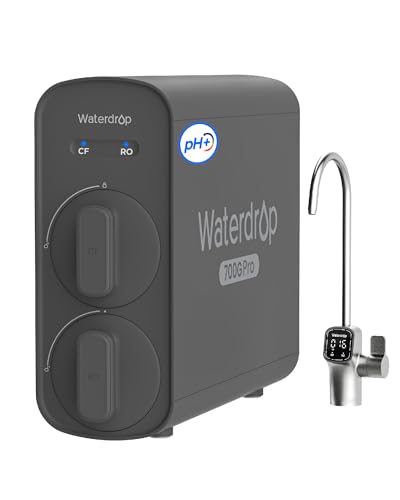
The G5P700A-Pro takes the top spot because it combines a high 700 GPD flow rate with a dual water path design — one line feeds the dedicated RO faucet while a second connects to your main kitchen faucet, dishwasher, or refrigerator. This eliminates the need for a separate filtered water tap at your main sink, a convenience no other system on this list offers. The 8-stage filtration includes an alkaline mineralization stage that adds calcium and magnesium for balanced pH, and the tankless footprint saves substantial under-sink space.
NSF/ANSI 58 and 372 certifications confirm the membrane reduces TDS, lead, fluoride, and PFOA/PFOS while guaranteeing lead-free construction. The smart faucet includes a real-time TDS monitor, and users consistently report that the pump operates quietly — a welcome detail for open-plan kitchens. The system measures just 16.69 x 5.69 x 13.9 inches, making it one of the most space-efficient premium units available.
Customer support receives high marks across the board, with multiple reviewers noting prompt replacement of parts under warranty. The only real limitation is the faucet’s maximum flow rate of 1.0 GPM, which is adequate for drinking but not for high-volume tasks like filling a stockpot. For everyday hydration and cooking, this is the most versatile RO system on the market.
Why it’s great
- Dual water path serves RO faucet and main kitchen faucet or appliances.
- 700 GPD flow rate fills a cup in seconds with minimal pump noise.
- Alkaline remineralization stage produces balanced pH water.
Good to know
- Requires drilling a hole for the faucet if one does not already exist.
- Faucet flow rate is capped at 1.0 GPM, not the system’s full output.
2. Home Master TMHP HydroPerfection Reverse Osmosis System
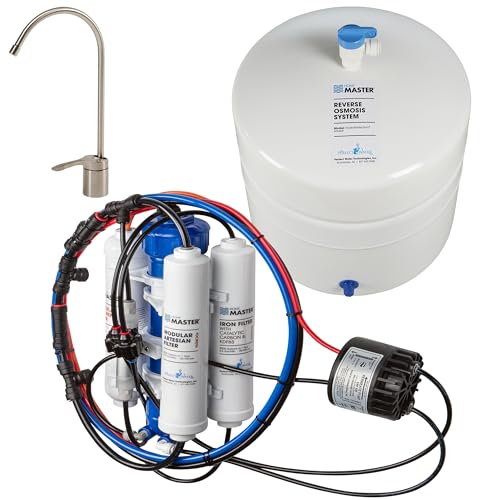
The Home Master TMHP is the only system on this list with an EPA-registered UV sterilizer that kills 99.9% of microorganisms, making it the definitive choice for homes on well water or in areas with boil-water advisories. Its patented 2-pass alkaline remineralization process adds calcium and magnesium twice, producing water with a noticeably smoother mouthfeel compared to standard RO output. The 9-stage filtration includes an iron prefilter, which is critical for well-water users who struggle with metallic staining.
What sets the TMHP apart is its non-electric permeate pump, which achieves a 1:1 pure-to-drain ratio without consuming power — a rarity among premium systems. The fill rate of 4.5 seconds per cup is competitive with tankless designs, even though this is a tank-based system. The 4-gallon storage tank provides a consistent supply even during power outages, and the color-coded push-to-connect fittings make DIY installation straightforward.
Customers consistently praise the company’s warranty support, with multiple reports of UV bulbs and parts replaced without hassle years after purchase. The trade-off is the larger footprint under the sink (15 x 5 x 16 inches plus the tank) and the need to flush the system before first use. For buyers who prioritize microbial safety and mineral-rich taste above all else, this system delivers unmatched quality.
Why it’s great
- EPA-registered UV sterilizer eliminates bacteria and viruses.
- Non-electric permeate pump delivers a 1:1 pure-to-drain ratio.
- Two-pass remineralization adds calcium and magnesium for great taste.
Good to know
- Tank design occupies more under-sink space than tankless alternatives.
- Requires an initial system flush of 2-4 hours before use.
3. iSpring RO500AK-BN Reverse Osmosis Water Filter

The iSpring RO500AK-BN strikes an impressive balance between certification depth, flow rate, and price. It holds NSF 58 certification for TDS reduction — verified by a scannable QR code on the unit — along with a 500 GPD capacity that delivers 0.4 GPM, filling an 8-ounce cup in about 10 seconds. The 3-stage filtration (composite sediment/carbon block, RO membrane, and carbon alkaline filter) is simpler than the 7-to-10-stage competitors, but each stage uses a high-quality element that is independently tested.
The 2:1 pure-to-drain ratio reduces wastewater by up to 400% compared to older RO systems, and the tankless design saves roughly 70% of under-sink space. Filter changes are tool-free — quarter-turn twist — and require no water shutoff, a convenience that matters when you have a busy household. The brushed nickel faucet looks substantial and integrates well with modern kitchens, though several users noted that the instruction manual could be clearer regarding specific adapter sizes for different pipe diameters.
Customer service is a standout here: multiple reviewers mention representatives like Nick and Michele who proactively sent replacement parts and even new filters when a price drop occurred shortly after purchase. The 1-year manufacturer warranty extends upon registration, and iSpring’s Atlanta-based support team is responsive. The only minor knock is that the system’s maximum flow rate of 0.4 GPM is moderate — adequate for drinking and cooking but not for rapid pot-filling.
Why it’s great
- NSF 58 certified with a scannable online test report.
- Tool-free filter changes with no water shutoff required.
- Responsive US-based customer support with generous warranty service.
Good to know
- Flow rate of 0.4 GPM is slower than higher-end tankless models.
- Instructions could be clearer for first-time RO installers.
4. Waterdrop G3P800 Reverse Osmosis System
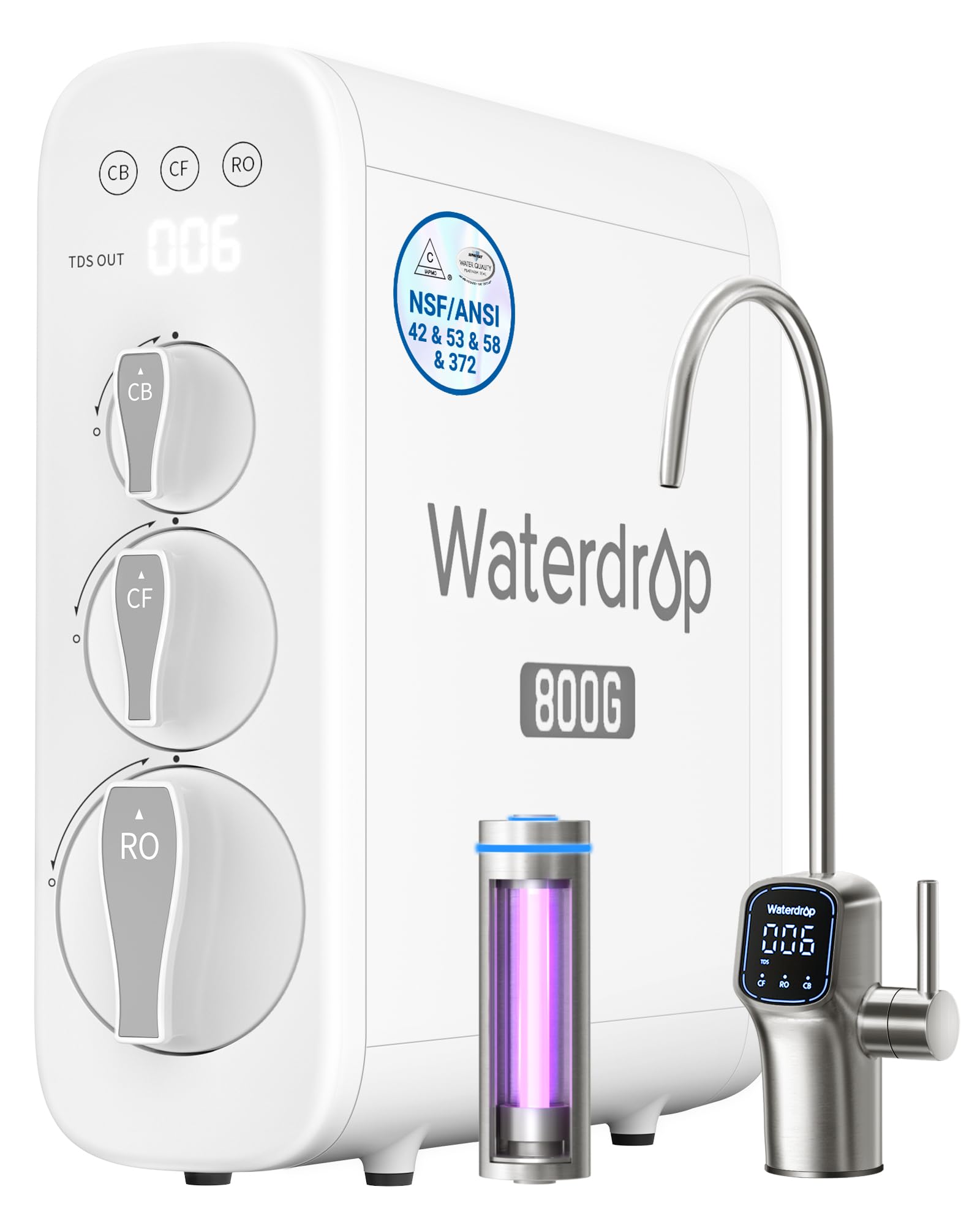
The Waterdrop G3P800 is the highest-capacity system in this roundup, delivering 800 gallons per day and filling a cup in just 5 seconds. Its 3:1 pure-to-drain ratio is the most water-efficient of any unit tested, producing only one cup of wastewater for every three cups of purified water. The 10-stage filtration is certified by IAPMO against NSF/ANSI 42, 53, 58, and 372, covering chlorine reduction, TDS reduction, and lead-free materials — a quadruple certification that very few systems achieve.
The smart faucet includes a backlit TDS display with an LED lifespan rated at 50 years, automatically illuminating when water flows. The tankless design measures 18.12 x 5.67 x 17.72 inches, which is slightly larger than the G5P series but still compact enough for most under-sink cabinets. Users consistently report TDS reductions from 400+ ppm down to single digits, and the quiet pump operation makes it unobtrusive in open-plan kitchens.
Customer support from Waterdrop’s team — particularly representatives like Krystal and Harper — receives strong marks for handling warranty replacement of UV bulbs and tubing issues without pushback. The system connects to refrigerator ice makers with the included tube cutter and fittings. The main consideration is the need to drill two holes (one for the faucet, one for the drain pipe connection), which adds complexity if your countertop is granite or quartz. For households that burn through water quickly and want maximum efficiency, this is the definitive choice.
Why it’s great
- Industry-leading 800 GPD flow and 3:1 pure-to-drain ratio.
- Quad-certified (NSF 42, 53, 58, 372) for comprehensive contaminant reduction.
- Smart faucet with TDS display and automatic LED activation.
Good to know
- Requires drilling two holes for installation, complicating solid-surface countertops.
- Larger footprint than other tankless units in this comparison.
5. Waterdrop T4-A Alkaline pH+ Reverse Osmosis Water Filter

The Waterdrop T4-A is built for buyers who want options: it delivers two separate purified water streams from the same faucet — a standard RO line and a mineral-enhanced alkaline line. This dual-flow design means you can pour high-alkaline water for drinking and coffee while using standard RO for cooking, all without switching cartridges or manual valves. The 10-stage filtration includes a dedicated alkaline mineralizer that adds calcium and magnesium, and the system carries NSF/ANSI 372 certification for lead-free materials.
With 450 GPD capacity and a 2:1 pure-to-drain ratio, the T4-A balances speed and efficiency well. The smart filter life indicator provides separate reminders for each cartridge (CF: 6 months, RO: 24 months, CB: 12 months, Alkaline: 12 months), which helps avoid the common mistake of letting one stage expire while others still function. The tankless design saves substantial space, and the dual LED indicators on the faucet provide a clear visual confirmation of which water path is active.
User feedback consistently highlights the immediate improvement in water taste — multiple reviewers noted that their coffee and tea tasted noticeably better within the first day. The installation is manageable for experienced DIYers, though the faucet requires drilling a dedicated hole. A few users mentioned that the included tubing length was slightly short for larger cabinets, but customer service responded quickly with longer lines. If you value the flexibility of choosing between alkaline and standard RO water from the same tap, this system is unmatched in its category.
Why it’s great
- Two independent water streams (standard RO and alkaline RO) from one faucet.
- 10-stage filtration with dedicated alkaline mineralizer stage.
- Smart filter life reminders for each cartridge type.
Good to know
- Faucet installation requires drilling a countertop hole.
- Some users found included tubing length insufficient for larger cabinets.
6. APEC Water RO-PH90 6-Stage Alkaline Reverse Osmosis System

The APEC RO-PH90 is a tanked system that relies on proven, US-made filter media — including a genuine Dow Filmtec RO membrane — rather than flashy electronics. Its 6-stage process is straightforward: sediment removal, carbon block, RO membrane, a second carbon stage, and an alkaline pH+ cartridge that uses high-purity calcium carbonate. The result is water that tests at 15-20 ppm TDS from a 225 ppm input, with a noticeable improvement in taste and clarity.
The 90 GPD flow rate is modest compared to tankless competitors, but the 4-gallon storage tank ensures you always have water available without waiting for the membrane to produce on demand. The alkaline stage is the real differentiator — most cheap alkaline cartridges leach minerals unevenly, but APEC’s US-sourced calcium carbonate provides consistent pH elevation. The all-metal, lead-free designer faucet feels significantly more premium than the plastic alternatives found on many budget units.
APEC offers lifetime technical support from certified water specialists, and the company will provide replacement filters for the life of the system — a rare commitment. The trade-offs are the slower membrane output (system needs to refill the tank after heavy use) and the requirement for incoming water pressure of at least 50 psi. Users below that threshold will need to purchase a separate booster pump. For buyers who distrust complex electronics and want a system that can last decades with proper maintenance, this is the most reliable tanked option available.
Why it’s great
- Genuine Dow Filmtec RO membrane with high rejection rate.
- Alkaline pH+ stage uses US-made high-purity calcium carbonate.
- Lifetime technical support from certified WQA water specialists.
Good to know
- Requires minimum 50 psi incoming pressure; a booster pump may be needed.
- 90 GPD membrane is slower than tankless designs; tank refill takes 2-3 hours.
7. Waterdrop T3-M Remineralization Reverse Osmosis Water Filter

The Waterdrop T3-M is a mid-range tankless system that focuses on delivering mineral-infused water without the complexity of the dual-flow T4-A. Its 9-stage filtration includes a dedicated remineralization cartridge that adds calcium and magnesium, combined with a 0.0001-micron RO membrane that reduces heavy metals, chlorine, and PFOA/PFOS. The 450 GPD capacity fills a cup quickly enough for daily use, though heavy demand from a large family may occasionally outpace the membrane’s instantaneous output.
The system’s standout feature is its all-in-one cartridge design — the three filter stages (CF, CBM, RO) twist into a single assembly, making replacement a 10-second job that requires no tools and no water shutoff. The smart alert system provides audible and visual reminders when filters approach end-of-life. The automatic flush function runs the RO membrane after 24 hours of inactivity, extending its lifespan and preventing biofouling.
Installation reports are consistently positive, with most users completing the setup in under an hour using the included push-connect fittings. The tankless design leaves plenty of under-sink space for storage, and the LED indicator on the faucet provides a quick visual confirmation of system status. The main limitation is the lack of NSF 58 certification — Waterdrop states the system is tested by a third-party lab but does not hold the full IAPMO-certified NSF 58 mark that some competitors carry. This is a solid choice for buyers who prioritize easy maintenance and mineral taste over certification paperwork.
Why it’s great
- All-in-one cartridge replacement in seconds with no tools needed.
- Smart alerts and automatic flush prolong membrane life.
- Remineralization stage adds calcium and magnesium for balanced taste.
Good to know
- Does not hold full NSF 58 certification; relies on third-party lab testing.
- 450 GPD capacity may be stretched by high-volume households.
8. Waterdrop G5P500 Reverse Osmosis Water Filter

The Waterdrop G5P500 is the entry point into tankless RO filtration without sacrificing the core features that matter — speed, compact size, and a decent pure-to-drain ratio. It delivers 500 GPD with a 2:1 pure-to-drain ratio, filling a 6-ounce cup in roughly 8 seconds. The 7-stage filtration includes a 0.0001-micron RO membrane and reduces TDS, PFOA/PFOS, chlorine, lead, and fluoride. The tankless design measures just 5.69 x 16.69 x 13.9 inches, freeing up most of your under-sink cabinet for storage.
BPA-free materials and NSF/ANSI 58 and 372 certifications provide independent verification of the membrane’s TDS reduction and the system’s lead-free construction. The smart faucet includes an LED spout that indicates system status, and the pump is notably quiet — multiple users mentioned they had to check if the unit was running. The G5P500 also supports connection to ice makers and refrigerators via the Waterdrop XT accessory, though that is sold separately.
Installation is straightforward for anyone comfortable with basic plumbing. The tubing connections are clearly labeled, and the included push-to-fit fittings require no glue or soldering. A few users noted that the faucet requires a dedicated hole in the countertop, which can be challenging for granite or quartz. Customer service representatives — particularly Krystal X — earn praise for resolving a range of issues, from missing parts to warranty claims. For someone stepping into tankless RO for the first time, this system offers the best balance of price and proven performance.
Why it’s great
- 500 GPD tankless flow with a quiet, unobtrusive pump.
- NSF 58 and 372 certified for TDS reduction and lead-free materials.
- Compact footprint saves significant under-sink space.
Good to know
- Faucet requires drilling a countertop hole, which is complicated on solid surfaces.
- Smart faucet TDS readout may be inaccurate compared to handheld meters.
9. ANGEL Reverse Osmosis Water Filter, 7-Stage Under Sink System
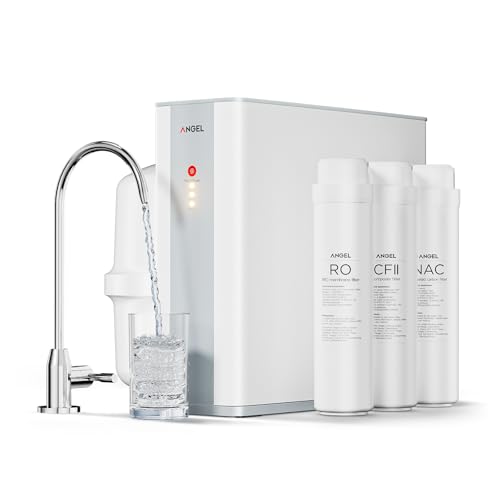
The ANGEL 7-Stage system is the most budget-friendly entry in this comparison, but it does not cut corners on the essentials. The 7-stage filtration includes a 0.0001-micron RO membrane, and the system is NSF 58, 42, and 372 certified for TDS reduction, chlorine improvement, and lead-free materials. SGS testing confirms PFAS/PFOS reduction. The standout spec is the filter longevity: the RO membrane lasts 24-36 months, the NAC filter 12-18 months, and the CFII filter 6-12 months — a replacement schedule that dramatically reduces long-term operating cost.
The compact dimensions (14.25 x 5.04 x 12.99 inches) make it one of the smallest tankless-style units, though it does use a small pressure tank (not fully tankless like the Waterdrop units). The 2:1 pure-to-drain ratio matches the efficiency of many mid-range systems, and the included lead-free faucet and 3/8-inch and 1/2-inch water lines ensure compatibility with most US plumbing. Users report that installation is straightforward with the provided video guide, and the company promises 12-hour response time for support inquiries.
The main limitation is the lower instantaneous flow rate — the system produces about 0.5 GPM, which is noticeable when filling a large pitcher. The tank holds roughly 1 gallon of purified water, so after that initial drawdown, you will need to wait for the tank to refill. Water taste reports are overwhelmingly positive, with several users noting immediate improvement in coffee and tea. For buyers on a tighter budget who still want NSF-certified filtration and long filter life, the ANGEL system provides exceptional value per gallon over its 3-year lifecycle.
Why it’s great
- Exceptional 3-year filter life reduces replacement frequency and cost.
- NSF 58, 42, and 372 certified with SGS testing for PFAS reduction.
- Compact, space-saving design with 2:1 pure-to-drain efficiency.
Good to know
- 0.5 GPM flow rate is slower than tankless alternatives; tank holds only 1 gallon.
- Requires waiting for tank refill after drawing the initial gallon.
FAQ
How often should I replace the RO membrane?
Can a reverse osmosis system remove PFAS and PFOA?
Do I need a booster pump for my RO system to work?
What is the difference between alkaline RO and standard RO water?
Can an RO system connect to my refrigerator or icemaker?
Final Thoughts: The Verdict
For most users, the best reverse osmosis water filtration system winner is the Waterdrop G5P700A-Pro because it combines a powerful 700 GPD flow rate, a dual water path that serves both the RO faucet and main kitchen appliances, and NSF 58/372 certified alkaline filtration in a compact tankless footprint. If you need absolute microbial protection and mineral-rich taste, grab the Home Master TMHP — its EPA-registered UV sterilizer and two-pass remineralization are unmatched. And for high-volume households that want the most water-efficient system on the market, nothing beats the Waterdrop G3P800 with its 800 GPD flow and 3:1 pure-to-drain ratio.