Digging through the fridge door for a small bottle of capsules feels deliberate, intentional—a daily ritual that signals serious gut health commitment. The difference between shelf-stable powders and a chilled, live culture is often the difference between a product that merely passes through your system and one that actually colonizes your gut. That cold chain is a promise of potency.
I’m Mohammad Maruf — the founder and writer behind AirfryerBite. I’ve spent years analyzing supplement manufacturing protocols, strain viability studies, and consumer feedback to separate market hype from genuine digestive support.
This guide breaks down the science, the specs, and the real-world performance of the top contenders on the market, helping you make an informed choice among the best refrigerated probiotics available today.
How To Choose The Best Refrigerated Probiotics
Selecting a chilled probiotic requires more than scanning the CFU count on the label. The delivery method, strain selection, and storage logistics dictate whether that expensive bottle actually delivers living bacteria to your colon. Focus on these criteria before you buy.
Strain Specificity Over CFU Hype
A 450-billion count means nothing if the strains are not matched to your symptom. For bloating, look for *Bifidobacterium lactis* HN019. For immune support, *Lactobacillus rhamnosus* GG has decades of clinical data. For general regularity, a multi-strain blend with both *Lactobacillus* and *Bifidobacterium* species is the most reliable approach. The sheer number is less important than the proven efficacy of the specific strain.
Delivery Mechanism and Survivability
Stomach acid kills unprotected bacteria. The best refrigerated probiotics use either acid-resistant capsules (DRcaps or Enteroguard coatings) or a powder format that allows for a higher dose to compensate for losses. Capsules with enteric coating release contents past the stomach, while powders give you flexibility but require careful timing away from hot drinks and acidic meals. Both work, but you need to know which your chosen product uses.
Quick Comparison
On smaller screens, swipe sideways to see the full table.
| Model | Category | Best For | Key Spec | Amazon |
|---|---|---|---|---|
| Visbiome Advanced GI Care | Medical Food | High-potency therapeutic use | 450B CFU per packet | Amazon |
| Flora Super 8 | Daily Maintenance | Gentle daily balance | 42B CFU, 8 strains | Amazon |
| Physician’s CHOICE 84ct | Value Size | Long-term supply | 60B CFU, 84 capsules | Amazon |
| Pure Therapro Rx Power | Allergen-Free | Pure, filler-free formula | 30B CFU, DRcaps capsules | Amazon |
| Physician’s CHOICE 60ct | Max Strength | Bloating & gas relief | 60B CFU, 10 strains | Amazon |
| Garden of Life 3-in-1 | Triple Action | Pre+Pro+Postbiotic combo | 50B CFU, 15 strains | Amazon |
| Jarrow Formulas Jarro-Dophilus | Travel Friendly | Shelf-stable backup option | 25B CFU, Enteroguard coating | Amazon |
In‑Depth Reviews
1. Visbiome Advanced GI Care

This is the closest thing to a clinical-grade probiotic you can buy without a prescription. The original De Simone formulation delivers a staggering 450 billion CFU per packet across 8 clinically tested strains, supported by over 100 human trials. It ships cold in a recyclable cooler with a temperature monitor, ensuring viability from warehouse to your fridge door.
The powder format allows for flexible dosing—many users report taking half a packet daily with excellent results. It is Low-FODMAP certified, Clean Label certified, and free from cornstarch and gluten (though it does contain trace milk). The unflavored powder mixes easily into room-temperature water or soft food, making it ideal for anyone who struggles with capsules.
Be prepared for the commitment: this requires continuous refrigeration and costs significantly more per serving than any capsule on this list. For chronic digestive conditions, bile acid issues, or candida protocols, this potency is often worth the premium.
Why it’s great
- Highest CFU count on the market at 450 billion per packet
- Shipped cold with temperature monitoring to guarantee viability
- Backed by 100+ human clinical trials as a medical food
Good to know
- Requires continuous refrigeration; cannot be left out
- Contains trace amounts of milk protein
- Premium price point, but justified for therapeutic use
2. Flora Super 8 Hi-Potency Probiotic

Flora Super 8 has been a mainstay in the refrigerated probiotic category for years, and loyal users swear by its consistent performance. The 42-billion CFU count comes from a blend of eight strains, including *Bifidobacterium bifidum* and *Lactobacillus rhamnosus*, specifically chosen to maintain intestinal balance rather than target a single symptom.
The capsules are vegetarian and require steady refrigeration—the label explicitly states “Keep Chilled.” Users often describe it as “gentle,” with minimal gas or bloating during the adjustment phase, which is a common complaint with high-CFU probiotics. It works well for overall regularity and maintaining healthy microflora without dramatic side effects.
Compared to the clinical potency of Visbiome, this is a mid-range option that suits long-term daily maintenance rather than immediate therapeutic intervention. The bottle contains 60 capsules for a two-month supply, making it a comfortable price point for sustained use.
Why it’s great
- Very gentle on the stomach with minimal adjustment gas
- Two-month supply in a single bottle
- Backed by over a decade of positive user feedback
Good to know
- Must be kept consistently chilled; no travel flexibility
- CFU count is moderate compared to newer competitors
- No prebiotic component in the formula
3. Physician’s CHOICE Probiotics 84ct

The 84-count bottle of Physician’s CHOICE is a bulk option for those who already know the 10-strain, 60-billion CFU formula works for them. Each capsule combines the probiotic blend with organic prebiotics (acacia fiber and chicory root) to feed the introduced bacteria, creating a symbiotic effect that many users find more effective than probiotics alone.
Acid-resistant capsules protect the bacteria through stomach acid, and the bottle itself is shelf-stable—you do not need to refrigerate this product. The 84 capsules provide a 12-week supply, reducing the per-serving cost and the frequency of reordering. Users report consistent relief from bloating, constipation, and irregularity within one to two weeks of starting.
This is a smart choice if you are committed to long-term gut health and want to minimize both cost and hassle. The only trade-off is the lack of refrigeration, which some purists argue reduces long-term viability, though Physician’s CHOICE tests each batch for potency at end of shelf life.
Why it’s great
- 12-week supply reduces per-serving cost significantly
- Includes organic prebiotics for enhanced colonization
- Acid-resistant capsules ensure delivery to the colon
Good to know
- Shelf-stable, not a true refrigerated probiotic
- Some users report needing to rotate brands every 3 months
- Large bottle may be bulky for travel
4. Pure Therapro Rx Power Probiotic Daily
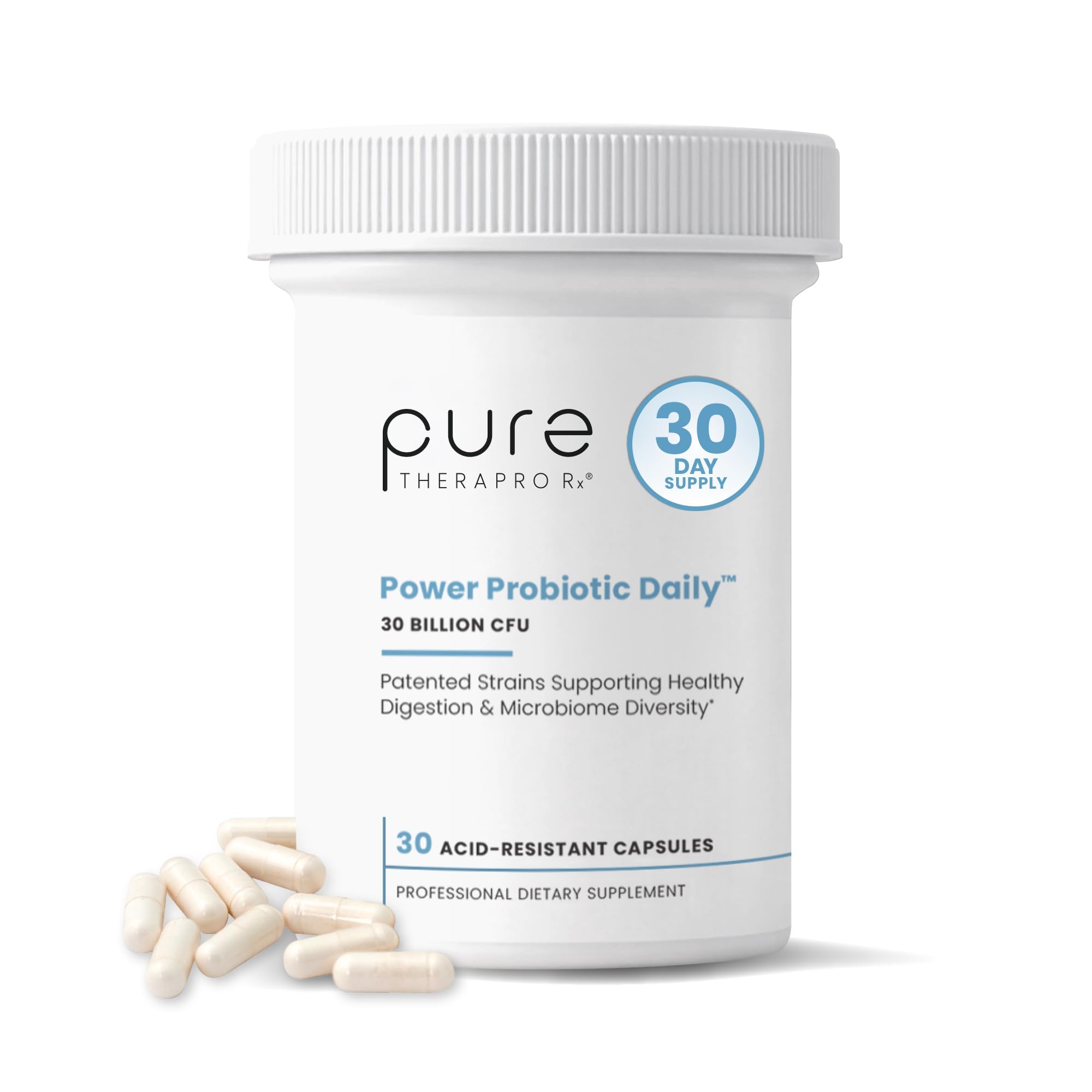
Pure Therapro Rx focuses on purity above all else. This formula contains only four strains—including the heavily researched *Bifidobacterium lactis* HN019—but at 30 billion CFU per capsule, packaged in patented Activ-Vial desiccant bottles that absorb moisture without refrigeration. It is one of the few products that claims no refrigeration needed yet still delivers live bacteria reliably.
The DRcaps gastro-resistant capsules are designed to resist low pH and release contents in the small intestine. The formulation is free of wheat, gluten, corn, soy, dairy, eggs, fish, shellfish, peanuts, tree nuts, GMOs, artificial colors, and flavors. For individuals with multiple food sensitivities or those on elimination diets, this is a clean option.
Users with sensitive stomachs specifically praise the absence of prebiotics, which can cause gas in some people. The 30-capsule bottle lasts one month. While the per-capsule cost is higher than blends with more CFU, the reliability of the HN019 strain and the purity guarantee justify the expense for the right buyer.
Why it’s great
- Free from all major allergens including dairy and soy
- Patented Activ-Vial desiccant bottle preserves potency
- DRcaps target release to the small intestine
Good to know
- Only four strains—less diversity than competitors
- 30-capsule bottle requires monthly reordering
- Low CFU count compared to other premium options
5. Physician’s CHOICE Probiotics 60ct

The 60-count version of Physician’s CHOICE is the entry point to the brand and the most popular SKU for a reason. With 60 billion CFU and 10 diverse strains plus organic prebiotics, it covers the bases for digestive support, immune function, and relief from occasional gas and bloating. The acid-resistant capsules and shelf-stable bottle make it convenient for daily use.
User feedback is remarkably consistent: bloating and discomfort reduce within the first week, and bowel regularity improves within a month. Many reviewers note that it resolves issues that other probiotics failed to address, particularly around slow digestion and chronic constipation. The two-month supply per bottle is a solid value.
The biggest complaint is that some users plateau after a few months and need to switch strains to maintain effectiveness. This is a known phenomenon with high-CFU probiotics—rotating between different products every 90 days is a common strategy recommended by healthcare providers.
Why it’s great
- Rapid bloating relief—many users feel results in under a week
- 60 billion CFU with 10 strains offers good diversity
- Acid-resistant capsules and shelf-stable packaging
Good to know
- Effectiveness may decrease after 3 months of continuous use
- Some users experience gas during the first week of adjustment
- Not a true refrigerated product
6. Garden of Life Dr. Formulated 3-in-1
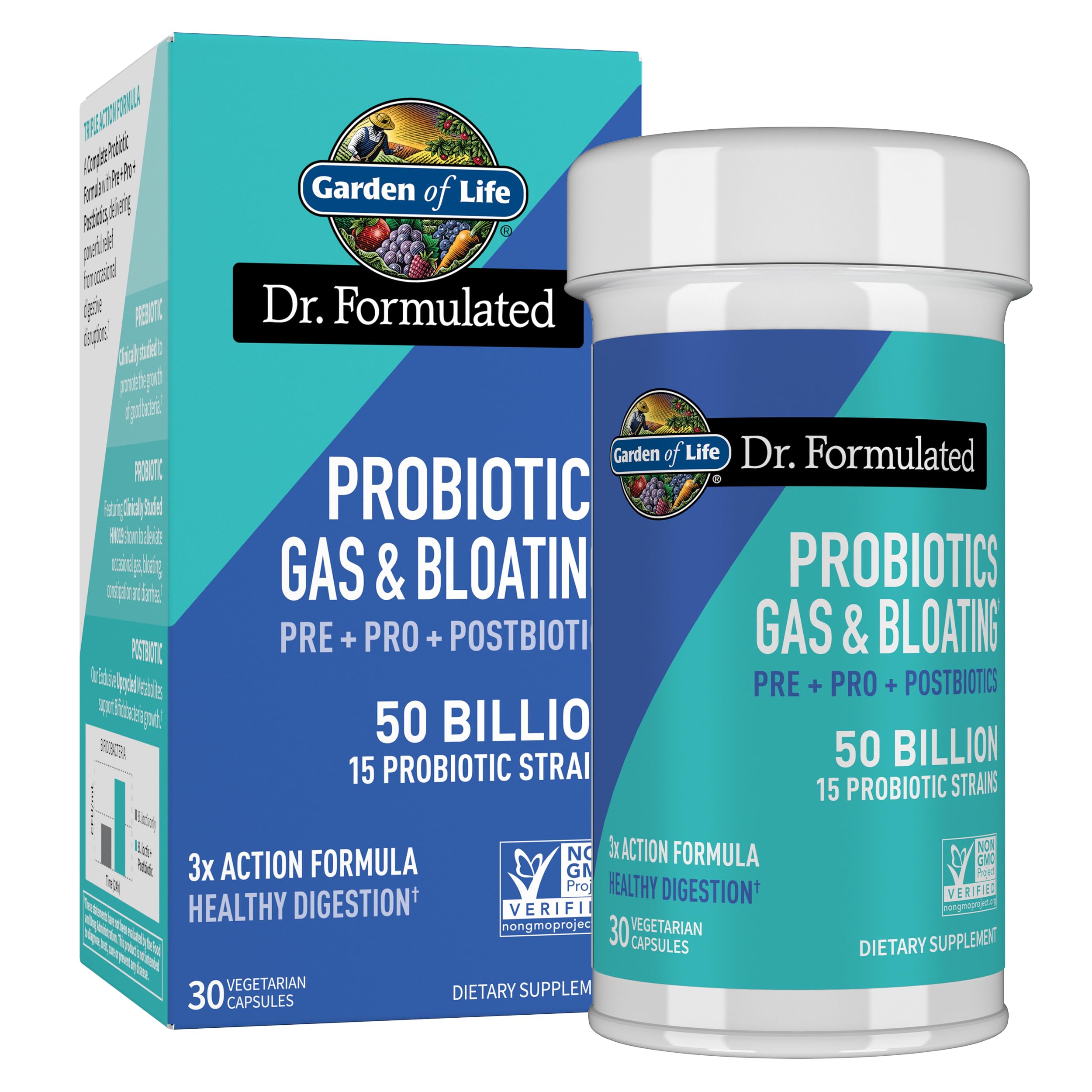
Garden of Life’s Dr. Formulated line takes a comprehensive approach by combining probiotics, prebiotics, and postbiotics in a single capsule. With 15 strains and 50 billion CFU, it includes the clinically studied HN019 strain for bloating relief plus organic potato starch and acacia fiber as prebiotics. The postbiotic component provides short-chain fatty acids that feed the gut lining.
This is an NSF Certified Gluten-Free, Non-GMO, and vegan formula with no artificial dyes or fillers. The shelf-stable bottle eliminates the need for refrigeration, though the company recommends a cool, dry place. Users consistently report significant improvement in gas and bloating, with several noting it works better than standard probiotics they had tried previously.
The only drawback is that some users feel the effectiveness wanes over time, and a few mentioned that the company’s customer service was less responsive when they had issues. If you want a true three-in-one formula that simplifies your supplement stack, this is a strong mid-range option.
Why it’s great
- Triple action formula covers pre, pro, and postbiotics
- 15 strains offer the highest diversity on this list
- NSF Certified Gluten-Free and vegan-friendly
Good to know
- Some users report reduced effectiveness after multiple bottles
- Not a refrigerated probiotic despite the brand reputation
- Capsules are slightly larger than some competitors
7. Jarrow Formulas Jarro-Dophilus EPS

Jarrow Formulas has been a trusted name in supplements for decades, and the Jarro-Dophilus EPS remains a reliable, cost-effective entry point for probiotic newcomers. With 25 billion CFU across eight clinically studied strains, it uses a proprietary Enteroguard coating—an enteric coating that protects bacteria from stomach acid until they reach the lower intestine.
The capsules are shelf-stable, making them an excellent travel companion. User reviews highlight its effectiveness for general gastric health and occasional constipation, with many noting it is gentler on the stomach than competing products. Consumer Lab has verified its potency, which adds a layer of trust for skeptics.
The 30-count bottle is a one-month supply at a very accessible price point. While the CFU count is lower than most competitors, the strain selection includes mood-influencing bacteria that have shown benefit for anxiety and depression, making this a dual-purpose option for some users.
Why it’s great
- Consumer Lab verified for potency and purity
- Shelf-stable with excellent travel convenience
- Enteroguard coating ensures targeted delivery
Good to know
- Modest 25B CFU count compared to market leaders
- 30-day supply requires frequent reordering
- Not a true refrigerated probiotic
FAQ
Do refrigerated probiotics work better than shelf-stable ones?
Can I take a refrigerated probiotic on a plane?
What is the difference between a medical food probiotic and a dietary supplement probiotic?
How long does it take for a refrigerated probiotic to start working?
Should I rotate between different probiotic brands?
Final Thoughts: The Verdict
For most users, the refrigerated probiotics winner is the Visbiome Advanced GI Care because its clinical-grade potency and rigorous cold-chain shipping guarantee the highest bacterial viability available without a prescription. If you want a gentle daily maintenance option that works reliably over years, grab the Flora Super 8. And for a high-value bulk supply with solid strain diversity and included prebiotics, nothing beats the Physician’s CHOICE 84ct.