Your home’s water supply carries more than just H₂O — sediment, chlorine, heavy metals, and even bacteria can degrade taste, damage appliances, and affect your family’s health. A properly engineered whole-house system intercepts these contaminants at the main water line, delivering cleaner water from every tap.
I’m Mohammad Maruf — the founder and writer behind AirfryerBite. I’ve spent over a year analyzing filtration hardware, mapping customer feedback across thousands of verified installs, and cross-referencing contaminant reduction claims against real-world performance to separate reliable systems from marketing noise.
This guide breaks down the top contenders in nine distinct configurations. Whether you’re fighting well-water iron or municipal chlorine, you’ll find a system matched to your specific water profile — and discover exactly what defines the rated whole house water filtration system that earns its spot on your main line.
How To Choose The Best Rated Whole House Water Filtration System
Selecting a whole-house filtration system is a long-term investment — the wrong choice means poor water quality, pressure loss, or a system that fails under your actual water chemistry. Focus on these decisive specs before buying.
Stage Configuration & Media Type
Three-stage systems are the standard: stage one uses a sediment filter (5–50 micron) to catch sand, rust, and silt; stage two employs granular activated carbon (GAC) or catalytic carbon to reduce chlorine taste and odor; stage three adds a carbon block (CTO) for finer particle removal. Systems that include KDF media (kinetic degradation fluxion) target heavy metals like iron, manganese, and hydrogen sulfide — essential for well water users. If you face bacterial contamination, a UV stage after filtration is non-negotiable.
Flow Rate & Pressure Drop
Your home’s peak simultaneous water demand dictates the required flow rate. A standard 3–4 bathroom household needs at least 12 GPM at normal line pressure. Systems with 1-inch NPT ports and large 20”x4.5” filters maintain flow without significant pressure drop. If you install restrictive filters (especially anything below 1 micron at the whole-house level) without a booster pump, you’ll notice weak showers and slow tap fill times. Stick to whole-house systems rated for 15 GPM minimum for comfortable multi-fixture use.
Filter Lifespan & Replacement Cost
Sediment pre-filters on well water may need replacement every 3–6 months; carbon filters typically last 6–12 months depending on chlorine load and volume. Systems that use standard 10” or 20” cartridge sizes (Big Blue format) offer cheaper, widely available replacements. Look for filter sets that cost under a dollar per week over a year of operation — anything higher creates a hidden recurring expense that undermines the system’s value.
Housing Material & Leak Protection
Filter housings must handle continuous pressure — polypropylene with double O-rings and brass ports resist cracking and seal reliably. Clear housings let you inspect cartridge condition without disassembly. Explosion-proof polypropylene or reinforced nylon housings protect against burst failures. For automated convenience, spin-down sediment filters with auto-flush modules reduce manual cleaning frequency dramatically.
Quick Comparison
On smaller screens, swipe sideways to see the full table.
| Model | Category | Best For | Key Spec | Amazon |
|---|---|---|---|---|
| iSpring WGB32B | 3-Stage Carbon | Chlorine & sediment reduction | 15 GPM, 5-micron sediment | Amazon |
| Express Water WH300SCKP | 3-Stage Heavy Metal | Scale & heavy metal protection | 17 GPM, 100K gal capacity | Amazon |
| SimPure DB20P-3KDF | 3-Stage KDF | Well water with iron & manganese | 15 GPM, clear housings | Amazon |
| SimPure DB20P-3 | 3-Stage Carbon | Odor & taste improvement | 15 GPM, 150K gal annual | Amazon |
| iSpring WSP50ARJ-BP | Auto-flush Sediment | High-sediment well pre-filtration | 25 GPM, 50-micron screen | Amazon |
| Tier1 WS-165-150 | Water Softener | Hard water scale elimination | 18 GPM, 48K grain cap | Amazon |
| HQUA-TWS-12 | UV Purifier | Bacteria & microorganism control | 12 GPM, 55W UV lamp | Amazon |
| Express Water 3-Stage | Anti-Scale | Scale prevention & general filtration | 15 GPM, stainless steel frame | Amazon |
| Waterdrop G3P800 | Tankless RO | High-purity drinking & cooking | 800 GPD, 10-stage filtration | Amazon |
In‑Depth Reviews
1. iSpring WGB32B 3-Stage Whole House Water Filter System

The iSpring WGB32B is a three-stage system built around industrial-standard 20”x4.5” Big Blue filters, giving you a sediment stage at 5 microns followed by two CTO carbon block stages using coconut shell carbon. This setup pushes chlorine, taste, and odor reduction above 99% — verified by third-party testing against NSF/ANSI standards. The 1-inch NPT brass inlet and outlet maintain a full 15 GPM flow rate without noticeable pressure loss, even during simultaneous shower and laundry use.
Installation is designed for confident DIY work. The unit comes with a filter housing wrench, clear manual, and online video guides. One unique risk: overtightening the inlet can crack the manifold — experienced users recommend 7–9 wraps of Teflon tape and hand-tightening only. Multiple long-term reviews report reliable operation spanning 5–10 years, with iSpring’s support team (often responding within 24 hours) replacing cracked housings free of charge even beyond warranty. The 100,000-gallon annual capacity means filter swaps cost roughly a hundred dollars per year — a fraction of the bottled water alternative.
Downsides: the system does not reduce TDS (total dissolved solids), so if you have hard water above 7 grains, pair it with a softener. The included mounting bracket uses weak plastic anchors — replace them with heavy-duty wall anchors if mounting on drywall. Some users note that the housings can be difficult to unscrew after months of use; applying silicone grease to the O-rings during installation solves this.
Why it’s great
- Third-party tested to NSF/ANSI standards for chlorine and sediment reduction
- Excellent customer support replaces defective parts well past warranty
- Standard 20×4.5 filter size makes replacements widely available and affordable
Good to know
- Does not reduce TDS or water hardness — needs a softener for hard water
- Manifold can crack if inlet is overtightened; use careful hand-tightening
- Included wall anchors are weak; upgrading them is recommended for secure mounting
2. Express Water WH300SCKP 3-Stage Whole House System

Express Water’s WH300SCKP targets a wider contaminant range than standard carbon-only systems. Its three stages include sediment, catalytic carbon, and a specialized scale-inhibitor cartridge loaded with polyphosphate — combined, they reduce chlorine, heavy metals like lead and arsenic, and prevent calcium scale build-up in pipes and water heaters. The free-standing stainless steel frame eliminates the need for wall drilling and keeps the 63-pound assembly stable on any level floor.
The deluxe series design includes pressure release buttons on each filter housing and individual pressure gauges so you can monitor differential pressure across every stage — a feature usually reserved for commercial systems. Users on well water report immediate elimination of sulfur odor and iron staining, with filters lasting 6–12 months depending on incoming water quality. The 17 GPM peak flow rate supports homes with 3–4 bathrooms without noticeable pressure drop. The anti-scale stage is especially valuable if you have a tankless water heater, as scale accumulation is the primary failure mode for those units.
Installation is moderately difficult — you’ll need 1-inch pipe connections and a basic understanding of sweat or push-fit fittings. Some units ship with a pressure gauge that arrives stuck or non-functional; Express Water’s support typically ships a replacement quickly. The polyphosphate cartridge adds ongoing cost (replacement every 6–12 months at roughly thirty dollars). And like all whole-house systems, this one does not lower TDS — it’s designed to protect plumbing, not to produce drinking-water purity.
Why it’s great
- Heavy-duty stainless steel stand provides stable, no-drill installation
- Polyphosphate anti-scale media protects tankless water heaters and fixtures
- Three pressure gauges enable real-time monitoring of filter condition
Good to know
- Some units arrive with non-functional pressure gauges
- Does not reduce TDS — not a replacement for an RO system
- Polyphosphate replacement cartridges add ongoing annual cost
3. SimPure DB20P-3KDF Whole House Water Filter System
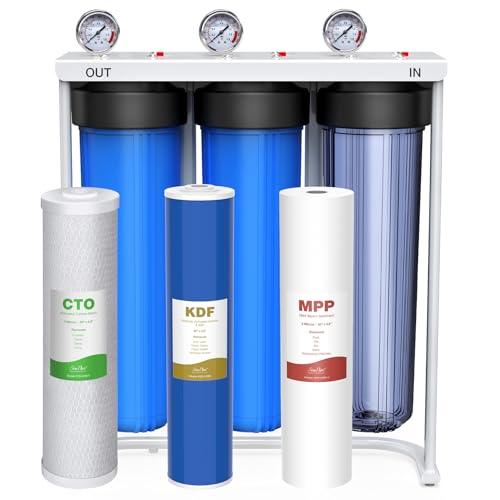
SimPure’s DB20P-3KDF pairs a KDF (kinetic degradation fluxion) media cartridge with a CTO carbon block, targeting contaminants common in well water: iron, manganese, hydrogen sulfide, and heavy metals like lead and mercury. The KDF media works by electrochemical oxidation — it doesn’t just trap particles, it chemically transforms chlorine into harmless chloride and inhibits bacterial growth within the filter bed. This makes the system unusually effective for well owners who smell sulfur or see rust staining on fixtures.
The dual clear housing design (one standard opaque, one transparent) lets you inspect sediment accumulation visually without disassembly. The 20”x4.5” cartridges are standard size, so replacements from any brand fit. Installation uses 1-inch brass ports and double O-rings for leak resistance — several plumber-verified reviews confirm the seals hold under continuous 80 PSI line pressure. The system handles up to 150,000 gallons annually, with the sediment filter lasting 6–12 months and the carbon filter needing replacement at 3–6 months on well water.
One limitation: the KDF cartridge is effective for moderate iron levels (up to 3 ppm) but won’t solve high-iron well water alone — you’d need an iron-specific filter or softener upstream. The mounting bracket spacing is not compatible with standard 16-inch wall stud centers, so you may need to install plywood backing or use the frame on the floor. A small number of users report that hydrogen sulfide smell returns after 30 days if the KDF media is exhausted, indicating that the replacement schedule must be followed strictly.
Why it’s great
- KDF media targets iron, sulfur, and heavy metals that carbon alone misses
- Clear housing shows when cartridges need replacement without disassembly
- Standard 20×4.5 filter size ensures low-cost, widely available replacements
Good to know
- KDF has limited capacity — high iron levels (>3 ppm) may require additional pre-treatment
- Mounting bracket does not align with 16-inch stud spacing
- Hydrogen sulfide removal depends on strict 3–6 month carbon change schedule
4. SimPure DB20P-3 Whole House Water Filter System
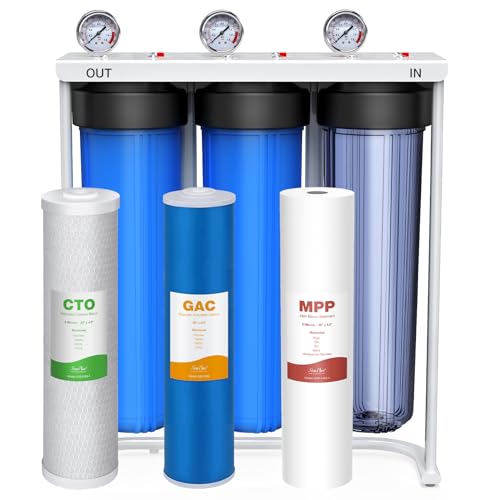
The SimPure DB20P-3 is a three-stage system built around MPP sediment, granular activated carbon (GAC), and a CTO carbon block. This combination is optimized for municipal water with chlorine taste, sediment, and odor issues rather than heavy metals. The 20”x4.5” cartridges deliver up to 150,000 gallons per year — enough for a family of four with standard usage — and the system operates at a 15 GPM flow rate that feels transparent during multi-fixture use.
Construction uses double O-rings and 1-inch brass ports to prevent blowouts under line pressure. The two-stage clear housing (one opaque, one transparent) gives you a direct view of sediment buildup without breaking the seal. Users on well water with red clay report that the sediment layer turns water crystal clear after installation. The filters are individually vacuum-sealed to preserve freshness — remember to remove the wrap before installation, as the carbon turning black inside the housing is normal adsorption activity, not a defect.
The main shortfall: the standard carbon-only media does not address iron, manganese, or hydrogen sulfide. If your water test shows those contaminants, the KDF variant (product 3) is a better fit. The included mounting bracket uses low-quality plastic anchors that struggle with the 48.5-pound loaded weight — replacing them with expanding metal anchors is a five-minute upgrade that prevents sagging. Operating range is 25–90 PSI and 41–100°F; exceeding those limits risks housing failure.
Why it’s great
- High annual capacity (150,000 gallons) meaning fewer filter changes
- Clear housing allows visual monitoring of filter condition
- Dual O-ring and brass port construction reduces leak risk
Good to know
- Standard carbon media won’t remove iron, manganese, or sulfur odors
- Plastic mounting anchors are undersized — upgrade to metal for stability
- Limited to 25–90 PSI operating range; low well pressure may require a pump
5. iSpring WSP50ARJ-BP Spin-Down Sediment Filter

The iSpring WSP50ARJ-BP is not a complete filtration system but a high-capacity pre-filter designed to handle extreme sediment loads — the kind that clogs standard filters in weeks. The 50-micron 316L stainless steel screen captures sand, rust, and large particles, and the integrated auto-flush module (dual power supply) opens the drain valve on a programmable schedule to expel trapped debris without manual disassembly. The jumbo-sized body holds a 1-gallon sediment capacity, roughly 22 times larger than standard spin-down filters.
The bypass valve design offers four operating modes: filtration, shut-off, bypass (for filter maintenance without interrupting home water), and backwash. The 25 GPM maximum flow rate means it won’t restrict supply even in large homes, and the explosion-proof transparent housing lets you visually inspect the internal screen condition. The housing has passed pressure tests exceeding 500 PSI and over 100,000 water hammer cycles — a critical safety margin for well systems with variable pump pressure. Users report that the auto-flush reduces cleaning frequency from weekly to quarterly on heavy-sediment wells.
The main drawback: the system is strictly a sediment pre-filter — it does nothing for chemical taste, bacteria, or hardness. The auto-flush timer programming is poorly documented, and the schedule can drift over weeks. The supplied drain hose is thin and may kink; upgrading to a braided line resolves this. The filter wrench is incompatible with the auto-flush module’s protrusion, making manual removal awkward. Despite these quirks, the build quality and customer support (Nick and John are specifically praised) make this the go-to pre-filter for high-sediment well setups.
Why it’s great
- Auto-flush module automates cleaning — reduces manual maintenance dramatically
- 316L stainless steel screen and explosion-proof housing provide long-term durability
- Bypass valve allows filter servicing without shutting off house water
Good to know
- Only removes sediment — requires downstream carbon/UV/softener for full treatment
- Auto-flush timer programming is poorly documented and drifts over time
- Filter wrench and drain hose quality are below the standard of the main unit
6. Tier1 Whole House Water Softener System 48,000 Grain

The Tier1 WS-165-150 is a 48,000-grain capacity water softener targeted at homes with hardness levels above 7 grains per gallon. The core technology is a ceramic disk control valve — unlike the piston seals in most residential softeners, ceramic disks resist abrasion from sediment and don’t require periodic seal rebuilds. The metered regeneration logic tracks actual water usage and initiates regeneration only when the resin bed is near exhaustion, minimizing salt waste and water discharge compared to timer-based units.
The system includes a 10”x59” mineral tank pre-loaded with 1.5 cubic feet of cation resin and a separate 13.5”x32” brine tank. The base includes an integrated sediment pre-filter, protecting the resin from premature fouling. At 18 GPM peak flow, the unit supports households with 3+ bathrooms without noticeable pressure loss during backwash cycles. Users with well-water hardness exceeding 400 PPM report reduction to 0–25 PPM, eliminating scale spots on dishes, crunchy laundry, and coffee maker scaling. The ceramic valve is rated for continuous 24/7 operation and has no maintenance interval — a genuine reduction in long-term hassle compared to softeners with rebuild-required piston valves.
Weaknesses: the pre-filter housing uses plastic threads that strip easily — users advise against overtightening. The brine tank walls feel thin and flex when full of salt. A small number of users report that the resin beads degrade after 3,000–4,000 gallons, though this may reflect individual water chemistry incompatibility (high chlorine or iron) rather than a universal defect. The included manual explains basic setup but skips some control valve programming details. For homes with both high hardness and high iron, adding an iron-specific filter before the softener protects the resin bed from fouling.
Why it’s great
- Ceramic disk valve eliminates seal rebuilds — a genuine maintenance advantage
- Metered regeneration reduces salt and water waste compared to timer units
- Pre-loaded with 1.5 cu ft cation resin for high-capacity softening
Good to know
- Pre-filter housing plastic threads strip easily — hand-tighten only
- Brine tank has thin walls and flexes when fully loaded with salt
- Resin life can be shortened by high chlorine or iron without pre-filtration
7. HQUA-TWS-12 Ultraviolet Water Purifier

The HQUA-TWS-12 is a standalone UV purification unit designed to be installed after sediment and carbon filtration. The 55-watt UV lamp emits 254nm wavelength radiation inside a 304 stainless steel chamber, deactivating up to 99.99% of bacteria, viruses, and protozoa (including Giardia and Cryptosporidium) without adding chemicals or altering taste. The 12 GPM flow rating matches standard household demand, and the compact 21”x3.5” chamber integrates easily into existing plumbing with 3/4-inch MNPT connections.
The unit ships with two UV bulbs and one quartz sleeve — a full spare set. The lamp life is rated at 9,000 hours of continuous operation (roughly one year), after which UV output degrades below effective levels even if the light still glows. Maintenance involves annual replacement of the UV bulb and cleaning of the quartz sleeve with a mild acid solution (hand oils on the quartz reduce UV transmission — always wear gloves during handling). Users report straightforward installation with flexible stainless steel connectors, though the included instruction manual lacks detail on troubleshooting and proper drain line orientation.
Critical limitation: UV treatment only works on microbiologically clear water — sediment particles can shield microorganisms from UV exposure, so UV must always follow a 5-micron or finer sediment/carbon filter. The 3/4-inch port size may require reducers to match 1-inch whole-house lines, and the small chamber size has raised questions from some users who cite newer research indicating that shorter UV exposure time may be less effective at high flow rates. The unit also requires a power outlet near the installation point. Despite these constraints, for homes with a positive bacteria test, this is the most cost-effective whole-house solution available.
Why it’s great
- Deactivates bacteria, viruses, and protozoa without chemical additives
- Includes spare UV bulb and quartz sleeve — ready for first maintenance cycle
- 316 stainless steel chamber offers corrosion resistance and long service life
Good to know
- Requires pre-filtration to remove sediment that can shield microorganisms
- 3/4-inch ports may require reducers to connect to 1-inch whole-house lines
- Lamp must be replaced annually — output degrades even if the blue glow remains
8. Express Water 3-Stage Whole House Anti-Scale System

Express Water’s original three-stage anti-scale system uses a sediment filter, a GAC carbon cartridge, and a proprietary anti-scale media cartridge packed with polyphosphate crystals. The anti-scale media sequesters calcium and magnesium ions, keeping them in suspension rather than allowing them to precipitate as hard scale on pipes and heating elements. This system is designed specifically for municipal water with moderate hardness (3–7 grains) where full softening is not needed but scale prevention matters.
The deluxe series frame is heavy-gauge stainless steel with a free-standing design — no wall mounting required. Pressure release buttons on each filter housing make cartridge swaps significantly less messy than systems that require full-depressurization disassembly. The three included pressure gauges let you track differential pressure across each stage, alerting you to a clogged filter before it affects flow. Users report immediate taste improvement and reduced spotting on dishes, and those with tankless water heaters note fewer maintenance alerts after installation. The 100,000-gallon filter life (6–12 months per cartridge set) keeps annual filter cost below a hundred dollars.
This system does NOT reduce TDS or actual water hardness — if your water is above 7 grains, you still need a softener. The polyphosphate media loses effectiveness at water temperatures above 100°F, so it must be installed before the water heater. Some units have shipped with non-functional pressure gauges, and the included filter wrench is loose-fitting and prone to slipping on the housing. The frame holds 0.01 ounces of listed weight (a listing error — actual weight is approximately 45 pounds), so ignore that spec and plan for a two-person lift during installation.
Why it’s great
- Anti-scale polyphosphate stage protects pipes and appliances without removing beneficial minerals
- Free-standing stainless steel frame allows flexible placement without drilling
- Pressure release buttons and gauges simplify maintenance and condition monitoring
Good to know
- Does not reduce hardness or TDS — incompatible with water above 7 grains without a softener
- Polyphosphate media is ineffective above 100°F — install before the water heater
- Some units ship with non-functional gauges; filter wrench fit is sloppy
9. Waterdrop G3P800 Reverse Osmosis System
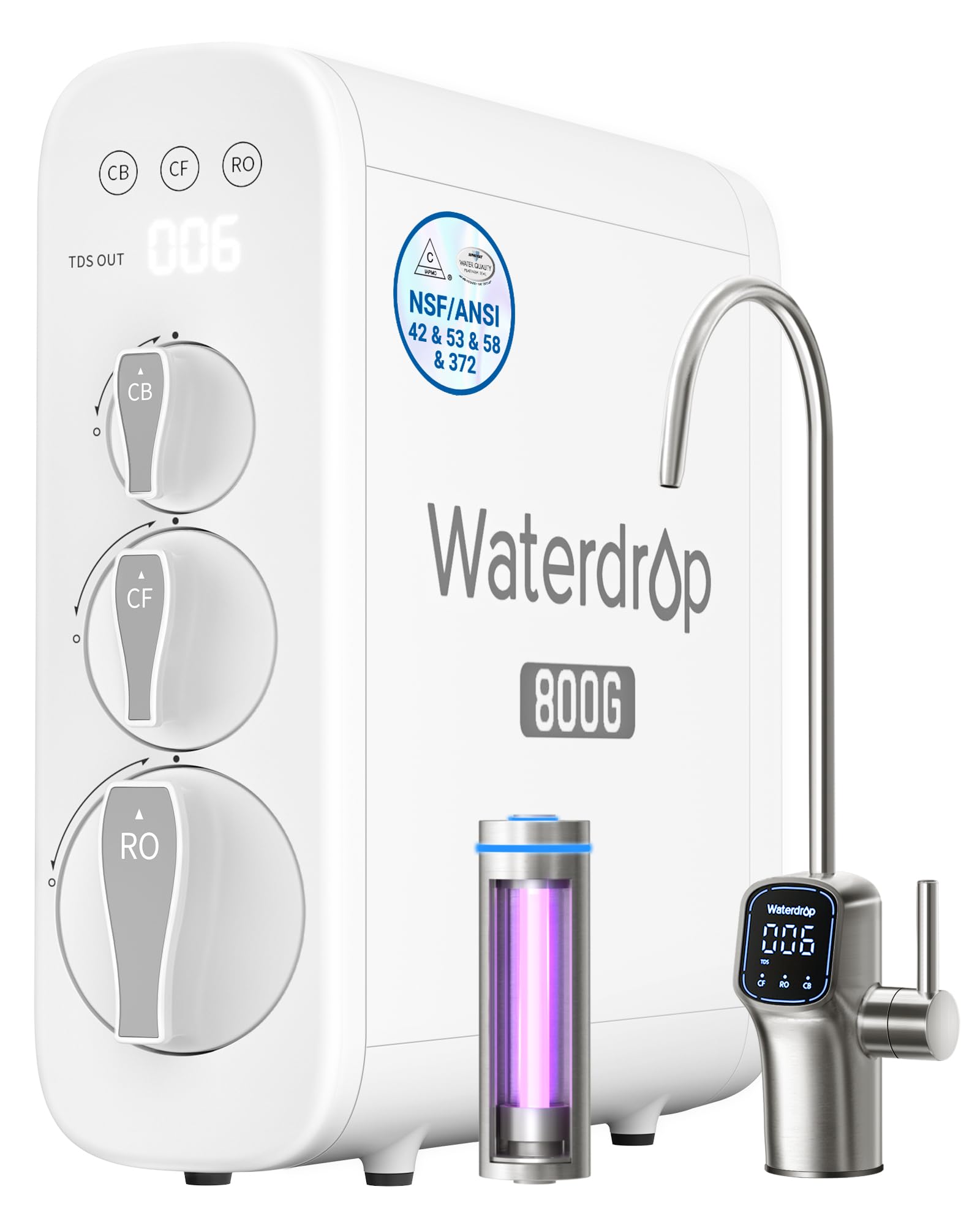
The Waterdrop G3P800 is an under-sink, tankless reverse osmosis system designed for high-purity drinking and cooking water — not whole-house treatment. Its 10-stage filtration process includes a sediment membrane, pre-carbon and post-carbon blocks, a reverse osmosis membrane, and a remineralization stage that adds back calcium and magnesium for taste. The system is NSF/ANSI 42, 53, 58, and 372 certified, meaning it has been independently tested to reduce chlorine, lead, mercury, PFAS, fluoride, TDS, and more than 100 other contaminants.
The tankless design uses a high-pressure pump to push water through the RO membrane on demand, producing 800 gallons per day — enough to fill a cup in 5 seconds. The 3:1 pure-to-drain ratio is exceptional for RO systems; most traditional units waste 3–4 gallons for every gallon filtered. The smart faucet includes an LED display showing real-time TDS levels, so you know exactly when filter performance degrades. Users with bad municipal water (TDS above 400) report output at 6–9 TDS, making tap water taste equal to or better than bottled spring water. The twist-in filter cartridges change in under 10 seconds without tools.
This system is NOT a whole-house solution — it treats only the water at the dedicated faucet. Installation requires drilling two holes (one for the faucet, one for the drain connection) and a nearby power outlet. The 800 GPD membrane is sensitive to feed water TDS and pressure — extremely hard water (>500 TDS) may reduce the membrane life below the rated 2–3 years. The pump produces a faint humming sound during operation that some users notice in quiet kitchens. For homes that want whole-house sediment/carbon + under-sink RO, the Waterdrop pairs well with any of the filtration systems listed above.
Why it’s great
- NSF/ANSI 42, 53, 58, and 372 certified — independently tested contaminant reduction
- 800 GPD tankless design delivers fast flow with a 3:1 pure-to-drain ratio
- Smart faucet LED displays real-time TDS for immediate water quality feedback
Good to know
- Under-sink point-of-use system — does not treat water for showers, laundry, or other whole-house faucets
- Requires two drilled holes and a power outlet for installation
- RO membrane life decreases with feed water TDS above 500
FAQ
Will a whole-house water filter remove the metallic taste from my well water?
Do I need a water softener if I already have a whole-house filtration system?
How do I know when to replace the filters in a whole-house system?
What size pipe connections do I need, and do whole-house filters reduce water pressure?
Can I install a whole-house water filter myself, or do I need a plumber?
Final Thoughts: The Verdict
For most users, the rated whole house water filtration system winner is the iSpring WGB32B because it combines third-party certified contaminant reduction, standard 20”x4.5” filters for affordable replacement, and customer support that consistently exceeds expectations — a rare combination in home filtration. If you need heavy metal reduction and scale prevention for a tankless water heater, grab the Express Water WH300SCKP. And for well water battling iron and sulfur odors, nothing beats the SimPure DB20P-3KDF for its targeted KDF media at this price tier.