A good Santoku knife turns a mound of onions into uniform dice in seconds and makes thin tomato slices feel effortless. But far too many blades claim “ultra-sharp” on the box while arriving with a geometry that wedges through carrots and sticks to potato slices. Real performance lives in the interplay of steel composition, edge angle, and blade profile—not just the marketing label.
I’m Mohammad Maruf — the founder and writer behind AirfryerBite. I have spent years analyzing kitchen knife metallurgy, edge-retention data, and buyer feedback to understand what separates a daily workhorse from a drawer decoration.
This guide breaks down seven contenders that have earned their place through tangible spec sheets and verified owner experience. If you are hunting for the best rated santoku knife, you need to compare core steel hardness, handle ergonomics, and edge geometry side by side rather than guess from packaging.
How To Choose The Best Rated Santoku Knife
A Santoku (“three virtues”) knife excels at slicing, dicing, and mincing. But not every version on the shelf delivers equal performance across those three tasks. The wrong choice leads to wedging on dense squash, sticking on potato slices, or a handle that fatigues your wrist after twenty minutes of prep. Focus on these four factors to land a blade that fits your hand and your cutting style.
Steel Hardness and Edge Retention
Rockwell hardness (HRC) tells you how well the blade holds its sharp edge under daily use. Entry-level knives sit around 55-57 HRC and require frequent honing. Mid-range and premium options land between 58 and 64 HRC. Higher numbers—like 62 HRC found in Japanese 10Cr15MoV or VG-10 cores—mean the edge stays sharp longer, but the blade becomes more brittle if abused on hard cutting boards or bones. For most home cooks, 60-62 HRC delivers the best balance of retention and toughness.
Edge Angle and Blade Geometry
Santoku knives commonly come sharpened to 12 to 15 degrees per side. A 12-degree edge feels laser-sharp out of the box and glides through soft produce with minimal resistance, but it needs careful handling and regular honing. A 15-degree edge is slightly more durable and forgiving for cooks who do not want to baby the blade. The blade profile—flat with a slight upward curve at the tip—determines whether you can rock-chop or must use a straight up-and-down motion. A true Santoku is designed for the latter.
Handle Material and Ergonomics
The handle connects your grip to the cutting edge. Natural woods like Pakkawood, olive wood, and rosewood offer warmth and a secure grip when dry, but they can crack if exposed to extreme temperature changes or frequent dishwasher cycles. Synthetic materials like G10 (glass-fiber composite) provide superior durability, moisture resistance, and a consistent texture even with wet hands. Full-tang construction—where the steel runs the full length of the handle—adds balance and prevents the handle from loosening over time. The bolster shape also matters: a sloped bolster supports a comfortable pinch grip without digging into your fingers.
Blade Features: Granton Edge vs. Plain Edge
Santoku blades often feature hollow-ground indentations (Granton edge) or a hammered (tsuchime) finish. These dimples create small air pockets between the blade and the food, reducing friction and preventing thin slices of cucumber or potato from sticking to the side of the blade. A plain edge is easier to sharpen and maintain because there are no divots to navigate with a stone, but you may find yourself prying sticky slices off the blade more often. For heavy vegetable prep, a Granton or textured finish is a practical time-saver.
Quick Comparison
On smaller screens, swipe sideways to see the full table.
| Model | Category | Best For | Key Spec | Amazon |
|---|---|---|---|---|
| HOSHANHO Damascus 7″ | Premium | Feather-pattern edge retention | 62-64 HRC, 67-layer Damascus | Amazon |
| Dalstrong Gladiator 5″ | Premium | Compact precision & knuckle clearance | 56+ HRC, German HC steel | Amazon |
| WÜSTHOF Gourmet 7″ | Premium | German durability & hollow edge | Laser-cut stamped, 10° edge | Amazon |
| Victorinox Rosewood 7″ | Mid-range | Professional balance & Granton flutes | Stamped, Granton edge | Amazon |
| SHAN ZU 7″ 10Cr15Mov | Mid-range | Razor 12° edge & matte finish | 62 HRC, 5-layer laminated | Amazon |
| TIVOLI Damascus VG-10 | Mid-range | Gift-ready olive wood & VG-10 core | 60-62 HRC, 15° edge | Amazon |
| HOSHANHO Red Sandalwood 7″ | Mid-range | Dense 10Cr15CoMoV core & red handle | 60-62 HRC, double bevel 15° | Amazon |
In‑Depth Reviews
1. HOSHANHO Damascus Santoku Knife, 7″
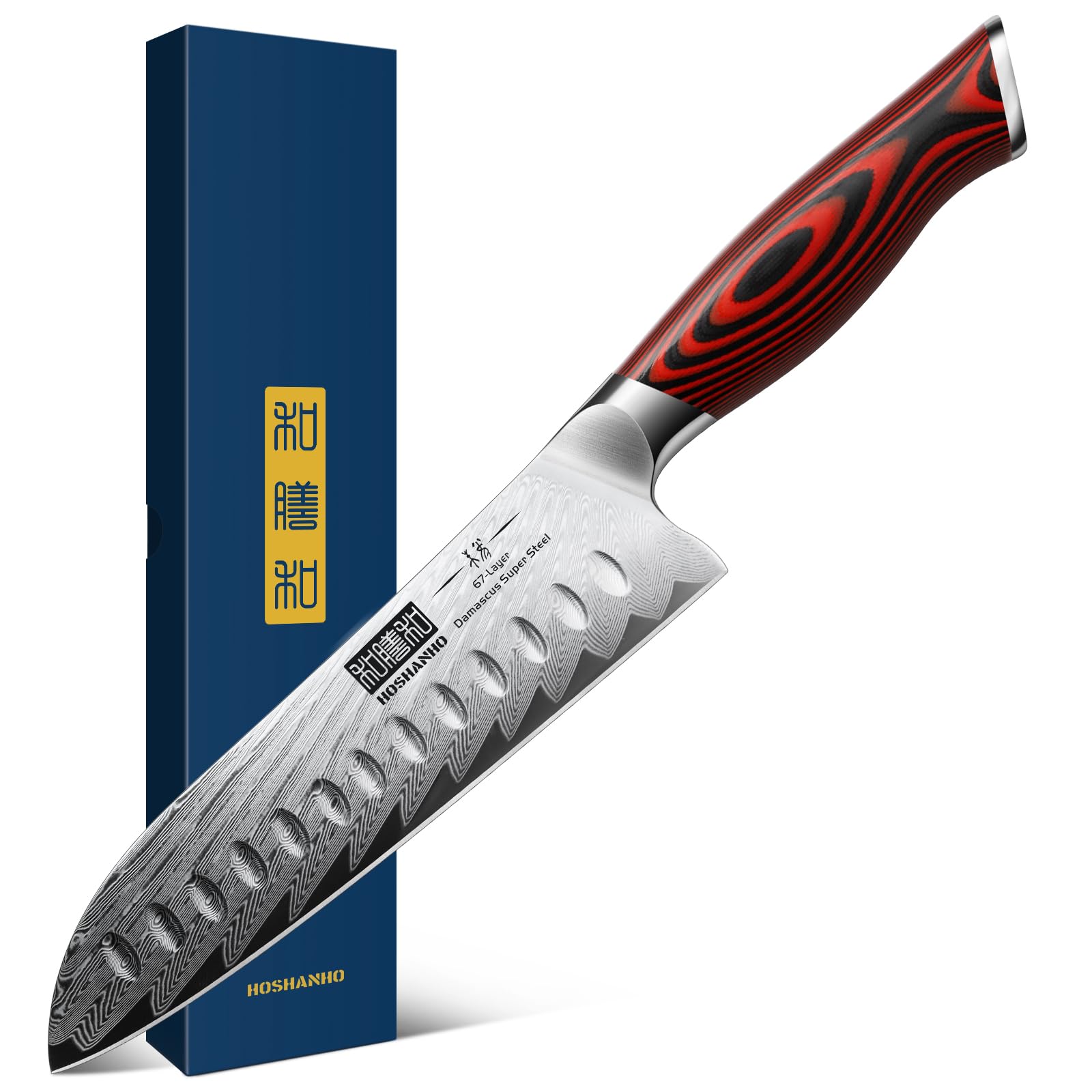
The HOSHANHO Damascus Santoku stands out among premium options because of its 67-layer Damascus cladding over a Japanese 10Cr15CoMoV core that hits 62-64 HRC. That hardness translates to a blade that holds its factory edge through dozens of prep sessions without needing a touch-up. The handmade 12-15 degree edge angle slices through dense squash and ripe tomatoes with equal ease, and the feather pattern on the blade is not just decorative—the sandblasted surface improves release and reduces sticking.
At 0.52 pounds with a thickness of 0.08 inches, this knife feels light and nimble for fast up-and-down chopping. The G10 glass-fiber handle offers more consistent grip texture than natural wood when your hands are wet from washing produce, and it resists cracking or swelling over time. Multiple buyers note the balance point sits forward of the bolster, which naturally drives the blade into the cut without extra wrist pressure.
The edge is brittle at this hardness level—avoid bones, frozen foods, and glass cutting boards. It is also hand-wash only, and the blade lacks a Granton edge, so sticky potato or cheese slices may cling more than they would on a hollow-ground alternative. For cooks who prioritize laser-sharp edge retention and a modern synthetic handle, this is the standout performer in the mid-range price bracket.
Why it’s great
- Extremely high edge retention due to 62-64 HRC Damascus core
- G10 handle resists moisture, cracks, and thermal expansion
- Lightweight 0.52 lb design reduces wrist fatigue during long prep
Good to know
- Brittle edge unsuitable for bones or frozen foods
- Hand-wash only; no Granton edge for anti-stick
- Feather pattern may wear with aggressive stone sharpening
2. Dalstrong Santoku Knife – 5″ Gladiator Series Elite

Dalstrong’s Gladiator Series Elite trades the traditional 7-inch Santoku length for a compact 5-inch blade that appeals to cooks with limited board space or smaller hands. The high-carbon German steel blade is forged full-tang and hand-polished to a 14-16 degree edge per side. While the Rockwell hardness sits at 56+—lower than the Japanese contenders—the German steel formulation provides excellent toughness and resists chipping even when the knife sees occasional contact with hard squash seeds or small bones.
The black G10 handle is triple-riveted and contoured for a secure pinch grip. Buyers consistently praise the weight: the blade feels substantial enough to drive through denser ingredients, yet the short profile reduces wrist stress during repetitive chopping. The oval Granton-like hollow divots along the blade minimize suction, though several reviews note that very sticky foods like raw sweet potato still cling to the flat section near the tip.
NSF certification gives commercial kitchens confidence, and the included protective sheath is a practical bonus that the other knives in this list lack. The 5-inch length limits your ability to slice larger items like a whole cabbage or a roast in one pass, and the lower HRC means you will need to hone more frequently than with a 62 HRC blade. If counter space or a smaller cutting motion is your priority, this compact Dalstrong delivers solid construction.
Why it’s great
- Compact 5″ blade ideal for small boards and tight kitchens
- Full-tang forged German steel resists chipping
- NSF certified and includes a protective sheath
Good to know
- 56+ HRC requires more frequent honing than harder steels
- Short blade struggles with large produce like whole cabbage
- Hollow divots do not fully prevent sticking on dense vegetables
3. WÜSTHOF Gourmet 7″ Hollow Edge Santoku Knife

WÜSTHOF’s Gourmet series sits below their forged Classic line, but the 7-inch hollow edge Santoku still carries the Solingen, Germany heritage that professional kitchens trust. The blade is laser-cut stamped from high-carbon stainless steel, not forged, which keeps weight low—just 0.13 kg. The 10-degree cutting edge is thinner than most Santoku profiles, giving it a nimble feel that excels at precise vegetable prep and thin slicing of boneless proteins.
The hollow-edge indentations run vertically along the blade face and create small air pockets that push food away from the steel. Buyers report noticeably less sticking on cucumber, carrot, and potato slices compared to flat blades. The synthetic polypropylene handle resists fading and heat, though it feels lighter and less substantial in hand than full-tang wood or G10 alternatives. A few users mention the included plastic blade guard feels cheap, but the knife itself holds an edge well with minimal honing over months of daily use.
This is not a blade for heavy rock-chopping or dense winter squash—the thin edge can bend or chip under lateral stress. The stamped construction also means the blade lacks the distal taper of forged knives, so the balance feels handle-heavy to some cooks. If you want a lightweight, low-maintenance Santoku with genuine German build quality and a proven track record in commercial kitchens, the WÜSTHOF Gourmet is a reliable pick.
Why it’s great
- Thin 10° edge delivers exceptional sharpness out of box
- Hollow indentations effectively reduce food sticking
- Lightweight polypropylene resists heat and discoloration
Good to know
- Stamped blade lacks the weight and balance of forged knives
- Thin edge risks chipping on hard squash or bones
- Plastic blade guard feels low-quality for the price
4. Victorinox 7″ Rosewood Santoku Knife with Granton Blade

Victorinox has built a reputation in professional kitchens for delivering high-functioning cutlery at accessible price points, and this 7-inch rosewood Santoku continues that tradition. The stainless steel blade is stamped with Granton flutes—oval indentations that reduce friction and prevent thin slices from sticking. Multiple buyers note that the edge arrives razor-sharp and holds up well on wood cutting boards through weeks of daily prep without significant dulling.
The rosewood handle is naturally heavy and crack-resistant, with color and grain variation that makes every knife slightly unique. Weighing just 0.29 pounds, the knife feels balanced with the blade slightly heavier than the handle, which encourages a forward-driven cutting motion. The thinner handle profile suits smaller hands well, though cooks with larger palms may find it less filling than chunkier contoured grips. Several users mention that the knife feels “alive” in hand—responsive and precise during fine dicing.
The edge is not as hard as Japanese high-carbon options, so it benefits from regular honing with a steel. The rosewood handle also requires hand-washing and periodic oiling to prevent drying over years of use. No protective sheath is included, and the thin blade does flex slightly when slicing thick root vegetables. For pro-level performance at a mid-range price with proven long-term durability, the Victorinox is a safe bet.
Why it’s great
- Granton flutes minimize sticking on vegetable slices
- Lightweight 0.29 lb design with excellent forward balance
- Professionally sharp out of box with lasting edge retention
Good to know
- Rosewood handle requires hand-wash and periodic oiling
- Thin blade may flex slightly on dense root vegetables
- No protective sheath included
5. SHAN ZU 7″ Santoku Knife – 10Cr15Mov Steel
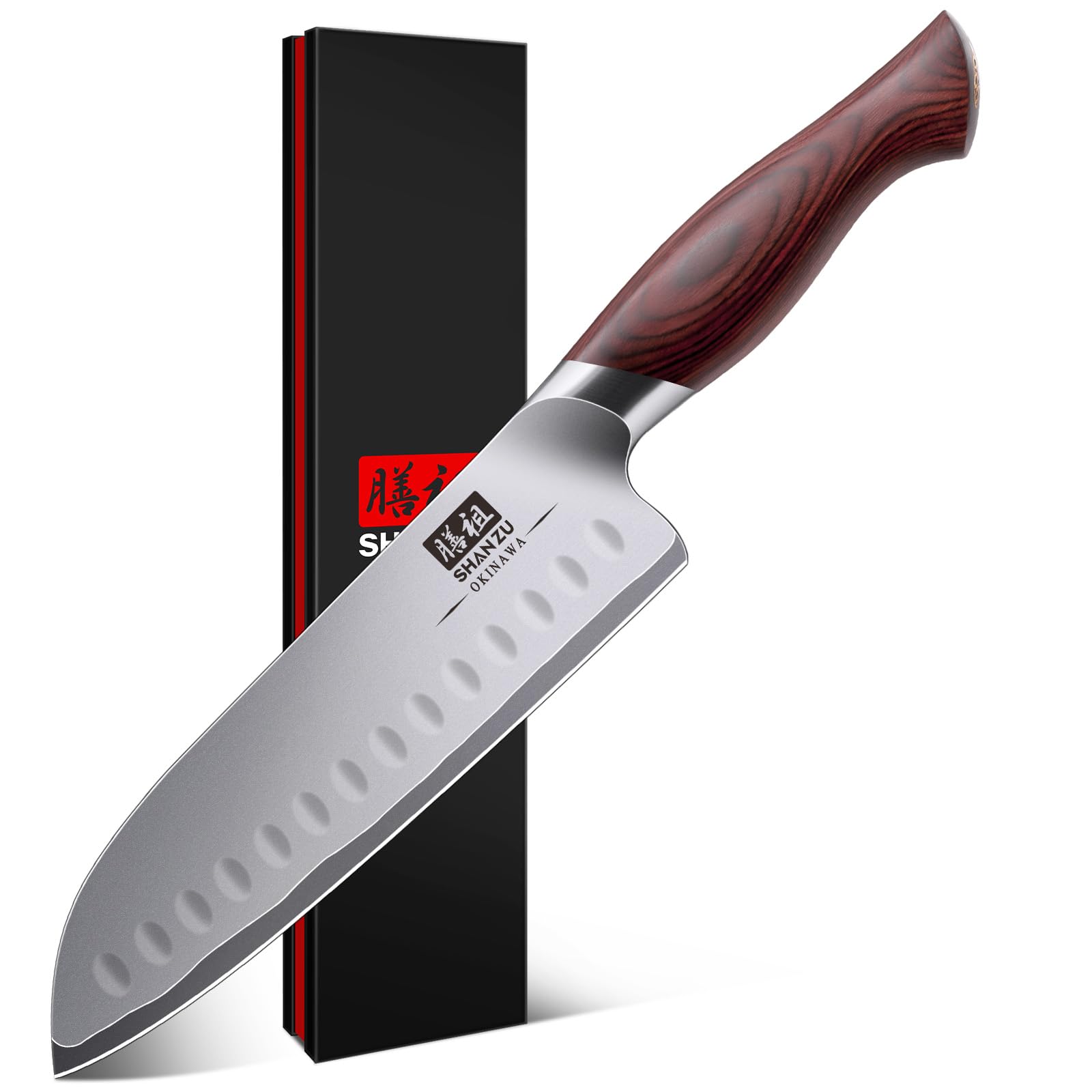
SHAN ZU’s 7-inch Santoku punches above its price point by using Japanese G5 (10Cr15Mov) stainless steel forged with five layers of lamination and heat-treated to 62 HRC. The blade is hand-sharpened to a 12-degree angle on each side—one of the most acute edges in this lineup. Multiple verified reviews describe it as the sharpest knife they have ever held, capable of shaving tomato skin without pressure and mincing garlic into a fine paste with minimal effort.
The matte frosted finish is both a visual differentiator and a functional feature: the micro-etched surface reduces drag and makes the blade less prone to corrosion than polished stainless. The Pakkawood handle is ergonomically contoured and full-tang, providing a secure grip that does not slip even when wet. At 7.36 ounces, the knife has a satisfying heft that helps the blade carry through denser ingredients without requiring extra downward force.
The 12-degree edge is fragile if misused—no bones, no frozen foods, no glass boards. The manufacturer lists the knife as dishwasher safe, but the Pakkawood handle and razor edge will degrade much faster with machine washing. Some users note that the matte finish shows fine scratches after use on ceramic honing rods. For cooks who want a budget-friendly entry into high-hardness Japanese steel and do not mind hand-care, the SHAN ZU delivers extraordinary sharpness.
Why it’s great
- 12° double bevel provides exceptional out-of-box sharpness
- Five-layer laminated 10Cr15Mov core hits 62 HRC
- Matte frosted finish reduces drag and resists corrosion
Good to know
- Acute 12° edge chips easily on bones or hard foods
- Dishwasher-safe claim contradicts best care practice for edge and handle
- Matte finish shows scratches from honing rods
6. TIVOLI Damascus VG-10 Santoku Knife, 7.1″
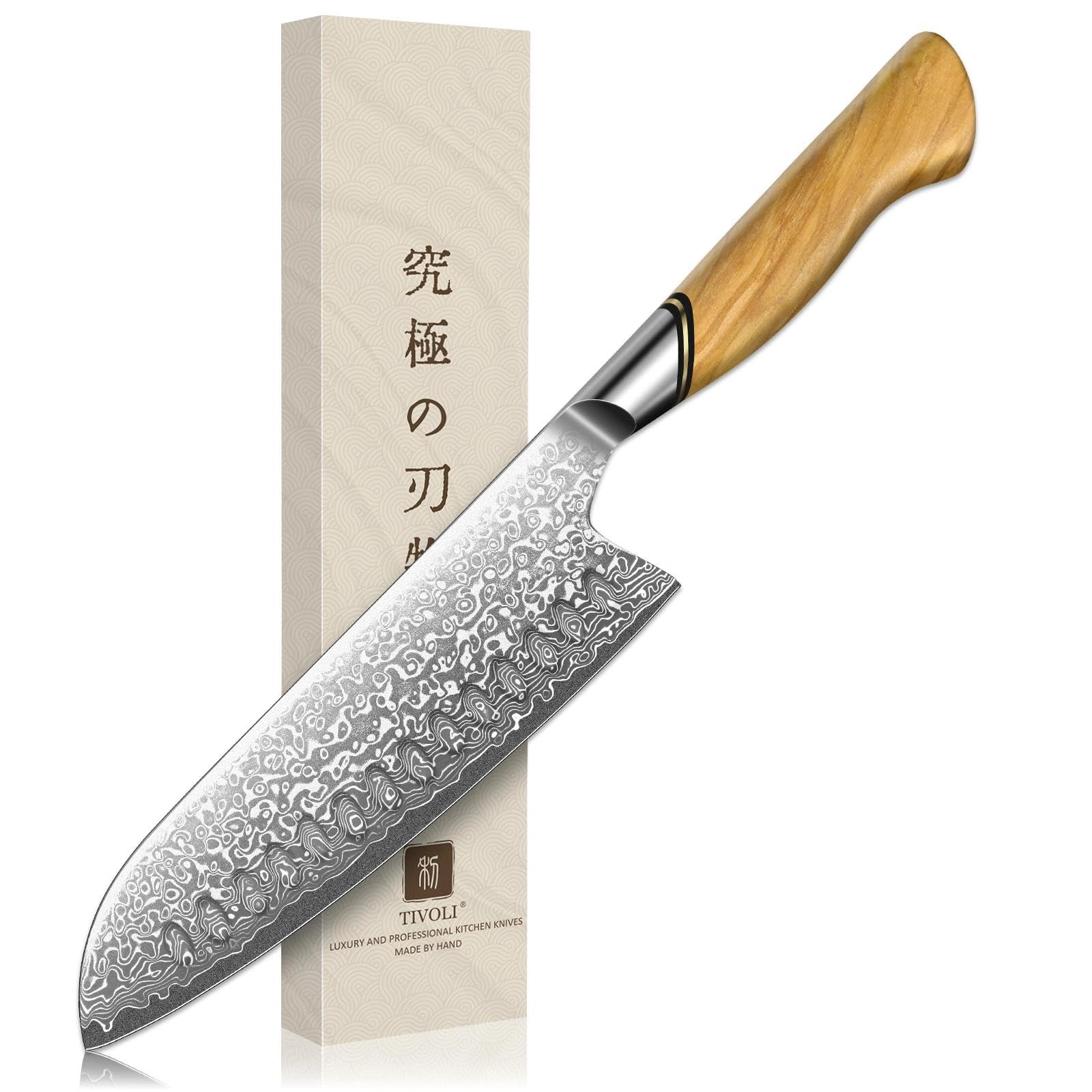
The TIVOLI Damascus Santoku pairs a traditional Japanese VG-10 steel core with natural olive wood in a package designed to be both a daily cutter and a gift-centerpiece. VG-10 is a well-respected super-steel in the knife community, holding an edge at 60-62 HRC while remaining tough enough to tolerate moderate abuse. The Damascus cladding is laser-controlled to a 15-degree edge per side, and the Honbazuke hand-sharpening method ensures a clean, burr-free finish out of the box.
The olive wood handle is organic, warm, and dense, with a sloped bolster that encourages a natural pinch grip. At 12.7 inches overall length, the knife has a slightly longer reach than a standard 7-inch Santoku, which helps when slicing larger bell peppers or blocks of cheese. Buyers consistently call the knife “stunning” and note that the Damascus pattern is deeper and more defined than expected at this price tier.
The natural olive wood handle is not dishwasher safe and will degrade with prolonged moisture exposure. Some users wish the knife came with a blade guard or sheath for storage. VG-10 steel can be more challenging to sharpen on standard stones than softer stainless steels—if you do not own diamond or ceramic stones, you may need to send the knife out for professional sharpening. For cooks who value aesthetics and VG-10 performance in a mid-range package, TIVOLI delivers both.
Why it’s great
- VG-10 core steel provides 60-62 HRC with good toughness
- Natural olive wood handle with sloped bolster for pinch grip
- Deep Damascus pattern with hand-sharpened Honbazuke finish
Good to know
- Olive wood handle requires hand-wash and periodic oiling
- VG-10 steel needs diamond or ceramic stones for sharpening
- No blade guard or sheath included
7. HOSHANHO 7″ Santoku Knife – Red Sandalwood Handle
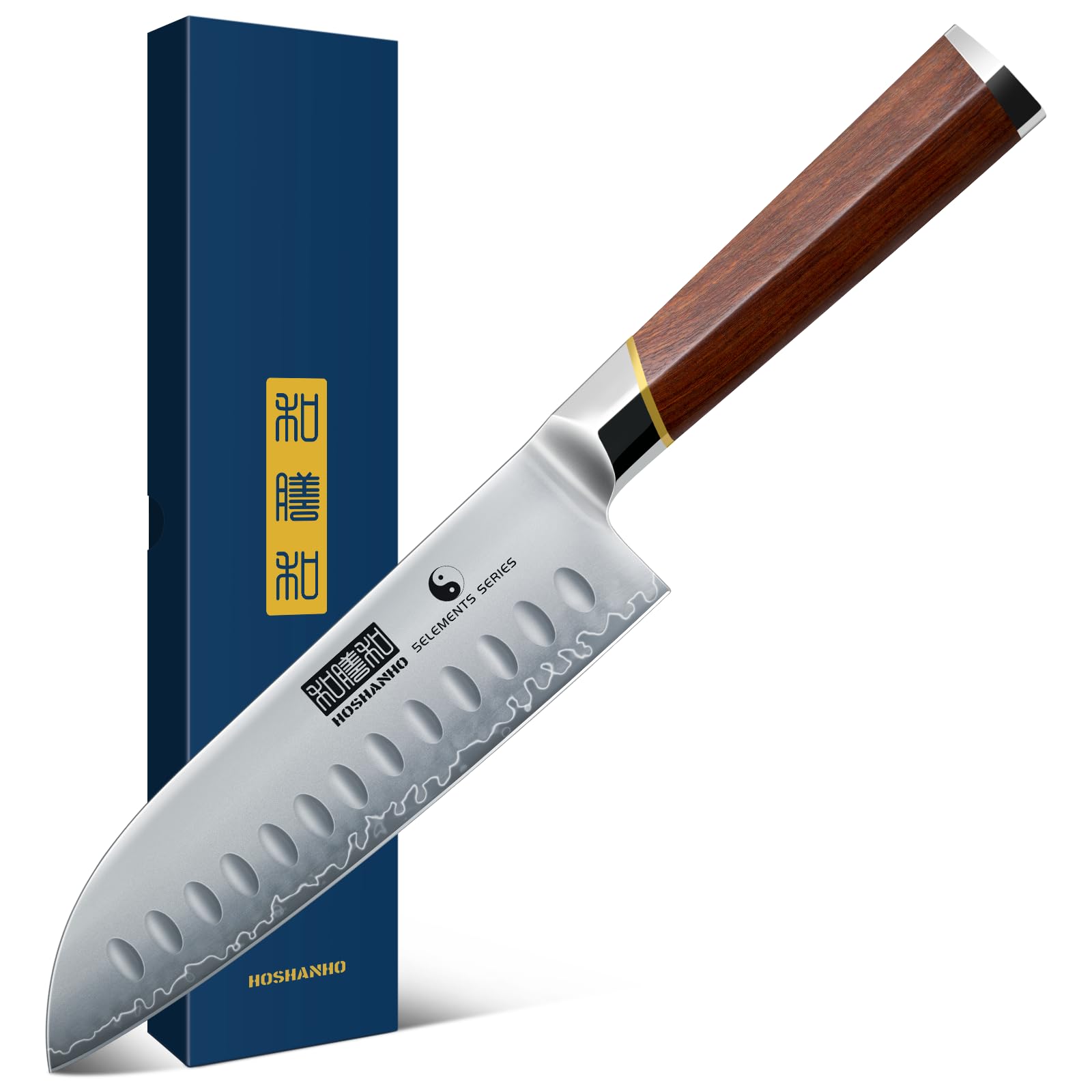
This HOSHANHO model uses a 10Cr15CoMoV cutting core—a cobalt-infused variant of the more common 10Cr15Mov—which boosts edge retention slightly while maintaining a 60-62 HRC hardness range. The blade undergoes a 12-step process that includes vacuum heat treatment and deep nitrogen freezing to stabilize the steel grain structure. The result is a knife that stays noticeably sharper longer than standard stainless options in the same price tier.
The red sandalwood (rosewood) handle is dense, moisture-resistant, and warm to the touch. Each handle has a unique grain pattern and hue, so no two knives look identical. The double-sided hollow design on the blade reduces friction and helps prevent food from clinging, though it is less effective than a true Granton edge. Buyers note the blade is heavier than expected—0.36 kg—which gives it solid momentum for chopping through thick carrots or butternut squash.
A few reviewers have pointed out that the handle material is synthetic resin-stabilized rosewood rather than solid red sandalwood, which can feel slightly different from natural wood. The blade is also hand-wash only, and the 15-degree edge, while durable, does not match the surgical sharpness of the 12-degree SHAN ZU. For cooks who want a heavy, dense blade with long edge retention and a striking red handle, this is a solid option in the entry-to-mid range.
Why it’s great
- 10Cr15CoMoV cobalt-infused core for enhanced edge retention
- Heavy 0.36 kg build provides momentum through dense produce
- Vacuum heat and nitrogen freezing treatment stabilizes steel
Good to know
- Handle is resin-stabilized rosewood, not solid natural wood
- Hollow design reduces sticking but not as effectively as Granton edge
- Hand-wash only; 15° edge less acute than 12° alternatives
FAQ
Can a Santoku knife replace a chef’s knife for all tasks?
How do I sharpen a Damascus Santoku knife at home?
Why does my Santoku blade stick when slicing potatoes or cucumbers?
Final Thoughts: The Verdict
For most users, the best rated santoku knife winner is the HOSHANHO Damascus 7″ because it combines a 62-64 HRC Damascus core with a durable G10 handle and excellent edge retention at a mid-range price. If you want a compact, NSF-certified blade that fits a small board and smaller hands, grab the Dalstrong Gladiator 5″. And for professional kitchen balance with proven Granton flutes and a comfortable rosewood handle, nothing beats the Victorinox 7″ Rosewood Santoku.