A dull blade turns every slice into a wrestling match, crushing tomato skins and mangling herb leaves before it finally gives up on a piece of raw carrot. The real fix is not muscle; it is a tool that removes steel at a consistent, controlled angle every single pass.
I’m Mohammad Maruf — the founder and writer behind AirfryerBite. I spend my days dissecting commercial kitchen hardware specs, comparing abrasive grit ratings, angle guide tolerances, and motor torque curves to separate genuine performance from packaging hype.
After analyzing seven top contenders across manual pull-through, electric, whetstone, and rolling-disc designs, one clear rated knife sharpener stands out for delivering a professional edge without the steep learning curve.
How To Choose The Best Rated Knife Sharpener
Choosing the right sharpener means matching the abrasive material and edge geometry to the knives you actually use. A ceramic sushi blade and a German chef’s knife demand completely different approaches at the grit level.
Abrasive Material — Diamond vs Tungsten Carbide vs Ceramic
Diamond abrasives cut the hardest steels — powder-metal alloys and high-carbon Japanese blades — because diamond is the hardest natural substance on earth and will not break down under heavy passes. Tungsten carbide is faster on softer German stainless (X50CrMoV15) but leaves a more ragged edge that needs honing. Ceramic rods polish and refine the burr; they should never be the primary cutting abrasive for a very dull blade.
Angle Guide Precision — Fixed vs Adjustable
A preset angle guide removes the single variable that ruins edges: inconsistent wrist angle. Look for magnetic or spring-loaded guides that lock at 15° (for thin, razor edges on Japanese knives) and 20° (for durable daily edges on Western knives). Adjustable guides offer flexibility but introduce a failure point if the alignment drifts after repeated use.
Number of Stages — Two vs Three vs Pull-Through
Three-stage systems (coarse sharpen, medium hone, fine polish/strop) produce the longest-lasting edge because each stage removes progressively smaller scratches before the final polish. Two-stage sharpeners skip the medium grit, which saves time but leaves micro-serrations that dull faster. Single-stage pull-through carbide sharpeners are emergency tools; they remove metal aggressively and shorten blade life with repeated use.
Quick Comparison
On smaller screens, swipe sideways to see the full table.
| Model | Category | Best For | Key Spec | Amazon |
|---|---|---|---|---|
| Bogoni Rolling Knife Sharpener | Manual Rolling | Effortless guided sharpening | 400 / 3000 Grit Diamond+Ceramic Discs | Amazon |
| Work Sharp Benchtop Whetstone | Whetstone Guided | Traditional stone feel with guides | 1000 / 6000 Corundum Water Stone | Amazon |
| Sharp Pebble Cordless Chainsaw | Electric Chainsaw | Field chainsaw sharpening | 4 File Wheels 5/32″ to 7/32″ | Amazon |
| VN3 Grihot Sailboat | Manual Pull-Through | Quick 3-action restoration | Tungsten Carbide + 304 SS Housing | Amazon |
| Homly Electric Diamond | Electric Diamond | High-volume kitchen duty | 3-Stage 100% Diamond Abrasives | Amazon |
| Chef’sChoice UltraHone | Electric Diamond | Serrated + straight edge | 2-Stage 100% Diamond 20° Guide | Amazon |
| Chef’sChoice 15XV | Pro Electric Diamond | Professional 15° XV edges | 3-Stage Metal Housing, 15° Angle | Amazon |
In‑Depth Reviews
1. Bogoni Rolling Knife Sharpener

The Bogoni Rolling system replaces the traditional back-and-forth pull with a rolling disc that travels along the blade edge. Its 400-grit diamond disc reshapes chips and rolled edges fast, while the 3000-grit ceramic disc applies a mirrored polish that slices through printer paper with zero drag. The natural wood base houses six N52 neodymium magnets that lock the blade flat, eliminating the side-to-side wobble that ruins edge geometry.
Two magnetic angle guides click onto the spine — 15° for ultra-thin Japanese profiles and 20° for durable German edges — and they stay put without clamps. Professional chefs with hand fatigue have specifically noted that the rolling motion requires minimal wrist torque compared to a honing steel. The included leather strop serves as a final de-burring step that extends the life of the polished edge between full sharpenings.
The compact footprint (4.6 by 5.9 inches) fits inside a drawer next to the knife block. Replacement discs are available, making this a long-term investment rather than a disposable gadget. Some users noted a minor chip on the ceramic disc out of the box, but the manufacturer backs it with responsive support.
Why it’s great
- Magnetic angle guides lock at 15° and 20° with zero drift.
- Two-stage diamond/ceramic progression handles dull to polished in minutes.
- Rolling action reduces wrist strain compared to pull-through or steel methods.
Good to know
- Leather strop purpose is not immediately obvious — watch the included guide.
- Ceramic disc may develop small edge chips if dropped; handle carefully.
2. Work Sharp Benchtop Whetstone

The Work Sharp Benchtop Whetstone bridges the gap between freehand waterstone sharpening and foolproof guided systems. The 1000-grit corundum side sets a fresh bevel quickly on carbon and stainless steel, and the 6000-grit side refines the edge to a smooth, toothy finish that bites into tomato skin without squashing. The water control base holds the stone steady and collects runoff, keeping the counter clean.
Magnetic angle guides attach to the stone base and can be set to 15° or 17°, or removed entirely for experienced users who prefer freehand control. The stone measures 4 by 2.25 inches — smaller than a traditional bench stone, but the guided approach compensates for the reduced surface area by keeping the knife path consistent. Work Sharp includes tutorial videos that explain how to soak the stone for five minutes and sweep the blade across the guide in a controlled arc.
The plastic base feels less robust than Work Sharp’s higher-end models, but for a sub-premium price point it delivers a genuine waterstone experience with training wheels. The 2.3-pound weight gives it enough mass to stay planted during aggressive passes on thick chef’s knives.
Why it’s great
- Dual-grit corundum stone (1000/6000) provides a proper whetstone feel.
- Removable angle guides support beginner and freehand sharpening.
- Water control base minimizes mess and stores the stone when not in use.
Good to know
- Stone surface is smaller than a full-size bench stone; longer blades need multiple passes.
- Plastic base feels lighter than typical Work Sharp build quality.
3. Chef’sChoice 15XV Professional Electric

The Chef’sChoice 15XV sits at the top of the electric sharpening food chain with a three-stage EdgeSelect system that converts standard 20° factory edges into 15° Trizor XV edges. Stages one and two use 100-percent diamond abrasives plated onto precision angle guides to carve a new bevel, while stage three deploys a patented flexible abrasive stropping disc that polishes the edge and extends the life of serrated knives. The brushed metal housing dissipates heat from prolonged sharpening sessions far better than all-plastic competitors.
Flexible spring guides automatically adjust to the blade thickness and maintain the 15° angle without manual alignment. The motor runs between 65 and 75 decibels — noticeable but not deafening — and initial sharpening takes roughly one minute per knife. Subsequent touch-ups require about ten seconds per blade, making this system viable for high-volume kitchens. Users have reported that aggressive pressure can remove more steel than intended, so a light touch is essential.
The 5-pound weight keeps the unit planted on the counter during operation, and the steel construction should withstand daily professional use for years. This model is particularly suited for users who own Japanese knives with factory 15° edges and want to maintain that geometry without sending blades out for service.
Why it’s great
- Three diamond stages produce a genuine 15° edge with factory-level consistency.
- Brushed metal housing dissipates heat and resists wear in heavy use.
- Flexible spring guides auto-adjust to blade thickness for drift-free sharpening.
Good to know
- Excessive pressure can remove more steel than needed; practice on a beater knife first.
- Packaging may arrive in a plain brown box without brand graphics.
4. VN3 Grihot Sailboat Sharpener
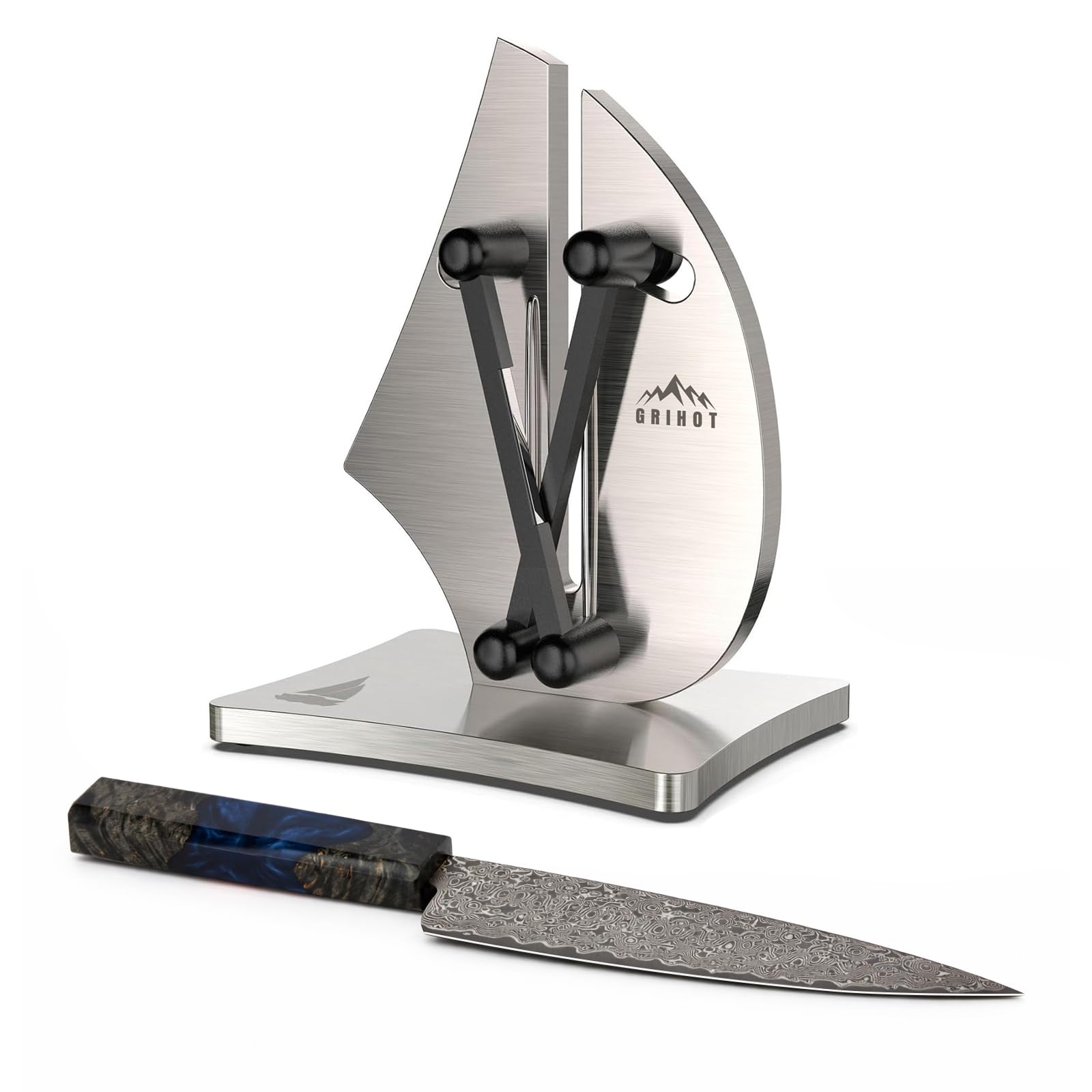
The Grihot VN3 stands out visually with its sailboat silhouette machined from solid 304 stainless steel, but the real engineering is inside: two independent spring-loaded tungsten carbide arms that automatically adjust to the blade’s existing edge angle between 11° and 21°. This self-centering mechanism means you do not need to guess the angle; the arms pivot to match the bevel as you pull the knife through. The 1.93-pound weight gives it a planted feel during one-handed operation.
The three-action base offers separate slots for edge repair (aggressive carbide removal), edge restoration (medium grit), and serrated blade maintenance. The ergonomic profile fits the palm comfortably and the broad base prevents tipping. Multiple customer reviews confirm that after twelve strokes on a dull German chef’s knife, the edge slices through ripe tomatoes without pressure. The 60-month manufacturer warranty exceeds the industry standard for pull-through sharpeners.
Because the carbide arms cut aggressively, this model removes more metal per pass than diamond or ceramic systems. It is best used on knives that need a quick refresh rather than daily maintenance, and it works especially well on softer stainless steel blades that respond to carbide abrasion.
Why it’s great
- Self-adjusting carbide arms automatically match any edge angle from 11° to 21°.
- Solid 304 stainless steel construction with a 60-month warranty.
- Three dedicated slots for repair, restoration, and serrated knives.
Good to know
- Carbide abrasives remove more steel than diamond; not ideal for daily honing.
- Technique matters — pulling too fast or at an angle can produce uneven results.
5. Homly Professional Electric Diamond Sharpener

The Homly electric sharpener uses 100-percent diamond abrasives across three dedicated slots — coarse diamond for edge restoration, fine diamond for honing, and a polishing stage for final refinement. The flexible spring guide rods in stage one and two keep the blade at a consistent angle regardless of knife thickness, producing an arched edge that maintains contact with the cutting board over the entire blade length. The motor runs quieter than most electric sharpeners in this class, and a magnetic shavings collector catches metal filings before they scatter.
This model supports both straight-edge metal knives and ceramic blades, making it one of the few electric sharpeners that can restore a decade-old ceramic chef’s knife to functional sharpness. The 3-pound weight and rubberized base provide stability during operation, and the 4-foot power cord offers sufficient reach for most counter layouts. Users with sixty years of sharpening experience reported that the Homly produced a cleaner, scratch-free edge than their manual stones.
The cobalt blue housing and chrome accents make it a countertop piece rather than a drawer item. The two-year manufacturer warranty and lifetime customer service support add confidence, though some users noted that moving too slowly through the slots can create a slight indent in the blade edge near the heel.
Why it’s great
- Three 100-percent diamond stages sharpen both metal and ceramic knives.
- Flexible spring guide rods maintain consistent angle across blade thickness variations.
- Magnetic shavings collector keeps metal dust contained and easy to dispose.
Good to know
- Moving the blade too slowly through the slot can create a heel indent.
- Scissors slot is included but performance is inconsistent across different scissor types.
6. Chef’sChoice UltraHone 2-Stage

The Chef’sChoice UltraHone is a distilled two-stage diamond electric sharpener that focuses on the 20° edge angle — the standard for Western German and French blades. Stage one uses coarse 100-percent diamond abrasives to restore a dull or nicked edge, while stage two switches to advanced micron-size diamonds that hone and finish the bevel to a smooth, polished surface. The 20° precision angle guide is factory-set and requires no adjustment, making this a genuinely foolproof option for anyone who owns Wusthof, Henckels, or Chicago Cutlery knives.
The unit handles both straight-edge and serrated blades; the serrated slot uses a specialized abrasive path that does not strip the scalloped edge. At 16 ounces, it is the lightest electric sharpener in this lineup, and its compact footprint (11.8 inches long, 3.9 inches wide) stores easily in a utensil drawer. Customers report that even users with no sharpening experience can take a set of dull German knives from frustrating to shaving-sharp in under ten minutes.
The all-plastic housing is less durable than the metal-clad 15XV, and the fixed 20° guide means you cannot convert your knives to a thinner 15° edge. For cooks who only need to maintain the factory edge on their existing knife set, this is the most cost-efficient electric option available.
Why it’s great
- Factory-set 20° diamond guides produce consistent results with zero learning curve.
- Two-stage design with micron-level diamond finish for a smooth, glass-like edge.
- Serrated blade slot preserves scalloped edges without stripping them.
Good to know
- Fixed 20° angle cannot be adjusted for Japanese or 15° edge knives.
- Plastic housing feels less premium compared to Chef’sChoice metal-body models.
7. Sharp Pebble Cordless Chainsaw Sharpener

The Sharp Pebble sharpener is a dedicated cordless tool for chainsaw chain maintenance, not a kitchen knife sharpener. It ships with four interchangeable grinding wheels (5/32, 3/16, 7/32, and another 7/32 inch) that match the most common chain pitch sizes, plus an angle guide attachment that locks the grinding head at the correct bevel relative to the cutter tooth. The cordless design lets you sharpen on a truck tailgate, a stump, or directly on the saw bar without hunting for a power outlet.
The motor runs at controlled speed to prevent overheating the chain’s cutting edge, and the high-quality bearings keep the wheel stable during rotation. Users report restoring two full saw chains to like-new cutting performance in under 15 minutes. Compared to hand filing, the electric wheel ensures each tooth is ground to the same depth and angle, eliminating the uneven drag that occurs with manual round files.
Because this tool is purpose-built for chainsaws, it has no application for kitchen knives or general-purpose edge tools. The 1.37-pound weight and compact body fit into a tool bag or chainsaw case. If you maintain your own firewood or felling equipment, this cordless sharpener will pay for itself in the first season by extending chain life and reducing saw kickback.
Why it’s great
- Four wheel sizes cover the most common chain pitch and gauge combinations.
- Cordless operation enables field sharpening without electrical access.
- Angle guide attachment ensures consistent tooth geometry across the whole chain.
Good to know
- Exclusively designed for chainsaw chains; will not sharpen knives or shears.
- Lacks the precision of a dedicated bench-mounted chainsaw grinder for heavy-duty use.
FAQ
What is the best angle for sharpening kitchen knives?
Can an electric knife sharpener handle ceramic blades?
How many strokes should I use on a pull-through sharpener?
Final Thoughts: The Verdict
For most users, the rated knife sharpener winner is the Bogoni Rolling Knife Sharpener because it delivers professional-grade diamond and ceramic abrasion with magnetic angle guides that eliminate guesswork and wrist strain in a compact, beautiful wooden package. If you want the convenience of electric diamond sharpening with the ability to restore both metal and ceramic blades, grab the Homly Professional Electric Diamond Sharpener. And for a budget-friendly whetstone experience with removable guides that teach you proper freehand technique, nothing beats the Work Sharp Benchtop Whetstone.