Preground bags are a compromise, losing volatile aromatics and staling within hours of being cracked open. The step to a dedicated grinder isn’t an upgrade in equipment — it is a fundamental shift in how much flavor you can actually pull from your beans. The difference between a blade chopper and a true burr mill is the difference between mud and clarity.
I’m Mohammad Maruf — the founder and writer behind AirfryerBite. My market research dives into burr geometry, motor torque curves, and grind retention rates to separate durable performers from countertop decorations.
Whether you need fines for espresso or a uniform bed for a French press, choosing the right rated coffee grinder means understanding how burr size, step resolution, and build material directly affect the taste in your cup.
How To Choose The Best Rated Coffee Grinder
Selecting a coffee grinder isn’t about picking a familiar brand name. It is about matching burr type, adjustment resolution, and construction to your brew method and budget. A machine that excels for espresso can be frustrating for pour-over, and vice versa.
Burr Type: Conical vs. Flat
Conical burrs tend to produce rounder, more chocolate-forward flavors with a larger proportion of fines, making them forgiving for medium to dark roasts. Flat burrs, especially larger diameters like 64mm, create a narrower particle distribution that extracts more acidity and clarity — ideal for light roasts and espresso where you want to separate tasting notes.
Grind Adjustment Resolution
The number of settings or clicks matters most for espresso, where a shift of 10-15 microns can turn a gushing shot into a choked one. Hand grinders often provide finer step increments (8-16 microns per click) than electric models at similar price points, offering more precise control for brew methods sensitive to particle size.
Quick Comparison
On smaller screens, swipe sideways to see the full table.
| Model | Category | Best For | Key Spec | Amazon |
|---|---|---|---|---|
| SHARDOR Professional 64mm | Electric Flat Burr | Home Espresso & Light Roasts | 64mm flat burr, 100 grind settings | Amazon |
| 1Zpresso J-Ultra | Manual Conical | Espresso Purist | 8-micron adjustment per click | Amazon |
| Aromaster 48 Setting | Electric Conical Burr | Daily Drip & Pour Over | 3.9 oz hopper capacity | Amazon |
| AMZCHEF 48 Setting | Electric Conical Burr | Versatile Home Barista | 40mm stainless steel burrs | Amazon |
| OXO Brew Compact | Electric Conical Burr | Small Kitchen Counter | 29 micro-adjustments | Amazon |
| KINGrinder K6 | Manual Conical | Budget Espresso & Travel | 16-micron click adjustment | Amazon |
| TIMEMORE Chestnut C2S | Manual Conical | Entry-Level Hand Grinding | 38mm conical burr | Amazon |
In‑Depth Reviews
1. SHARDOR Professional 64mm Burr Coffee Grinder
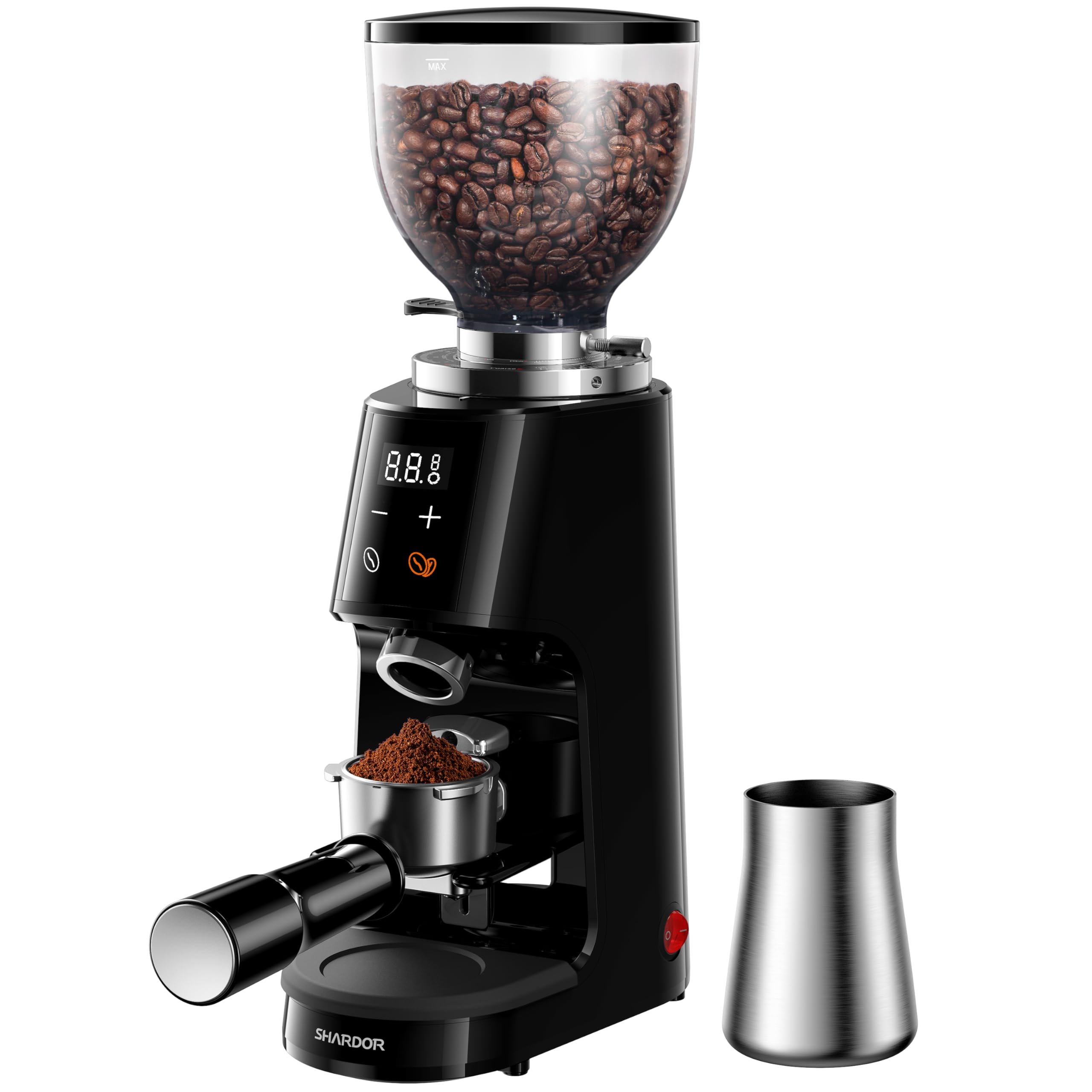
The SHARDOR CG301 brings a 64mm flat burr set to a price point where most competitors still use 40mm conical burrs. The larger diameter creates a tighter particle distribution, pulling more clarity from light-roast single origins. It grinds 18 grams for espresso in roughly five seconds, noticeably faster than similarly priced options. The all-metal grinding chamber provides a stable thermal environment, keeping burrs cool during back-to-back doses.
The stepless adjustment ring lets you dial in micro-changes without fighting preset clicks, a feature usually reserved for grinders costing two to three times as much. The LED display and programmable timer allow repeatable dosing for single, double, or continuous brews with 0.1-second accuracy. The magnetic discharge pipe and stainless steel catch cup reduce static cling, though the included rubber mat is a weak point and slides on smooth counters.
For home users wanting true espresso-grade grind quality without stepping into commercial territory, the SHARDOR delivers exceptional uniformity. The plastic exterior housing feels less substantial than the burr chamber, but the internals justify the investment. It is a legitimate entry point to flat burr grinding that competes with units from Eureka and Mazzer in grind quality.
Why it’s great
- 64mm flat burrs provide café-quality particle distribution
- Stepless adjustment for precise espresso dialing
- Fast grinding speed — 18g in ~5 seconds
Good to know
- Plastic housing feels less premium than the burr chamber
- Rubber base mat has poor grip on smooth surfaces
- Retention is low but not zero; bellows help clear stuck grounds
2. 1Zpresso J-Ultra Manual Coffee Grinder

The J-Ultra is engineered specifically for espresso, with a coated conical burr that produces a narrow fines distribution to maximize sweetness and texture. Each click shifts the burr by only 8 microns, giving you the granularity to fine-tune shots through ratios and extraction times. The magnetic catch cup holds 35-40 grams and snaps into place with strong magnets, eliminating the screw-on threading that can bind on other hand grinders.
Grinding 18 grams for espresso takes about 45 seconds, which is fast for a manual grinder but still slower than electric options. The foldable handle collapses for compact storage and prevents tipping on narrow countertops. Tool-free disassembly makes cleaning straightforward, and the included air blower helps clear retained grounds from the burr chamber — retention measures under 0.1 grams in practice.
Some users report that the handle requires significant torque for light-roast espresso, and the grind time can stretch past a minute for very fine settings. The build quality is exceptional, with smooth bearings and factory-calibrated burrs that maintain alignment over hundreds of grams. This is a long-term investment for the espresso enthusiast who values precise control over speed.
Why it’s great
- 8-micron click adjustment for micro-dialing espresso
- Magnetic catch cup with strong hold and easy release
- Low retention under 0.1g for single-dosing accuracy
Good to know
- Grinding light-roast espresso requires noticeable physical effort
- Handle must be removed for stable storage on a shelf
- Not ideal for those who prefer push-button speed for daily use
3. Aromaster Burr Coffee Grinder
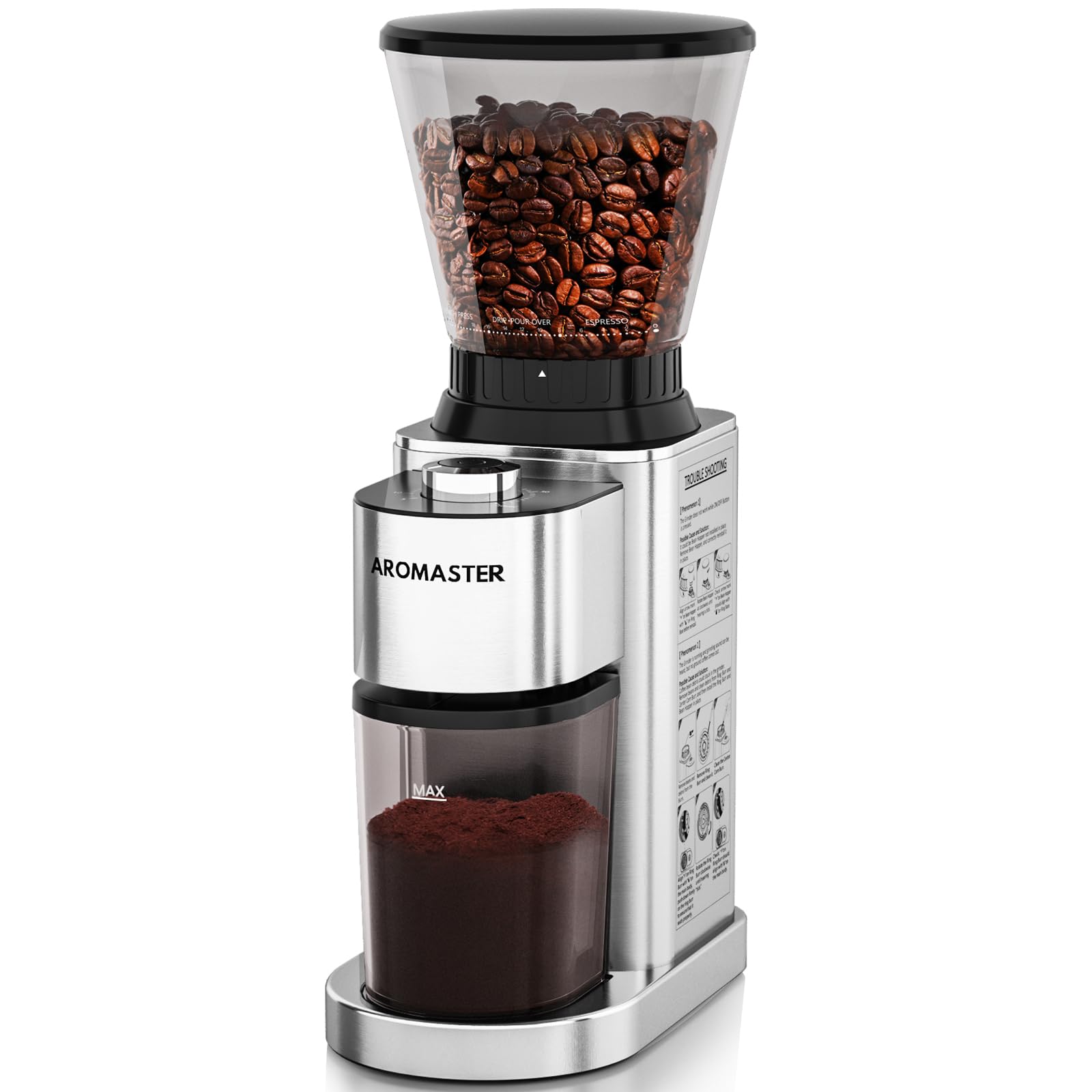
The Aromaster strikes a compelling balance between grind versatility and countertop practicality. It offers 48 settings spanning espresso fine to French press coarse, controlled through a simple dial and timer system. The 3.9-ounce hopper capacity suits households brewing multiple cups per session, and the conical stainless steel burrs produce consistent grounds with minimal heat buildup. The anti-static technology genuinely reduces flying grounds, keeping the workspace clean during transfer to a filter basket.
Noise level is noticeably lower than many competitors in this class, and the timer dial allows repeatable dosing between 5 and 40 seconds. The removable ring burr simplifies deep cleaning, though the cleaning brush is tucked under the hopper lid and easy to misplace. Users report that a light hand on the lid further dampens vibration noise during operation. The build uses a mix of stainless steel and matte plastic, feeling solid without being heavy.
Grind consistency is reliable for drip coffee and pour-over, with a few customers noting the finest espresso settings can lack the micro-adjustment resolution needed to perfectly dial in a shot. The 12-month repair service adds peace of mind for a mid-range purchase. For the brewer who wants one grinder that handles multiple methods without fuss or mess, this is a strong contender.
Why it’s great
- Quiet operation with effective anti-static design
- 48 settings cover espresso through cold brew
- Easy-to-remove ring burr for thorough cleaning
Good to know
- Finest espresso adjustments may lack resolution for perfectionists
- Cleaning brush location is easy to overlook
- Timer increments are consistent but not 0.1-second precise
4. AMZCHEF Conical Burr Coffee Grinder

The AMZCHEF CG209 integrates a digital interface that makes grind-by-volume straightforward. The LED touchscreen lets you select between 2 and 12 cups, set grind time up to 40 seconds with 0.5-second precision, or switch to manual control for custom doses. The 40mm stainless steel conical burrs deliver uniform grounds across 48 settings, from fine Turkish to coarse French press. The built-in anti-static system and stainless steel grounds container effectively reduce cling — grounds pour cleanly into a filter without the usual static spray routine.
The removable bean hopper holds 10.6 ounces and features UV-blocking tinting to slow oxidation of beans left inside. A trap door prevents beans from spilling when the hopper is removed mid-grind. The burrs run relatively quietly compared to other electric grinders, and the motor handles 110 seconds of continuous operation without tripping thermal protection. The touchscreen responds well even when slightly dusty, and the preset times for each cup setting are close enough to dial in within a few tries.
Some users mention the initial grind time pre-sets run slightly long for their preferred dose, requiring fine-tuning in the timer menu. The body uses ABS plastic, which keeps weight down but doesn’t feel as premium as all-metal builds. For a home barista who wants programmable convenience without sacrificing grind quality, the AMZCHEF offers a modern workflow at a reasonable price.
Why it’s great
- Intuitive LED touchscreen with programmable cup settings
- Anti-static design keeps grounds in the container
- 10.6-ounce hopper with UV-blocking tint
Good to know
- Plastic body construction feels less robust than metal alternatives
- Pre-set grind times may need adjustment after first use
- Some espresso settings could benefit from finer step resolution
5. OXO Brew Compact Conical Burr Coffee Grinder

The OXO Brew Compact is designed for kitchens where counter space is at a premium. Standing only 10.75 inches tall with a 3.75-inch footprint, it slips under cabinets and into tight corners. Despite its size, it offers 15 primary grind settings with 29 total micro-adjustments covering fine to coarse. The stainless steel conical burrs produce consistent particles for drip and pour-over, and the upper and lower burrs are both removable for cleaning without tools. The hopper and grounds container are made from Tritan Renew, a certified recycled material that feels durable and is BPA-free.
Noise output is significantly lower than average for an electric grinder, making it suitable for early-morning brewing without waking the household. The simple push-button operation with a single dial keeps the workflow minimal. Users report that grounds collect with minimal static, though a few rogue specks on the counter are common. The 50-gram capacity handles up to six cups, suitable for small to medium households. The included hopper lid has a built-in spout that directs beans into the burrs without scattering.
The grind size adjustment mechanism uses a ratcheting feel that is tactile but not as fine-grained as some competitors. Some users note that disassembling the burrs for deep cleaning can be awkward, with small crevices that trap oily grounds. The compact design also means the grounds bin is narrow, which can cause fresh grounds to mound against the edges during dispensing. For someone prioritizing a small footprint and quiet operation over ultra-wide grind range, this is a sensible pick.
Why it’s great
- Ultra-compact design fits under low cabinets
- Very quiet operation for early morning brewing
- Removable burrs for easy cleaning
Good to know
- Grind adjustment has fewer steps than some competitors
- Narrow grounds bin can mottle distribution
- Occasional counter mess from static cling
6. KINGrinder K6 Manual Coffee Grinder

The KINGrinder K6 delivers features typically found on grinders costing double. The interior mechanical adjustment provides 16 microns per click, giving you 60 detectable steps per full rotation. This resolution is sufficient to dial in espresso, pour-over, and French press with repeatable accuracy. The full metal body uses aluminum for the main tube and stainless steel for the conical burrs, creating a durable chassis that weighs 620 grams. The dual bearing support on the central shaft reduces wobble during cranking, which translates to more consistent particle size.
Grinding 15 grams for pour-over takes roughly 20 seconds, while espresso doses take 35 to 45 seconds depending on roast level. The catch cup screws onto the body, which is secure but can bind if over-tightened. The K6 comes with a straight handle rather than a folding one, which some users find less ergonomic for storage but acceptable for grinding torque. The burr set produces a balanced flavor profile with enough body for espresso and enough clarity for filtered methods.
Some units ship with a factory zero that doesn’t align with the marked zero, requiring a quick mental offset during adjustment. A few users mention the screw-on catch cup can jam if not aligned perfectly. The static inside the chamber after grinding light roasts is manageable but present. For the budget-conscious espresso enthusiast who doesn’t mind a manual workflow, the K6 offers grind quality that rivals electric machines in a more portable, quieter package.
Why it’s great
- 16 microns per click for precise espresso dialing
- Full metal body with durable stainless steel burrs
- Portable and quiet — no power cord required
Good to know
- Screw-on catch cup can bind if over-tightened
- Factory zero may require a small mental offset
- Straight handle is less compact for travel storage
7. TIMEMORE Chestnut C2S Manual Coffee Grinder

The TIMEMORE Chestnut C2S is an upgraded version of the popular C2, addressing the earlier model’s fragile plastic top with a full metal unibody. The 38mm stainless steel conical burrs are CNC-machined to a hardness of 55-58 HRC, producing uniform grounds with minimal fine powder. The double bearing central shaft ensures smooth rotation, and the handle continues spinning for a moment after release — a sign of well-lubricated bearings. The 25-gram capacity suits single doses for pour-over or Aeropress, and the compact 52mm diameter body is comfortable to grip even for smaller hands.
Adjustment offers roughly 36 clicks across the range, controlled by a nut that threads onto the central shaft. Turning clockwise produces finer grinds and counter-clockwise yields coarser particles. The grind quality is impressive at this price point, with noticeably fewer boulders than blade grinders or cheaper manual models. The included cleaning brush and carry bag add convenience for travel. The body weighs 700 grams, giving it a substantial feel without being heavy.
Some users find the grind size adjustment mechanism less convenient for frequent changes, as the nut can drift if not tightened carefully. The 36-click range provides enough resolution for filter coffee and French press but feels limited for espresso dialing compared to grinders with 8-micron steps. For someone entering the world of freshly ground coffee without a large budget, the C2S sets a strong baseline for flavor improvement over pre-ground coffee.
Why it’s great
- Full metal construction solves the fragility of the original C2
- Uniform grind distribution with minimal fines
- Comfortable ergonomics and smooth bearing action
Good to know
- 36 clicks limit fine espresso dialing precision
- Adjustment nut can drift if not properly tightened
- 25g capacity requires multiple batches for larger groups
FAQ
Should I get a flat burr grinder for espresso specifically?
How many grind settings do I actually need for daily use?
Is manual grinding always slower than electric?
Final Thoughts: The Verdict
For most users, the rated coffee grinder winner is the SHARDOR Professional 64mm because it brings café-quality flat burr grind consistency to a home-friendly price with stepless adjustment. If you want the ultimate precision for espresso without plugging in, grab the 1Zpresso J-Ultra. And for a compact, quiet electric grinder that excels at daily drip and pour-over, nothing beats the OXO Brew Compact.