The average orange only gives up about 40% of its juice when squeezed by hand. A proper citrus juicer can coax out nearly every drop, turning a bag of fruit into a full glass of fresh, vitamin-packed juice without the elbow strain or the sticky mess. Whether you are after a daily morning orange juice ritual or need to juice a bushel of lemons for a weekend baking project, the right machine changes the math on effort versus reward.
I’m Mohammad Maruf — the founder and writer behind AirfryerBite. I have spent hundreds of hours analyzing the build quality, motor ratings, extraction efficiency, and real-world wear patterns of kitchen appliances to separate the gadgets that genuinely deliver from those that just take up counter space.
After collecting thousands of verified owner experiences and comparing every key spec — from motor wattage to pulp filtration — across dozens of models, I have narrowed the field to the seven machines that earn a spot among the best rated citrus juicers on the market today.
How To Choose The Best Rated Citrus Juicers
Selecting the right citrus juicer is not about picking the most expensive or the cheapest option. The three factors that matter most are the extraction mechanism (manual leverage vs. electric motor), the material quality of the parts that contact your fruit, and the cleanup routine the design demands. Ignoring any of these leads to wasted fruit, wasted time, or a machine that sits unused in a cabinet.
Electric vs. Manual: Which Motor or Leverage Class Fits Your Volume?
Electric juicers use motors ranging from 75 watts to 300 watts to spin a reamer cone against the fruit half. Higher wattage generally means the motor maintains speed under pressure, extracting more juice from the final stubborn pulp. Manual presses use a long lever arm and a cast iron or heavy steel frame to generate mechanical force. Manual models require more physical effort per fruit but have no electronics to fail and are often quieter. If you juice three oranges a day, an electric model saves time. If you juice in high volume or want a device that lasts decades, a heavy-duty manual press is the better bet.
Cone Design and Pulp Control
Juicing cones come in different sizes and shapes. A single cone that only fits small lemons will leave half a grapefruit untouched. Machines with two interchangeable cones cover the full range from lime to grapefruit. Pulp control varies widely: some models use a built-in strainer basket that separates seeds and coarse pulp from the juice, while others require you to pour through a separate sieve. Look for a model that lets you collect juice directly into a pitcher or glass and that has a pulp container you can empty mid-session without stopping the job.
Cleanup Path and Dishwasher Safety
Citrus juice leaves sticky residue that hardens if left to dry. Every part that touches the fruit — the cone, the strainer, the juice collector — should be removable and dishwasher safe. Stainless steel and glass parts resist staining and odor absorption better than plastic. Manual presses with fewer parts often clean faster than electric models with multiple crevices. A machine that requires hand-wash-only parts will collect grime in the hard-to-reach gaps over time.
Quick Comparison
On smaller screens, swipe sideways to see the full table.
| Model | Category | Best For | Key Spec | Amazon |
|---|---|---|---|---|
| Breville BCP600SIL | Electric | Largest fruit range | 110W motor, 1L capacity | Amazon |
| Eurolux ELCJ-4800 | Electric | Fastest extraction | 300W motor, 110 RPM | Amazon |
| TONGCHANT Cast Iron | Manual | Heavy duty daily use | 13.8 lb cast iron frame | Amazon |
| Healnitor 150W | Electric | Quiet operation | 150W motor, under 60 dB | Amazon |
| Oster 75W | Electric | Glass pitcher direct feed | 75W motor, 450 ml glass | Amazon |
| Norpro 523 | Manual | Long term durability | Stainless steel, 0.6L | Amazon |
| Reemix 85W | Electric | Budget entry level | 85W motor, two cones | Amazon |
In-Depth Reviews
1. Breville BCP600SIL

The Breville BCP600SIL uses a 110-watt motor paired with a finned juicing cone and a fruit dome that applies even downward pressure across the entire fruit half. This design lets you juice everything from the smallest lime to the largest grapefruit without peeling or re-cutting. The triple-hinged arm locks into place as you lower it, and a dual safety switch prevents the cone from spinning unless the arm is fully engaged.
The built-in drip-stop spout holds juice back after you lift the arm, so you can slide the glass out without a trail of drips across the counter. The juice collector, filter, and cone are all dishwasher safe, though the fruit dome requires hand rinsing. In tests with 18 limes, the machine extracted about 2.75 cups of juice in under a minute, leaving the pulp noticeably dry.
Owners consistently report that the motor runs quietly and the rotating cone requires almost no physical force. The one-liter capacity jug holds enough juice for a family breakfast before needing to be emptied. The only practical complaint is that the handle does not lock into a storage position, so the arm hangs loose when not in use.
Why it’s great
- One cone fits every citrus size from lime to grapefruit
- Drip-stop spout keeps the counter clean between glasses
- Motor extracts juice quickly with very low effort required
Good to know
- Fruit dome is not dishwasher safe despite other parts being safe
- Handle does not lock upright for compact storage
- Plastic housing feels less premium than full stainless steel models
2. Eurolux ELCJ-4800
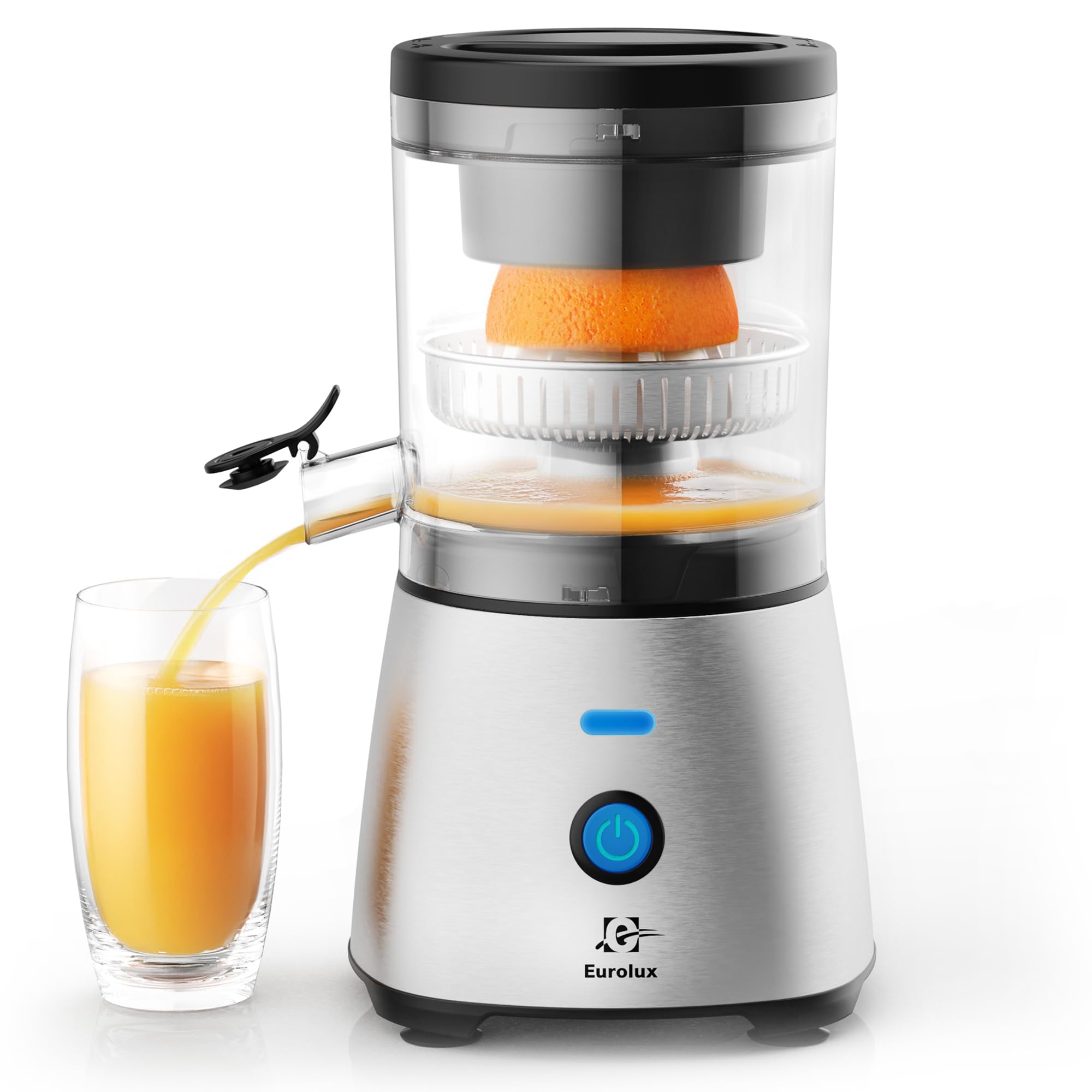
The Eurolux ELCJ-4800 pairs a 300-watt motor with a low 110 RPM rotation speed, which is an unusual combination. Most high-wattage juicers spin fast and generate heat; this one spins slowly and uses torque to crush the fruit structure cleanly. The result is a machine that squeezes oranges completely dry while running quieter than typical centrifugal juicers.
Operation is a one-button affair: load a fruit half onto the cone, close the lid, press the button, and release when done. The brushed stainless steel body measures about 8 by 4 inches of counter footprint, making it noticeably compact for the power output. All food-contact parts are top-rack dishwasher safe, and the unit includes a rest-interval protection circuit that prevents the motor from overheating during continuous use.
Owners note that the pulp strainer fills up after about one cup of juice and needs to be emptied mid-session if you are juicing a large batch. The motor does get warm after several minutes of continuous pressing, though it has not been reported to shut down during normal home use. A few users mention that the lid can lift slightly during operation and recommend holding it down with a light hand.
Why it’s great
- 300W motor with low 110 RPM for high torque dry extraction
- Very compact footprint for the power class
- All parts that touch food are dishwasher safe
Good to know
- Pulp strainer needs emptying after roughly one cup of juice
- Lid can lift during pressing and may need to be held down
- Motor warms up after several minutes of continuous use
3. TONGCHANT Cast Iron Juicer
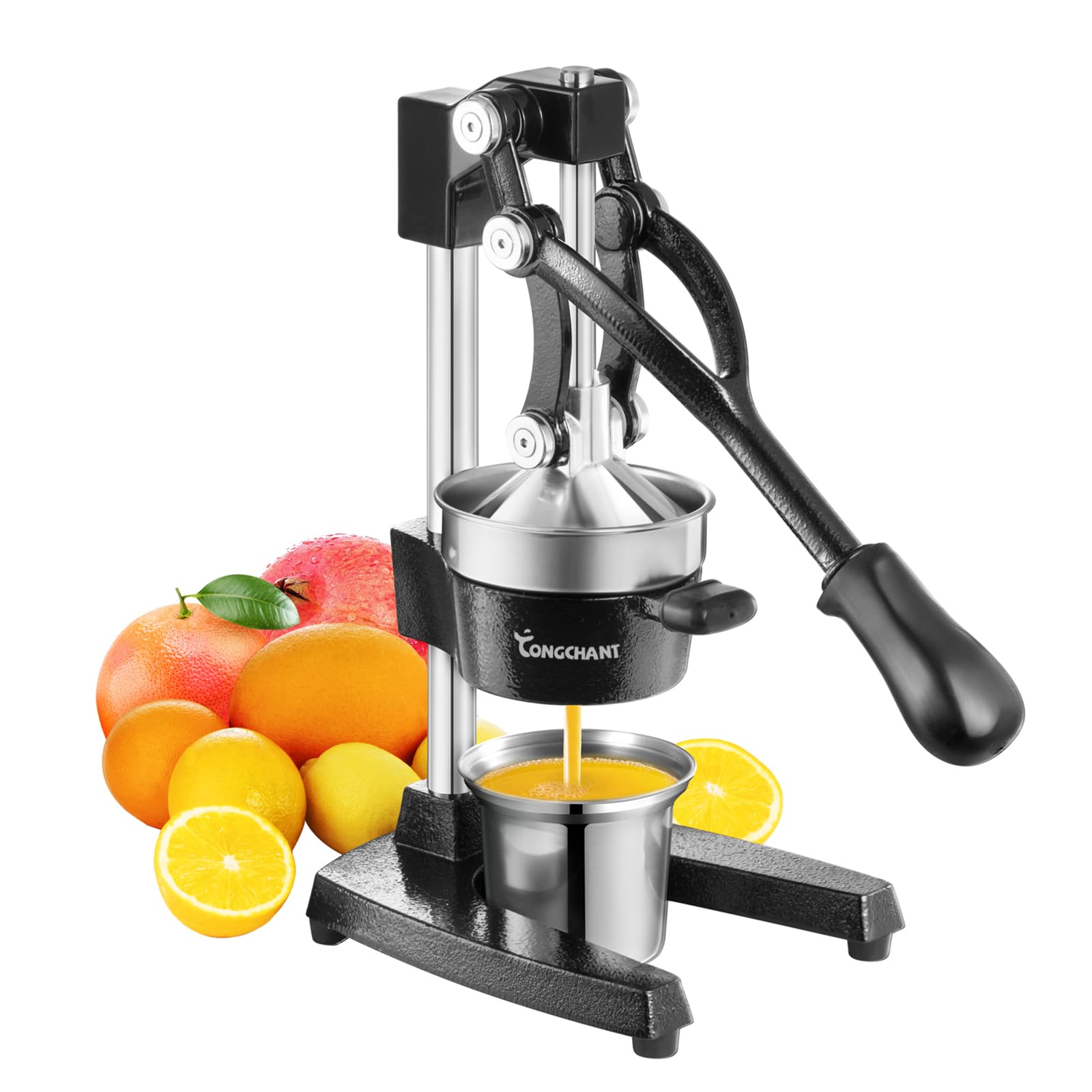
The TONGCHANT Cast Iron Juicer is built around a solid cast iron frame that weighs 13.8 pounds. That mass provides the stability needed to press fruit without the base sliding across the counter. The lever arm uses a soft rubber grip, and the hinge gives enough mechanical advantage that you can squeeze a lemon dry with one hand without straining.
The funnel and strainer detach for cleaning, and the included stainless steel cup holds about 15 fluid ounces of finished juice. The 5-inch funnel fits standard oranges and grapefruits, though larger fruit may need to be repositioned after the first press to extract the outer edges. The pressure cap removes with a supplied wrench, letting you access every crevice of the press mechanism for thorough cleaning.
The rubber feet keep the base planted, though the press can tilt slightly if you apply force off-center. It is also worth noting that the press can crush pomegranates, which requires more force than citrus and tests the frame’s rigidity.
Why it’s great
- 13.8 lb cast iron frame provides unmatched stability
- Detachable funnel and strainer for thorough cleaning access
- Works on pomegranates and other hard fruits beyond citrus
Good to know
- Large grapefruit and oranges may need repositioning to fully extract
- Heavy enough to cause injury if dropped from counter height
- Requires physical effort over electric models for high volume sessions
4. Healnitor 150W Electric Citrus Juicer

The Healnitor 150W runs at a noise level rated below 60 decibels, which is about the volume of a normal conversation. That makes it one of the quieter electric citrus juicers in this comparison. The motor is paired with an aluminum die-cast handle and two interchangeable juicing cones — a larger one for oranges and grapefruits and a smaller one for lemons and limes.
The stainless steel shell wraps around a detachable slag tray that catches pulp and seeds before they reach the juice spout. All removable parts are dishwasher safe, and the anti-drip spout design prevents the last few drops from trailing onto the counter after you lift the jug. The compact footprint, 8.8 by 6.5 inches, leaves room for other countertop appliances.
Owner feedback highlights that the pulp tray fills quickly when juicing multiple fruits, requiring a mid-session dump. Some users also note that when you lift the handle, a small amount of juice drips down the back side rather than into the tray, which can run toward the base of the unit. The machine has no dedicated power button — it starts when you press the handle down and stops when you release it.
Why it’s great
- Quiet motor below 60 dB won’t disturb early mornings
- Two interchangeable cones cover lime to grapefruit sizes
- Stainless steel shell resists staining and looks clean on the counter
Good to know
- Pulp tray fills fast and needs emptying during large batches
- Juice can drip down the handle back rather than into the tray
- No separate on/off switch; motor runs only while handle is pressed
5. Oster 75W Electric Citrus Juicer

The Oster 75W Electric Citrus Juicer uses a 75-watt motor with a glass pitcher that doubles as the juice collection vessel. The pitcher has a two-cup capacity with measurement markings and a lid, allowing you to store juice directly in the refrigerator without transferring to another container. The unit also has a drip-free spout that lets you pour juice directly into a glass while the pitcher stays on the base.
The juicing cone is stainless steel, and the motor assembly includes a strainer basket that separates seeds and larger pulp particles. The design gives you two ways to collect juice: either fill the pitcher or bypass it by removing the pitcher lid and letting juice flow directly into a glass placed on the base. All parts that contact fruit are dishwasher safe.
Owners who have owned previous Oster juicers for over twenty years report that the new version performs similarly but with better pulp control and a more stable base. Some users also find that they need to manually push the fruit down onto the cone for complete extraction.
Why it’s great
- Glass pitcher with lid stores juice without extra containers
- Direct-feed spout lets you fill a glass without the pitcher
- Stainless steel cone and strainer are fully dishwasher safe
Good to know
- 75W motor can struggle with large grapefruit and may overheat
- Fruit may need manual pushing for complete extraction
- Plastic housing feels less substantial than stainless steel rivals
6. Norpro 523 Stainless Steel Citrus Press

The Norpro 523 is a manual stainless steel press that uses extra-long handles for mechanical leverage. There is no motor, no cord, and no electronic component that can fail. The pressing bowl is made from stainless steel sheet metal with a polished finish, and the hinge mechanism has proven durable enough that some owners report daily use for over seventeen years without failure.
The press works by placing a citrus half cut-side down into the bowl and squeezing the handles together. Juice flows through slots in the bowl and out through a spout, while seeds and most pulp stay trapped in the bowl. The entire unit is dishwasher safe, which is rare for a manual press of this size. The 0.6-liter juice capacity is sufficient for a single serving of orange juice or several lemons.
Long-term users note that the press bowl is sized for medium lemons and limes but may not fully accommodate larger oranges or grapefruit. The handles have a slight spring-back that some users counter by flipping the fruit for a second press to extract the last drops. A few owners point out that the hollow stainless steel construction, while durable, is not as heavy-duty as cast iron alternatives and can deflect slightly under extreme force.
Why it’s great
- Full stainless steel construction resists rust and staining
- Extra-long handles provide ample leverage for easy pressing
- Entire unit is dishwasher safe for effortless cleanup
Good to know
- Bowl is small for large oranges and grapefruit
- Hollow sheet metal can deflect slightly under heavy force
- Side spray is common with this press design during squeezing
7. Reemix 85W Electric Citrus Juicer

The Reemix 85W Electric Citrus Juicer delivers an 85-watt motor and two interchangeable cones in a brushed stainless steel body at an entry-level price point. The large cone fits oranges and grapefruit, and the small cone stores inside the large cone when not in use — a practical space-saving detail. The pressure sensor system starts the motor when you push the handle down and stops it when you release, saving energy during quick juicing sessions.
The base has non-slip feet and a stable weight distribution that keeps the machine planted during operation. All removable parts rinse clean under running water, though the manufacturer specifies that the parts are not dishwasher safe. The motor is rated for quiet operation, and owners confirm that it runs at a lower volume than many similarly priced alternatives.
Customer feedback consistently highlights that the machine juices lemons, limes, and small oranges in seconds with thorough extraction. The unit does not handle continuous high-volume juicing as well as more powerful models; the motor can slow when pressing multiple large grapefruit back to back. A few owners note that the price feels slightly high for the plastic components mixed into the build, even though the exterior is stainless steel.
Why it’s great
- Two cones cover lime to grapefruit with nested storage
- Pressure sensor start-stop saves power and simplifies use
- Quiet motor and stable base with non-slip feet
Good to know
- Parts are not dishwasher safe despite being removable
- Motor can bog down with consecutive large grapefruit
- Plastic internal components limit long-term durability
FAQ
What wattage motor do I need for daily orange juice?
Does a manual citrus press extract more juice than an electric model?
Why do some citrus juicers have two different sized cones?
Final Thoughts: The Verdict
For most users, the rated citrus juicers winner is the Breville BCP600SIL because it combines a powerful 110-watt motor with a single versatile cone that handles every citrus size without needing swaps or repeats. If you want the fastest, driest extraction in a compact footprint, grab the Eurolux ELCJ-4800 with its 300-watt motor and low-RPM torque. And for a no-electronics, heirloom-grade juicer that will likely outlast every other appliance in your kitchen, nothing beats the TONGCHANT Cast Iron Juicer.